As the sun dances on the sparkling waters of the Wenyu River, a gentle trickling lulls a patient photographer into a sense of deep relaxation. High above the paddy fields that frame the banks of the shore, a lone eastern buzzard gracefully soars through the air as a black-eared kite glides on a thermal breeze in the expanse of sky. A shy long-eared owl rests on the ledge of a branch nearby, inspiring the photographer to capture its beauty before it flutters away. Refocusing the lens from the sky to the land however reveals an incongruous backdrop; electricity pylons litter the landscape as concrete pillars supporting colossal highways intercept the peaceful pastures around the river. This is Beijing in 2013, the megalopolis is growing, steam-rolling on and enveloping all that borders it. Yet, despite the dystopian picture propagated by many, along with the seemingly birdless skies within Beijing’s 3rd Ring, China’s capital is fairing surprisingly well for birds of prey.
Among the manicured lawns and neat rows of cypress tress at Beijing’s iconic Temple of Heaven Park (天坛公园 Tiāntán Gōngyuán), birders lurk, eagerly searching for the elusive long-eared owl which makes the park its winter home. A lack of tagging makes auditing the number of birds difficult, but most agree that the numbers seen here are dwindling. Despite historical attempts to control avian populations in Beijing (some will remember the late 1950s drive to bang pots and pans for three days non-stop to spook every sparrow in sight) the latest count is an impressive 430 species resident or migrating through the city and its environs, a number which has risen over the past decade.
British birder Terry Townshend is optimistic about the plight of birds in China, as documented in his exhaustive blog, birdingbeijing.com, detailing all things ornithological in Beijing. In an interview, he shared his experiences as a prolific birder in a city many believe to be bereft of any “nature” at all. “For a capital city,” he says “(Beijing) has a surprising amount of raptors.” The city’s optimal geographic positioning, surrounded by mountains to the north and west along with a large expanse of sparsely-populated land further north, indulge the birders of Beijing in this migration pit stop. For many species, Beijing offers the ultimate idyllic oasis, perfect for that long-awaited break, respite from the arduous migration routes traversing the country from south to north.
For many others, Beijing acts as their final destination. “Greater spotted eagles, oriental honey buzzards, lesser kestrels, northern goshawks and grey-faced buzzards will all make an appearance in spring as they head to the warming northern reaches of China and beyond,” says Townshend. But sadly, not all will survive the long journey north. The slowly rising city forms an ever-growing barrier for these birds to hurdle, and this is by no means the only problem they face.
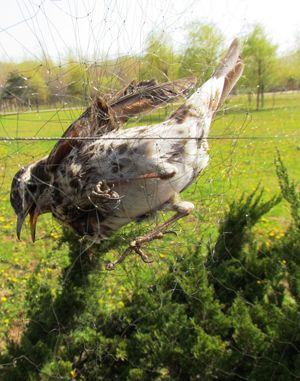
Illegal mist nets plague the bird population of Beijing.
The detritus spewed out by a city of Beijing’s size and population is complicated to control. From the razing to the ground of trees and forests many of these birds call home to ingesting poisoned bait they call food, the plight and future of the raptor is concerning. “Destruction of these creatures’ habitats is by far the biggest concern for the avian population,” Townshend says. Mudflat land reclamation along much of China’s coastline spells disaster for a multitude of species using this area as a breeding ground, not to mention the rapidly expanding cities and towering factories churning out pollutants and poisoning water supplies. Yet, more sinister activities also exist which threaten these worryingly dwindling species.
Trapping wild birds is illegal in China. Despite this, chancers frequently string up mist nets during migration seasons to catch birds either for food or to sell as pets. The nets usually catch smaller song birds, still seen, particularly among older generations, in the markets of Beijing. While this may not be a gargantuan problem, the practice is symptomatic of a wider issue affecting attitudes to bird conservation which are blighting China. As retailers struggle to quench the thirst of buyers searching for the next luxury, high-end product, the consumer looks for new ways to spend the money burning a hole in their pockets. In a situation reminiscent of the Victorian fascination with the exoticism of the Orient, unusual birds of prey are hot property among China’s elite, particularly in the south of the country. However, this time the birds are headed for the table, as opposed to the taxidermist. Illegal poachers have subsequently emerged, with, naturally, disastrous effects for the birds themselves.
The IFAW Beijing Raptor Rescue Center (BRRC) was co-founded by the International Fund for Animal Welfare (IFAW), Beijing Normal University and the Wildlife Protection Station of the Beijing Forestry Bureau. Since 2001, the center has rescued a whopping 3,577 raptors, consisting of 33 species, from buzzards to vultures, falcons to golden eagles. An average of 55 percent of the rescued raptors are rehabilitated and returned to the wild, often within the municipality of Beijing. As well as being a center for rehabilitation, the IFAW BRRC is committed to educating people about the issues facing these creatures and the dangers inherent in illegally handling them.
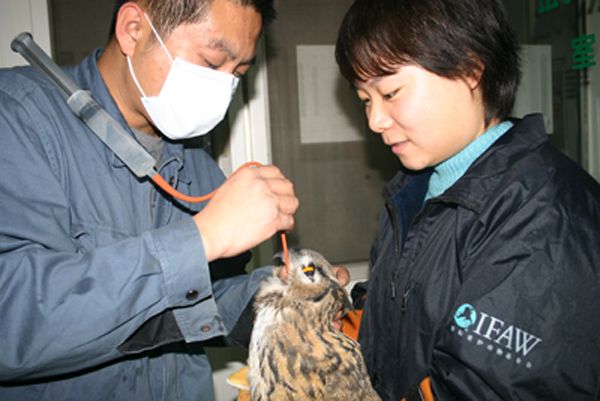
Rehabilitators at the IFAW BRRC treat an injured eagle owl.
Horror stories of the illegal trading, mistreatment and poaching of raptors abound, and the IFAW BRRC are keen to share such stories to highlight the issue and encourage conservation. The IFAW BRRC regularly receive birds showing evidence of having been shackled, implying that attempts at training them have been made.
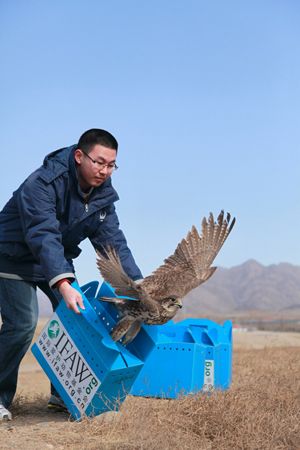
A recovered saker falcon is successfully returned to its natural habitat.
Recently-implemented laws have tightened the restrictions on keeping raptors in captivity. Raptors in cages for sale in markets, however, are still— despite the practice being outlawed—seen in China. Handlers attempting to dodge the law often hide the animals in poor conditions. Cases of misguided handlers sewing up raptors’ eyes in order to prevent them from struggling during transportation or muffling the animals tightly under quilts are all too common for the rescuers, and many birds die in the process. The IFAW BRRC also receives birds that have suffered from malnutrition and dehydration, poorly cared for in captivity.
Another issue facing the birds is a lack of rescue common sense. The misguided goodwill of rescuers can often lead to the birds having to live for the rest of their lives in captivity. When handled by a human, the raptor’s parents will disown it, ridding it of the opportunity to gain the necessary survival skills to live in the wild. Once taken to the state-of-the-art IFAW BRRC, the raptors undergo a thorough physical examination, which includes nutritional support and exercise before its condition can be fully assessed.
A rescued northern goshawk and a peregrine falcon, both convalescing at the rescue center, are the current poster children for anti-illegal trading. The latter was found, shackled, in a restaurant in Jishuitan, Xicheng District by a member of the public in May 2012. Shocked by what he saw as he was dining in the restaurant, a man decided to buy the bird for himself and promptly delivered it to the IFAW BRRC, attesting to Townshend’s optimism that the general public are taking matters into their own hands and encouraging animal cruelty prevention. Now, almost a year hence, the bird still bears the scars of the shackles. Its damaged feathers have been molting; but its flying skills need to be up to scratch in order to survive in the wild. The center ensures it is given sufficient flying exercise to encourage its strength and hope it can be released back into the wild in the future.

A common kestrel perches high above the ever-expanding city below.
The city itself also presents a jungle of hazards for birds of prey and raptors in general. The IFAW BRRC treats many birds that have suffered trauma due to collisions with buildings or cars. One eagle owl was recently admitted to the center after colliding with the windscreen of a car, apparently stunned by its piercingly bright headlights. This situation is becoming an all-too common occurrence, along with birds plowing beak-first into buildings, and is one that is sadly more difficult to combat.
Raptor rehabilitator Steele Shang has the run down on some basic precautions he takes in the clinic to minimize human impact on the birds in order to ease their transition back into the wild.
“Noise is an important factor, as is physical contact with the birds. No pictures are allowed, and you can only view the birds through small holes pierced in cardboard divides, shielding them from humans as much as possible.” The onus is on retaining their sense of being in the wild to ease the transition of their eventual release.

IFAW BRRC rehabilitators take precautions when feeding raptor nestlings/fleglings to avoid imprint behavior.
Take the case of the Japanese sparrowhawk; in general, raptors like standing high, on cliffs, but this bird remained firmly on the ground. Its feathers had been badly damaged resulting in it struggling to fly. This may have occurred because it has been in captivity since it was very young, meaning it is not afraid of humans. Shang says, “If we want to send it back to the wild, it requires very careful assessment. If we can reverse their habits, that’s good; it will recover its wild nature. But, if the behavioral imprint is too heavy, it may not work and may still not fear humans.”
But human impact on raptors is by no means all bad news. In 2012 a golden eagle was rescued by a member of the public in Inner Mongolia. A Mr.Li was driving back to his home in Hebei Province when he saw a man standing at the side of the road with a desperate looking golden eagle, its wings tethered, unable to move. Pulling over, he asked the man what he was going to do with the bird, to which he replied “I caught the bird, I want to kill it and stuff it.” Horrified, Mr. Li asked him how much he would accept in order for him to buy, and subsequently save, the bird. He replied “500 RMB”, which Mr. Li agreed to. Unaware that he was rescuing a Level I endangered species, he drove the bird back to Beijing and promptly delivered it to the IFAW BRRC.
An examination revealed its propatagiums (wing webs) had been badly injured. Shang laments that, “(for the eagle) it is not very optimistic. It is likely that he will take more time to fly again.” Sadly, in this case, the center will have to spend more time rehabilitating the bird.
This situation confirms Townshend’s view that times are changing and Shang agrees with him; attitudes are shifting for the better. “There are changing attitudes here in China. Weibo is being utilized to raise awareness about protection and conservationism.”
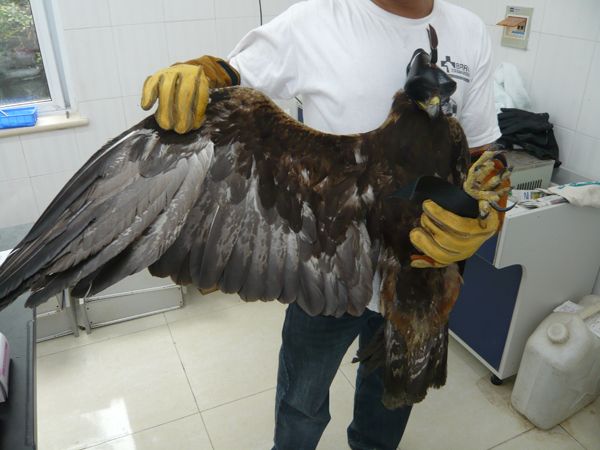
A golden eagle undergoing a physical examination at the IFAW BRRC.
In November 2012 at least 20 Oriental Stork, internationally recognized as endangered with possibly fewer than 3,000 individuals remaining in the world, were found dead in a lake in Tianjin. The birds had fallen the victim to poachers who had poisoned the lake with carbofuran, a pesticide banned in many countries but still widely used in China. The poachers were fueling the lucrative demand for new and unusual exotic meat, the the ramifications of which ripple throughout the country. The actions of some local enthusiasts and volunteers prevented the situation from getting worse, catching the birds and even working with local authorities in attempting to catch the poachers. So despite the gloom, the signs indicate that there are shifting patterns in Chinese attitudes to conservation and the importance of protecting these birds. “I am optimistic,” Townshend says. “When such events happen, there is very clear outcry.”
With a multitude of environmental difficulties facing China today, many view the situation negatively. But with a menagerie of raptors showcasing themselves around Beijing, nature lovers can be hopeful that, with heightened awareness and compassion from members of the public, these species will not face the same fate that many of their mammal and reptilian counterparts in China have.
A FEATHERED TALE OF HOPE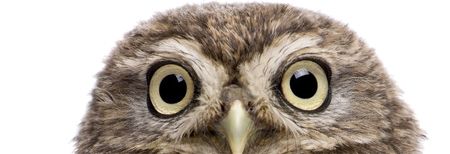
An incessant drilling plagues the heightened senses of the athene noctua; the strains of nearby bulldozers drift across their weary bones; piercing rays of light flood into their temporary home; desperate calls for their mother to feed them fall on deaf ears. Terrified and aching with hunger, the babies huddle together, searching for comfort from one another away from the uncertainty that has enveloped them. Stunned with fear, they refuse the offerings of the jovial factory owner, delighted and cooing over his find in a darkened corner of his new, sprawling empire. Incarcerated within their sterile container, they remain locked in the terror of what lies ahead. Transported from one makeshift home to another, the caring intentions of the gallant rehabilitators from the IFAW BRRC go someway in abating their fears of the unknown.
The center was adamant that the mother and her babies remain together; the chicks could grow up with natural maternal love and learn the skills necessary for survival in the wild from their mother. The staff provided a suitable “nest” and nutritional food for them. Once used to the relative protection and care within the rehabilitation clinic, the injured mother cares not only for her own chicks, but also adopts the orphaned chicks of others. Once her offspring are ready to be rereleased into the wild, she lets go, finally passing away and succumbing to the bumble foot she had contracted prior to her arrival at the center, safe in the knowledge that she has done everything in her power to protect and care for her, and other’s, chicks.
Finally able to leave their mother behind, the little owls soar into the sky with the hope that they can continue their young lives free from the dangers they have already experienced first-hand and that they can sing freely, just as their mother would have wanted.
Related Articles