

Whether you prefer heavy metal dirges or delicate sonatas, music—as Confucius once said—is something that “produces a kind of pleasure which human nature cannot do without.” (夫乐者, 乐也, 人情之所不能免也。 Fū yuè zhě, lè yě, rénqíng zhī suǒ búnéng miǎn yě.)
This universal language, which in Chinese goes by the name 音乐 (yīnyuè), first found written expression more than 3,000 years ago, when the earliest versions of the character 乐 appeared in oracle bone script, drawn to represent an instrument with strings on top and a wooden base on the bottom.
By the time bronze script rolled around, the character 白 (bái) had been added between the two strings to represent a tuning device, to form 樂. It’s speculated that 白 also served a phonetic purpose, but that the pronunciation naturally evolved. 樂 may have been vivid, but it was also a pain to write, and during the Han dynasty (206 BCE – 220 CE), quick cursive versions simplified the character to 乐.
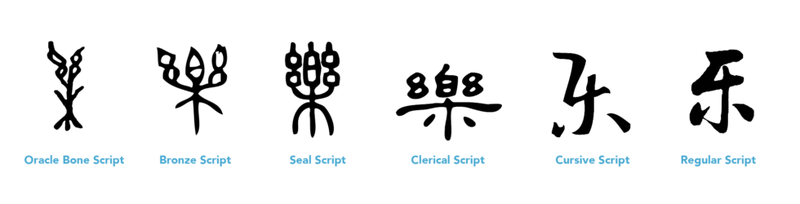
It wasn’t a great leap for the character 乐 to also take on the meaning of “happiness” by the Spring and Autumn period (770 – 476 BCE), as indicated by another Confucian quote, “When friends come from afar, isn’t it a joy!” (有朋自远方来, 不亦乐乎! Yǒu péng zì yuǎnfāng lái, bú yì lè hū!)
Of course, multiple interpretations of the same character get confusing, which is why people decided to distinguish the meanings by their pronunciation. The “music” 乐 became pronounced as yuè, while “happiness” converted to lè.
In modern Chinese, 乐 is used in tons of musical terms, like 乐器 (yuèqì, instrument), 器乐 (qìyuè, instrumental music), 声乐 (shēngyuè, vocal music), 乐队 (yuèduì, band), 乐谱 (yuèpǔ, musical score), 乐曲 (yuèqǔ, song), 乐团 (yuètuán, orchestra), 奏乐 (zòuyuè, to perform music), 民乐 (mínyuè, folk music), and so on.
Yet in the grand scheme of things, the number of 乐-words related to music are relatively few and simple in meaning. By contrast, 乐-words related to happiness are both abundant and complex. A few examples include 快乐 (kuàilè, happy), 娱乐 (yúlè, entertainment), 乐观 (lèguān, optimistic), 乐不可支 (lèbúkězhī, overjoyed), 乐极生悲 (lèjí-shēngbēi, from extreme joy comes extreme sorrow), 极乐世界 (jílè-shìjiè, paradise), and 幸灾乐祸 (xìngzāi-lèhuò, schadenfreude).
乐 can also be used in verbs to mean “to like” or “be willing to.” For example, 乐此不疲 (lècǐ-bùpí), means to enjoy something and never get sick of it. 乐善好施 (lèshàn-hàoshī) means to take joy in doing good for others. 喜闻乐见 (xǐwén-lèjiàn) means to love to hear and see, or to love to be entertained.
乐 can also be used as a noun to express pleasurable things. For example, 及时行乐 (jíshí-xínglè) means to have a good time while you can, while 寻欢作乐 (xúnhuān-zuòlè) means to seek and indulge in sensual pleasures.
But 乐 doesn’t always mean livin’ large—it was Song dynasty (960 – 1279) poet Fan Zhongyan (范仲淹) who urged, “Be the first to concern yourself with the affairs of state and the last to rejoice in personal happiness.” (先天下之忧而忧, 后天下之乐而乐。Xiān tiānxià zhī yōu ér yōu, hòu tiānxià zhī lè ér lè.) This socially responsible message leaves room for both selflessness and personal fulfillment—a sentiment that captures the essence of 乐.
In recent years, the 乐 family of words has adapted to include words referring to fun or comfort. 安乐窝 (ānlèwō) means “comfort zone,” 安乐椅 (ānlèyǐ) is an “easy chair,” and 安乐死 (ānlèsǐ) means “euthanasia.” In life or death, you can always be sure to find 乐.
Cover image by VCG
Related Articles