

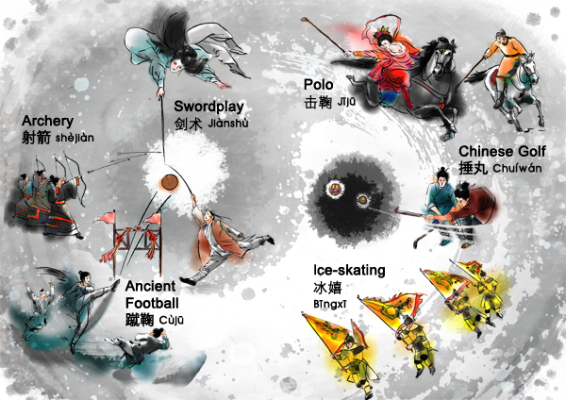
Archery 射箭 (shèjiàn)
In the Western Zhou Dynasty (1046 – 771 BCE), archery was an essential part of education for an accomplished gentleman. Starting at age 15 they began learning five techniques, including being able to shoot with enough force to penetrate a target and shooting three arrows in quick succession.
Swordplay 剑术 (jiànshù)
In Chinese legend, swordplay wasn’t always just a man’s game. Due to her skills with a blade, a teenage girl living in the forests of the ancient State of Yue (722 – 221 BCE) attracted the attention of the king, who sent her to train the royal army. On the way, she was challenged by a senior swordsman. They competed with two bamboo branches, and—when the dust cleared—the young girl won in only three moves, paving the way for competitive swordplay. She was later honored with the name “The woman of Yue” (越女 Yuènǚ). Swordplay was prevalent in later dynasties as it matured and became more complicated.
Ancient Football 蹴鞠 (cùjū)
First recorded 2,000 years ago, cuju is known as the earliest form of football. The popularity of the sport peaked in the Tang (618 – 907) and Song Dynasties (960 – 1279). Eight pieces of leather were stitched together to form a round shell. Inside, an animal bladder was installed and inflated; the goal was a net on bamboo sticks. Cuju differs in that a single goal was located at the middle of the field, and the number of players varied as long as both teams were equally matched. Players also had competitions on technique—for example, juggling the ball with their feet. One women’s team, consisting of 153 members, was recorded as so proficient that, once they started, the ball never touched the ground.
Polo 击鞠 (jījū)
Nobles in the Tang Dynasty (618 – 907) loved to hit wooden balls with a stick on horseback. Of all 19 emperors, 11 were hardcore fans. Two of them even died in polo accidents. Said to have been introduced by Persian and Tubo Kingdoms, Polo was also actively practiced by ancient Chinese women. Sometimes, it was more than recreational. When Emperor Xizong had trouble choosing between four candidates to be the military official for the Sichuan region, a game of polo was set as the decider. In the end, the low-born, but excellent polo player, got the job.
Chinese Golf 捶丸 (chuíwán)
No one is really sure of the connection between ancient and modern golf, but there are some surprising similarities. Chinese golf was usually set in open country with various landscapes, and according to a depiction of Emperor Xuanzong of Ming Dynasty (1368 -1644) enjoying the game, there were 10 holes spread across the course with small flags inserted beside them. Whoever strikes the wooden ball into the hole with their stick gets a point. The game was most popular in the Song and Yuan Dynasties (1206 – 1368). From the emperor and nobles to the common folk and children, Chinese golf was the sport of the age. Luckily many aspects of the sport are recorded and discussed in the book Ball Scripture (《丸经》), compiled in the Yuan Dynasty.
Ice-skating 冰嬉 (bīngxī)
You might not imagine it from watching Brian Boitano today, but ice-skating was once a warriors’ art. Manchu men needed to master the skill to move 350 kilometers in a single day to get to their enemies. When they came to power in the Qing Dynasty (1616 – 1911) and moved from the north to the capital city of Beijing, it became a traditional sport. Each winter, 200 proficient ice-skaters were selected to perform on the frozen royal lake for the court. Skaters would wear knee pads and secure their shoes with leather, shoes fitted with single iron blades for speed or double blades for security. Competitions for figure skating, ice acrobatics and speed skating were also held for the benefit of the royal family.
Related Articles