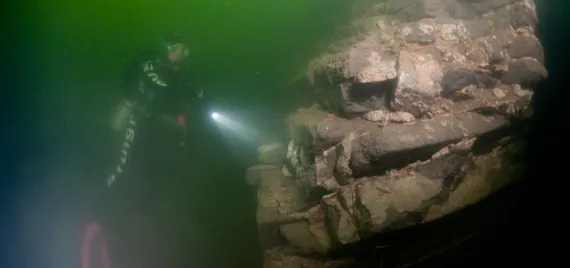

Scuba diving at China’s most famous monument is an adrenaline rush not to be missed
For centuries, the Great Wall symbolized the edge of civilization; precariously perched on sweeping mountainsides and barren plains, the wall seemingly echoes the untamed spirit of the wild north.
It seems a shame, then, to trudge along with the tourist hordes, scaling the same sections of the wall over and over again. There are plenty of alternatives. You can camp in old watchtowers or scrabble up the broken joints of the unrestored lengths of the Great Wall. You can saddle up for a horseback ride to the top, or hop on a toboggan and slide down. But, scuba diving is definitely off the wall’s beaten track.
Imagine floating above the bricks and masonry, gliding up and down the thick, heavy fortifications, darting in and out of watchtowers, tracing the arc of ancient stone steps, one by one, all while hooded by a dark sheet of water.
The point of most Great Wall visits is to climb up to a place high enough to see the “sweeping grandeur” the monument exudes as it snakes along craggy ridges and peaks. “They focus on the ‘Great’ but not the ‘Wall’,” quips Steven Schwankert, founder of the diving outfit SinoScuba, Beijing’s first official diving school.
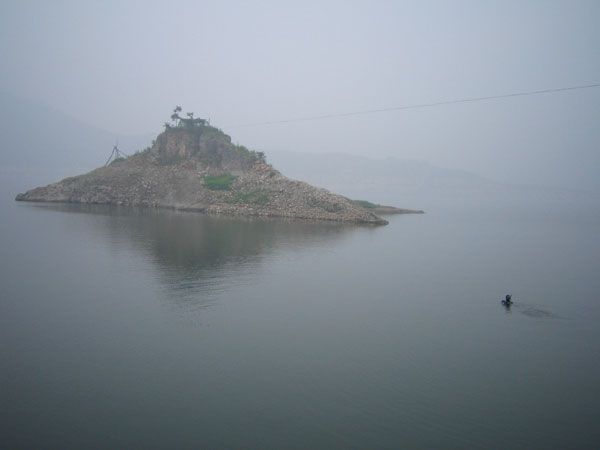
Scuba diving in the murky waters of Panjiakou Reservoir
The submerged wall has been a local secret for years, accessible only to intrepid Chinese divers who had few other options for diving spots near Beijing. “I heard about [the Great Wall dive] through the grapevine,” recalls Schwankert. “I thought it was just too cool! I
mean, can you dive the Pyramids?”
While Beijing is not exactly a desert (yet), the region still suffers from periodic droughts that can severely limit water sports. Diving conditions in much of China (with the exception of Hainan) aren’t ideal, but on the flip side, the diving here has a more adventurous DIY feel. You dive wherever you can get away with it—an attitude that takes adventurous divers surprisingly far.
Schwankert himself has squeezed into wells, organized shark dives in local aquariums, and caught ear infections in far-flung lakes. But when he geared up for the Great Wall dive at Panjiakou Reservoir (潘家口水库 Pān jiākǒu shuǐkù), he was in awe. “It was majestic… You stop to look at the detail, the workmanship. You don’t tend to notice those things [above the water].”
The Panjiakou Reservoir, just three hours from Beijing, was built in the late 70s to provide drinking water for a growing population in Tianjin and Tangshan, the latter newly rebuilt after a devastating earthquake pounded the city in 1976. Sadly, the construction plans called for a section of the magnificent Panjiakou Pass to be completely submerged in water. Occasionally, a few crumbling watchtowers dot the dark waters during particularly severe spells of dry weather, which lends the surroundings a particular kind of broken beauty.
Above the water, a section of “wild” wall snakes down a jagged copse of mountain before plunging dramatically into the reservoir. It gently resurfaces on an island (a former hilltop) before disappearing completely from view. Not unsurprisingly, Panjiakou is a popular site for hiking and photography, with many visitors staying overnight in basic farmhouse accommodation. Incidentally, Panjiakou was also the backdrop for the memorable outdoor shots in Jiang Wen (姜文)’s well-received film Devils on the Doorstep (《鬼子来了》 Guǐzi láile).
While you might not think that a public works project would so easily drown an important section of the wall, in fact, the Panjiakou Pass might have some historic importance. William Lindesay, the Englishman who famously walked the entire Great Wall, had surmised that this area was a key troop deployment area. This is based on the existence of an archway that probably functioned as a sally port; the high curves of this archway allowed for a great numbers of soldiers to quickly move to the opposite side. These structures are incredibly rare, and if you want to see Panjiakou’s version, you’ll have to suit up, as the archway is now deep underwater.
But what really makes an underwater visit to Panjiakou Reservoir (other than the obvious) is the sheer “intimacy” a diver can experience with the Great Wall. Will Moss, an experienced diver who has taken the plunge twice, describes it as “a different kind of
Great Wall experience”. After all, very few are aware that underwater exploration of the ancient wall is even possible, so “the novelty value is a big part of it,” according to Moss. “If you just want to see the wall, go to Mutianyu (慕田峪) or Simatai (司马台) or better, the un-touristy spots of the wild wall. But if you want a China-only diving experience, then it’s pretty cool.”
There is also a sense of playfulness that can’t quite be had after plodding up step after step on the wall. Scuba divers can drift among crumbled bricks, observing how the bones of the wall were constructed and languidly swim among the small fish and tiny shrimp that have made their home within the cracks and fissures of this drowned monument.
“I didn’ t find diving the Wall challenging,” says Moss. “The parts we dove were relatively shallow, and I am used to poor visibility diving.” Then again, Moss is a veteran, having dived in a wide range of conditions. However, Panjiakou is not entirely without difficulties for those less experienced.
Most certified scuba divers learned to dive in tropical environments with excellent visibility. Freshwater diving, on the other hand, doesn’t follow the exact same principles, leading to problems with buoyancy control. This is because salt water, due to its heavier weight, is more “buoyant” than fresh water. Divers need to compensate for this, or they find themselves sinking faster than expected.
There is also the chill factor. The water is cold most of the year, except for a blissful few months in late summer and early autumn. While proper gear means that this won’t be a problem, beginner divers do need to be aware that additional equipment will either need to be purchased or rented. Moss recalls that his second dive was “extremely cold” with water temperatures hovering around five Celsius, though he ultimately considered the “temporary loss of feeling in his hands and face” worth the experience.
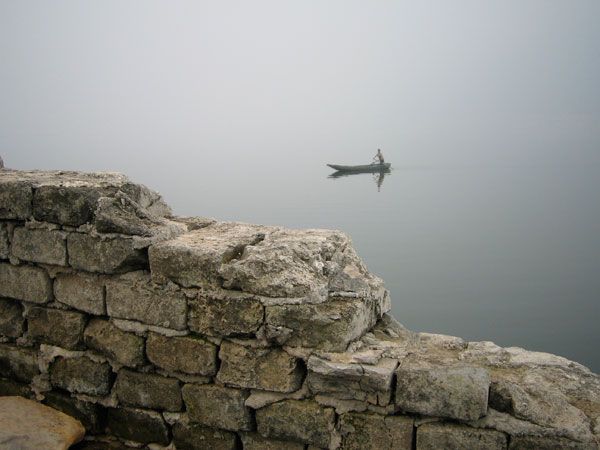
A lonely boat floats by the wall on a chilly day
Visibility is another factor. Ten meters is considered peak conditions for this particular spot. “The water is cloudy, and the visibility isn’t great,” cautions Moss. “So you don’t get panoramas so much as a moody, slightly claustrophobic experience in dim light.”
There are also environmental dangers. The last few years has seen a climatic shift from the extremely dry to the unusually rainy. This has introduced hazardous conditions that were mostly absent five years ago.
“When we first started diving in 2008, the signal tower, the centerpiece of a dive on the wall, was five to 10 meters deep. Anyone [with basic certification] could do it,” explains Schwankert. Water levels have increased significantly since then. After the heavy rains that inundated Beijing last summer, the signal tower is hovering around the 40 meter mark, which is, cautions Schwankert, the recreational limit and the edge of what is considered “permissible and prudent”. With so much new territory sunk into the reservoir, objects that are not normally underwater have cropped up, such as trees.
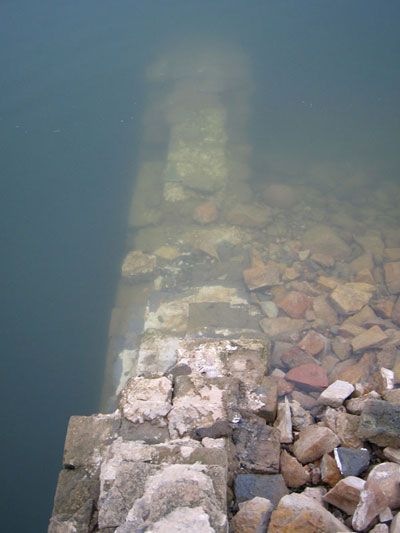
A submerged section of the Great Wall at Panjiakou Reservoir
“The average diver is not trained to dive around trees,” notes Schwankert with a little laugh. “[At Panjiakou] divers need to be ready to address things on the fly.” Fishing nets and other detritus of rural Chinese households also litter the lake, though Schwankert insists that they try to “pre-dive” when possible to take stock of potential hazards.
“My first time up,” recalls Schwankert, “I didn’t know the conditions, or how deep it would be. I was surprised how much fun it was… If you just floated above it, you’d get tired of it. But [exploring] the watchtower, swimming in and out of the archway… going down and to the side, feeling how high it is, you get more of a feeling of what it would be like to take on the wall. You see it the way it was conceived, as this insurmountable obstacle that you can just ‘fly’ around.”
That said, the majesty of the underwater experience does vary, not just from year to year, but from month to month. While parts of the Panjiakou Wall are currently straddling the edge of what might be considered safe for inexperienced divers, in times past, the water levels were simply too low to make for any decent dives.
In 2010, the diving season was scuppered due to low water levels. It was practically “snorkeling depth” with hardly any opportunity for underwater exploration of the reservoir. “Snorkeling the Great Wall,” says Steven with a derisive snort, “don’t think there’s a demand for it.”
For now, however, the conditions are excellent.
Related Articles