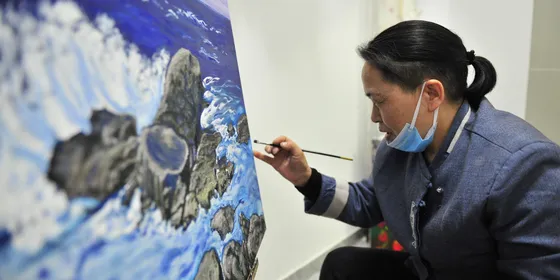
The title of Chang Yuchen’s (常羽辰) copperplate exhibition puts the overall feel of her works into words quite concisely: “Barbaric Poetry”. The exhibition title references a famous quote by Theodor Adorno, “to write poetry after Auschwitz is barbaric”.
“To me,” Chang explains, “the contradictions [in my works] are also barbaric”. Rather than affecting viewers and soliciting a response, Chang’s art possesses a state of detachment, made aware by her own artistic inquiries and self-reflection.
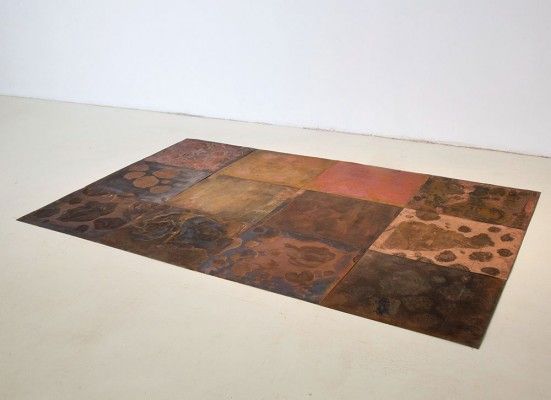
Rose, Etching and Aquatint on Copper Plates, 2013
Due both to the nature of copperplate etching and the artist’s pursuits, an overarching poetic sense permeates the exhibition. “Snake”, a set of copperplate etchings that form a giant snake when assembled on the wall, is a key piece that reveals the artist’s inquiries into the practice of etching as well as the imagery and emotions this format can realize. Although the piece can be enjoyed from afar, its details are all the more captivating upon closer inspection, not dissimilar to how a classic Chinese landscape painting extends far beyond an artistic portrayal of natural scenery. After being etched out inch by inch on copperplate, stroke by stroke, the snake skins are dipped into acidic liquid to be eroded, a process that requires meticulousness and patience. Close up, the texture of the skin reveals both the process and a sort of scorched earth, barren landscapes left behind by catastrophe, destruction, and the simple passing of time.
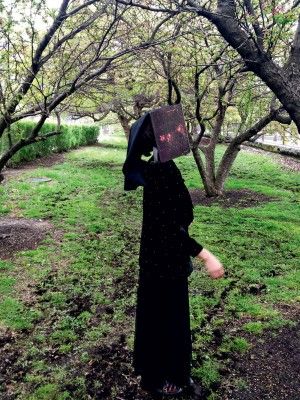
Catalogue of the Universe, 2012
One of Chang’s early works on display was inspired by a book called Catalogue of the Universe she stumbled on in a used bookstore. The finished work lets the wearer experience the “universe”. This wearable book not only possesses the ability to isolate the wearer in any space with light to gaze upon the “stars” in the “dark sky”, but also plays with and comments on the relationship between the original book and its title. “I was interested in investigating the boundaries of reason,” Chang says. This connection/disconnection between the signified and the signifier is her attempt to decipher the Buddhist story of “如人以手,指月示人” (loosely meaning that when people point to the moon, the finger points at the location but the finger is not the moon nor does the moon need to be signified via the finger).
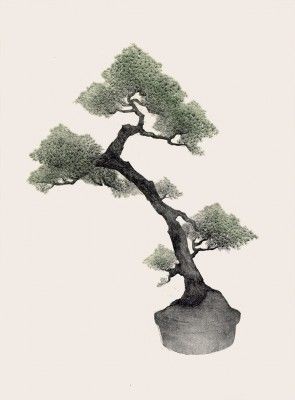
Bonsai, 2015
A fan of Walter Benjamin and Theodor Adorno, Chang’s approach to art is contemplative and introspective, which renders her works both approachable and alienating. She describes her snake sketching process as “semi-automatic”, a term that seems to apply to her other pieces as well.
Rather than designating herself a specific role and historical context as an artist, she is more concerned with how she can explore and articulate her inquisitive endeavors and collective subconscious via art. Her works urge spectators to hold their gaze and pay closer attention, to find contradictions within each piece in broader dimensions: the imagined versus reality, fragility versus endurance, decay versus permanence, the poetic and the barbaric. While possessing a high degree of self-awareness, these works have an intrinsic alienating effect.
“Poetry, Barbarism, and Philosophical Inquiry” is a story from our newest issue, “Mental Health”. To read the whole piece, become a subscriber and receive the full magazine. Alternatively, you can purchase the digital version from the iTunes Store.
Cover image is of Chang’s piece “Snake, 2013”
Related Articles