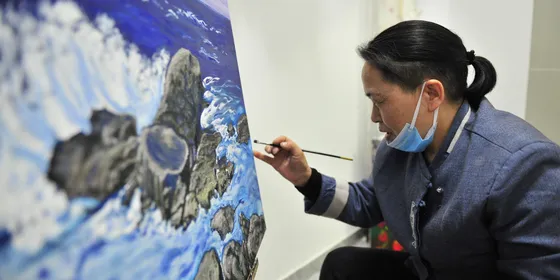
He Xun (贺勋) knows exactly how to play with paradoxes.
A painter and a poet, He Xun, 31, graduated from the China Academy of Art in 2006 and often leaves the viewer with a very real sense of paradox, a reflection of his views both physically and philosophically. For example, one of his representative works, “Empty Baggage” gives a sense of weight and importance. Unlike most painters, He takes his inspiration from language as well as the mysterious powers of religion and folklore.
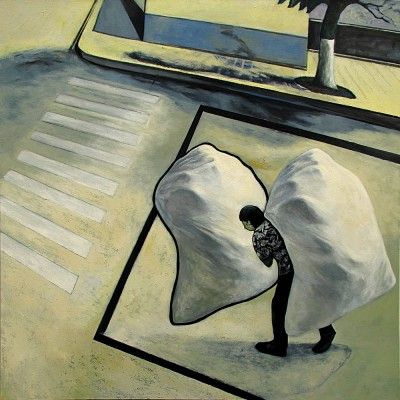
Empty Baggage, 2013
“As an object, baggage or cloth-wrappers have fallen into disuse in our life; it only exists linguistically. Baggage is supposed to be heavy, but I give it a modifier of being ‘empty’. The paradox between ‘heavy’ and ‘empty’ is what I am focusing on—the nature of the word. In short, what I am doing is ‘painting a word’,” says He.
Most of his works have a distinctive title that plays into the work. For example, “Finite and Infinite Snakes” conveys the concept of commencement and closure and “A Pole Without Shadow” builds a world in which light doesn’t create a shadow. “All the works are like my own kids, so I should give them names,” says He.
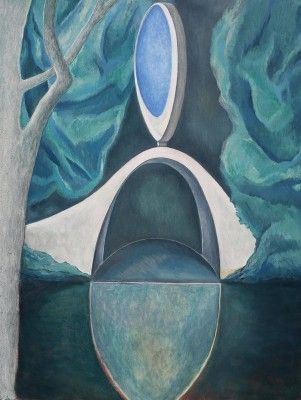
A Mirror Blocks the Way, 2013
As the Chinese saying goes, “Painting exists in poetry; poetry exists in painting (诗中有画,画中有诗)”. It was once used to compliment poet and painter Wang Wei in the Tang Dynasty (618 – 907), but it works just as well for He Xun.
This love of poetry comes from He’s endearing relationship with the countryside. Once when he was young, he went to sweep the grave of his school headmaster in a wooded valley. On his way back home, he ran and shouted, and he found that the echoes were speaking to him. “The echo would come home with me,” He wrote after he got home. And that became the start of his poetry writing.
He’s poems have been published by many well-known periodicals, including Poems of Jiangnan and West Lake, and the poem “We Seem to Live a Real Life” was included in The Best Poems of China 2006.
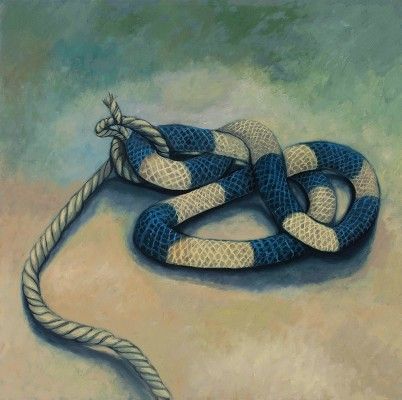
Finite and Infinite Snakes, 2012
“Both poetry and painting are expressions from the heart and will be eventually directed at the heart. They have similar elements and artistry and both demand resonance,” says He, believing that the two art forms are interdependent.
As it pertains to painting, He prefers the Chinese expression “美术”, literally the art of beauty. He saw the works of Van Gogh, El Greco, and Cezanne in a magazine before he started learning painting, and he knew that it was what he wanted to do. Like many artists, He experiences anxiety while creating, but he maintains that the most difficult moment is when you see your own hypocrisy. For him, he says, the best part of creating art is when you finally face yourself, overcome the false self, and express yourself successfully.
“Painting the Paradox” is a story from our newest issue, “Family”. To read the whole piece, become a subscriber and receive the full magazine. Alternatively, you can purchase the digital version from the iTunes Store.
Cover image is A Plane World, 2013
Related Articles