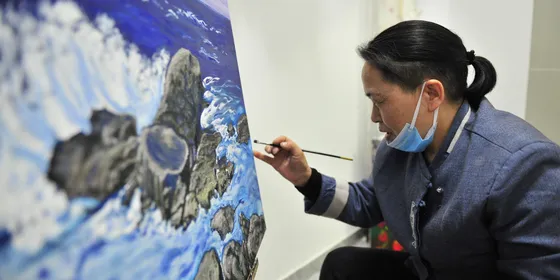
Xu Hongxiang (许宏翔) Born and raised in Changsha, Hunan Province, Xu Hongxiang (许宏翔) studied printmaking at the China Central Academy of Fine Arts. Now based in Beijing, Xu mainly works in the medium of painting and is most well known for his “Flowing Landscapes” (流动的风景) and “Meat” (肉) series.
How did you come to create your series “Flowing Landscapes” and “Meat”?
In 2008 I began a series of experiments with visual language. I collected all kinds of imagery, including my own photographs, old photos I bought online, magazine cutouts, and advertisements. In some of them I found clues to my visual questions. I would print photos onto canvases using techniques so they could be dissolved. Superfluous visual elements would be removed, and missing ones would be added. “Flowing Landscape” is not about a landscape, rather a visual exploration. A still image is dead, but painting is alive. When painting interferes, the image becomes unpredictable, alive, and graceful. Hence the name: scenery that flows. The “Meat” series was an exploration into the body and uses the same techniques as “Flowing Landscape”, a reappropriation, or as some say, “deconstruction” of images.
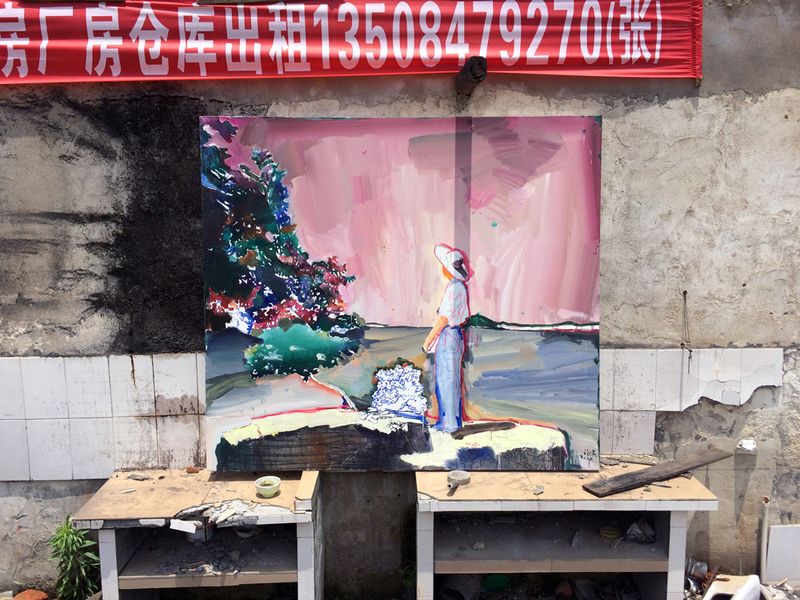
Look Over There, 2016
How much has your printmaking background influenced your work?
With printmaking, there is always a methodology. Only by calculating and following a set of procedures can you achieve your expected visuals. These past few years, I was trying to perfect my methods. Now, I am trying to shake away compulsory methods to seek something new, so I’ve moved away from my previous techniques. Yet, I feel that what I am looking for has become more precise. One doesn’t do contemporary art to do contemporary art; contemporary art and painting are not inclusive. To me, it’s significant for works to have an aura, to see oneself in them.
Your works all seem to have a distinctive “Changsha” aura, almost as if one can feel the city’s moisture in the air. They seem very personal, not necessarily specific.
You could say that. Very “local”. I use painting to look back and inwards. However, if I took them to New York, they would still work because I am not trying to be like Changsha, I simply am. One of the main leads I pursue is perhaps to inquire into myself, the past that adds up to be me. Although I moved to Beijing, my way of thinking is still in a Changsha state of mind. To me, painting is not about making high art, or eye-catching art, it’s about being oneself, being real, and putting one’s feet firmly in the ground. So, a lot of my source materials are ordinary objects and scenes. Earlier this year, I went home and exhibited my paintings on the walls of demolished buildings in Changsha, but not as cries against demolition or urbanization. I saw visual language, not demolished ruins. It was purely a personal act, to see my paintings—fruits born because I left home to study—interact with the lower class streets where I grew up.
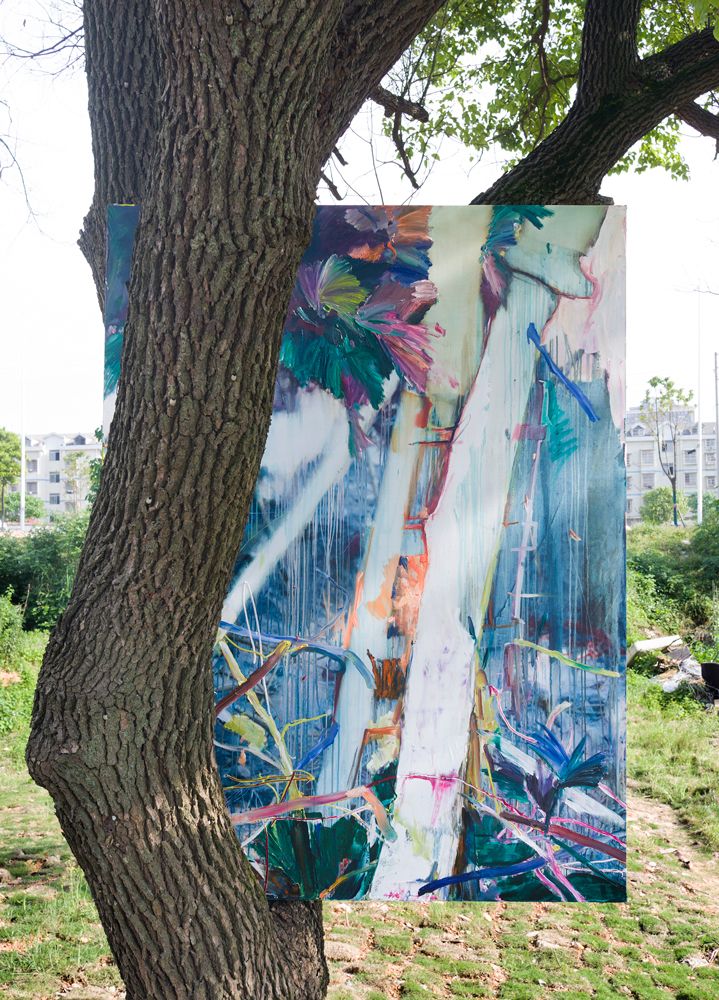
Flowing Landscapes No.2, 2016
My works are me. I am not into making refined or pretty works, and refuse strong narratives and specific references such as 红领巾, or the red scarf. I try to distinguish between imagery that interest me and imagery connected to me. One shouldn’t try to become a stereotype to fit characterizations, such as the trend of Peking Opera imagery. Many confuse interests with what they are. Some artists create similar works because they share similar interests. We all share similar experiences, watch similar TV shows, and read similar news stories, which leads to similar interests—hence, similar languages of drawing. I am especially wary of this pitfall. Who am I? What I want to explore is myself, which you could say is human nature. The self is human nature.
“What it means to be me” is the cover story from our newest issue, “Agriculture”. To read the whole piece, become a subscriber and receive the full magazine. Alternatively, you can purchase the digital version from the iTunes Store.
Cover image is Up and Down No.1, 2016
Related Articles