Is Qu Guangci (瞿广慈) an artist or a businessman? If you search for the artist online, the controversial topics of his role and integrity appear in almost all interviews. An artist whose main creative medium is sculpture, Qu owns a company with his wife called “X+Q” (稀奇), selling reproductions of his sculptures, bags, jewelry, furniture, and other products that stem from the couples’ works. In his recent solo exhibition “Northernmost Country” (终北国) at Today Art Museum, Qu embraces his two seemingly opposite identities and blurs the distinction between art and commodity using a story from ancient China to comment on contemporary Chinese society.
Northernmost Country is a fictitious, remote land mentioned in the Taoist book Liezi (《列子》) in a chapter called “The Questions of Tang” (《 汤问 》). The country is a utopia where food and drink are abundant, all people are equal, there is no manual labor, and no illnesses. Its residents eat, drink, play, sing, copulate, and experience only happiness—with no knowledge of aging, sadness, or pain. Qu’s famous “little fat figures”, the trademark antagonists in his other works, depict the residents of that faraway utopia as caricatures of the modern Middle Kingdom.
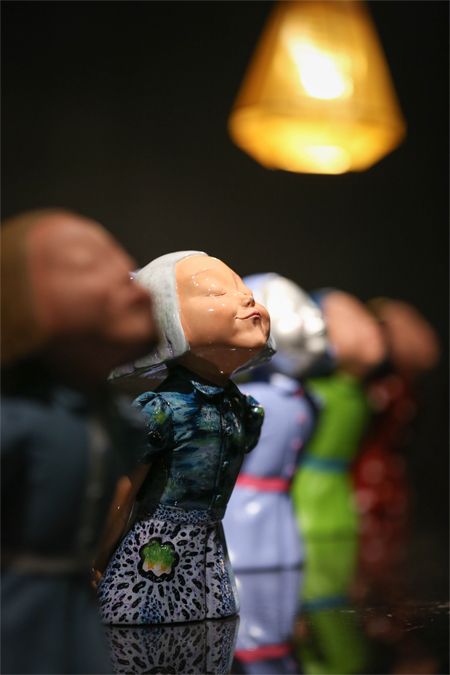
“I have seen happiness”
With plain-white, stark, monotonous expressions and body shapes, the chubby figures freeze in motion, lit by white studio lights in the vast exhibition space. Their identical features allow ambiguity in the interpretation of their character. Childish, inauthentic, simplistic, the crowd mentality; by keeping the allegory obscure, Qu leaves the question open: What is your Northernmost Country?
In “The Last Supper—Like!”, the center figure sits with arms and legs crossed, unmoved by the praise, while men face toward a man in the middle, giving him the thumbs up. In “Endless Tower—Great Men”, the chubby men perform acrobatic stunts forming a totem pole, where each is stacked on another, expressionless and unresponsive to the twisted state they are in and from the oppression from above. The lack of individuality and the pervasiveness of collective thinking and behavior are meant to resonate with the collective memories of modern Chinese history, but Qu deliberately denies the depiction of a definite conclusion or interpretation.
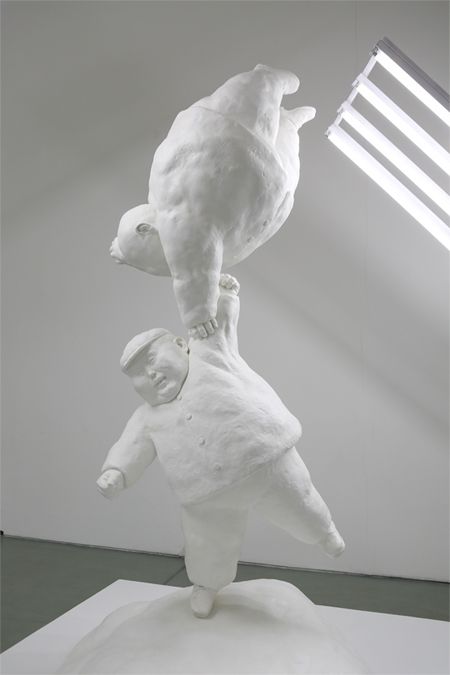
Even Pets Ascend to Heaven with Taoism Immortal
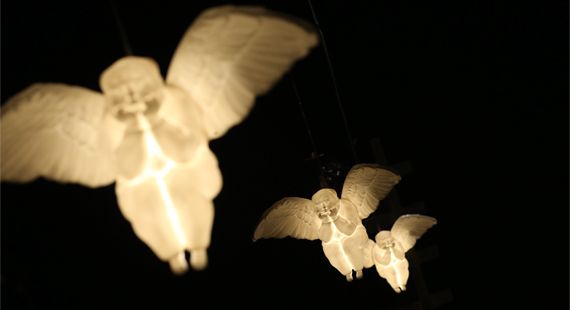
In great contrast to the monotony/purity of the white exhibition space, the adjacent room overflows with exuberance, color, and consumerism. As one of the most commercially successful artists today, Qu exhibits the most well-received products from X+Q in his Burtonesque room: cherubic “Rainbow Angels”; sweet girls with bunny ears in “I Have Seen Happiness”; and the “little fat figures” as communist idealists. Projected onto a wall in a dark room, the video “Qu Guangci and His Friends” loops as the introduction to this solo exhibition, where 37 celebrities and industry heavyweights explain their versions of the Northernmost Country.
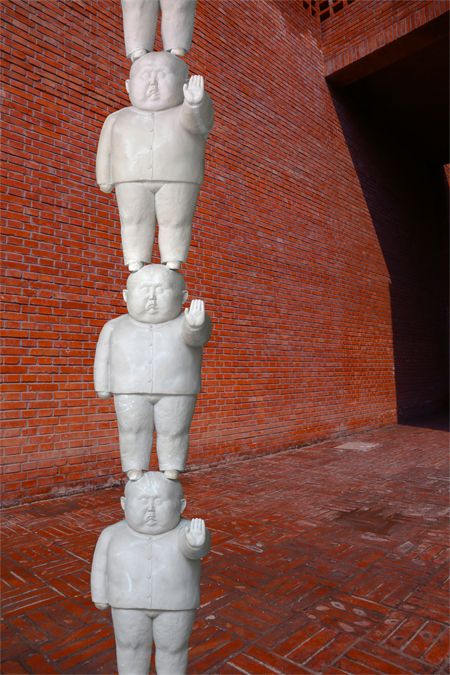
Endless Tower-Great Men (detail)
The exhibition isn’t so much about Qu’s utopia as the concept of utopia itself—maybe even its futility, and viewers play the main part. His little fat figurines call out for classification, and the empty, barren white space of the exhibition breeds yet more ambiguity. Perhaps that’s the secret of the controversy surrounding Qu—he lets the viewers see what they want.
Related Articles