
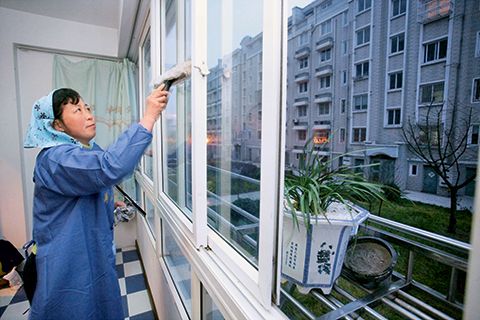
Stuffing her black backpack with cleaning materials, 45-year-old Lu Ayi leaves her bungalow outside the Sixth Ring Road in the east of Beijing, heading to her first appointment of the day at eight in the morning. It takes at least two hours and a bus transfer to get to her client’s home near Chaoyang Park inside the Fourth Ring Road, but she’s not too worried. Her company offers six RMB in compensation for trips like this, and she can save four. Wiping, scrubbing, and washing meticulously, all at the rate of 25 RMB per hour, until the two-bedroom apartment is spotless, she then rushes to do the same on the other side of the city—just another day.
Lu Ayi’s face is tanned and there are wrinkles at the corners of her eyes, but her bright eyes reveal a cheerful nature. Many in Lu Ayi’s position come from difficult circumstances; her misfortunes began with a gambling husband. Skipping out on his debts, he disappeared, leaving his family and his job as a coal miner. Lu Ayi had to persuade the coal mine to hire her as a replacement just to earn a living. Today, she is part of a burgeoning but sometimes dangerous industry, that of the domestic service worker.
(VCG)
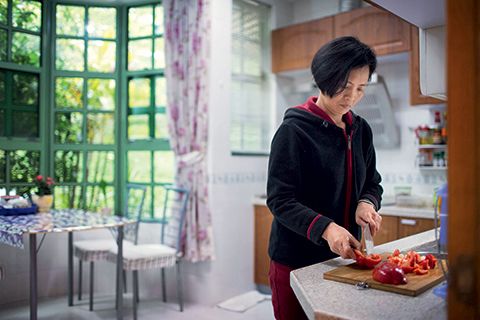
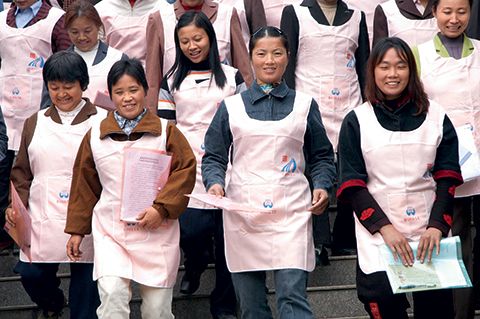
There are over 22 million women like Lu Ayi across the country working in the domestic service industry (家政服务). Primarily women from rural areas, they are called baomu (保姆, nanny), zhongdiangong (钟点工, hourly worker), or the more affable ayi, (阿姨) which means “aunt”. However, in this case, these “aunts” are a part of the family in the sense that they do the cleaning, cooking, babysitting, nursing of children and the elderly—whatever chores busy, modern Chinese families have no time for, or simply can’t do.
Back in the 1990s—before the age of booming factories, restaurants, salons, and stores—a profession in the domestic services was one of the few options open to rural women when they migrated to the city. There were limited channels for them to find such jobs, and their distant urban relatives were their only hope for work. Earning merely a few hundred RMB a month, they still took it as a good deal, as their food and accommodation would be covered. Also, the kinship inherent in the position meant that employers were willing to put trust in their nannies who were, after all, family.
(VCG)
This model is virtually extinct today. An unprecedented number of working opportunities have opened up to rural workers, and a domestic service industry formed and grew along with the rising demand. Finding an ayi has never been easier, what with all the agencies and, most recently, electronic platforms helping to match an ayi with a family, but at the same time, there is a serious lack of industry standards. Stuck in the middle are these rural women, and while they may have better prospects than their predecessors, they are still fighting to find their place in the modern metropolises around the country.
Currently, the demand for domestic service workers is at an all time high. People’s Daily estimates that of the 190 million urban families in China, 15 percent require domestic service in order to function, and Beijing alone needs more than 1.5 million such workers. This is largely due to the drastic change in the Chinese family structure over the past few decades. Before the 1950s, a Chinese family consisted of 5.3 members on average, whereas a Chinese Family Development Report released by National Health and Family Planning Commission of the PRC in 2014 indicates that the number has shrunk to a mere 3.02. With the one-child policy, urban migration, and lifestyle changes, the extended multi-generation family is already becoming resigned to history. This means less help within the family, especially when it comes to caring for the young and old. And with both spouses working full time and a new emphasis on quality of life, a typical urban family requires a lot of help at home.
(VCG)
Though the demand is urgent, according to many clients, finding the right ayi is almost impossible. The urban-rural lifestyle differences are palpable. “Here, we call hiring an ayi, qing (invite), because it’s so hard to meet a good one. Once you find her, you want to treat her like a god,” says Hangzhou resident Hu Yang, sharing her experience on the quest to find the one true ayi. To Ms. Hu, the statement is not a joke; she went through 13 different ayi prospects in three years. “The first ayi bailed on me after only a month despite our previous agreement; another ayi broke our 3,000 RMB stereo while cleaning the living room and left a week later because she found out that she was pregnant. From then on we were afraid to hire anyone under 50.”
Hu also stated that there were problems with, shall we say, work ethic: “She would drink the leftover milk directly from the baby bottle and feed my baby food that she chewed in her mouth. I told her it was unhygienic, but she insisted that it was how babies were raised in her hometown.”
“We finally gave up and just wanted an ayi to help with the cleaning, but this time, the ayi we hired threw everything into the washing machine at the same time, including baby clothes, adult clothes, and dirty cleaning towels,” Hu states. “It drove me insane the first time it happened, but she just refused to change her ways.”
Related Articles