

Leisure or 闲 (xián) is increasingly a luxury in modern China, especially for those trapped in the rat race of the first and second-tier cities. The country’s rapid growth, combined with aspiration to do better than the previous generation, has left people little time to breathe. To many, in between buying apartments, and educating their children, free time is wasted time; just the thought induces anxiety and guilt.
In late July, an article titled “20 Million People in Beijing Live a Pretend Life” by the WeChat account Zhangxianshengshuo hit a nerve online by claiming that the sprawling metropolis crushes all relationships, diversity, and local culture in its expanding orbit; that “there’s no life in this city, only dreams of a few and jobs of many.” The article was reposted so many times that People’ Daily was compelled to a rebuttal, titled “Not a Fake Life, Just a New Life.”
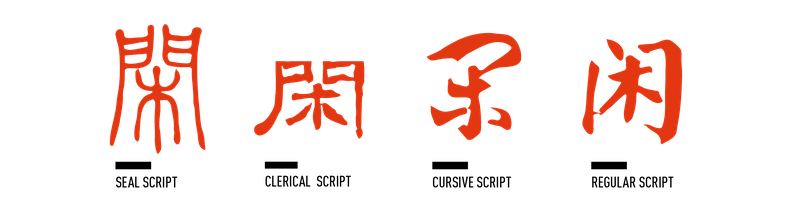
Long forgotten and worth bringing back, perhaps, is the notion of leisure, enshrined in the character 闲. The creation of the character was somewhat romantic. The ancients caught a glimpse of moonlight shining through the gaps of the wooden panels of a door at night and created , which originally referred to physical gaps, given that the outside radical stands for “door” while the inside radical 月 stands for the moon. Later, the character evolved into 闲, its modern form, and took on the meaning of “gaps between time periods or events.”
Together with 空 (kòng, empty, free), the two characters formed the phrase 空闲, which means “leisure time” or “free time,” as in 等你空闲下来,我们一起去钓鱼。(Děng nǐ kòngxián xiàlai, wǒmen yìqǐ qù diàoyú. When you are free, let’s go fishing together.)
More colloquially, people say 闲工夫 (xián gōngfu) to mean a short period of free time. Snatching a moment of leisure from one’s busy schedule is 忙里偷闲 (máng lǐ tōu xián)—but this is an unaffordable luxury for many living in the fast-paced city.
Back when the world moved at a much slower speed, Chinese literati developed the notion of the “leisurely and carefree mood,” or 闲情逸致 (xián qíng yì zhì), which became the theme of many literary and artistic creations, such as poetry and calligraphy.
Even ordinary Chinese were known for their mastery of this art of living, as illustrated by author Lin Yutang’s classic My Country and My People, written in the 1930s: “Whereas the Chinese in politics are ridiculous and society is childish, at leisure they are at their best. They have so much leisure and so much leisurely joviality.”
There are a series of phrases associated with the pastime: 清闲 (qīngxián) means “leisure with peace and quiet;” 闲适 (xiánshì) means “leisurely and comfortable.” Someone living in leisure, unbound by worldly affairs, can be referred to as “floating clouds and wild cranes” or 闲云野鹤 (xiányún yěhè), which was used to describe hermits and Daoist priests in the past. For instance, 退休之后,他如闲云野鹤,无拘无束。(Tuìxiū zhīhòu, tā rú xiányún yěhè, wú jū wú shù. After retirement, he lives a leisurely life, free from worldly cares and obligations.)
The character 闲 can also mean “idle,” but pure idleness is discouraged. The phrase 吃闲饭 (chī xiánfàn), “consuming idle food,” refers to a loafer or slacker. Another phrase, 游手好闲 (yóu shǒu hǎo xián) also means “to idle about.”
Another meaning of 闲 is “unoccupied,” as in 闲置 (xiánzhì), meaning “to leave unused,” or in 闲钱 (xiánqián), meaning “money left over.” This is why Alibaba’s second-hand sales platform is named 闲鱼 (xiányú, Idle Fish). So if you have items you don’t use, you can sell it on Idle Fish to make some surplus cash.
Irrelevant or meaningless activities that one does to kill time is also called 闲, such as 闲逛 (xiánguàng), meaning “loaf, stroll, or gad about,” and 闲聊 (xiánliáo) means “idle small talk.” 闲话 (xiánhuà, literally “idle words”) can either mean “digression,” “gossip,” or “complaint.” A fun phrase that’s used to describe busybodies is 狗拿耗子,多管闲事 (gǒu ná hàozi, duō guǎn xiánshì), which means “meddling in other people’s business like a dog trying to catch mice.”
When it comes to the importance of leisure, perhaps it was Lin who put it best: “It is when the repressions of society and business are gone, and when the goads of money and fame and ambition are lifted, and man’s spirit wanders where it listeth, that we see the inner man, his real self.” Though society the pressure on everyone to better themselves, it’s important to remember not leave behind the true, inner self. So take a break.
On the Character: 闲 is a story from our issue, “Down to Earth.” To read the entire issue, become a subscriber and receive the full magazine.
Related Articles