
In director Han Yan’s new movie, A Little Red Flower, teenagers Wei Yihang (Yi Yangqianxi) and Ma Xiaoyuan (Liu Haocun) battle cancer and fall in love as they struggle to deal with the disease with help from their families.
If the plot sounds familiar, it’s because the premise is basically the same as Hollywood’s 2014 movie based on John Green’s novel, The Fault in Our Stars. But while that movie focused on the hardship and physical decline of battling cancer, Red Flower focuses on how the two young people with cancer manage to live ordinary lives despite their illnesses.
The film has dominated China’s box office since its debut on Dec 31, 2020, generating a total of 1.16 billion RMB as of January 17, far outstripping Han’s 2015 movie on a similar topic, Go Away Mr Tumor, which made 510 million RMB in the month after its debut. Despite flaws, audiences are broadly positive about the film, garnering a rating of 7.5 out of 10 on China’s most popular film reviewing platform, Douban.
Wei, a cynical and unsociable boy suffering from a brain tumor, gradually opens his heart to the people surrounding him after encountering Ma, an optimistic girl who has the same disease. When Ma has a relapse, Wei encourages and accompanies her, and both she and Wei are healed psychologically by each other, even as their physical conditions worsen.
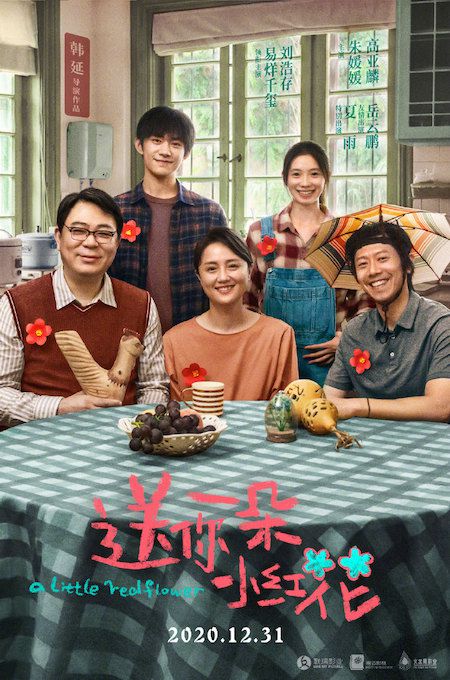
Promotional poster for A Little Red Flower (fair use)
But the romance between Wei and Ma is not the only central relationship in the movie. In contrast to Go Away Mr. Tumor, a comedy which centers on one individual’s fight against cancer, Red Flower puts the limelight on an entire family’s battle against cancer. Scenes of parents scrimping and saving money for their child’s medical treatment and relatives offering to help them raise money by selling their house are enough to move audiences to tears.
Despite the bleak subject matter, Red Flower refrains from creating an oppressive atmosphere of sadness and revealing the physical pain of cancer patients during the process of treatment. Instead, the film presents montages of the various cheerful make-believe adventures that Ma and Wei create in their minds in an attempt to live as “ordinary people.”
The movie does a good job of emotionally engaging viewers, but weak storytelling and plot holes mean it never truly hits home. The emphasis on family and adventure means Ma’s personality is never fleshed out, and little effort is put in to showing how he falls in love with Wei. Other than that they both have cancer, there is little to explain their romance, and their relationship isn’t always convincing as a result. Other holes are less fundamental (how do cancer patients walk out of a hospital unchallenged in the middle of treatment?), but still annoying.
Yi, who is a member of boyband TFboys and better known by his stage name Jackson Yee, performs impressively as Wei, transforming via his relationship with Ma from closed off and nervous, to more at peace with himself. “I always choose the corner table in a restaurant because I hate making contact with people. I’m afraid of being noticed. You want to know why? Because I am afraid that if I open myself to someone, I’ll die,” he says in one scene.
Red Flower is credited with continuing a small but growing trend by exploring a bleak and sensitive subject not often featured in Chinese cinema. In recent years, a handful of films with cancer as their theme have captured the hearts of audiences, including Go Away Mr. Tumor and Dying to Survive, a 2018 film based on the real-life story of a Chinese leukemia patient who smuggled cheap but unproven cancer medicine from India for 1,000 Chinese cancer sufferers. Behind them is a cultural shift around the taboo of death that once perhaps served as a barrier to directors’ attempts to produce truly realistic films.
Now, perhaps especially amid a global pandemic, people are more willing to talk about disease and death in an open and empathetic way. Ren Sainan, a young model who challenged traditional perceptions of the funeral industry by making and modeling burial clothes, a profession traditionally regarded with suspicion, recently went viral online for her efforts to help the dead leave with dignity and to comfort their living families.
Instead of something to be feared or ignored, Red Flower suggests that disease and death can be normalized as common states of life. Just as Wei’s mother Tao Hui tells him: “Everyone in life experiences loss, which we are all afraid of. Yet when it happens, the most powerful weapon we have against it is to live each moment to the fullest. Every second counts.”
Cover image from VCG
Related Articles