


The four baxia guarding the main arch of Gongchen Bridge (拱宸桥), statues of the sons of the formidable Dragon Emperor in Chinese mythology, look a bit nervous.
This is natural, considering these stone statues’ function is to stop ships from hitting the bridge while heading in and out of Hangzhou via the Grand Canal. For centuries, the baxia have seen the flow of trade pass to and from one of the greatest cities in ancient China.
The Grand Canal was once the heart of the global economy. Stretching nearly 1,800 kilometers from Beijing to Zhejiang province, the canal was arguably the main contributor to the integration of southern and northern China more than 1,400 years ago. Wherever it flowed, it brought prosperity and communication, with Hangzhou as its most vital nexus.
The Grand Canal, in fact, made Hangzhou. Before 605, Hangzhou was an obscure town with a population of 15,000. When the Grand Canal was completed in 610, Hangzhou burgeoned into a cosmopolitan metropolis. By the middle of the Tang dynasty (618 – 907) in the eighth century, Hangzhou already had over 30,000 shops, and the ships mooring in the canal stretched on for more than ten kilometers.
Departing from the Wulin Square Boat Terminal (武林门码头), the 30-minute Grand Canal boat trip to the Gongchen Bridge shows the ebb of history along this waterway. Modern glass towers line this stretch of the canal today, interspersed with small pagodas.
The first sections of the Grand Canal were dug in the fifth century BCE in northern China. Its southern terminus in Hangzhou, however, was not completed until a thousand years later during the Sui dynasty (581 – 618). Known for his cruelty, Emperor Yang of Sui forced millions of workers to complete 2,000 kilometers of the canal in just four years, with four workers in ten reportedly dying from the intense labor.
In the 1280s, Marco Polo visited the Grand Canal at Hangzhou: “There runs a very large canal, on the bank of which towards the squares are built great houses of stone,” the Venetian traveler remarked. “In each of the squares is held a market three days in the week, frequented by 40,000 or 50,000 persons, who bring thither for sale every possible necessity of life.”
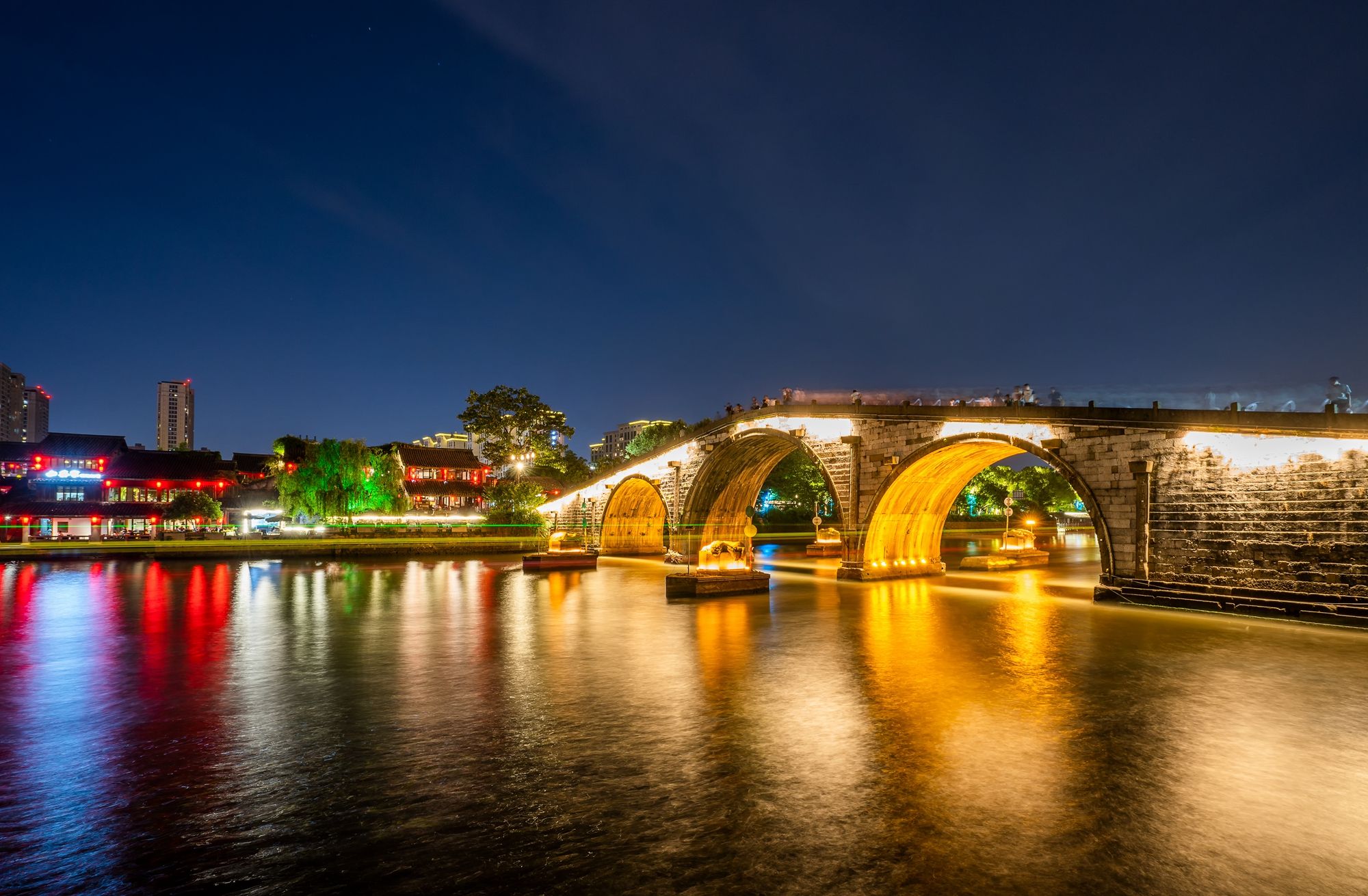
Gongchen Bridge (VCG)
The boat trip ends at Gongchen Bridge, the canal’s main ferry terminal during the 19th century, when rulers sought to modernize China. Architecture from that time still stands preserved in the whitewashed lanes of this neighborhood, where there are museums displaying cultural arts including fans, umbrellas, knives, and scissors in avant-garde installations.
As of 2014, the Grand Canal has become a UNESCO World Heritage Site, no surprise, considering how it shaped the Chinese nation. Even after more than a millennium of history, this canal still sees important shipping through Zhejiang, Jiangsu, and Shandong provinces.
For the perfect stroll along the Grand Canal, visit Xiaohe Straight Street (小河直街), a flourishing suburb during the Tang and Song (960 – 1279) dynasties that became a fully-fledged commercial hub in the 20th century.
Today, Xiaohe Straight Street hosts some of the last living “indigenous” dwellers of the neighborhood from the early 20th century, along with blacksmith shops and rice mills adorned with black Jiangnan tiles along the waterfront. Sitting in any of the cafes along these streets, the river’s flow is as hypnotic as its heritage is palpable.
Excerpt taken from Rolling with Zhejiang, TWOC’s new booklet on tourism and language in Zhejiang province available in English, French, German, Russian, Korean, and Japanese. Get your digital copy today from our WeChat Store or iTunes Store!

Related Articles



