With a thumbs-up from Wu Yufei, Lady Gaga’s “Abracadabra” blasts across the stage of America’s Got Talent, and the Sichuan dancer launches into an electrifying street dance routine. Behind him, eight silver Unitree humanoid robots follow the pounding beat in perfect harmony, mirroring every twist and pop of Wu’s body. After just over 30 seconds into the showcase, they pause before executing a flawlessly synchronized front flip. The crowd gasps. In under two minutes, the audience is in raptures, and the act has earned four enthusiastic yeses from the panel.
“I’ve never seen anything like this because usually those robots are very weird, but these ones have rhythm,” exclaims Sofía Vergara, one of the judges.
The Modern Family actress is clearly impressed, but this kind of performance is far less novel to the Chinese audience encountering it online. Unitree first wowed the country back in 2025 with their handkerchief-twirling humanoid robots at the Spring Festival Gala. By this year’s event, their routines had evolved to include martial arts demonstrations, the handkerchiefs replaced by nunchucks.

Dozens of humanoid robots performed alongside martial arts students from Henan’s Tagou Martial Arts School during the 2026 Spring Festival Gala (VCG)
These shows now seem ubiquitous in China, appearing everywhere from shopping malls and fashion shows to schools, fueling a lucrative robot rental market in the process. Robot marathons and soccer tournaments, too, have become annual events that draw crowds and media attention alike.
Read more about China’s tech industry:
- Exit Stage Left: China’s Robots Need a Job
- Overseas, Optimized: How AI Is Driving China’s Next E-commerce Push
- Smart Earth: How AI Is Rewriting Rural China
Yet amid all the excitement, the question remains as to whether the country’s humanoids will ever be more than expensive performers. If these machines can dance, flip, and wield objects, why aren’t they already taking on more practical tasks in homes, offices, and factories across the country?
Graceful attraction
Zhao Ruotong, a violinist and graduate student at Shanghai University, has spent more than a decade performing with orchestras. Yet at a school event this May, she had a different kind of co-performer. As Zhao and a fellow musician played a seven-minute duet, a Unitree robot, the same nunchuck-wielding model from the 2026 Spring Festival Gala, danced along to the music dressed in a silver T-shirt and shorts. “It could react to the rhythm and tonal changes in our performance in real time. That really came as quite a shock to me,” says Zhao.
While this is Zhao’s first time working alongside a robot, she doesn’t expect it to be the last. Unitree’s performance at the 2025 gala sparked an explosion in demand for robot shows from business owners, event planners, and tourist attractions, who all want mechanical entertainers to draw crowds, generate buzz, and impress clients. According to a May report by Yi Magazine, most of the more than 10,000 humanoid robots sold in 2025 by Unitree and AgiBot, two of China’s leading robotics companies, were used for cultural and entertainment performances.
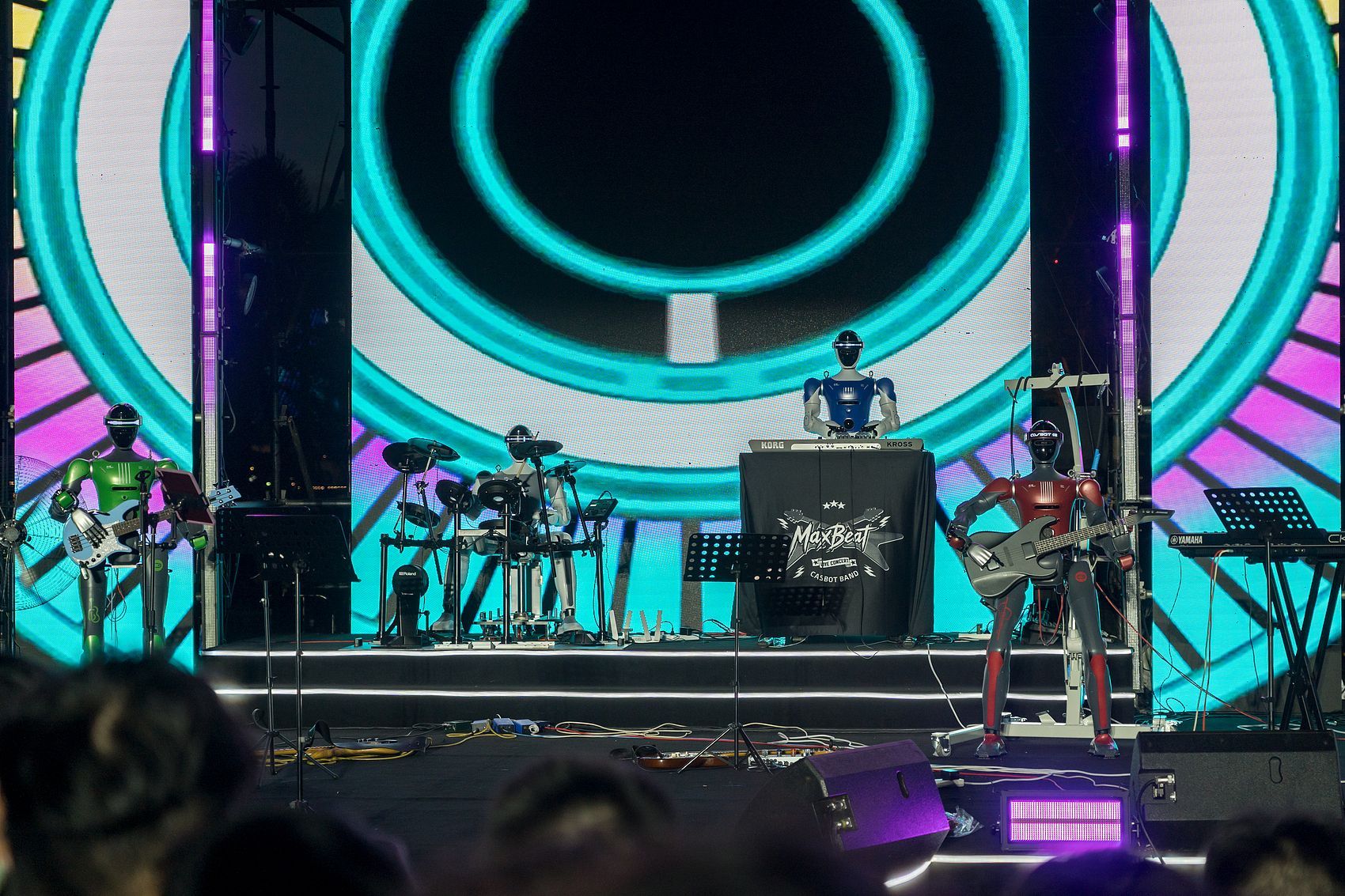
A robot band from the Chinese robotics company Casbot performed at an outdoor concert in Shenzhen during this year’s Dragon Boat Festival in June (VCG)
“[Performance robots] have become a main source of profit for robotics companies,” says Kairi, a robotics industry observer who runs the Xiaohongshu (RedNote) account “Embodied Kairi” and has collaborated closely with some of China’s leading robot companies for events like soccer games.
Most event organizers, however, choose to rent rather than purchase robots. “At the moment, robots are still relatively expensive,” explains Kairi. “In the short term, commercial leasing will be the common choice, because the general public doesn’t really have much need to purchase them.”
The Unitree G1, one of the most commonly used models for performances, retails for 99,000 yuan. At the peak of the robot show craze in early 2025, it could be leased for over 10,000 yuan per day, allowing owners to make a profit within a month. “The biggest money-makers were the exhibition operators who had stock in early 2025,” says Chen Yanxi, who works on project deployment at a robot financing and leasing company in Beijing. “Many of them have long since recouped their costs.”
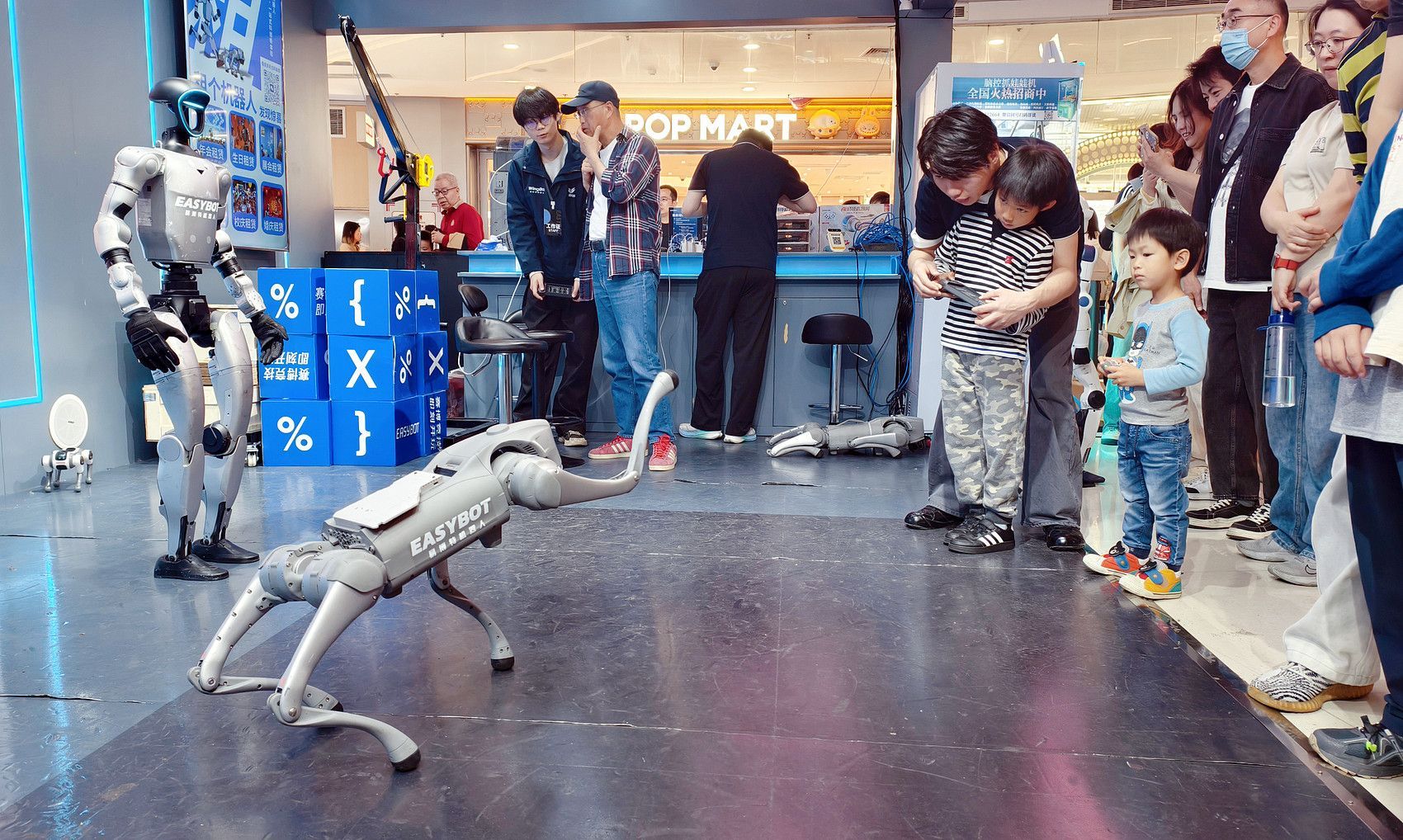
Rental businesses have set up shop in shopping malls, offering free demonstrations and attracting visitors of all ages (VCG)
Some robotics companies have even begun developing their own rental platforms, the most successful of which is AgiBot’s Botshare. The platform works with lenders to help finance robot purchases, partners with developers to add new functions, and recruits local operators to provide training, technical support, and job coordination. “It’s a win-win-win situation for all involved. I think overall the model has been a success,” says Kairi.
Chen believes that while demand for performances will continue, buying large numbers of robots and profiting solely from rentals is unrealistic in the long term, especially in major cities like Beijing and Shanghai. “Performance bookings are now extremely competitive, and prices have basically been driven down to around 2,000 to 3,000 yuan per day,” she says. “On our company’s app, you can rent a Unitree G1 for 1,800 yuan per day with shipping and an engineer included.” With a wave of second-hand units expected to hit the market by the second half of this year, prices are likely to be driven down even further.
Attention economy
Other kinds of robot performances, like marathons and soccer games, have proven less directly lucrative than their dancing counterparts. The Beijing E-Town Half-Marathon in April offered just 5,000 yuan for first place, but there is value in participating for companies beyond the prize money.
“The industry needs visibility. These events generate buzz, attract potential partners, and help familiarize the public with the technology,” explains Kairi. The same value proposition holds true for robot performances at galas and concerts. “Most robotics companies still rely heavily on investments; only a few have turned a profit just by selling products,” says Chen Yanxi.
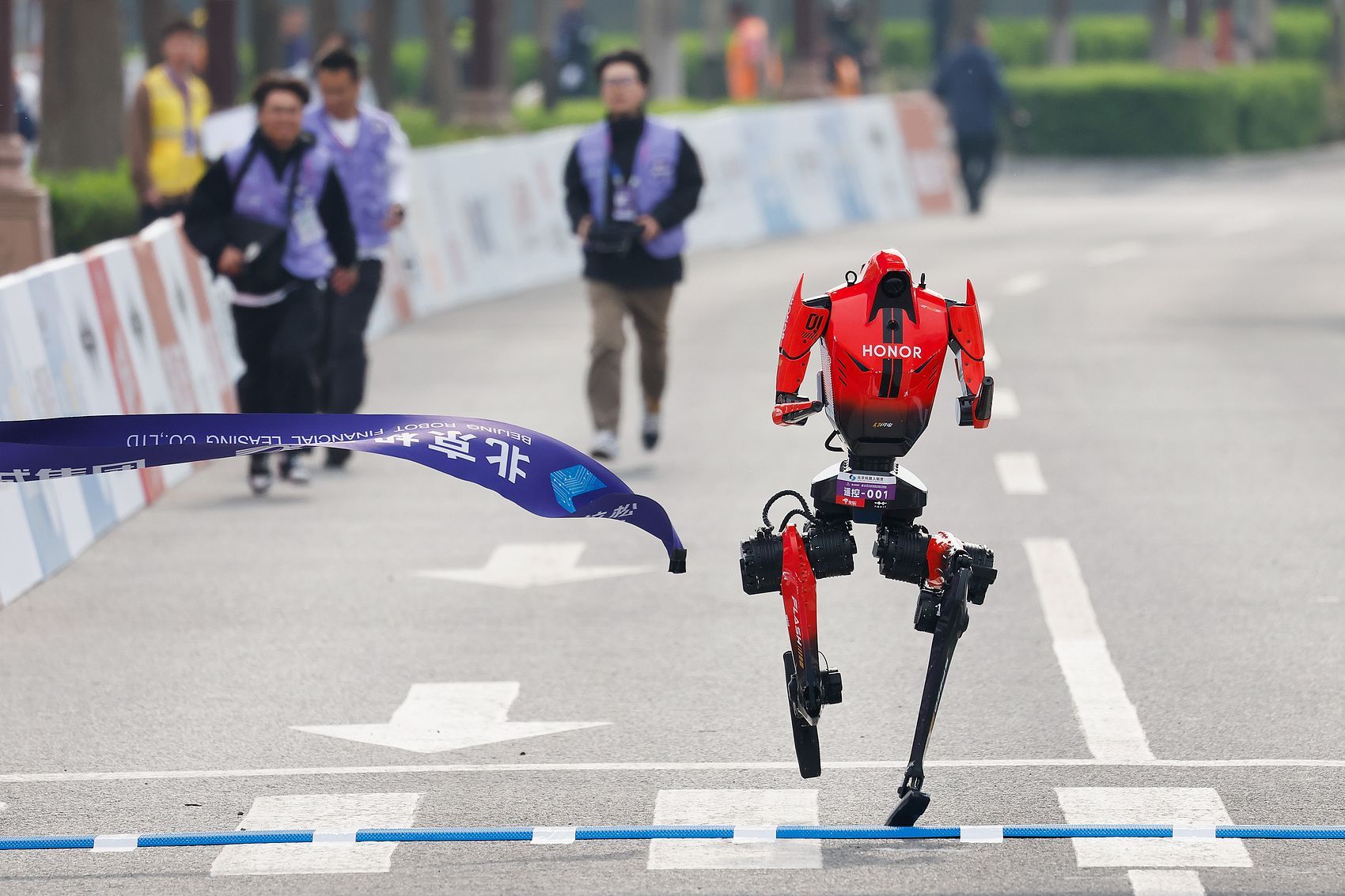
“Flash,” a humanoid robot from smartphone maker Honor, won the Beijing E-Town Half Marathon on April 19, finishing in 50 minutes and 26 seconds and surpassing the human world record set by Uganda’s Jacob Kiplimo (VCG)
Unitree recently sponsored The Pulse, a dance theater performance featuring AI-powered robots, at the 2026 Aranya Theater Festival in Qinhuangdao. The production brought together contemporary dancers and the company’s humanoids in an exhibition of how the two might coexist in an increasingly automated future.
“It’s not simply a display of the robot’s capabilities, but bringing together human performers and intelligent machines to share the stage,” says contemporary dancer and director of the production Chen Zihao.
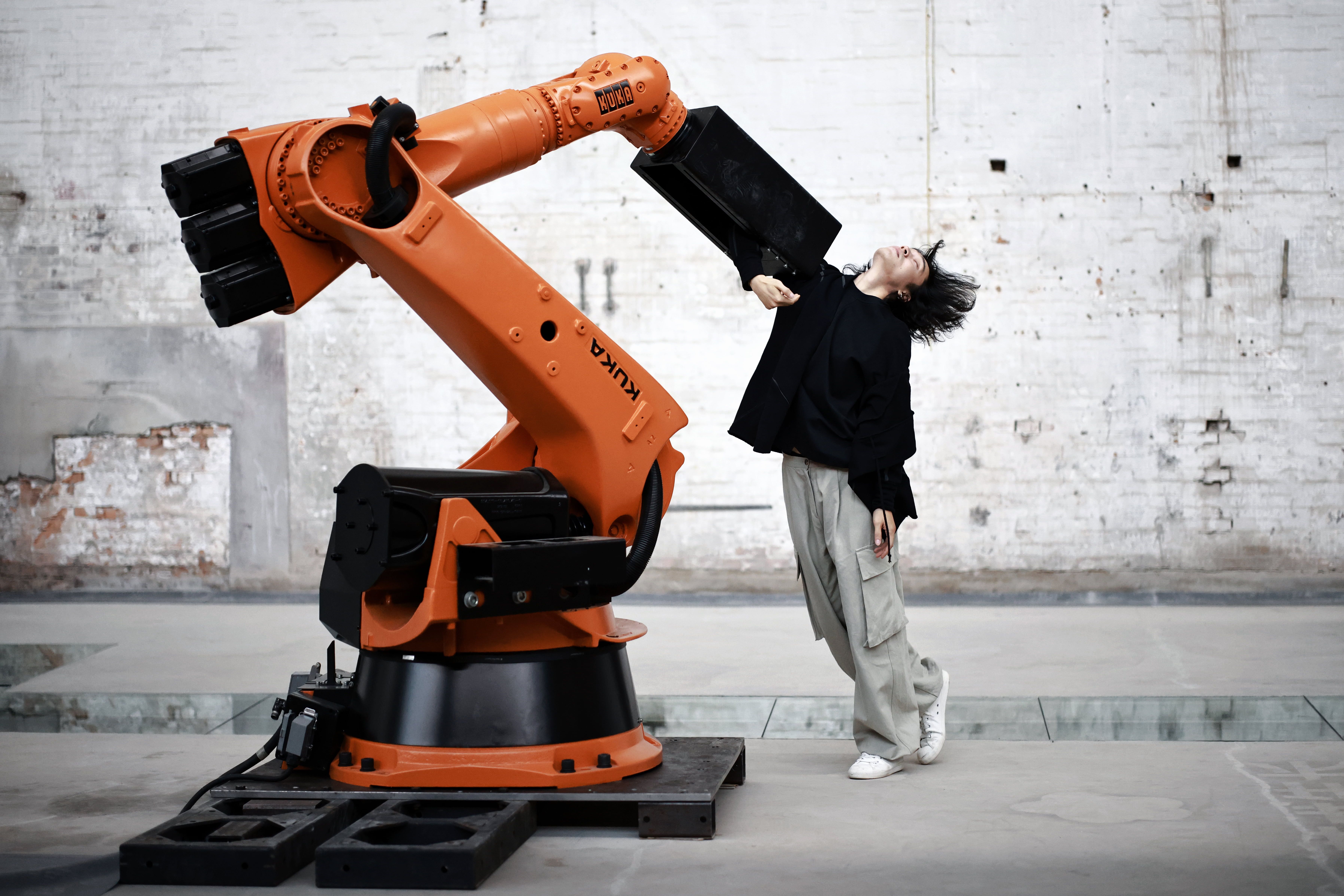
An earlier version of The Pulse premiered last December during Beijing Art and Technology Week, featuring robots from five leading Chinese robotics companies (courtesy of Chen Zihao)
One of the show’s most striking moments saw Chen, dressed in a flowing white lab coat, push a wheelchair-bound robot in a reversal of the “caregiver” roles many assume humanoids will one day fill. At other points in the performance, British dancer Amy Grubb walked a robot dog amid the audience, and folk dancer Liu Yanbei performed a fan dance beneath giant robotic arms wielding oversized calligraphy brushes as Inner Mongolian musician HalamJ filled the space with throat singing and the mournful sound of a traditional horsehead fiddle.
Working closely with robots on this project has given the choreographer a new understanding of our relationship with technology. “I realized that robots are not nearly as distant from us as people might think, nor are they as frightening as many imagine,” says Chen. “They’re a lot like young children who have just learned to walk.”
Stepping up
As posters, photos, and clips from The Pulse spread online, a familiar tension at the heart of today’s humanoid robot industry has resurfaced. Why, some commenters question, should robots be taught to dance when they could be washing dishes, caring for the elderly, or taking on hazardous work in factories and disaster zones?
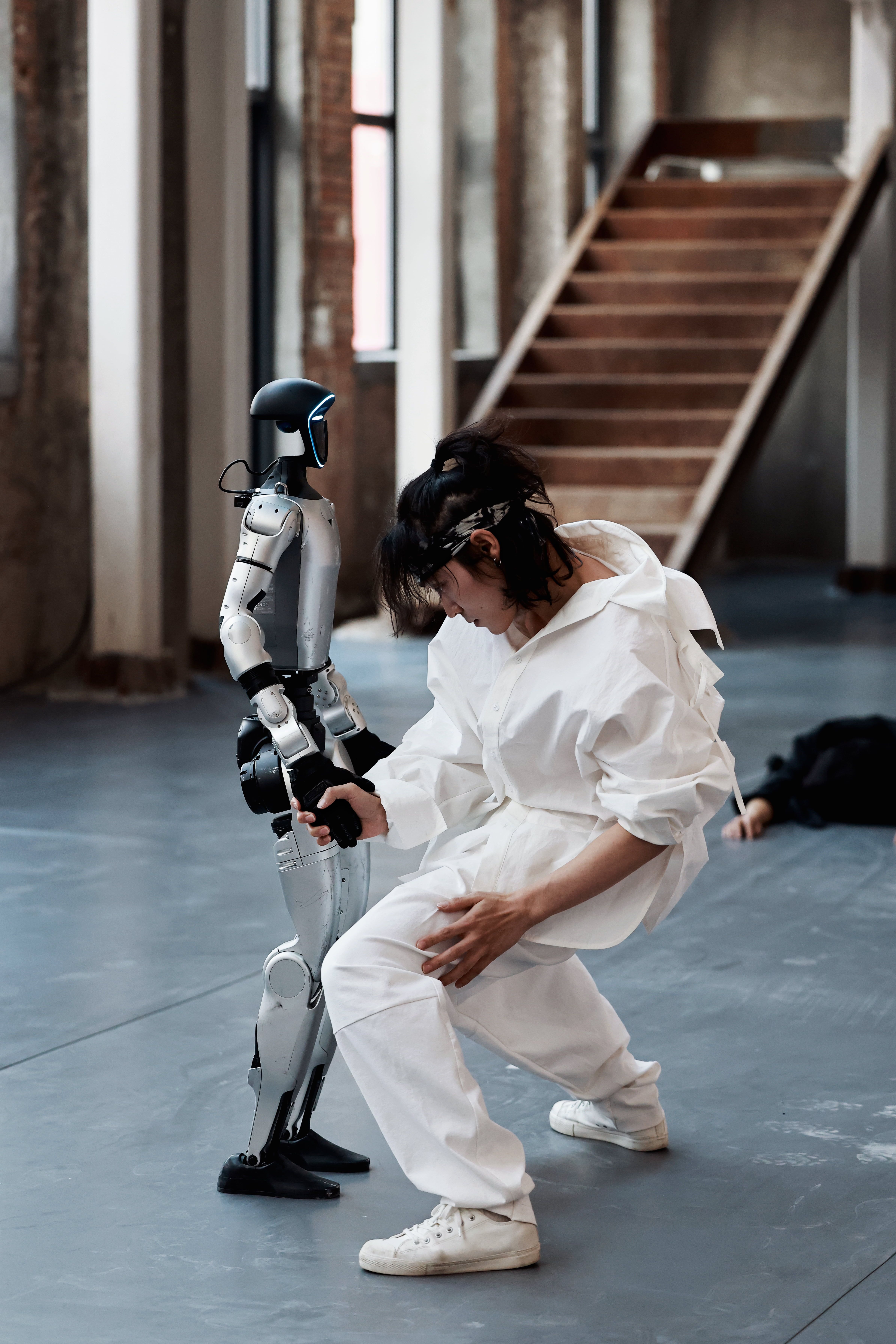
While the machines in The Pulse still follow preprogrammed routines, choreographer Chen Zihao believes it may be only a matter of years before robots can respond to their surroundings and dance in real time with minimal human intervention (courtesy of Chen Zihao)
For Chen Zihao, these aren’t competing paths; instead, performing robots are a step on the way toward broader and more useful capabilities. “Once robots achieve a high enough level of coordination, once they can move fluidly and execute a wide range of actions, they will be capable of performing all kinds of tasks in service of people,” he says.
Kairi, the industry observer, agrees. She explains that because the technology is still in its early stages, activities like dancing help generate the large amounts of data necessary for training. “With more data, robots can improve their learning and capabilities more quickly. Only then can they eventually take on the more complex physical tasks people expect of them, such as household chores,” she says.
Since domestic work involves navigating both complex physical environments and varied tasks, companies are starting with simpler settings and easier assignments, gradually improving the technology through iteration. “Ultimately, the industry’s vision is for robots to become a part of everyday home life,” Kairi adds.
Chen Yanxi, the robot deployment worker, echoes these ideas, explaining that robotics companies are not specifically building their products to be performers—public performances just happen to be one of the tasks robots excel at, and benefit from, at their current stage of development. Marathons train a robot’s mobility, battery life, and cooling capabilities, while soccer games test their ability to collaborate and coordinate with others. “The point of pushing robots’ physical capacity is to enable them to replace humans in real-world work environments,” Chen says.
Robots have already begun taking on jobs in places people rarely see, from wheeled robotic arms that package medicines overnight at pharmacies to mechanical dogs that inspect power lines and patrol remote or hazardous terrain. While humanoids are better suited to navigating complex home layouts, they still require much more data and training before they can safely become part of everyday life.
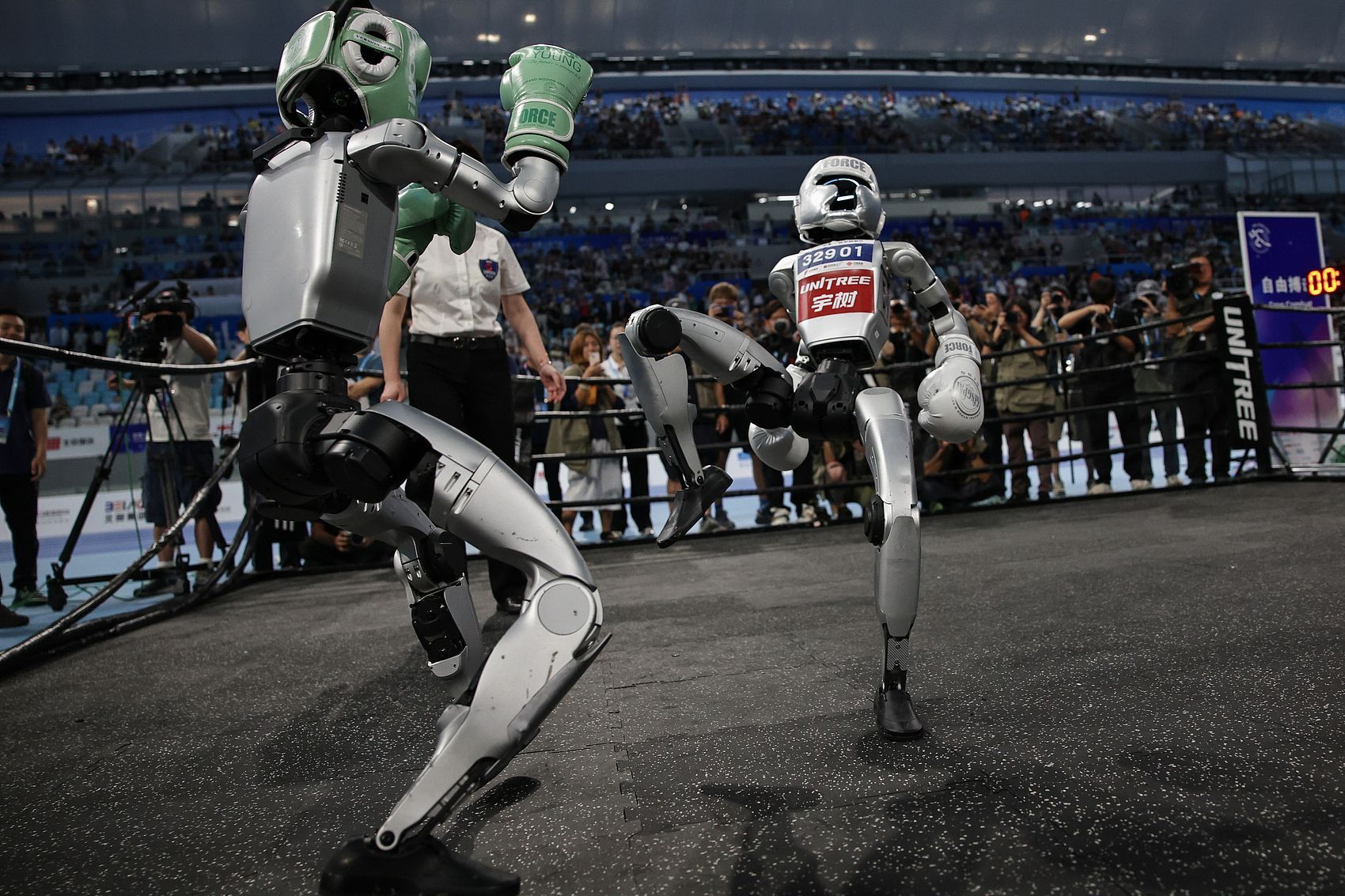
Beijing hosted the first World Humanoid Robot Games in 2025, with more than 500 humanoid robots in 26 events, including boxing, football, cleaning, and sorting medicines (VCG)
The government is also actively pushing for more robots to make this transition to the real world of work. On June 9, the Ministry of Industry and Information Technology launched a special initiative for humanoid robots and embodied AI in real-world settings, stating that by the end of the year, key embodied AI products such as humanoid robots will have completed the final tests necessary to start deployment in a number of real-world scenarios. The initiative also aims to develop over 100 high-value applications and enable large-scale deployment at the level of tens of thousands of units.
With the industry fast evolving, it’s hard to say what role robots will play in the future, but for now, dancing robots seem to have found a place in Chinese society. “Robots are, at their core, part of the service industry. Dancing robots provide emotional value for some people, and it makes them happy to see them perform tricks. There is enough value in that to justify their existence,” says Kairi.
As for the real dancers and musicians, Chen Zihao and Zhao Ruotong aren’t too worried about losing their roles to machines. “Every performance by a human dancer is unique. Their mood, physical condition, emotional state, and the audience’s response shape each show differently. The warmth, emotion, and sensitivity that can ‘breathe’ with the audience is irreplaceable,” says Chen.
Dance Dance Revolution: For Now, China’s Robots Shine Brightest on Stage is a story from our issue, “I, Humanoid.” To read the entire issue, become a subscriber and receive the full magazine.
Related Articles