It takes skill to hold an umbrella. At least, that is what I told myself as I awkwardly balanced one in the crook of my left arm, a camera in my right hand, and my jacket sleeve getting more soaked by the second. I was standing atop a city wall well over 1,600 years old, fiddling with camera dials to try and get an acceptable nighttime photo of the ancient pagodas in the distance. As the rain turned from a manageable drizzle into a drenching pelt, I considered that this might not be the place for such modern struggles. But it could be worse. At least there were no pirates.
I was in Linhai, a county-level city within the larger Zhejiang city of Taizhou, home to the Jiangnan Great Wall, one of the most complete surviving city walls south of the Yangtze River. The area within the walls is known as the Ancient City of Taizhou, a guzhen (古镇), or ancient town, in the parlance of Chinese tourism. At worst, these guzhen can be little more than theme parks for offloading locally flavored snacks and trinkets, but I had read that Linhai’s was an example of living preservation—an ancient city that still hums with the rhythm of daily life. I had taken the train down from Shanghai earlier that day to investigate, accompanied by a friend who had a similar interest in historical sites and the same skepticism toward manufactured experiences.
The history of Linhai stretches back to the Three Kingdoms period (220 – 280), but the mid-16th century is what locals celebrate most. This is when the military leader Qi Jiguang (戚继光) took control of the area’s defenses against pirate raiders and added a series of guard towers to the city wall. Qi was successful in the fight against pirates and was promoted to man China’s northern defenses, where raiders arrived on horseback from the steppe rather than aboard boats from the East China Sea.

A statue of Qi Jiguang in the Ancient City of Taizhou
Qi began upgrading the meager fortifications along the border between Shanhai Pass and Juyong Pass, north of Beijing, fortifications known today as the Great Wall of China. His strategy was to construct defense towers just like those at Linhai. By 1571, most of the 1,200 commissioned watchtowers had been built under Qi’s watch. Today they feature prominently at the Great Wall’s most famous tourist sites. The iconic photo backdrop for everyone from Richard Nixon to Kim Kardashian has its roots 900 miles to the south, defending a small Jiangnan city against pirates.
In Linhai, Qi is a hero, with a street named in his honor and a large statue placed prominently at the terminus of the city wall. For his opponents, however, there is less historical clarity. The name by which the raiders were known, wokou (倭寇), translates to “dwarf pirates,” long a derogatory name for the Japanese, but modern research shows that the majority of those who rose to regional prominence were actually Chinese by the late Ming dynasty (1368 – 1644).
Find more travel stories in China:
- Slow Ride: A Journey Through Time Aboard one of China’s “Moving Markets”
- Mount Putuo: The Many Faces of Guanyin’s Island
- Jianshui: One of China’s Last “Living” Ancient Cities
Today, with piracy thankfully a thing of the past, the wall defends Linhai against a different enemy: the bulldozers of modernity. In the 1990s, as many Chinese cities flattened old neighborhoods to make way for new construction, Linhai was setting up a framework to preserve and rehabilitate its walled city. At the heart of Linhai’s preservation work is Ziyang Street, a thousand-year-old commercial street running north from Xingshan Gate. We spent our first night strolling its length in the drizzle. The architecture is well preserved—or, more accurately, well remodeled—but it is here that Linhai feels most like a theme park, with a repeating cycle of stores selling local snacks, interspersed with national chains like Mixue Bingcheng. It is still a pleasant walk, highlighted by the internal stone gates, a fire-prevention technique dating back to the Ming dynasty.
As the rain began to pick up, we went to find a small restaurant off the main tourist street, drawn in by one of Taizhou’s signature dishes, ginger noodle soup. The dish is basic in its components: rice noodles and simple toppings, often seafood, bathed in a biting ginger broth. I asked the woman running the restaurant how she makes hers. “I take five jin of fresh ginger and cook out the moisture until it is reduced to two jin,” she explained. “Then I add water and simmer for 10 hours.” Ten hours was evidently enough—the soup kicked you in the back of your throat as you drank. “It’s good for getting rid of the cold,” she said, pointing to the rain now beating down outside and adding more broth to our bowls to delay our journey back into the damp.

The Linhai city wall winds up Beigu Mountain
The next day was still wet, so we spent the morning under our umbrellas poking around the backstreets of Linhai. Here, we began to get a sense of what preserving an ancient city meant on the ground. The lanes were narrow, built without consideration for cars. Many had walls draped with vines of pink bougainvillea and piles of orange peel drying in windows. Ornate stone gates guarding the entrance to Qing-era (1616 – 1911) courtyard houses were everywhere, and construction was constant, the unceasing work of maintaining centuries-old homes. Brick walls sagged like deflating balloons, and around one corner we encountered what used to be a bookstore under a caved-in roof. My friend, who grew up in the nearby city of Jinhua, said the lanes reminded her of the route she used to walk with her grandmother to school. Those lanes are now gone, replaced by broad streets and tall buildings.
On the menu for lunch was a signature of Taizhou cuisine: Xin Rong Ji, a restaurant—or perhaps more accurately, an empire—that has done more than any other to put Taizhou cuisine on the gastronomic map. What started as a Linhai basement eatery in 1995 now boasts multiple sub-brands and high-end establishments across China. Its Beijing branch was the first restaurant in the capital to be awarded three Michelin stars. At Xin Rong Ji’s flagship in Linhai, tables must be reserved far in advance, but diners have other options across the city.
We settled for Rong Cun, a country-style restaurant franchise under Xin Rong Ji. Located a short drive into the mountains outside the city, its low-slung bamboo chairs and chipped enamel bowls were reminiscent of 1960s factory canteens, but the food was fresh and the dining room bright. While the mountains make Linhai feel far from the ocean, Taizhou is a coastal city and seafood dominates the menu. We ordered cuttlefish sausage, razor clams, and yellow croaker. Outside, a pair of women washed laundry in the mountain stream. It was a rustic atmosphere that matched the timelessness of Linhai’s ancient city.
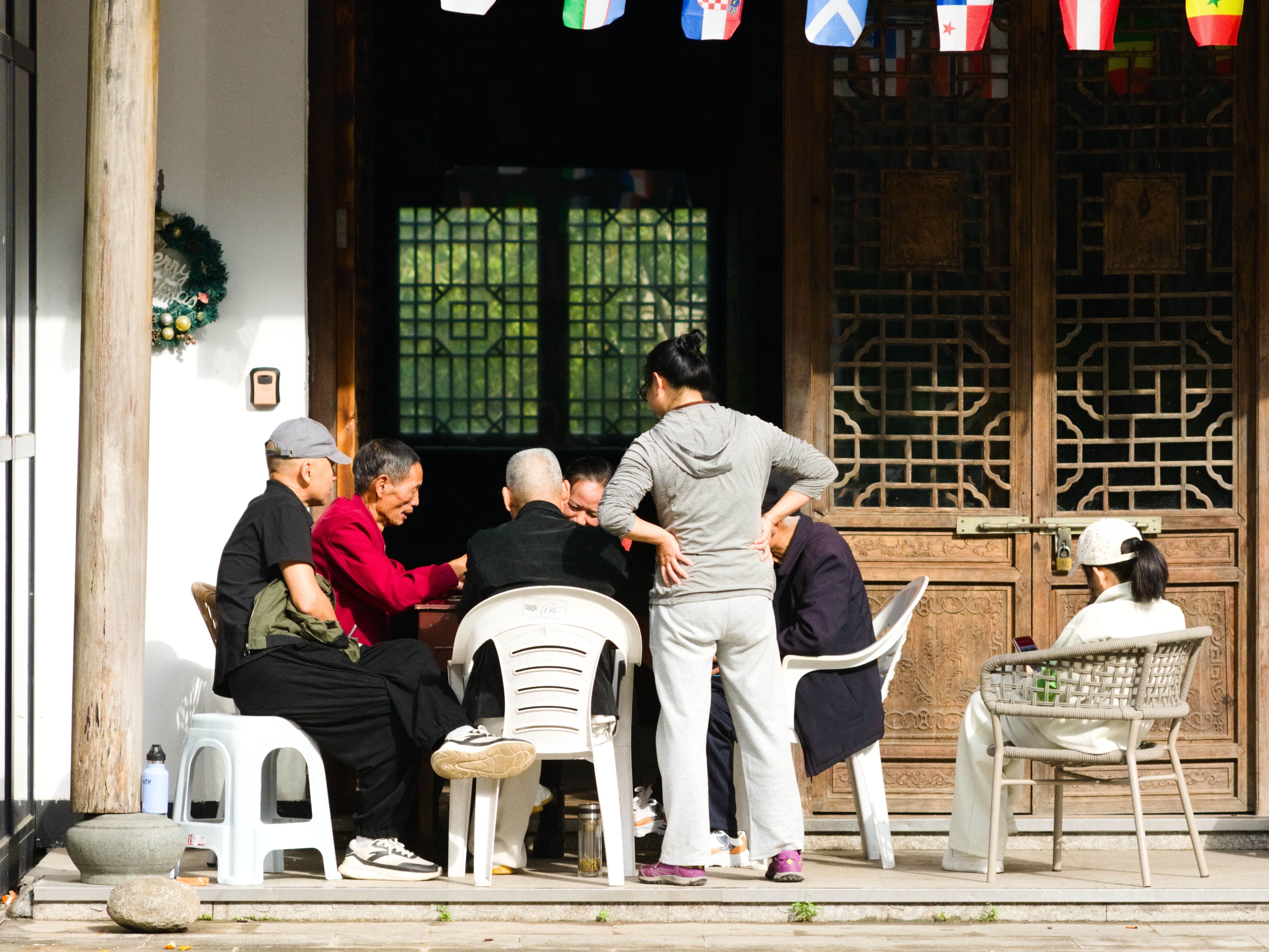
Linhai residents play cards on Tianning Road in the Ancient City of Taizhou
That evening, we ventured out of the city walls to get a feel for the rest of Linhai. Although Taizhou moved its administrative center from Linhai to Jiaojiang district in the 1990s, the area outside the ancient town is still a modern district with office towers, KFCs, and cell phone repair stores. Inside the ramparts, the graying facades and sagging walls reflect a certain historical dignity, but here it is just the everyday grime that has built up on China’s 90s architecture.
The next morning’s weather forecast promised that the sun would finally emerge that afternoon, so we decided to walk the city wall. It wraps around three-quarters of the ancient city, flat in its southern and western sections, and hilly in the north. The eastern section was demolished in the 1950s, and a large portion of what stands today was the result of a rebuilding campaign in the 90s. Nowadays, the wall is a ticketed tourist site, with replica cannons and headless suits of armor designed for photo opportunities scattered around. Walking its length allows for voyeuristic views down into the lanes and courtyards below. We spied a fruit orchard in the southwest corner and watched a young woman chasing after two geese on an exploratory waddle. At the eastern end, the wall terminates on a steep slope down to the East Lake.

An overview of Linhai
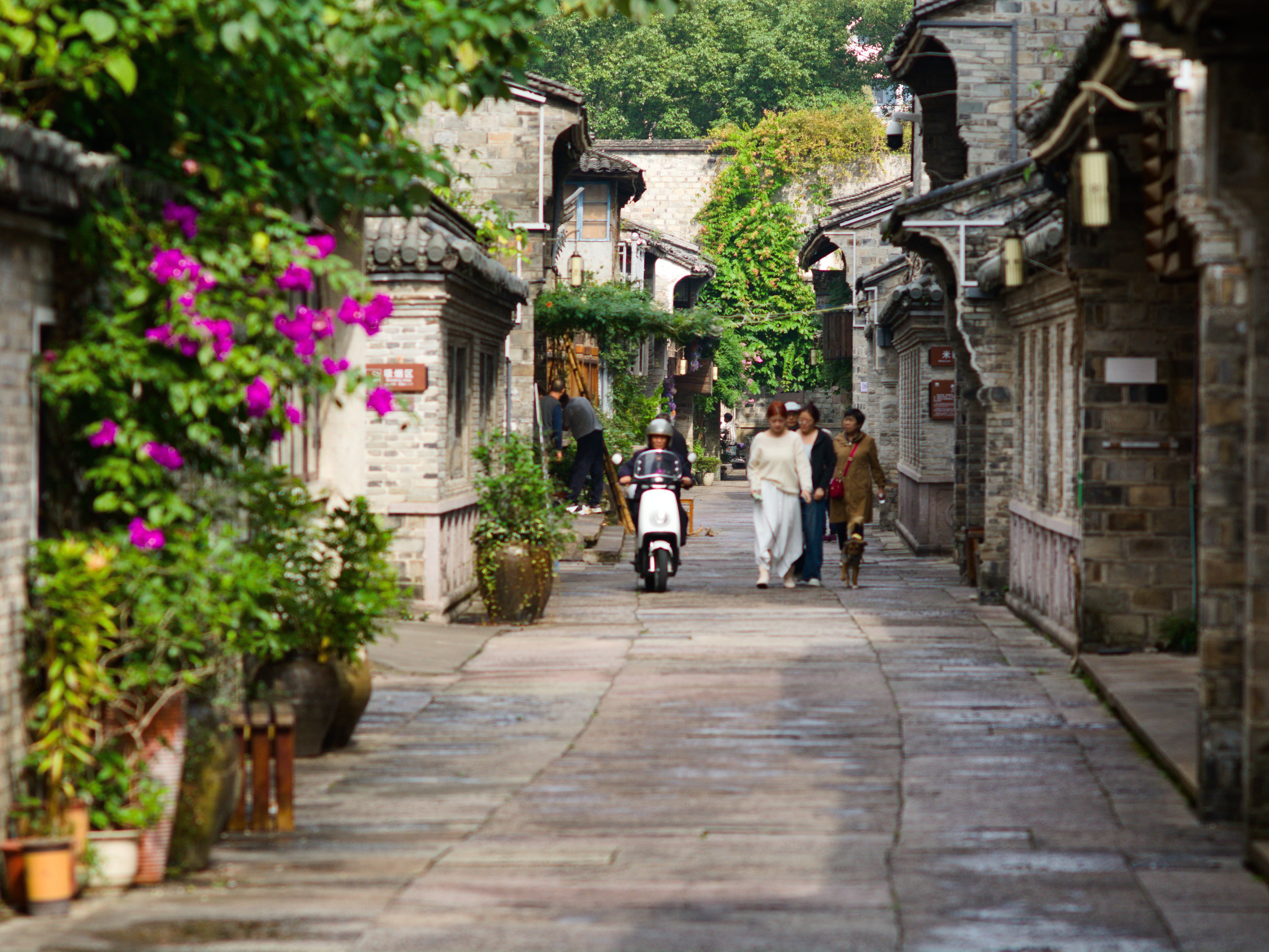
People walk along Ziyang Road in the Ancient City of Taizhou
I found myself far more interested in the compact residential districts of the ancient city than the wall itself. Wandering with a camera, I struck up conversations with the residents. It wasn’t strange to them that I would be interested in the history, and many were happy to chat. In one courtyard, three men stood outside a concrete house with flowerpots in the upper-story windows. I asked them when the houses were built. “These aren’t old,” they laughed, “they are just ordinary homes, less than 100 years old.” I asked them why certain houses were torn down, but others were not. “Those buildings were weijian (违建),” one of the men replied. Weijian refers to unauthorized construction—such as a balcony sticking out from a building facade like a disjointed knee, or a cowlick of an extra floor atop what should be a roof—and Linhai’s city officials don’t like it.
There were more questions I wanted to ask. Linhai has a large number of public bathrooms, convenient for tourists, but that fact made me suspicious of the indoor plumbing situation in the old houses. Cooking was another household amenity I started to question. On the first night, while strolling down narrow Hulong Street, a man on a motorized tricycle squeezed by, singing out to advertise the large propane tanks he was hauling around. This turned out to be a frequent sight. The walled city wasn’t just an ancient facade; at least some of these houses had yet to be connected to any municipal gas service.

A cart carrying gas tanks in the Ancient City of Taizhou
I also began noticing piles of wood stacked outside doors and numerous signs about fire safety. The occasional smell of smoke added to my suspicion that some houses might still be using wood-burning stoves for cooking. I wonder if the ancient city wall was more like a sarcophagus, preserving the squalor of a past age inside. Finally, in a courtyard full of laundry racks across from a small temple, I struck up the courage to pose these questions to a middle-aged man. “Of course we have toilets,” he said. “Actually, Linhai is quite convenient; it is easy to walk around.” The piles of wood, he informed me, were collected by residents to sell. I asked him if he was proud of Linhai’s old houses. “It is a tricky situation,” he said. “Repairing them is complicated, which makes it difficult to sell them.”
On our final afternoon, we stopped by a teahouse not far from our hotel, one of many ancient structures that have been given new life as modern businesses. Dozens of courtyard houses in the city have been converted into affordable minsu (民宿), or guesthouses. Other buildings are now luxury hotels, such as Fucheng Yin, an upscale boutique in a former printing factory where the cheapest room is over 2,000 yuan a night.
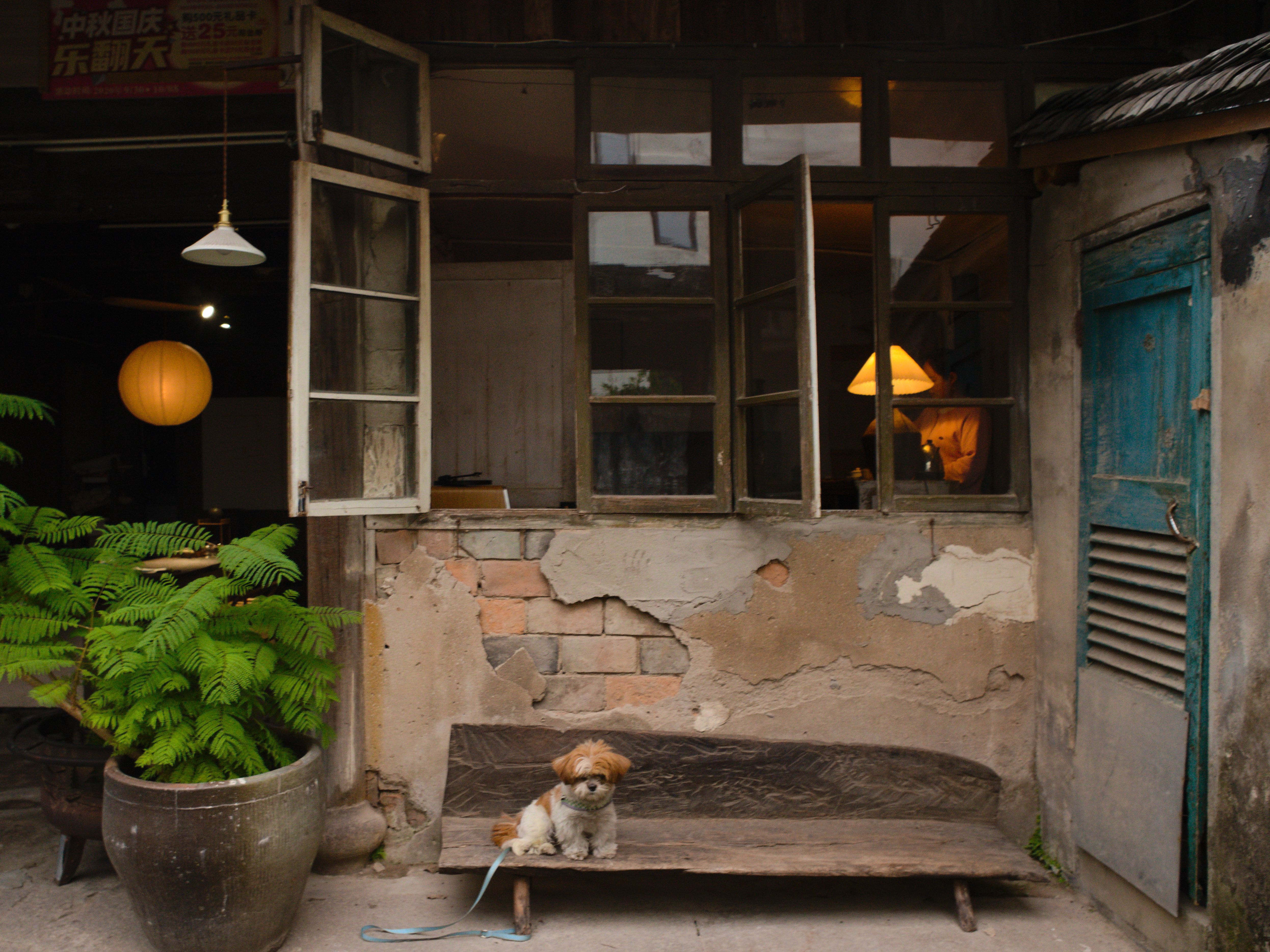
The local teahouse owner lives upstairs with her small dog, a rescue
The teahouse was a more modest affair and had been opened the previous year by Miss Yan, a student of Daoist divination who spent two years living on nearby Mount Tiantai. It was purposefully sparse. “I only wanted a few tables, so people have space to read.” We were sitting in the wooden-walled hall of the teahouse, its front gate open to the courtyard. On top of a stool in the corner was a stack of Daoist books. Even the tea selection had a Daoist theme, with varieties written on the bottom of sticks to be picked blindly out of a cup—a playful twist on qiuqian (求签) fortune telling. In the back was a room that Miss Yan hopes to turn into a salon to host events. She said the city has strict rules about renovating the space, but she doesn’t mind since she enjoys the old structure. “Life here is comfortable,” she said. As the rain dripped from the Qing-era eaves, a woman rode past outside, her bike loaded with a basket of oranges for sale. It was hard to disagree.
Photography by Evan Taylor
Related Articles