Di Renjie was a heroic figure in real life, but his fictional afterlife has been even more spectacular. He was one of the great judges and administrators of the Tang dynasty (618 – 907), known for his compassion, talent, and incorruptibility. He won credit for softening the rule of the oft-maligned Wu Zetian (武则天), China’s only ruling Empress.
Within a century of his death, Di Renjie (狄仁杰) was already being mythologized as a heroic detective and investigator, the subject of popular novels and stories. Today, that tradition continues in Chinese entertainment, from China Central Television’s splendidly cardboard-and-sequins period dramas to the blockbuster movies of Tsui Hark. This is, perhaps, the point to note that any battles between the real Di Renjie and sea monsters have gone unrecorded by history.
But, in the West, Di became famous because of the work of one man, Dutch writer and polymath Robert van Gulik, who went by 高罗佩 in Chinese. Van Gulik’s Judge Dee series introduced the character and the world of Tang dynasty China to a global audience for the first time. The books, first published in the 1950s, are still in print today.
Van Gulik didn’t expect to be a novelist. Raised in Indonesia to Dutch parents, he spoke nine languages, which he put to use as a diplomat for the Netherlands and as an amateur, but highly respected, sinologist. His work on Chinese sexuality and art was praised by the legendary Joseph Needham and incorporated into the latter’s epic Science and Civilization in China. While serving as a representative of the Dutch government-in-exile in Chongqing during the war, he married Shui Shifang (水世芳), the daughter of a Nationalist official, with whom he had four children.
The Dutch diplomat’s association with Dee began with a chance discovery in a Tokyo bookstore; the 18th century Chinese text Dee Goong An (《狄公案》), a collection of detective stories in the once-popular gong’an (公案, magistrate’s desk) genre, which centered around the investigation of murders and other crimes, by upright local judges.
Van Gulik translated the text, at first self-publishing it in Tokyo before the rights were bought by a Western publisher. Gong’an stories functioned much like Columbo; the murderer’s motivation and identity were given in detail at the start of the tale, and the audience’s pleasure derived from watching the magistrate follow the trail and unearth wrongdoing, not from the mystery itself.
Van Gulik removed this all-revealing introduction but otherwise made minor changes, and clearly relished the job, writing in his appendix that he hoped others would take inspiration and write more modern examples of the form. When no one took up this call, he tackled the job himself, writing in English to reach a wider audience. His energy was legendary; he wrote the books in two or three months, at the same time as acting as Dutch ambassador to Japan, practicing on the guqin (a traditional Chinese plucked string instrument), painting and drawing, writing his scholarly works, and taking his kids on still-remembered family outings.
The Dee of the books is more human, likeable, and self-doubting than the original version of the popular tale. Over the course of 17 books, van Gulik formed his own mythology around Dee, his legendary family sword Rain Dragon, his three wives, and his circle of friends and contacts. The books combine elements of Tang dynasty practices, when the books are set, with Ming dynasty (1368 – 1644) ones, when most of the detective stories about Dee were written. Unlike the original gong’an stories, as likely to deal with specters as sociopaths, the Dee books have only occasional hints of the supernatural. They also drop the original’s reliance on torture, seen as a confident route to the truth by the Chinese justice system; Dee, instead, induces confessions through deduction, trickery, or stagecraft.
Dee’s assistants, the buff brawler Ma Joong, angsty ex-soldier Chiao Tai, and cunning former con-artist Tao Gan, all add to the charm of the stories. Ma Joong’s adventures deal with the martial underworld of easy (but loyal) women, Chiao Tai falls for a series of doomed femme fatales, and Tao Gan grifts his way through danger.
Although they were written rapidly, one of the pleasures of the Dee books is seeing van Gulik’s writing mature. The early books all follow the same format: Dee and his assistants arrive at a new post, and a series of tangled cases, one usually an intimate family matter and one a wider plot against the government, presents itself. Worked into the plot is a delightful gallimaufry of Chinese culture, based on whatever interest van Gulik had picked up of late, southern boat people, puppets, cricket fights, Mongolian female wrestling, beggar’s guilds, Arab traders…
According to Marie-Anne Souloumiac, van Gulik’s granddaughter, he “saw Dee as being a kind of ideal man. And he modeled him after himself, though he also modeled himself after Dee.” But Dee’s friend Magistrate Lo, a cheerful lover of women, drink, and poetry, seems to have a dash of van Gulik’s energy and enthusiasm, as well as being a closer physical model than the lean, solemn Dee. If, like the present writer, you discovered the books as a 10-year-old, van Gulik’s cheerful pictures of naked women are an additional bonus. In a nod to Chinese moral values of the period, though, he never drew their feet.
And in the later books, the focus becomes smaller and the cases more morally ambivalent, with the plot often featuring either just Dee himself, or the judge and a single assistant. Dee, a loyal Confucian servant of the empire, increasingly finds himself questioning the social order, whether in the treatment of women or the suffering of the poor.
Buddhist monks often get a harsh run in the books, usually portrayed as corrupt, venal, or lecherous. This was a deliberate choice by van Gulik, echoing the suspicion toward them that was common in Dee’s day, especially before the great purge of the monasteries in the ninth century. But Daoists are much more ambivalently portrayed; while Dee instinctively distrusts their ideas, he recognizes their insights.
Van Gulik died of cancer at just 57. But his delight in Chinese culture and his hopes that his books could introduce the world he loved to a wider audience live on. Not only are the novels still in print, but the Robert van Gulik NOW! Committee, founded by his granddaughter, is working on projects to introduce his works, popular and scholarly, to a new generation.
Judge Dee Reading Guide
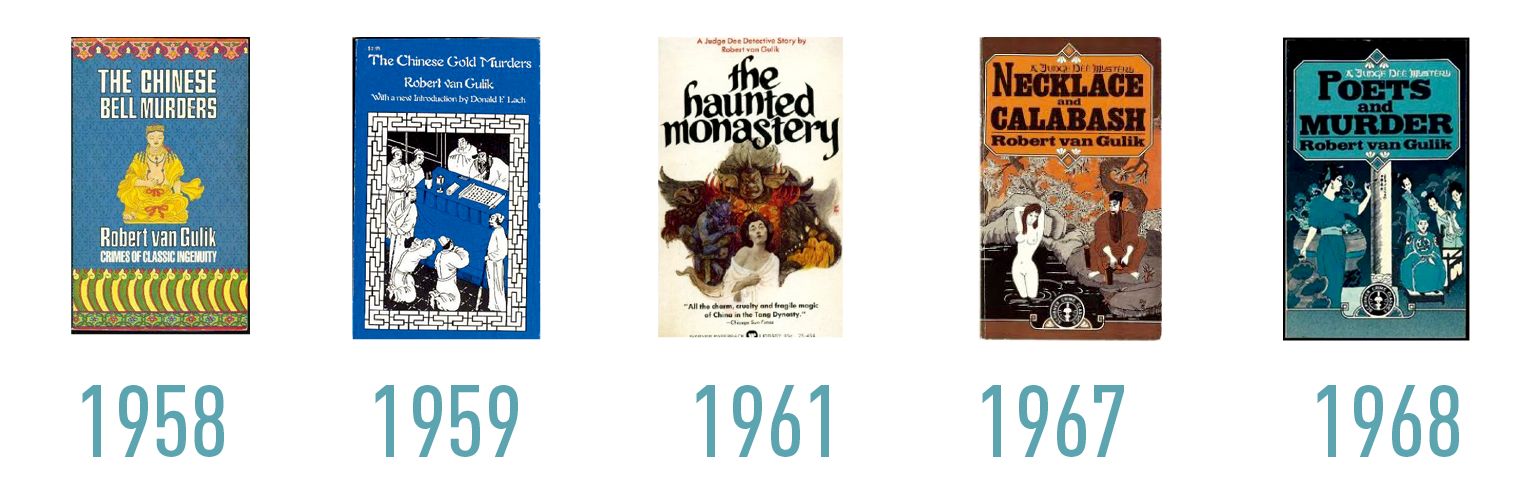
If desired, the Judge Dee series could be read either in chronological order starting with The Chinese Gold Murders, or publication order, starting with The Chinese Bell Murders. But the series loses nothing from skipping around, and van Gulik’s later books are better written and more tightly composed. The Haunted Monastery features Dee at his best, coping with scheming monks, family worries, actors, and a bear. Poets and Murder, based on the real case of poet and accused murderer Yu Xuanji (鱼玄机) brings out van Gulik’s love of art and literature. Necklace and Calabash may be the most psychologically subtle of the stories, as Dee is forced to confront a possible rot at the very heart of the imperial system he protects.
Related Articles