

When you think of “culture shock” you generally think about foreign countries, but the stark differences between the north and south of China can cause just as much discombobulation to locals unaccustomed to the bizarre habits of their fellow countrymen. Whether it’s bathing, central heating or even the minimum amount of food you can get in certain stores, rude awakenings abound.
Taking baths together?
How close are you to your best friend? Would you bathe with them?
Northerners are much more likely to frequent public baths than their southern counterparts, and the bathing culture is markedly different. Northern bathhouses have more of a communal layout, with less privacy.
Even in the bathrooms in dormitories of students or workers, northerners are more likely to have a large shared bathroom, while southerners would expect that each dorm room gets their own. Schools and companies would have individual shower cubicles in the south, while in the north, there may be no partitions, or possibly partitions that only cover a limited field of view.
“What a sight! Students are queuing naked with a full view of those naked bodies in the bath,” Gao, a senior postgraduate student in Beijing, has written online.
Southerners usually take a bath every day in summer, or every one or two days in other seasons. However, some northerners bath once a week, even during summer, and don’t see the need for more frequent bathing. But keep in mind, this is a generalization, and a holdover from earlier decades when people often couldn’t afford a shower at home. As more people have their own shower, they have become more common.
But with many northerners—particularly migrants—living in dorm situations, it’s not uncommon to find people who shower on a weekly basis.
Where is colder, the south or north?
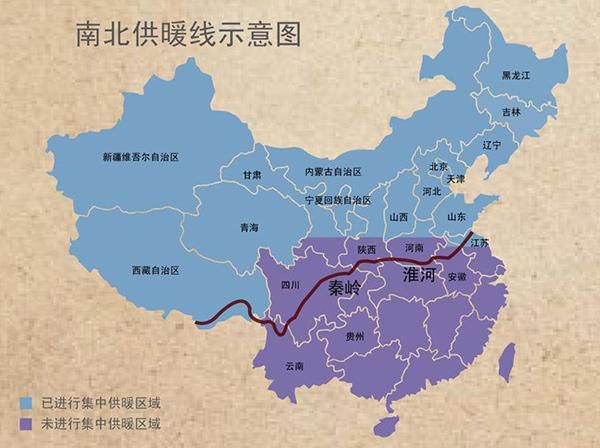
The red line separates the southern and northern parts of China; areas in blue are equipped with central heating, and purple ones are not (China News)
Several days ago, the CGTN Weibo account warned people in northern China of heating-related illnesses. Central heating will be provided from this month to next March in northern China, and as every year, southerners vented that they are not able to get free heating.
Here are some of the most liked comments:

Kids in the south would never have such an illness…because we don’t have central heating [crying face].

It is one of the greatest rumors in the century that it is not cold in the south.

This notice definitely rubs salt into the wound of southerners.

You doze cozily in the northern haze, while I shiver in the southern sun.
Many southerners feel left out, because the south still gets pretty cold yet they aren’t able to access the free central heating. There are various reasons for this, Zhihu provides many practical explanations, such as urban planning, economic concerns, the adverse climate conditions for pipelines in the south and many others.
The debate tends to then focus on how much colder the north is, and technically that is true. Generally, winter is colder in the north: 10-30 degrees [Celsius] lower than it is in the south. But it’s also drier, and humidity can make low temperatures feel much colder. Central heating is regulated to keep the indoor temperature at or above 18 degrees for northerners. In the south, the heavy humidity makes winter unbearable everywhere, and even colder indoors than outdoors.
A common joke perfectly describes the situation: In winter, southerners would say “let’s go outside to get warmer”, while northerners say “I’d go outside to get some cool air”.
Buying food for a meal, or a year?
In small corner markets, one can easily distinguish a southerner from a northerner by how much food they buy.
In the south, people can buy one unit or a portion of vegetable like one tomato, one carrot, a small part of winter melon, and a few hundred grams of pork or fish and have them shredded or sliced at the market, regardless of the quantities involved. But if they do the same in the north, they may get “no sale”, contempt or even worse feedback from a hot-tempered northern vendor, (or if they’re lucky, a small amount for free). Northerners usually buy at least a few kilograms of food material at one time. This is particularly the case in winter.
In this September, the story of Weibo user @朋友圈那些事 going to the market with a northern friend vividly depicted the difference (the post can no longer be found on the user’s Weibo, but it has been forwarded by many media and other users).
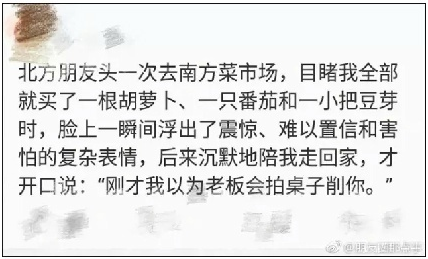
“The first time my northern friend went to a southern market, after witnessing me buy one carrot, one tomato, and a handful bean sprouts, accompanied me home in silently and in disbelief, before finally sying, ‘I thought the seller would slap the table and start swearing at you.’” (@人民日报海外版-海外网)
Cover image from Yueyang News
Related Articles