
By the time Yin Haikuan, party secretary of Nanzhangjing village, confirmed that 300 garden snakes had been released in the mountains above his picturesque Hebei community on October 18, 2019, it was already too late for forestry officials to round up more than a few dozen.
“A car with non-local license plate was seen driving into the mountain on October 17…[the snakes] could be anywhere by now,” Yin told the Beijing News resignedly, mentioning that some villagers had spotted the reptiles in their homes.
Yet judging from past events, Nanzhangjing got off easy. Last June, a resident of a village in Hubei’s Shennongjia forest died after being bitten by a venomous snake set free by two men, who had made a habit of releasing deadly reptiles in forests and mountains around China. A similar incident that month in Zhanjiang, Guangdong province, ended badly for the snakes: Hundreds were killed by frightened villagers, who found them in their fields, wells, and even living rooms.
The PRC’s Wildlife Protection Law requires any group or individual releasing animals to “choose a suitable natural environment for the species and avoid endangering locals and the ecosystem.”
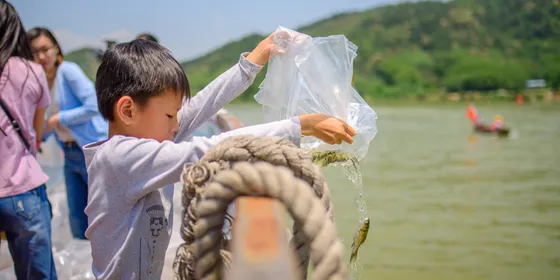
However, according to a 2015 estimate in The Economist, as many as 200 million animals are “freed” in China each year, often into unsuitable environments and without permission from local authorities. A lack of wildlife education is to blame, along with a Buddhist tradition of accruing karma through releasing captive animals, known as fangsheng (放生), or compassionate release.
The tradition dates back to at least the sixth century, when Buddhist monks would lead worshipers in releasing fish and turtles into temple ponds. Suppressed during the early decades of the PRC, fangsheng has seen a large scale revival.
According to China.com, May and June are a peak period for fangsheng, ahead of the nation’s college entrance exams. The belief that the more dangerous the animal, the greater the karma, is likely behind the more exotic recent releases, such as that of a baby crocodile discovered in Beijing’s Changping district last August, or a piranha that bit a man in a river in Liuzhou, Guangxi Autonomous Region, in 2012.
Even seemingly innocuous releases have unintended consequences: In 2016, park staff reported scooping 50 to 100 kilograms of dead fish per day out of Jinan’s Daming Lake due to fangsheng groups releasing species unsuited to the water environment there.
Fangsheng has also encouraged illegal wildlife trafficking. According to a NetEase report last November, protected species such as sea turtles and cobras were being sold, explicitly labeled for fangsheng, on e-commerce websites and WeChat groups for 3,500 RMB or more each. In 2013, the Legal Daily found that fox farms were continuing to thrive despite a downturn in the fur market by supplying fangsheng customers.
Several regions have vowed to regulate the practice, including Jiangxi province, which has stipulated fines of up to 50,000 RMB for introducing species not native to the release area.
However, a Tianjin fangsheng group seems to have already discovered a better solution, or at least one that lets them have their compassionate cake and eat it too—“releasing” bottled water into the ocean. “There are tens of thousands of micro-organisms in water,” its organizers advertised on Baidu in 2018. “This is a huge amount of merit.”
Costly Karma is a story from our issue, “Alpine Ambitions.” To read the entire issue, become a subscriber and receive the full magazine.
Related Articles