Decked in a radiant, limited-edition crow-feather coat, swishing pleasingly as you switch to camera mode for a quick selfie, you approach a crouched figure. After observing them for a moment, you deduce that they’re not in prayer but in wait, seemingly wanting to glean martial arts knowledge from a leaping frog. Having seen enough, you double-dash into the air, twisting 360 degrees to land on a temple roof. A twinkling catches your eye—a message left by another player—simply asking you to respond with “BOOYEAH!!” You chuckle, leave a comment, then toggle from your twin blades to your umbrella, launching yourself from the tiled roof with a flourish.
This is one of the near-infinite scenarios that might play out in Where Winds Meet, a massive open-world, single or co-op wuxia action role-playing game (ARPG) from NetEase’s Everstone Studio. Set during the transition from the Five Dynasties period (907 – 960), a time of turbulence following the Tang dynasty’s downfall, leading up to the reunification under the Song dynasty, the game depicts a time of general prosperity in southern China, marked by advances in landscape painting, poetry, and key technologies like printmaking and gunpowder. As an orphan mentored and raised by a mysterious uncle and aunt on stories of heroic warriors, you’re slowly drawn into a mix of intergenerational feuds, warring sects, and dynastic intrigue. Recovering a stolen jade pendant becomes your personal quest, set against a larger world grappling with the mundanity of day-to-day survival.
The game’s domestic version officially launched in January 2025, and quickly amassed 30 million players in just two months. Its international release in November 2025 has also proven a megahit by both critical and player metrics, reaching 15 million players across platforms and garnering an 88 percent positive player score on Steam. In terms of gameplay, Where Winds Meet is a unique hybrid of genres tuned for wide appeal, a philosophy that contrasts with 2024’s Black Myth: Wukong—its closest point of comparison in terms of delivering a huge, stunning world based on Chinese wuxia myth, or jianghu, as well as worldwide success.
Read more about gaming in China:
- Monkeying Around: Chinese Gamers on the ‘Black Myth’ Phenomenon
- Grinding for Gold: Inside China’s Game Boosting Economy
- Creativity Meets Constraint: China’s Video Games Head to Overseas Markets
But unlike Wukong, Where Winds Meet is entirely free to play, relying on optional paid in-game cosmetic items, like skins, poses, and animations. While free-to-play games are easier to attract players because there’s no upfront cost, this model has been accused of promoting predatory “pay-to-win” tactics or prioritizing addictive gameplay over quality to boost long-term revenue. Where Winds Meet avoids these pitfalls by limiting purchases to cosmetic items rather than power-boosting advantages. And rather than a mostly empty world filled with punishing battles—Wukong’s overarching dynamic—Where Winds Meet prizes exploration, character interaction, and setting challenges suitable for players’ skillset. Players also won’t need an expensive PC or console to play it, as it runs as smoothly even on mobile.
Although its core player base is primarily on PC, Where Winds Meet’s mobile version, released globally on December 25, 2025, has also consistently ranked near the top of the App Store’s free games chart (NetEase Games)
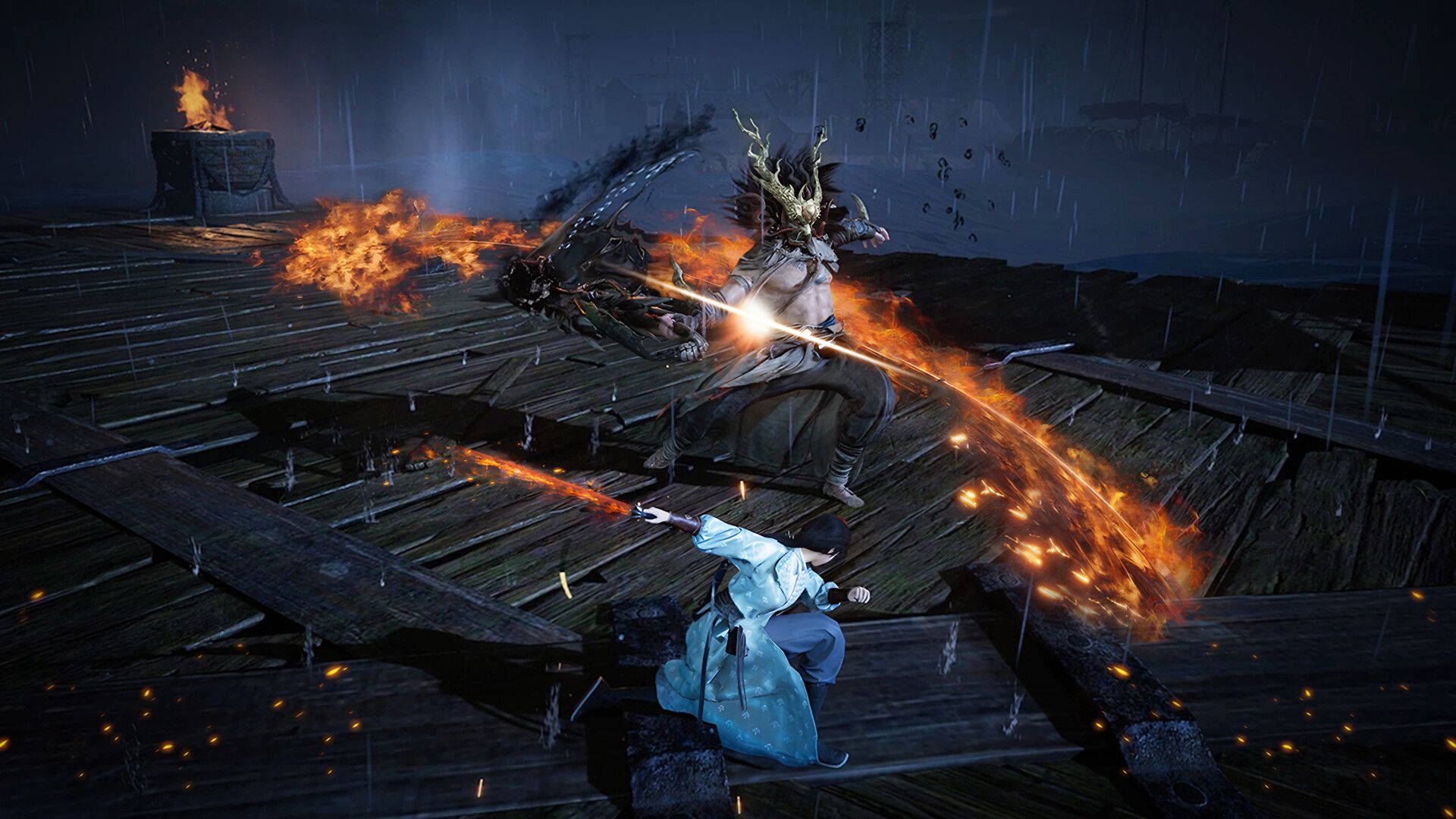
Despite this, the game still feels like a AAA (a term designated for video games with high-budget, high-production value, and high-profile), offering a premium experience—arguably its greatest coup. This ambition colors everything. Visually, it looks fantastic, with fluid character movement and lush environments: players can easily get lost watching the wind rustle through bamboo, taking in the majestic gradients of sunsets over tranquil ponds, or examining true-to-life recreations of classical handscrolls. Its expansive gameplay brings to mind many of the top games from the past decade, encouraging players to set out for distant peaks like in Zelda, dash across ancient rooftops à la Assassin’s Creed, form a World of Warcraft-style guild and engage in timed events, or hone your reflexes like in Elden Ring. Players can also build a house, go fishing, practice archery, play cards, go on a date, dance, and much more.
But while the game is undoubtedly beautiful, provides potentially hundreds of hours of gameplay, and is memorably wacky—goose memes (seriously, don’t antagonize the geese) and a grizzled, puzzle-hungry cat first come to mind—how does Where Winds Meet actually stack up? Despite garnering a significant fanbase for its commitment to maximalism, it has received a much more muted reception among professional reviewers, including a now-infamous 6/10 rating from IGN due to uneven localization and its kitchen-sink approach that tries to do too much at once. Players have reported clunky in-game dialogue and voice acting of wildly varying quality. While this is still somewhat the case, much of the dialogue has since been refined, with names and features updated as well.
Where Winds Meet is indeed scrappy and less focused than most single-player experiences. The sheer volume of game mechanics can be overwhelming, but they can largely be ignored in favor of focusing on the main story. You never truly have to be lost, unless you want to be.

The Where Winds Meet booth at Hangzhou’s CP32 Pre Fan Art Exhibition (VCG)
Some of its more experimental aspects, such as AI-powered NPC dialogue, have received mixed reactions. While open-ended, AI-driven conversations offer immersive potential, this early implementation makes it too easy to game the system and disrupt the game’s world-building when things go off-script.
In all, Where Winds Meet is a wondrous mess of ideas and lofty ideals, as ragtag and lovable as the jianghu wanderers it portrays. It feels like a living thing, always growing and changing, never finished. Being free makes it worth checking out for casual players alone, if only to behold the splendor of ancient China at its peak. However, those looking to get lost will also find plenty of chaos to delve into—it’s these players who’ll converge around a love for the game, wherever their winds meet.
Related Articles