




“The arm was merely a piece of metal, but, having spent so much time with it, Song Zhen felt as if she had formed some mysterious connection with it.”
I
Song Zhen awoke. Another day of the same. It was too quiet, she thought. Since moving to the uninhabited patch of land two years prior, she had never slept well. But, still, she had managed to give up on her sleeping pills.
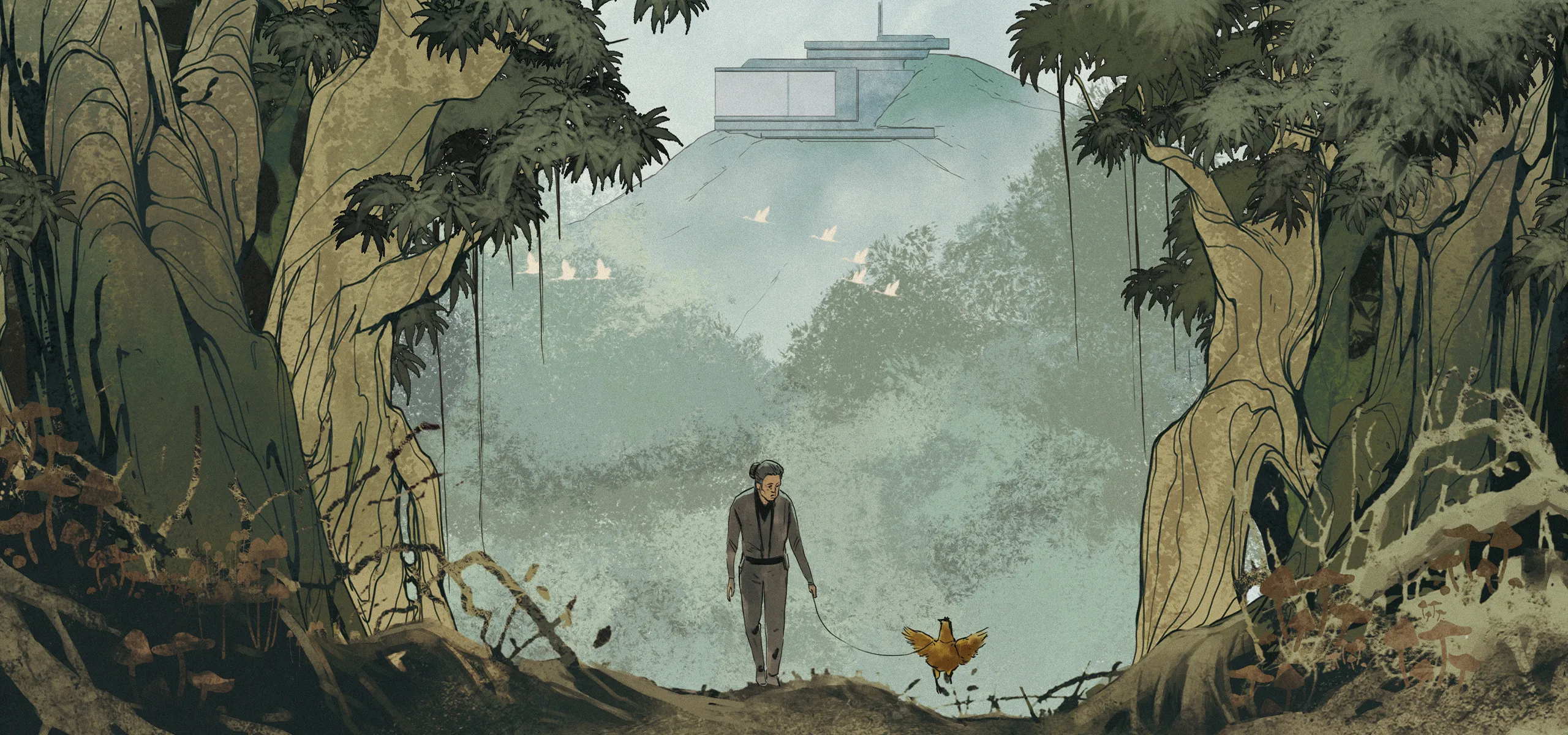
Song Zhen walked out of the wooden house and onto the broad terrace. The terrace was enclosed on all sides by immense glass walls. Through the glass, she could watch the stretch of virgin forest. Song Zhen studied the woods. They were exceptionally still. Apart from the squirrels leaping and scavenging around the Masson pines that covered the slopes, she had seen no living things in the forest. There didn’t even seem to be any birds. Thinking of birds, she remembered the time many years before when she had joined a bird-watching club. She had gone out with them to take pictures of cuckoos. Song Zhen let out a few calls, imitating the cuckoo. Suddenly, the forest seemed to shudder, as if some wild beast was about to leap into view. Startled, Song Zhen froze. She kept watching the treeline, but nothing appeared. She decided it must have been the wind.
Read more Chinese sci-fi stories:
Song Zhen rushed to the backyard to check on her darling—her hen. The hen was completely black. Its feathers were shiny and sleek. Its bright, round eyes gave the bird a slightly rakish countenance. The hen had been perched on top of the glass wall, but it fluttered to the ground and clucked excitedly when it saw Song Zhen approaching. It was hungry. It circled her, begging to be fed.
The hen had been hatched from an egg that Song Zhen bought at the black market. The package had arrived with a dinosaur egg enclosed, as well. It was a free gift. She couldn’t quite wrap her head around the idea that people in the past had eaten chicken eggs. When given the choice between a dinosaur and a chicken egg, she chose the chicken. Following the steps in the instruction manual, it wasn’t long before she had hatched a chick. Watching it grow into a plump, healthy bird, Song Zhen felt a sense of achievement.
Song Zhen knelt beside her hen and gently fondled the smooth feathers on its back. The hen was worth a fortune. No, she corrected herself, it was the egg that was expensive. She had to sell a mechanical arm to scrape together the surplus energy to pay.
She had bought the mechanical arm with money earned working in a factory. Her job was monitoring the robots that worked on the assembly line. The mechanical arm had been a great help to her. She could call on it to lift heavy things, but also to chat with her, carry her, or even give her a massage. Since moving to the house in the woods, though, the arm hadn’t served much purpose. It collected dust in a corner of the room. Song Zhen resolved to sell it: it took up space in the tiny house, and, if it wasn’t constantly maintained, it would rust.
It had been thirty-three days since she sold the mechanical arm. She still felt uneasy about parting with it. The arm was merely a piece of metal, but, having spent so much time with it, Song Zhen felt as if she had formed some mysterious connection with it. She seemed able to sense its presence. North. It was somewhere north of her. When she felt herself missing the arm, she went and found the invoice she got from the buyer, and carefully studied the distant date. If she had fallen in love back then or had managed to make a couple of friends, things might have turned out differently. She might have joined the majority, who were taking trips off the planet. But she was poor and old. She had no choice.
Song Zhen looked up. Strange sounds erupted intermittently from the woods. She tried to decide what they might be. Not animals. She had heard there might be aliens in the woods. But she didn’t believe in them. She had never seen one.
Soon, the strange sounds died away.
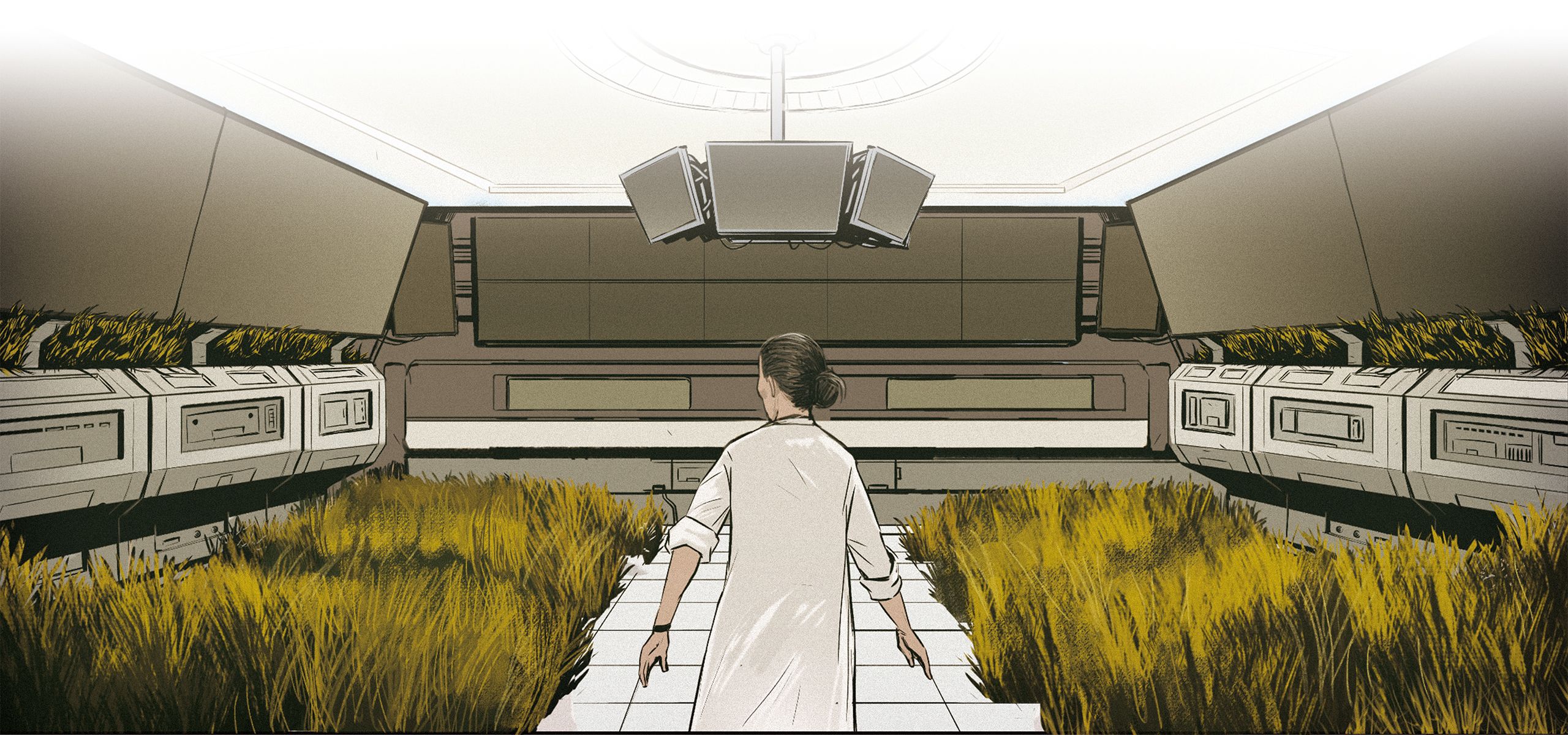
Song Zhen was not afraid. She rose and went to the shed at the side of the house. It had once been a storage space, but she had converted it into a greenhouse, where she grew cucumbers, corn, tomatoes, a handful of other sorts of vegetables, and, most importantly, two plots of rice. She fed her hen with the rice from her garden.
Song Zhen cut a bundle of rice ears with a pair of scissors and began stripping the grain onto a plate. She enjoyed the process. It made her feel calm. She counted the grains as she worked, and her mind wandered into hazy memories.
A heavy iron door swung open. She stretched out her foot and touched the snow with the toe of her shoe. She paused until she had grown accustomed to the piercing cold, then stepped out onto the snow-covered ground. A strong wind blew around her. She could barely keep her eyes open. She tugged her winter hat down low and peered out from under it at the world around her. Heavy snow covered every building. The falling flakes were swirled by the wind into an impenetrable, endless haze that turned the world ashy gray. Snowplows roared by every ten minutes or so, scraping the main roads clean.
When she felt as if she had become used to the icy air, she hoisted her rucksack. It was almost as big as she was. She pulled the strings tight at the collar of her coat, then set off, following the path left behind by one of the plows. She was on her way to school.
She was preoccupied with one question: Why didn’t they just cancel the classes? They could be taught at home, by bots. Those strange lessons—how to find a clean source of water, how to forage enough to stave off hunger...When would that sort of thing ever come in handy? Their time would be better spent volunteering in the factory district, helping the old folks look after their mechanical arms.
A red light flashed on top of the cab of the snowplow she was following. A warning bell chimed rhythmically. She watched the light. She hummed a tune along with its beat. A folk song, maybe, that she had heard a long time ago...She knew the words to the song, but seemed to have forgotten its name.
Song Zhen filled one round container with grain and a basin with water. She carried them out to the hen, who pecked half-heartedly, lazily circling its meal. The same old stuff again. Song Zhen wondered why the hen didn’t lay eggs. If she had a rooster, she could sell off the fertilized eggs for enough to buy back the mechanical arm. The hen was full before the grain was gone. It took a few sips of water, then went to peck impatiently at Song Zhen’s shoes. She knew what that meant: the hen was ready for its walk.
Song Zhen felt a twinge of regret when she saw the half-finished grain. She hadn’t come by it easily. It was hard to coax grain to grow in the laboratory. When the weather turned bad, she worried the power from the solar panels on the hilltop would fail. When the sun didn’t shine, she would have to march up and down to adjust them.
Song Zhen pointed to the rice and tried to coax the hen to eat some more. Not understanding the invitation, the hen turned away from the container. Song Zhen scattered a few grains in front of the hen, beckoning it to eat. The bird finally lost its patience. It turned and kicked over the container of rice, then, as if its anger had not yet been satisfied, toppled the water basin. Song Zhen gave up. She swept up the spilled grain, then went to the cupboard to get the silk cord that served as the hen’s lead. The hen saw this and stretched out its neck. Song Zhen tied the cord and led the hen out of the yard.
She and the hen walked along a dirt path that ran near the house. Bushes grew along both sides. The ground was carpeted with horsetails. The hen was thrilled to be outside. Even though it had walked the same path countless times, its gaze still excitedly darted from side to side, as if taking in everything for the first time. The hen stuck to the dirt path, stopping its pursuit of stray insects when they reached the weeds that grew alongside.
The hen walked faster than Song Zhen and turned from time to time to urge her on with hoarse clucks. Song Zhen was already ninety years old. After a few steps, she was panting. The air in the wooden house had been artificially enriched, but in the woods, the carbon dioxide level was far above normal—fortunately, there was just enough natural oxygen to keep anyone from suffocating.
She had once heard a Daoist on the radio describe the sort of oxygen still left in the atmosphere: it was natural yang essence. Song Zhen felt she had a lot of dampness in her body and needed to replenish some yang energy. When it became unbearable, she brought out her rapid-oxygen mask and eased her breathing.
Song Zhen wondered if she should get a mask for the hen, too. It enjoyed its walks so dearly.
II
“Name”
“Wang Qian.”
“Who are you visiting?”
“Song Zhen.”
“Relationship?”
“Daughter.”
Wang Qian sat calmly in the center of the tiny room. A mechanical arm hanging from the ceiling was aimed directly at her face. She answered each question patiently. It was difficult to secure the right to visit. If she failed the interview, it would be another year before she could apply again.
A body of water stretched out in front of Wang Qian’s eyes. It was a reservoir. In the middle of the water stood a stand of tallow trees. The trees bore small white fruits, each about the size of a marble. She had often rowed a boat to the trees and collected their fruits to use as ammunition for her slingshot. She hunted the birds that perched by the water.
In autumn, the water level dropped by more than a foot, exposing the banks. Within a day, the naked shoreline was overgrown with green, tender weeds. The birds left the water to nestle lazily in the vegetation, staring blankly.
It was almost winter. The weeds grew less quickly. When the cold weather hit, the vegetation would quickly wither. But before that, they would welcome the last batch of autumn insects. These grew quickly, too. Within a week, they went from lava to adults. The faint chirping they raised in the weeds, became a mighty chorus. The insects that called the most exuberantly, however, were the first to be swallowed up by the birds.
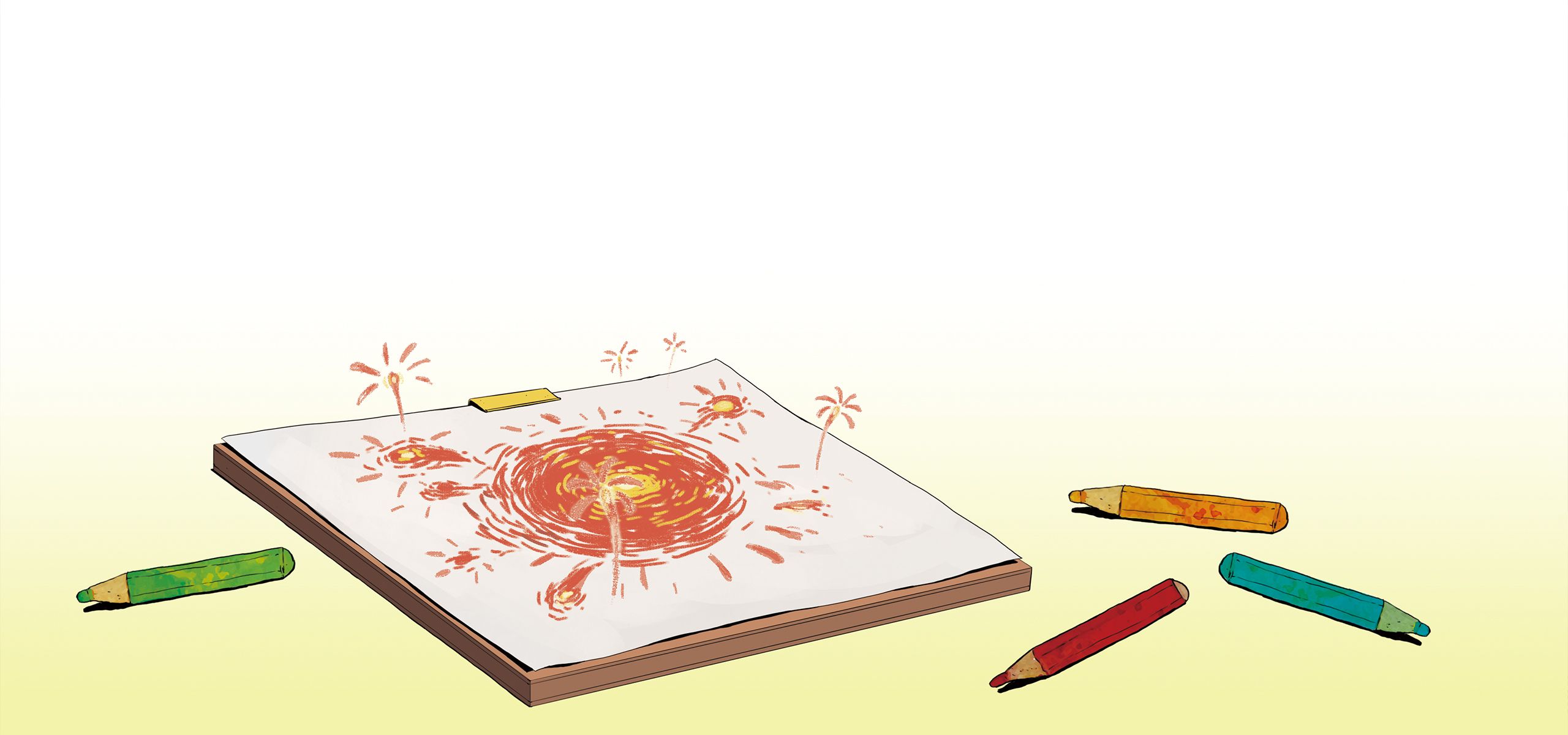
A breeze prodded gentle waves against the sandy bank. There was a rock there in the grass, shaped like a reclining water buffalo. Its back was broad and flat. Wang Qian sat on the rock with her daughter. Her daughter held a drawing board and worked at a sketch. Wang Qian was beside her, gently combing out her long hair. It smelled like orchids.
Wang Qian glanced at the drawing board. Her daughter had drawn a fireball. This made Wang Qian curious. “What is that supposed to be?” she asked.
“An explosion. It’s burning the house—and whatever else…”
Wang Qian was surprised by the answer. She wondered why her daughter would draw something like that. “Why don’t you draw the two of us together?” Wang Qian asked.
“I don’t feel like it,” her daughter said coolly.
Wang Qian looked away, to where several water buffalo were lying on the bank of the reservoir, leisurely munching grass. It would be the freshest meal they would have before winter set in. The water buffalo turned to Wang Qian and softly mooed.
Wang Qian bit her lower lip. “Why are you drawing that?” she demanded.
“This is what I see,” her daughter said. She shifted playfully to face her mother: “If the whole planet exploded, what do you think it would look like?”
“What are you talking about?” Wang Qian asked. She was becoming agitated. “Why don’t you think about happier things? How could a whole planet explode!”
“Nothing’s impossible. An asteroid could come along and punch a hole right through it,” her daughter said. “Pop! Blow it right up. Anyway, all of this will be gone.” She noticed her mother’s baffled, skeptical expression. She stood, took the sheet of paper off the drawing board, and spun around, showing it to the world around her. The picture and the landscape did not match. She ripped the picture into shreds. She scattered them in the wind.
Wang Qian watched, seething.
As the shreds of paper fluttered to the ground, the reservoir, the weeds, and the water buffalo were swept up with them, cracking and falling away like flecks of paint, revealing a tiny silver room. A harsh light filled the silver room. Wang Qian turned and studied her daughter’s messy hair. “Where do you want to go?” she asked.
“I don’t want to go anywhere,” she said. She twisted her hair angrily. “I want you to leave.” She put her earphones back in. She didn’t want to hear anything else that Wang Qian had to say.
Wang Qian rubbed her own ear and called up her daughter’s audio feed. As her legal guardian, she had the right to eavesdrop. Her daughter was listening to a rapper named BlaX Skyn, who had become popular with people of her daughter’s age. His voice was gruff. He cursed a lot. His vocabulary was crude. Wang Qian had heard enough. She switched off the feed. Her daughter, though, headphones still in, seemed to be completely absorbed in the music.
“Song Zhen!“ she yelled.
Her daughter ignored her. Wang Qian was not quite sure what to do. Her daughter had always been a good girl. Why had she suddenly become so stubbornly rebellious?
Wang Qian wrote a note to the system, requesting a counsellor for Song Zhen.
Wang Qian answered the mechanical arm’s final questions. A white door suddenly slipped open in front of her. Wang Qian walked through it. In the white room on the other side, separated by a pane of glass, she finally saw her daughter. In the few days that Wang Qian had not seen her, her daughter had grown old. Her skin was wrinkled like tree bark. She walked unsteadily, stumbling forward. The mechanical arm explained: a year in reality was equivalent to ten in confinement.
Her daughter lived alone in a small wooden house. She leaned heavily on a tree branch as she struggled down the mountain path.
“Why is she by herself?” Wang Qian asked.
“Song Zhen has a peculiar temperament,” the mechanical arm said. “Nobody was willing to spend time with someone like her.”
“You can’t just leave her there all alone,” Wang Qian protested
“There is nothing to be done,” the mechanical arm said. “This is also a form of punishment. Of course, on humanitarian grounds, we will dispatch community volunteers from time to time to render whatever aid she might require.
Song Zhen stopped often to rest. It took her several hours to reach the edge of a small town. There was a bar there.
“What is she doing?” Wang Qian asked.
“I don’t know,” the mechanical arm said. “All that I can do is temporarily obscure key memories. While in the confinement space, her social behavior is down to her own consciousness.”
Behind the bar stood two men, armed with pistols. When they saw Song Zhen, they swore angrily at her. They only relented when she produced a wad of bills.
“Is this some kind of gangster hideout? Is she in danger?” Wang Qian asked.
“Of course,” the mechanical arm replied. “There’s danger everywhere.”
Song Zhen entered the bar. Two burly men escorted her toward a back room. They shoved her ahead of them, impatient with her unsteady pace. She tried her best to go quicker, but her legs trembled and refused to obey her. When she emerged from the back room of the bar, she was clutching a bag to her chest.
The mechanical arm scanned the bag: “It contains eggs.”
Wang Qian found this puzzling. What did she need eggs for? She did’t even eat eggs.
Song Zhen only made it a few steps before she stumbled and fell. Her first thought was the eggs. She opened the bag to check that they were intact. A layer of cloth wrapping had protected them. The eggs were unbroken. She noticed then that she had hurt her foot. She sat for a long time where she had fallen, trying to regain her strength, and then finally staggered to her feet. There was no time to worry about her foot. She knew she needed to make it home before nightfall. Step by step, she climbed back up the mountain. It was obvious that every step Song Zhen took was torment. Her wrinkled face was disfigured by the pain.
Wang Qian’s heart ached. She asked the mechanical arm why nobody went to help her.
The mechanical arm merely answered that the confinement space was also a society, operating according to the same interpersonal rules. Song Zhen was not well-liked. She was stubborn, as well. She refused the kindness of others. She got angry if anyone so much as looked at her. She was quick to curse people in the foulest terms. People thought of her as a mad old woman.
Wang Qian wiped away tears. She never believed that her daughter could murder the mechanical arm’s host. She was sure that her daughter was a good person. There must be some other explanation, even if she had no proof. The scene unfolded, and Wang Qian could only watch helplessly.
“I can’t take it,” Wang Qian said to the mechanical arm. “The only thing I can do is apply to go in and visit her. Please give me that, at least.”
III
A clattering sound came from above. Song Zhen rushed upstairs and out onto the roof. The out-of-control drones could be driven off with a burst from her radio transmitter. The drones needed a power supply to survive. They had banded together like wild birds, flocking around human settlements, risking elimination by other mechanical swarms, to seek out electricity.
The radio wave device blasted them with an electronic signal that disrupted their controls. One drone drained its batteries trying to escape, fell from the sky, and smashed into pieces on the ground. Song Zhen was nearly hit by some of the shards. Startled, she took shelter and hid for a while. The swarm circled a few times overhead and left. The ground was covered in broken pieces of the drone. Song Zhen went and crouched near the wreckage. She picked a chestnut from among the broken pieces. A few days back, she discovered a chestnut tree by the wooden house. The chestnuts were ripe and falling from their husks. She gathered some and brought them to the rooftop to dry in the sun.
Song Zhen stood and looked out at the glass house on the hilltop nearby. Except for the social workers, coming to check that she was still alive, she rarely saw anybody else in the area. A few weeks earlier, a young woman had moved into the house. She was about twenty or so. Her name was Wang Qian. She became Song Zhen’s only neighbor. Song Zhen found it peculiar that such a young woman would come to live alone in the mountains.
The next day, there was a knock at the door. Wang Qian was there. Her skin was tanned, her hair styled in wavy curls, and her eyelashes were exceptionally long. Wang Qian came bearing a block of honey cake. She smiled brightly as she greeted Song Zhen. Song Zhen did not hesitate: “Get lost,” she grunted, and slammed the door.
She didn’t expect that Wang Qian would knock again the next day. She asked to borrow an electric saw from Song Zhen. She said she wanted to cut down the pear tree in her yard. She had a superstition about pear trees.[1] Song Zhen told her that she didn’t have a saw, and, anyway, cutting down trees was illegal. “There’s nobody around,” Wang Qian said. “Who would ever know that I cut down a tree?”
“I’ll report you,” Song Zhen said.
When Wang Qian came the next day, she brought a sack of flour and a slab of pork belly. She explained that she had bought them to make dumplings, but she wasn’t sure how. She asked for Song Zhen’s help. Song Zhen admitted that she didn’t know how to make them, either. It had been ten years since she had even eaten them. “That’s perfect! We can watch a video about how to make them, and follow along together,” Wang Qian said. Before Song Zhen could refuse, Wang Qian brushed by her and went into the house. By the time Song Zhen came to her senses, Wang Qian was in the kitchen. “Most of the new houses don’t have kitchens,” Wang Qian said, smiling. “It’s to save power. Most people just eat nutritional supplements. But if you eat too many, you’ll get constipated. I knew this old house would have a kitchen in it, though.”
Song Zhen was still considering how she might drive the meddling girl out of her home.
“I still have some excess power at my place,” Wang Qian said. “I can cover whatever we need for cooking.”
Song Zhen considered this for a moment, then decided to let her do as she pleased. She stood to one side and watched Wang Qian’s back as she worked. Wang Qian followed along with the video, kneading, then rolling the dough.
When she saw the dough, Song Zhen suddenly remembered her virtual cat. The plump cat with curly hair had been a gift from her mother for her tenth birthday. It looked like a pudgy little dumpling, so that’s what she had called it: Dumpling. She loved it fiercely. She fed it every day, made sure it had water, cleaned up its droppings, and took it for walks in the virtual square. But Dumpling was lazy. It didn’t like going for walks. After taking a dozen or so steps, it would flop down on the ground and roll over, refusing to go any further. Song Zhen let it do as it pleased. After a few months, Dumpling looked more like a ball of yarn than its namesake. Its fur became fluffy and soft and pettable.
One day, Song Zhen realized that Dumpling was missing. She searched the system but there was no trace of the cat. There was no record of Dumpling having existed. Song Zhen panicked. Suddenly, an email arrived: it was from a hacker, who said that he had taken the electronic cat hostage. If Song Zhen didn’t do exactly as he said, he would completely erase all records of the cat, and she would never be able to track it down. She agreed to his conditions without a second thought. When he asked how much money she had, she said honestly that she had less than a thousand, counting her pocket money and New Year red envelopes. Instead of buying snacks, she had saved up her money, planning to use it for Dumpling’s food and clothes.
“How long did it take you to save up?” the hacker asked disdainfully.
“I’ve been saving up since I was in first grade, so it’s been about three or four years. I can give you all of it.”
“I couldn’t even buy a vape with that much,” the hacker said. “I don’t want your money.”
“What do you want?” Song Zhen asked.
The hacker snickered: “I want you to get down on your hands and knees. Bark like a dog.”
Song Zhen didn’t understand what he meant.
Impatiently, the hacker explained his request a second time. He threatened her again.
Song Zhen had no choice but to do as he said. She got down on the floor and barked like a dog. “I can’t hear you,” the hacker said, so she barked louder. Satisfied with the performance, the hacker laughed. “Now, I want you to do it every day, half an hour, without stopping, for a hundred days.” If she refused, Dumpling would be erased.
“If I bark for a hundred days, will you give Dumpling back?” Song Zhen asked.
“Sure,” the hacker said.
Song Zhen agreed. Every day when she got off school, she got down on the floor and barked like a dog, imagining Dumpling the whole time. Each time she barked, she felt as if Dumpling was growing larger. A hundred days went by. Dumpling became a fully grown cat. The ball of yarn had become a cat about waist height.
She waited for Dumpling to come back to her. But the hacker disappeared. She had no idea how to get in touch with him. She waited for three days, but he never contacted her. She began to wonder if perhaps she had not barked correctly, or not loudly enough. But then she realized that she had been tricked. Dumpling was never coming back. For a moment, she was stunned. And then she began to sob.
Song Zhen rubbed her eyes. She studied Wang Qian’s back. “Where are you from?” she asked, suddenly very curious about her visitor.
“Far away,” Wang Qian said. “It’s not on any maps. I like it much better here, anyway.”
“Why did you move up here?” Song Zhen asked.
Wang Qian hesitated for a moment. “I’m waiting on a friend,” Wang Qian said.
“Who are you waiting for?” Song Zhen said.
Wang Qian smiled but said nothing.
Song Zhen thought for a moment. “You’re waiting for your boyfriend, aren’t you?” she asked.
“Maybe,” Wang Qian said, still smiling.
“Give it up,” Song Zhen said. “A man isn’t as reliable as a machine.” She stepped closer to Wang Qian, reached out, and began kneading the dough with her. The dough was too wet, so Song Zhen sprinkled a bit of flour on it. “With the war down south, I hear flour is hard to come by. If you have to buy it from the black market, they run out of that bar down the mountain, you’ll pay double.”
“It’s fine,” Wang Qian said. “I don’t eat this way very often.”
“Why don’t you take the supplements?” Song Zhen asked. “They’re cheap. They’re easy. They’re healthy.”
“I could ask you the same,” Wang Qian said. “I saw your vegetable garden.”
Song Zhen had eaten her fill of supplements. She was forced to trade her power surplus with hackers, but she managed to get hold of some vegetable seeds. Harvesting vegetables from your own garden was no simple task. You needed to water and fertilize them, aerate the soil, and, most importantly, maintain the temperature. One mistake and an entire plot could die.
If you managed to coax the plants into growing vegetables, thieves could snatch them up before you picked any. Bands of thieves went out to the countryside just to steal vegetables grown by the old people that lived alone in the hills. The thieves didn’t want to eat the vegetables. They didn’t sell them. They enjoyed stomping them to mush. These were people that had been ground down by life. The thieves preyed on the only people more vulnerable than themselves. It was the only way they could find any dignity.
The thieves had raided Song Zhen’s garden twice. She had no choice but to hide the greenhouse. She covered it in leaves.
As they began to put the filling into the dumplings and pinch them shut, Song Zhen noticed that the ones made by Wang Qian were quite tidy, while her own were a mess. “Have you made dumplings before?” Song Zhen asked.
Wang Qian shook her head: “Never.”
Song Zhen was skeptical. For a moment, she was lost in thought, then abruptly asked, “Do you have a mechanical arm?”
“Yes,” Wang Qian said.
Song Zhen nodded. She didn’t say anything more.
IV
Song Zhen untied the cord around the chicken’s neck. The hen had been acting strange. Earlier, it had walked across the path and for the first time entered the woods. A short time later, after the hen returned, there was a burst of noise from among the trees. A couple of squirrels leapt out from the branches, chittering excitedly. Song Zhen looked on from a distance. The noise had sounded mechanical to her. Her first thought was to rush back to her house. She bent down, fondled the feathers on the hen’s back, and put the cord back around its neck. The hen stretched its neck to peck at the cord. The hen seemed relieved to be back on its lead. It lowered its beak and continued pecking the ground. Song Zhen sighed. Even the soil outside smelled more fragrant than the rice in her plot.
Song Zhen had grown accustomed to living alone. As soon as she woke up each morning, she began thinking about how she would make it through another day. She began listing the things she would need to do. The hen provided company and a routine. Each day, she knew she needed to feed the chicken and take it for its walk. She had never given the hen a name. She had never come up with one that suited it.
Song Zhen led the chicken home. The hen perched in its basin, eyes half-closed, shaking the water droplets from its feathers with a contented litter shiver. Song Zhen did not untie the cord as she usually did. The hen felt the cord tightening around its neck and felt uncomfortable.
Song Zhen bent and lifted the chicken from the basin. She brushed the water droplets from its feathers. The chicken lay on the ground, completely docile. Song Zhen tied the cord to the table leg, then bolted into the kitchen. She took a knife from the shelf. She had just honed it that morning, and it was incredibly sharp.
She brought the knife down on the hen’s neck with all her strength. Before it could make a sound, its head was nearly off. She brought the knife down one more time and cut all the way through. Bright red blood gushed from the chicken’s neck. Its legs kicked a few times, then it lay still.
Song Zhen put the hen back into its water basin and ladled boiling water over it. She had watched enough videos on slaughtering chickens to know what to do. She plucked the hen’s feathers, one by one. The process required patience. When she was done, the chicken was completely bare. Song Zhen grabbed the knife again and slit open the hen’s belly, just as she had seen done in the videos. She pulled out its heart and guts, then chopped the chicken into pieces. On the stove, she added oil to a pot, and dumped in the pieces of meat. When the fat had rendered from the skin, she added water. Next, she put in the chestnuts that she had dried on the roof. She simmered her soup for a few hours, then added salt. She had a pot of stewed chicken and chestnuts. She tasted it. It really was delicious. She poured the soup into a container.
She went out, carrying the soup with her.
A few steps outside the door, she began to wonder if she had forgotten something. She realized that she was not used to going out without the hen on its lead. She picked up a branch to use as a cane.
A few days earlier, Wang Qian had broken her foot. She was picking fir mushrooms in the woods, and had slipped on a patch of moss and fallen on some rocks. She shut herself up inside while recuperating.
When Wang Qian didn’t come that day, Song Zhen became worried. The young woman had come to see her every day, as if seeking something from her. But what could a lonely old woman possibly have that she might want? At first, Song Zhen had tried to be cool to Wang Qian, but the younger woman’s exuberance overcame her defenses. After a few visits, she even became friendly to her.
When Song Zhen arrived at Wang Zhen’s house to check on her, she found the young woman in bed, drawing. Song Zhen leaned over to see what she was working on. On the drawing board was a vast expanse of starry sky. “You’ve got some talent,” Song Zhen said with a chuckle.
“Not really,” Wang Qian said. “I draw for fun.”
“What are you drawing?”
“A massive explosion,” Wang Qian said.
It was just a bunch of stars, Song Zhen thought. Where was the explosion? She looked again, more closely. The drawing seemed strangely familiar to her. She reached down and traced the lines on the page.
Wang Qian suddenly spread out her hands, and it made her jump.
“It’s my time to go,” Wang Qian said.
“Where are you going?” Song Zhen asked. Wang Qian was too young to die, she thought to herself.
Wang Qian smiled but didn’t answer.
When Song Zhen arrived at the glass house with her container of chicken soup, she noticed a pile of rusty scrap metal poking out from under a tarp by the door. She assumed they were mechanical arms.
Song Zhen went inside and set the soup in front of Wang Qian. Wang Qian sniffed at it and frowned. She had not expected Song Zhen to kill the hen. She lifted the container without speaking and took a large mouthful. It had been a long time since she had tasted chicken soup. She scooped out a chestnut with her spoon.
As she chewed, a memory suddenly came to her: she was with her mother, going into the mountains to collect chestnuts. She ran ahead of her mother, waving the ten-foot bamboo pole that they used to knock down the chestnuts. One of the spiky husks fell and hit her in the eye. It hurt so badly that she could’t open it.
Wang Qian left the clinic with a few thorns still lodged in her eye. The doctor said that he had to wait until the swelling went down to remove them. For several days, she applied drops to her dry, swollen eye. When she shut one eye and narrowed the injured eye to just a slit, she found that when she looked into the light, she could see bright, multicolored rings. The rings of light shrank and grew without warning. These abrupt shifts made her head ache.
When Wang Qian told her mother about this, she said that immortals moved in auspicious haloes of light. She told Wang Qian to look closer. Maybe she might see what the immortals really looked like.
Wang Qian believed her mother. She squinted and looked into the white rings of light. The rings became squares. The squares became lines. She asked her mother why immortals have haloes.
“Immortals live forever,” her mother said.
The lights gradually changed color, turning red, green, and blue. Wang Qian thought she saw a figure in the blurry haze. It was an immortal. She recognized it.
Song Zhen watched Wang Qian take several healthy sips of the soup. “How is it?” she asked.
“Just the way I remember it,” Wang Qian said.
Song Zhen saw how frail Wang Zhen had become. “You’re still young,” she said anxiously. “You’re much younger than me—and I’m still alive! You’ll be fine.”
Wang Zhen smiled. “Of course,” she said. “Maybe I can just close my eyes, and we can meet again somewhere else.”
Song Zhen hurriedly asked, “Where should we meet?”
Just then, a rumbling sound came from the trees outside the window. It seemed to grow closer and louder. Song Zhen leapt to her feet and raced to look outside. The woods were still. Even the leaves seemed to be holding their breath, afraid that they might fall.
A mechanical arm pierced upwards through the floor.
Song Zhen thought it looked familiar. It was her own.
But before Song Zhen could reach out to stroke it, the mechanical arm reared back and drove a blade through Wang Qian’s heart. She collapsed in a pool of blood. She gripped Song Zhen’s hand tightly, one final time before she died. “We can still see each other again,” she rasped.
Song Zhen stared dazedly. She couldn’t believe what she had just seen.
The mechanical arm turned obediently back toward Song Zhen. It was like a sulky child, looking for forgiveness after causing a fuss. It edged closer to her.
Song Zhen reached stealthily for the branch. She smashed it down on the mechanical arm. She managed to catch it unaware. It fell to the floor.
Song Zhen turned to run, but she found she couldn’t move. She seemed to have been frozen in place. The mechanical arm came up in front of her, brandishing its blade. Song Zhen was terrified, but made no sound. The mechanical arm drove its blade into her heart. Song Zhen shuddered. She shut her eyes. But she soon realized that there was no pain.
She squinted and peered out of the narrow crack. In front of her, she could see a starry sky. Rings of light appeared, glowing in variegated colors. After that, she saw a blaze of red.
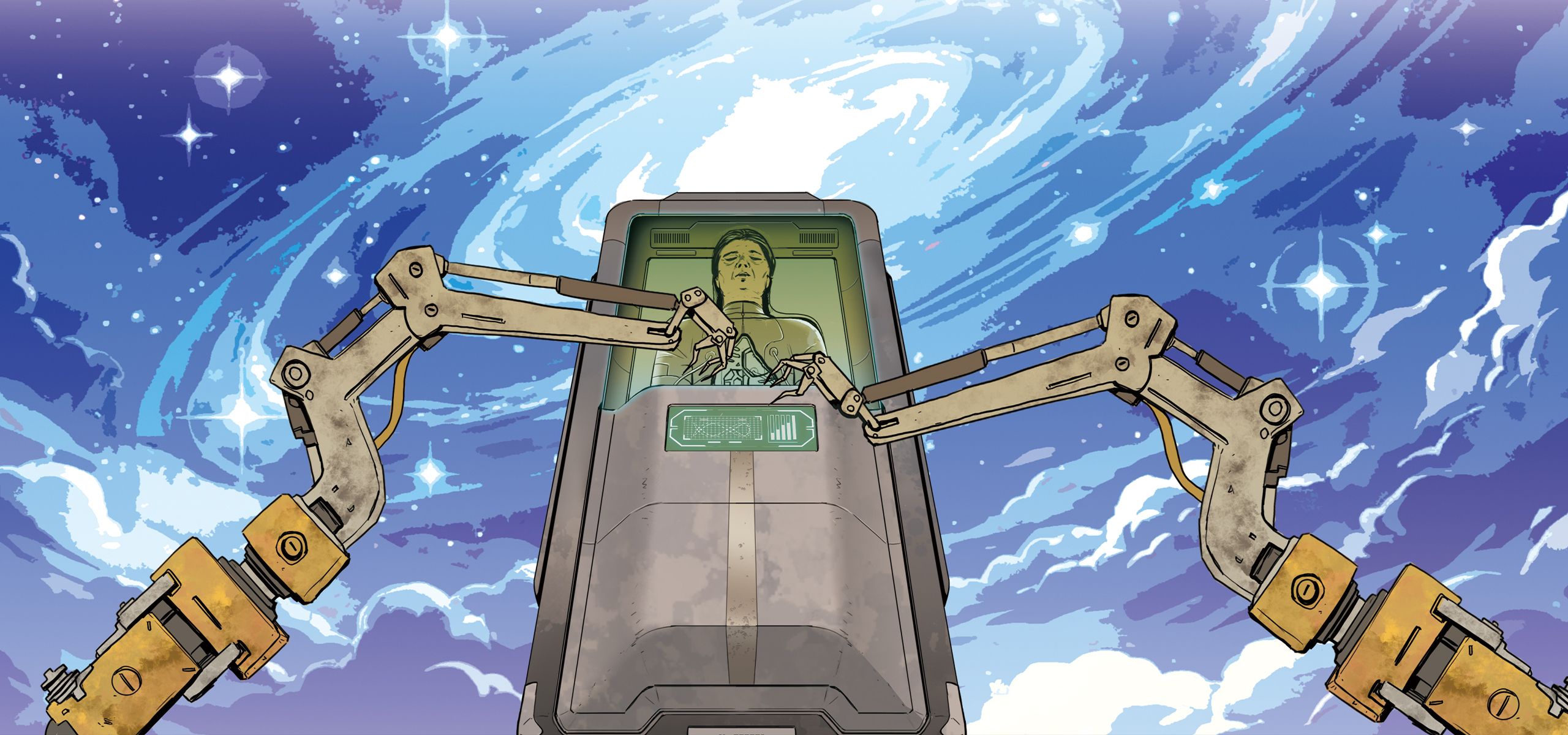
She could see the mechanical arm moving. It was removing the heart from her body. To her surprise, she saw that the organ was made of steel. It was still beating.
Song Zhen looked up. She opened her eyes. She knew that she was still alive. Beneath where her heart had been, she could see circuit boards and wires. It came as a surprise to her that she was a robot. She realized why the pictures of starry skies and explosions had been so familiar: they were the start-up sequence.
The mechanical arm was working on her heart. It was modifying the data on a chip in her heart. A section of Song Zhen’s memory was being erased.
Song Zhen turned and looked out the window. The wind was still blowing. Leaves were falling, whirling and spinning in the air like a flock of birds in flight. She heard a soft rustling sound. She knew someone was coming.
[1] “Pear,” or li in Chinese, sounds like “parting,” so planting it in the courtyard is traditionally considered inauspicious.
Author’s Note:
My day job is “guarding the lake,” and in my spare time, I write. I live and work at Paradise Lake, nestled on the southern slope of the Dabie Mountain in Hubei province. True to its name, the lake rests high among the peaks, so close to the sky it feels almost within reach. Life here is sparse. Often, when I patrol the lake, my only companions are the birds and beasts. A profound solitude settles over me, as if some must dwell in quiet isolation to balance the world’s bustle, bearing humanity’s loneliness. This solitude fuels my creativity. Gazing into the primeval forests, I imagine future woods, hidden eyes watching us as we watch them. The forest holds our joys, sorrows, and most cherished emotions. I am certain that, in days to come, some will still wander these woods alone, seeking the innocence of human nature.
Related Articles



