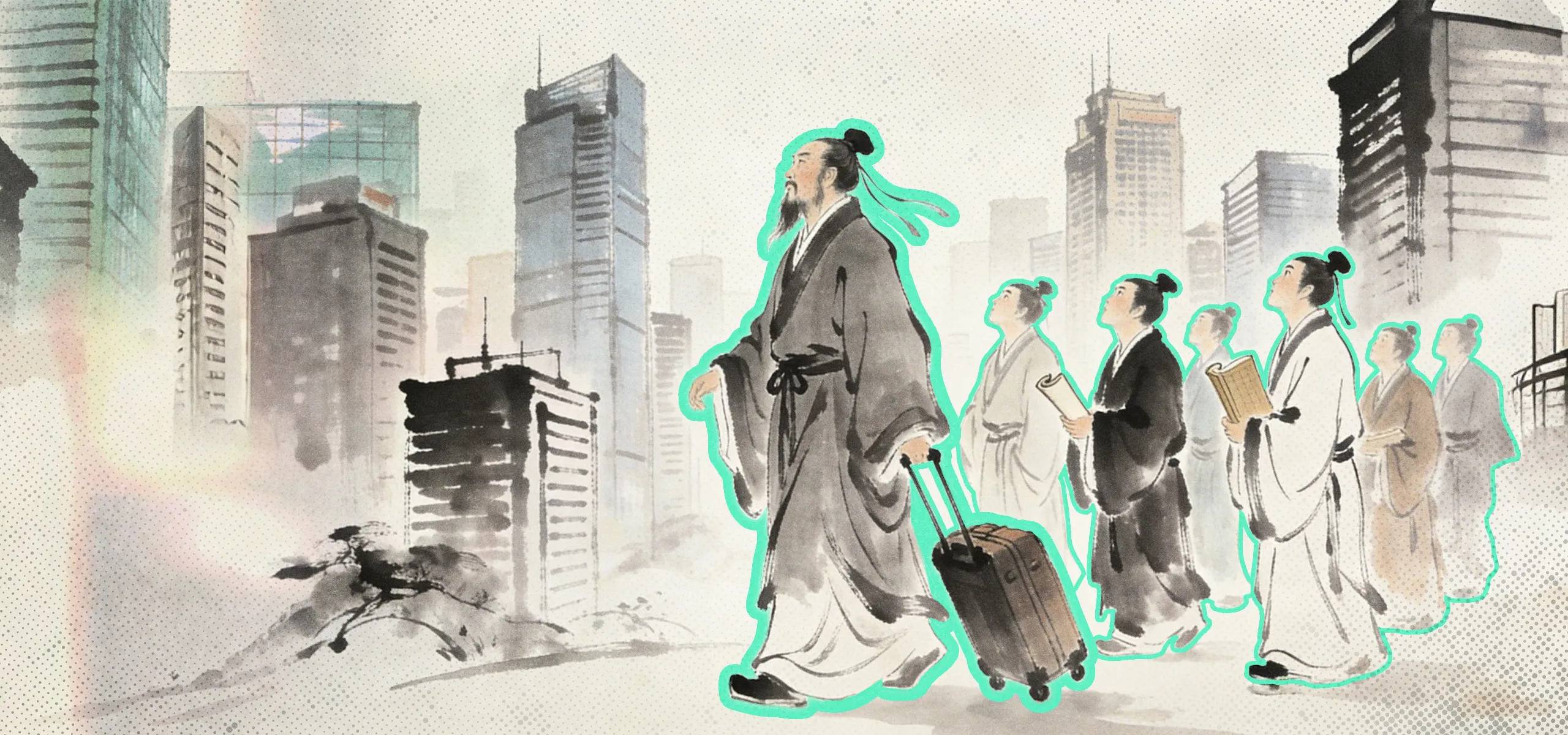

China’s great philosophers, historians, and poets had one thing in common. They got up from their desk and hit the dusty trail.
Walk around a Chinese museum, historical site, or university during school holidays, and there is one group you will likely encounter: students dressed in school uniforms and waving colorful flags. Their footprints can be found across China and abroad, as they are learning about the world through travel—a practice known as youxue (游学) or “study tours.” But this is not a modern invention. In China, the tradition of traveling to study dates back more than 2,000 years, and has helped build the foundations for Chinese philosophy, historiography, and poetry.
Confucius’s journey through the feudal states
Like so much of Chinese history, the idea can be traced back to Confucius (孔子), the 6th-century BCE philosopher, politician, and educator. Born into a gentry family in the Lu state, in what is today Shandong province, he undertook his first study tour as a young man, a journey that deeply influenced his philosophy.
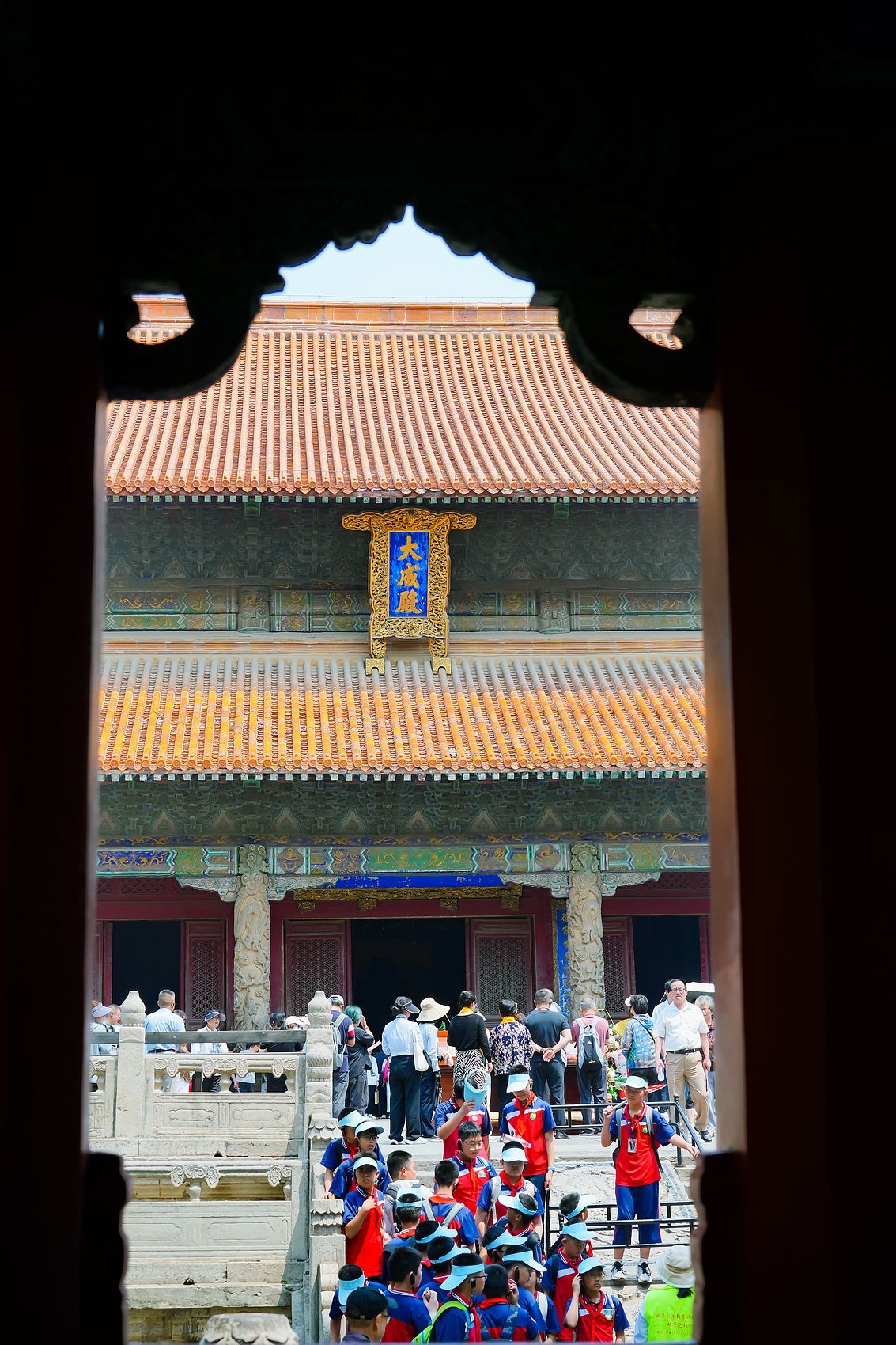
Confucius’s hometown, Qufu, Shandong province, has become a popular destination in recent years for study-tours, with its historical relics telling the life story of the great educator and philosopher (VCG)
Most sources indicate the trip took place in 518 BCE, when Confucius traveled to Luoyi, the capital of the Zhou dynasty (1046 – 256 BCE). Here, he consulted Laozi (老子), the father of Daoism, who was then serving as the keeper of the Zhou royal archives and historical records, and learned about music from a court official named Chang Hong (苌弘).
For Confucius, ritual kept society in order, and music shaped people’s character. The system of rites and music created by the founding statesman, Duke of Zhou of the early Western Zhou dynasty (1046 – 771 BCE), was, in his eyes, the model of an ideal society. This journey was a key step that deepened his understanding of this tradition, and the meeting between Confucius and Laozi an important moment in the interplay between Confucianism and Daoism.
Twenty years later, in 497 BCE, Confucius left his official position due to disagreements with the rulers of Lu and departed with his disciples, a journey now known as his “travel through the feudal states (周游列国).” For the next 14 years, he meandered through present-day Henan and Shandong provinces, touring the many states of the central plains. The journey was filled with hardships—mobbed by locals in Wei, expelled from Song, and trapped between Chen and Cai without a hot meal for seven days. Yet even in the most difficult moments, Confucius never stopped learning and teaching his students. During his journeys, he trained more than 3,000 disciples and edited works including the Book of Changes (《易经》), the Book of Songs (《诗经》), and the Spring and Autumn Annals (《春秋》), all foundational texts in Chinese philosophy.
The grand historian’s field trip
Confucius’s practice of traveling to study established the Chinese intellectual tradition of seeking wisdom on the road. This tradition continued for centuries, with countless later scholars following the path Confucius had paved. In the Han dynasty (206 BCE – 220 CE), Sima Qian (司马迁), China’s first grand historian, was its most remarkable practitioner. In fact, it was Sima who originated the term youxue, using it in his seminal work Records of the Grand Historian (《史记》), where he wrote that Lord Chunshen, a nobleman from the Warring States period (475 – 221 BCE), had “traveled widely to study and became broadly learned.”
Read more about traveling in ancient China:
- Rebellion, Corruption, and the Lychee: The History of Chinese Couriers
- A Trip in Time: How Did People Travel in Ancient China?
- Power on a Paper: The Passport in Chinese History
Sima Qian came from a family of court historians, and his travels were undertaken with a clear purpose: to gather firsthand material for his historical writing. According to his postface to the Records, Sima began his journey at 20 years old, spending years visiting what are now Shaanxi, Hubei, Hunan, Jiangxi, Zhejiang, Jiangsu, Shandong, and Henan.
Wherever he went, Sima collected oral accounts. In Huaiyin (in present-day Jiangsu), local people told him the story of how General Han Xin (韩信), one of the founding figures of the Han dynasty, had buried his mother in his youth. In Jining (in present-day Shandong), he observed scholars practicing the “village archery,” a ritual competition to select talents and one of the traditional ceremonies of Confucianism. In Xueyi, locals spoke of the lavish hospitality of their former Lord Mengchang, who had once welcomed adventurers and outlaws into his fiefdom, inadvertently reshaping local customs into something rougher and more violent. This use of orally collected information became a distinctive feature of his work and consequently informed much of what we know about his time today.
Wandering poets chasing inspiration
Moving forward to the Tang dynasty (618 – 907), a new form of travel emerged, known as zhuangyou (壮游), or “grand touring.” The term comes from a poem titled after the phrase by the reknowned poet Du Fu (杜甫), referring to long journeys undertaken by ambitious young men. In that poem, Du recalled his own youthful adventures: “I played and roamed freely between Qi and Zhao, in light furs and on fine horses, wild and unrestrained.” His experience was far from unique—for many Tang literati, such journeys were a defining part of their youth.
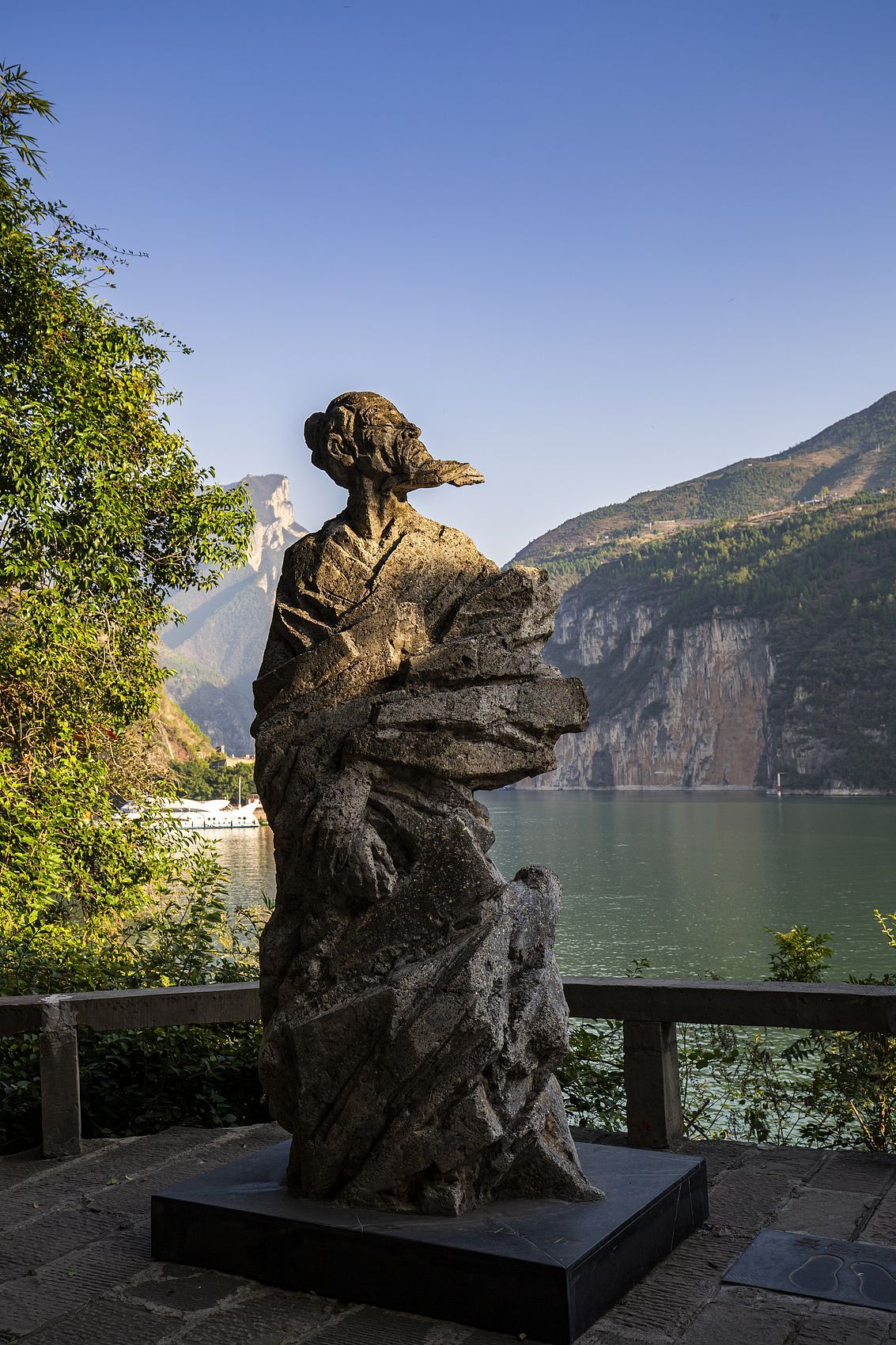
A bronze statue of Du Fu stands at Baidicheng, a mountainous fortress at the western end of the Three Gorges of the Yangtze River, where he was inspired by the sublime landscape to write the poem, “Baidi”(VCG)
The rise of grand touring was closely tied to the Tang’s civil service examination, which included poetry as one of the subjects, often judged not only by its prose but also by its originality and emotional depth. Therefore, candidates hoped that travel would make their works more vivid and unique. Furthermore, meeting influential figures was also a common way to seek recommendations—essential for securing official positions.
The Tang-era grand tours could last for years. Du recounted that he began traveling east to the Wu and Yue regions (roughly present-day Jiangsu and Zhejiang) at 20, a journey that lasted four years. After failing the exams, he traveled north to Qi and Zhao (present-day Shandong and Hebei) for another eight or nine years. During these travels, he met fellow poets Li Bai (李白) and Gao Shi (高适); the three toured present-day eastern Henan together, composing some of China’s most canonical poems as they went.
Li Bai was another grand tourist. He once wrote in a poem: “I never tire of seeking immortals on the Five Sacred Peaks; all my life I have loved to roam famous mountains.” At the age of 25, Li started his travels from Shu (present-day Sichuan). His poems show that during his lifetime, he traveled through at least 18 provinces, 206 counties, over 80 mountains, more than 60 rivers, and around 20 lakes. These travels nourished his poetic imagination, making him one of China’s greatest poets.
Scholars learning on the road
During the Song dynasty (960 – 1279), the tradition of traveling to study was elevated to an important educational ideal. The educator Hu Yuan (胡瑗) stated: “A scholar who stays in one place remains narrow-minded. One must travel widely to see different customs, landscapes, and ways of life—only then can learning truly benefit.”
One of the prime drivers of Song-era study tours were government schools, with students from across the country coming to the taixue (太学, Imperial University) and guozijian (国子监, National Academy in the capital of Bianjing (present-day Kaifeng). The government actively supported this mobility. According to Southern Song (1127 – 1279) memoir A Record of the Millet Dream (《梦梁录》), the Imperial University provided students with generous stipends on a massive scale, and daily meals were supplied in great abundance and treated with the utmost courtesy. In the History of Song (《宋史》), the official dynastic history of the period, it describes the lectures of Hu Yuan at the Imperial University, where his followers grew so numerous that the university could not contain them, and neighboring government buildings were used.
Xu Xiake’s journeys of scientific inquiry

Xu Xiake is widely regarded as a pioneer in the study of karst terrain, having described its formations in detail in his work (VCG)
In the late Ming dynasty (1368 – 1644), a unique figure emerged in the history of study travel: Xu Xiake (徐霞客). Xu was born into a wealthy family in Jiangyin (present-day Jiangsu). His great-great-grandfather, Xu Jing (徐经), was banned from office due to an exam scandal, and the family grew distant from official careers. Influenced by this family background, Xu Xiake failed the junior-level exam and never sat for another examination again.
Xu began traveling at age 22 and continued for more than three decades, covering what are now 16 provinces and regions. Unlike all previous traveling scholars, Xu’s journeys were driven purely by personal interest in geography and landscapes. He traveled mainly on foot, and wherever he went, he meticulously recorded mountains, rivers, landforms, vegetation, climate, local products, and even the customs of ethnic groups. These records were compiled into The Travel Diaries of Xu Xiake (《徐霞客游记》), totaling over 600,000 characters and over ten volumes—the first work in Chinese geographical history based entirely on firsthand field investigation.
From Confucius traveling among the feudal states to Xu Xiake walking thousands of miles to see a single mountain, the tradition of seeking knowledge on the road has never ceased. As the Chinese idiom goes, 读万卷书,行万里路—“read ten thousand books and travel ten thousand miles”—today’s students, waving flags on study tours, are simply continuing this enduring journey.
Related Articles