


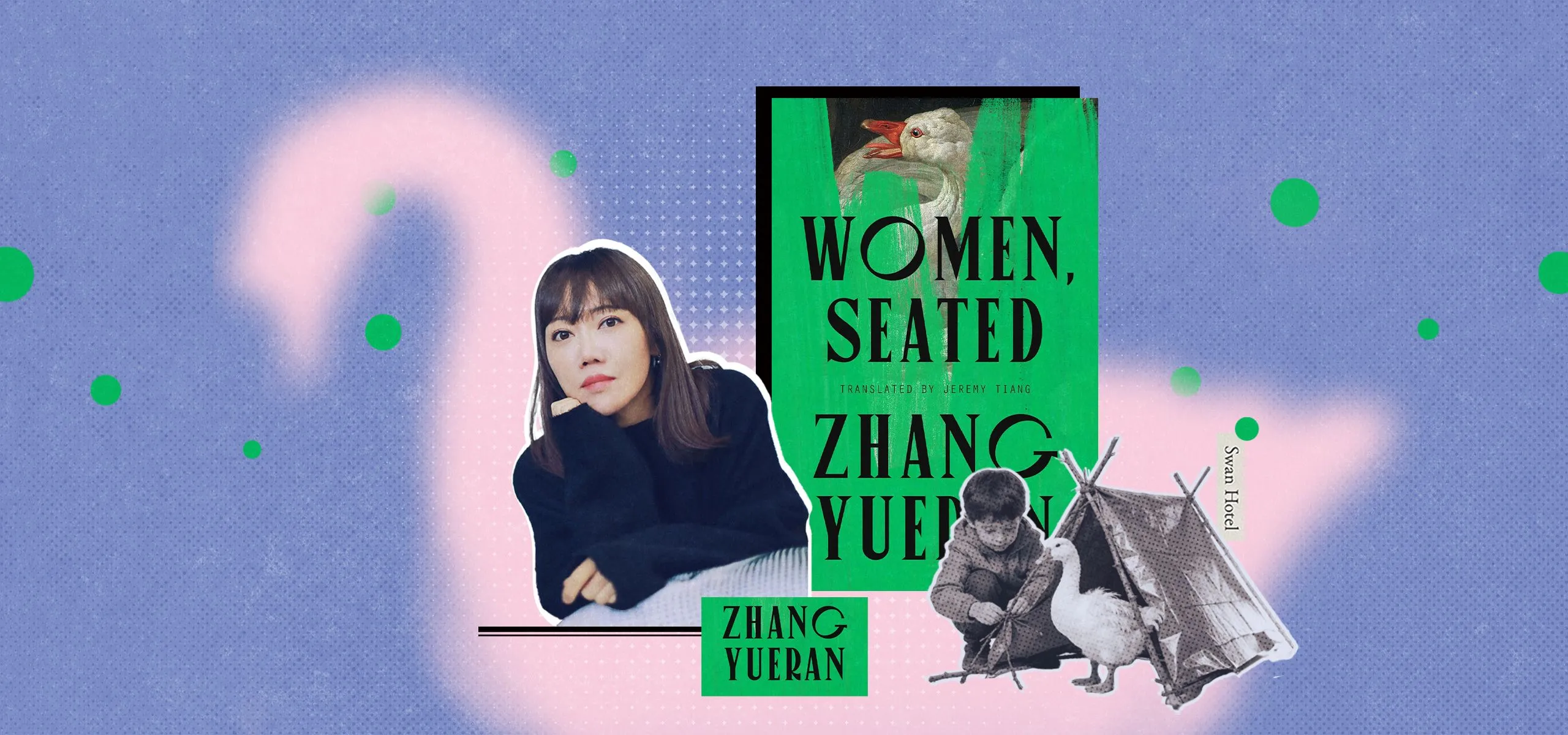

In her latest novel, Zhang Yueran offers a stark, nuanced portrait of three women from different socioeconomic backgrounds navigating power, desire, the men in their lives, and a fraught bond that begins to unravel in the wake of an abduction and a corruption arrest
Yu Ling stuffs several Tupperware containers with wagyu beef and Alaskan snow crab legs into a duffel bag, telling Kuan Kuan, the seven-year-old son of the affluent Beijing family she works for, that they’re heading out for a picnic. Outside, instead of the family’s driver, Yu’s boyfriend waits by a battered white van with no license plate. The excited boy suspects nothing, simply glad to listen to the radio and not classical music for a change.
Zhang Yueran’s latest novel, Women, Seated—originally published in Chinese in 2024 and translated to English by Jeremy Tiang in 2025—begins with a kidnapping. But instead of a ransom demand, a detective cracking the case, long-buried family secrets, or a dramatic rescue…none of these familiar beats of a suspense story happen.
Before they’ve even left the city, they hear on the radio that Kuan Kuan’s grandfather and father had been taken into custody for corruption. His mother, on a trip in Hong Kong, cannot be reached. Half-relieved that she no longer has to go through with the crime, Yu takes Kuan Kuan back home. Finding little left to take that the housekeeper hasn’t already cleared out, Yu’s boyfriend makes off with her life savings. The story then settles into its core: the lives and struggles of three women who stayed in the house: the nanny, Yu; the boy’s father’s personal trainer, Huang Xiaomin; and his mother, Qin Wen.
Read more from female writers in China:
- Can Xue: The Experimental Voice of Chinese Literature
- The Feminine Critique: Women and the Absent Men in Chinese Family Life
- Fang Si-Chi’s First Love Paradise: A Chilling Tale of Grooming and Abuse
Women, while set in an affluent suburb of Beijing, is not confined to this setting. Its themes of class tension and feminism resonate more universally. For years, Chinese literature translated into English has largely consisted of classics or works set in periods of historical or political upheaval. Women is a refreshing addition from a young female author that examines contemporary China.
Born in 1982, Zhang began publishing at just 14 and became a defining voice for the “post-80s” generation. Her early work, known for its florid writing style, centers on adolescent loneliness and sensitivity. Shaped by fractured families, fragile love, and trauma, her characters are often caught in cycles of inevitable tragedy and suffering. A prolific writer in her early 20s, Zhang later paused novel-writing to serve as founder and chief editor of the literary magazine Carp, which ran from 2008 to 2021 and relaunched in 2023.
Her later works, including Cocoon (2016, translated into English in 2022), Unseen Sister (2017), and Women, Seated, shift the focus to female perspectives, exploring women’s desire, psychology, and growth. Unseen Sister was adapted into a 2024 film of the same name, for which Zhang served as a screenwriter; as well as the 2025 viral TV drama Love’s Ambition, starring Zhao Lusi.
Female relationships—between strangers, friends, or family—and their capacity for mutual redemption are familiar themes in Zhang’s recent works. Her female characters are never straightforward embodiments of liberation. In Women, all three protagonists, despite their vastly different socioeconomic backgrounds, find their sense of worth in self-sacrifice for the men in their lives.
“In this novel, I wanted to explore a certain weakness in women—one that is often also a source of strength,” said Zhang at an event hosted by the novel’s Chinese publisher, Imaginist, in 2024. “The illusions they hold onto, along with their capacity for self-sacrifice, can at times ease doubts about their own worth, allowing them to feel that they matter.”
Yu, who was the first female truck driver in her rural Gansu hometown, takes the rap for her father after he hits and kills an older man while driving. Blaming herself for not watching the road, she makes a sacrifice that “her delicate younger brother never could” and spends three years in prison. Growing up in a deeply patriarchal place, she has seen countless women fare worse—abused, left disabled, driven “mad,” or trafficked as wives. When her boyfriend takes off with her life savings, she makes peace with this because she intended to pay off the man’s debt with that money anyway.
But that strength, forged through sacrifice, also enables her to leave her small hometown and secure her well-paid job in Beijing. It later leads her to care for the boy without pay when his entire family becomes unreachable.
Huang, the personal trainer, rushes to Kuan Kuan’s home after hearing of his father’s arrest. Grateful that he had once helped her secure treatment for her mother at a prestigious hospital, she quits her job to care for the boy, even paying for his groceries out of her own pocket, hoping to build a family with him and his father once the man is released.
Qin, Kuan Kuan’s artist mother and the daughter of a powerful politician, seems least likely to sacrifice herself, given her privileged upbringing. When she discovers before her wedding that her fiancé had been married before—and that his ex-wife had even encouraged him to divorce her and marry Qin to further his career—she mocks women like these, who wear their self-sacrifice “as a badge of honor.” But, “there really are women who’re willing to live within this delusion, and they’re proud of it,” she thinks.
Yet when Kuan Kuan’s father asks her to give up her burgeoning career in the US and return to China because he couldn’t find work, she obliges, even enlisting her father’s help. Later, when she considers leaving the marriage, she relents again, as her father valued her husband’s loyalty and their deep business ties. And when both men are arrested, she could have fled abroad—but instead risks her own arrest to return home and search for the leverage her husband has allegedly hidden in a painting, which could save both men
“Is this feminism? Not exactly,” writer Mao Jian commented at the 2024 event. “[But] in what seems almost like an anti-feminist set of actions, a bond forms among the three women that feels distinctly contemporary. Perhaps this is a kind of modern feminism.”
Indeed, through Zhang’s writing, a more nuanced picture emerges of these women’s relationships— especially between the wife Qin and the nanny Yu, in the way modern society and class divides shape their bond and the choices they make.
Despite their vastly different backgrounds, both Yu and Qin long to be valued for their work. Yu has always wanted more than a life as a nanny: at a previous housekeeping job, she effectively became an assistant to an interior designer. Later, in Qin’s art studio, she starts sorting catalogs, mixing paint, and preparing canvases. When Qin begins hosting art salons, Yu discovers a talent for baking and takes pride in the guests’ praise.
Qin, meanwhile, keeps postponing the exhibition her husband has offered to arrange for her. She knows her audience would neither understand her work nor buy it for its merit, but for her father’s and husband’s influence. There seems to be a certain understanding and camaraderie forming between the two in the small space of Qin’s art studio.
But when Yu is asked to fill in for Kuan Kuan’s babysitter at her house for a week—a role that becomes permanent after he refuses to let her go—everything shifts. Seeing the bond between them, Qin grows jealous, while Yu’s sense of self-worth comes to depend increasingly on the boy’s enjoyment of her food and company.
After learning Yu had served time, Qin blackmails her into staying to care for Kuan Kuan. Then, when Yu learns of Qin’s family’s downfall, she feels a sense of victory that her employer is now the one without freedom or agency. Back at the house, she bathes in Qin’s hot tub, sits at her spot at the dining table, and slips into the role of the mistress of the house.
“Sometimes, we see ourselves most clearly in those who seem farthest from us,” Zhang said at the event. She believes Qin is Yu’s shadow in Jungian terms, embodying both the qualities Yu shares and those she resents, and that confronting this “shadow” is essential to Yu’s growth.
This confrontation arrives at the very end of the book, as Qin finally reaches the house while evading police detection. The three women sit at the dining table. When Qin attempts to order Yu to fetch the wine and glasses, Huang stops her, insisting she serve them herself. For the first time, they are on relatively equal footing. It is at this point that Yu learns about Qin’s struggles beneath her seemingly carefree, well-cared-for life. In a candid exchange about what each has endured, they seem to reach an understanding.
Beyond its exploration of female relationships, symbolism plays a central role in Zhang’s writing. The novel’s Chinese title translates as Swan Hotel, and the swan serves as a recurring thread throughout the story. En route to the picnic, the boy “rescues” a goose from a truck bound for market. Convinced it is a swan, he sets up a tent in the living room and names it the “Swan Hotel.”
The “swan” can be read as a symbol of class-bound illusion or a representation of the women who feel powerless over their fate, but it is also seamlessly woven into the narrative as a pivotal driver of the plot. In the final pages, the goose is brutally slaughtered by Qin, who believes it has swallowed a USB drive containing evidence she could use to save her husband and father. Yu, who has already found and hidden the USB, watches as Qin kills the animal, believing it’s the only way to convince her that there is no evidence hidden. The goose is sacrificed along with the dangerous idea of confronting powerful figures alone—a riskier path, in Yu’s view, than being taken in for police questioning.
Some have expressed disappointment with the novel’s ending, noting that none of the women appear to fully get what they want, nor break free from the patriarchal and class structures they inhabit. But this might be a more realistic outcome: rather than neat liberation, the characters are left navigating limited choices within their worlds, making decisions that feel possible rather than ideal.
Related Articles



