In 1957, at a construction site in Liangjiazhuang, west of Xi’an, a Sui dynasty tomb was unexpectedly discovered. Inside lay a stone sarcophagus carved in the shape of a miniature palace, complete with a traditional Chinese hip-and-gable roof. The front of the sarcophagus had three bays and a closed gate, with each side decorated with carvings of a female attendant. On its cover, four characters were engraved: “开者即死,” or “Whoever opens this shall die immediately.” Despite this chilling curse, over 230 burial objects were unearthed, each a masterpiece of its time.
Untouched by grave robbers, this tomb surpassed most aristocratic tombs of its era in both scale and wealth, and even rivalled some imperial mausoleums. However, its occupant was merely a noble girl named Li Jingxun (李静训), who died in 608 at the age of nine. How could a young girl be buried with such extravagant grandeur? Currently on view at the National Museum of China in Beijing until October 8, the exhibition “Li Jingxun and Her Era” sheds new light on both the mystery surrounding Li and the rich, complex period of history she lived in.
A short but intense family history
Li Jingxun was born in 600, during the Sui dynasty (581 – 618), but her family’s roots can be traced back to a dynasty that had already disappeared. In 316, the Western Jin dynasty (265 – 317) was overrun by the Xiongnu, a northern tribal confederation, plunging the empire into nearly three centuries of division. In the north, a succession of non‑Han regimes vied for control, while in the south, five dynasties—Eastern Jin, Song, Qi, Liang, and Chen—rose and fell. In 577, the Northern Zhou (557 – 581), a kingdom based in the Guanzhong region (around present‑day Xi’an), defeated its rival and unified northern China.
Read more about ancient Chinese archaeological discoveries:
- Vanished Empire: Resurrecting China’s Western Xia Tombs
- Mercurial Mystery: What’s Inside the Tomb of China’s First Emperor?
- Clothed in Jade and Gold: The Ancient Dream of Immortality
The driving force behind the rise of Northern Zhou—and later the Sui and Tang (618 – 907)—was a noble military bloc that emerged in the sixth century, known by historians as the “Guan-Long Group.” It was a coalition of Han and non‑Han elite families from the Guanzhong (present-day central Shaanxi) and Longxi regions (present-day southeastern Gansu). To maintain their influence, the group practiced internal political marriages, weaving a dense network of blood ties. As a result, the founders of the Northern Zhou, Sui, and Tang dynasties all came from this bloc, and Li Jingxun was an offspring of the marriage politics that bound it together.
Li Jingxun’s father, Li Min (李敏), belonged to the Li clan of Longxi, one of the core families of the Guan-Long Group—this same clan would later produce the founding emperor of the Tang dynasty, Li Yuan (李渊). Her mother’s lineage was even more intricate, with the key figure being her grandmother, Yang Lihua (杨丽华).
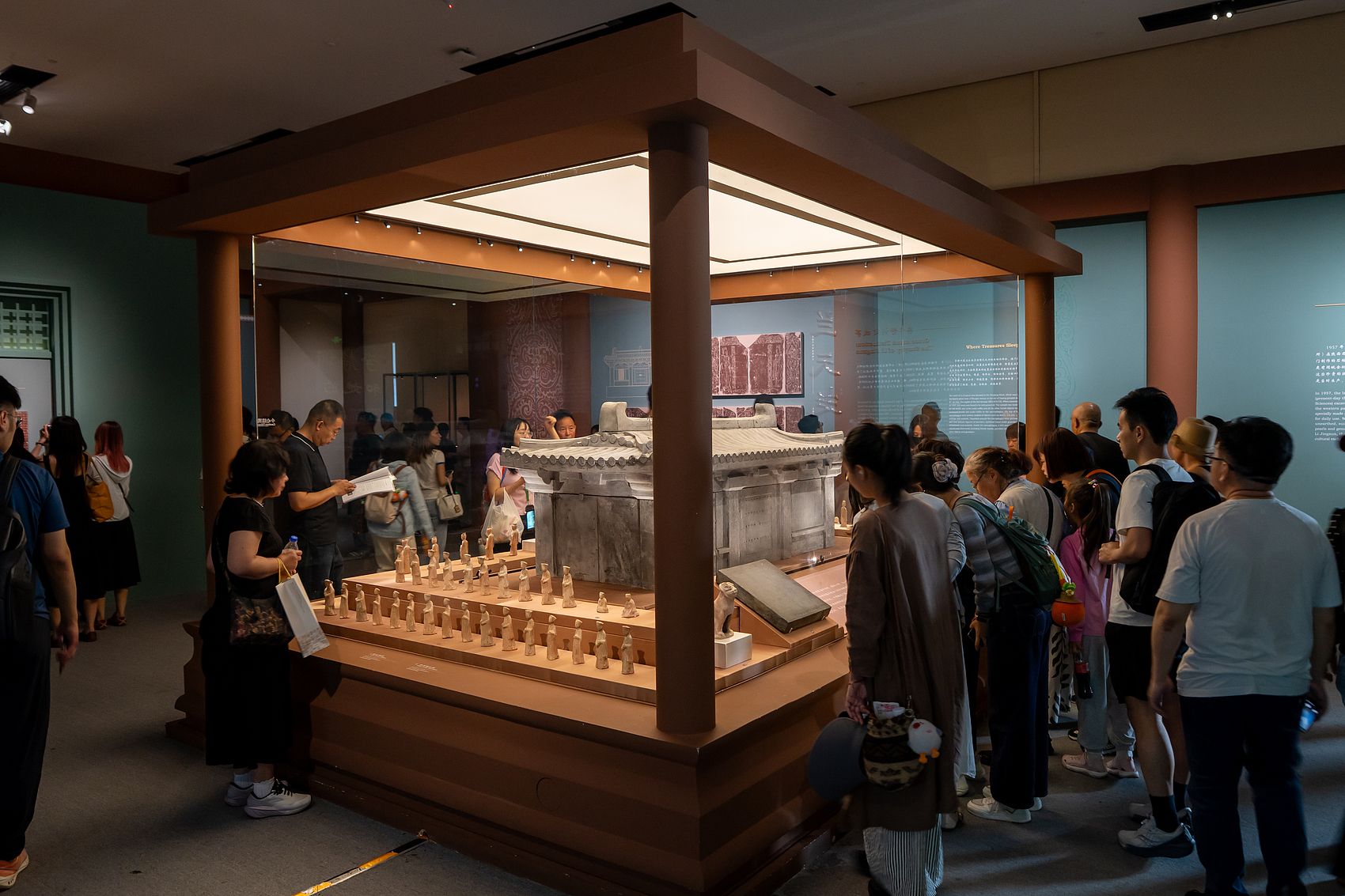
This 1.9-meter-long sarcophagus, carved in the style of a three-bay palace hall, is surrounded by rows of clay figures, her loyal attendants in eternal wait (VCG)
At the age of 13, Yang Lihua married the crown prince of the Northern Zhou. Five years later, she became the empress. Their marriage lasted only a few years, until her husband died unexpectedly at 22, leaving the throne to his six‑year‑old son, who was not Yang’s biological child. Yang Lihua then assumed the title of empress dowager, but real power fell into the hands of her father, Yang Jian (杨坚). Within a year, Yang Jian forced the child emperor to abdicate and founded the Sui dynasty in 581.
Overnight, Yang Lihua was reduced from empress dowager of the Northern Zhou to a princess of the Sui. Deeply hurt by the power struggle between her father and her late husband’s family, she poured all her remaining love into her only child, Yuwen Eying (宇文娥英)—Li Jingxun’s mother. Yang Lihua personally chose Li Min (李敏), from one of the Guan-Long Group’s most distinguished families, as a worthy husband for her daughter. Dynastic history describes Li Min as “handsome, skilled in riding and archery, and proficient in both music and dance.” Yuwen Eying and Li Min had four daughters, the youngest of whom was Li Jingxun.
Not just any girl
Li Jingxun’s courtesy name was 小孩 (xiǎohái, literally “child”). In ancient China, people were usually given a formal courtesy name upon reaching adulthood—at 20 for men, 15 for women. That a child received such a simple yet affectionate name shows the extraordinary love her family had for her. Given her noble lineage and lavish burial, she has jokingly been called “the most spoiled child in history” by netizens.
According to her epitaph, Li was raised in the palace by her grandmother, Yang Lihua. The epitaph praises her as intelligent and well‑behaved, noting that her good reputation was established even in childhood. In the summer of 608, while accompanying Yang to the Fenyuan Palace (in present‑day Ningwu, Shanxi province), she suddenly fell ill and died.
Yang Lihua was heartbroken. When Emperor Yang of Sui heard the news, he ordered ritual instruments removed and court meals suspended as a sign of mourning. He also issued several edicts to ensure the coffin was escorted back to the capital.
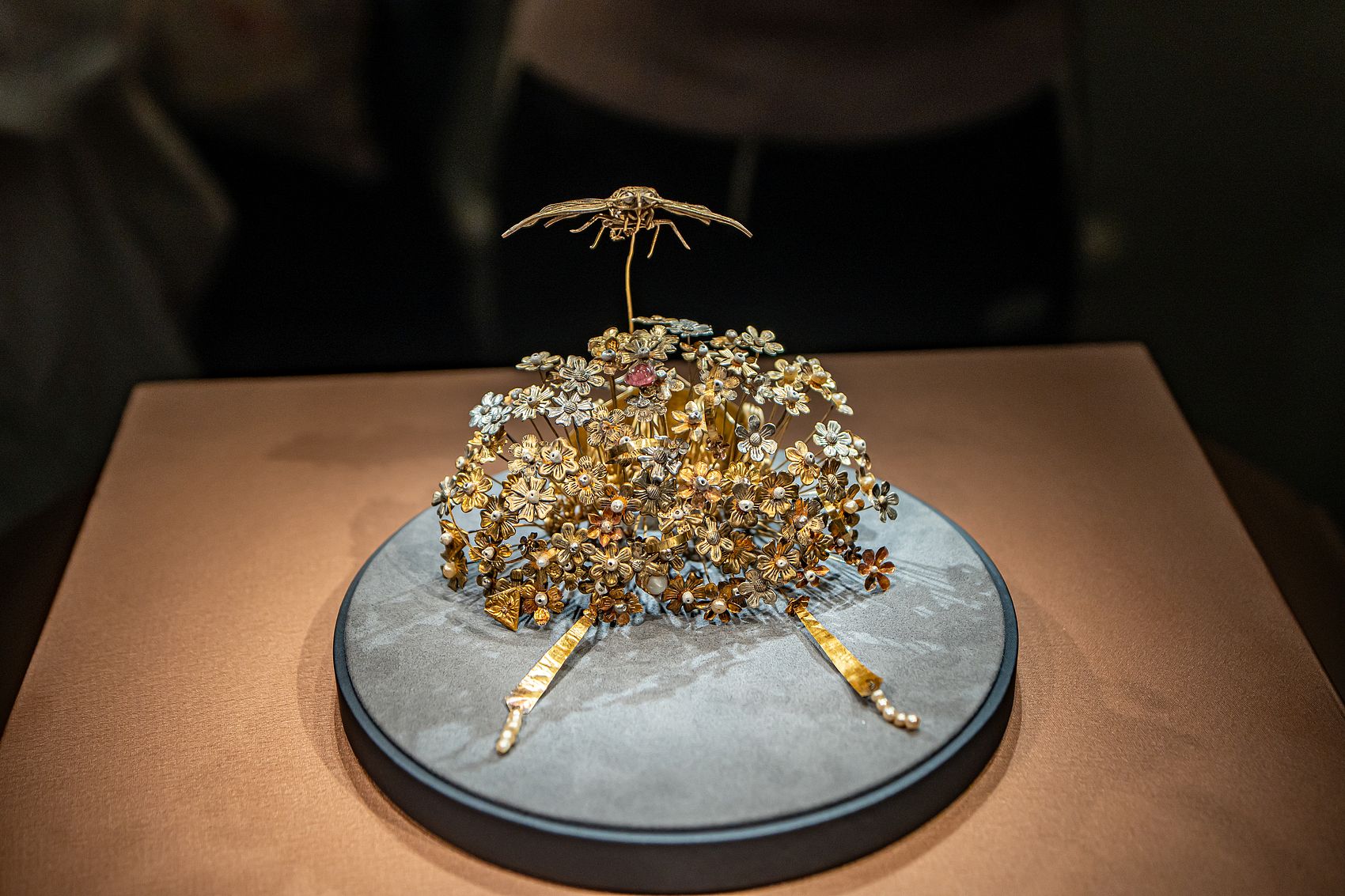
The gold hairpin, adorned with a “fluttering moth,” is one of the most stunning artifacts from Li’s tomb (VCG)
According to classical Chinese rites, a child’s death should be given a modest and simple burial. Yet Li’s burial broke funerary rules at nearly every turn. This nine‑year‑old girl, holding no official rank or military merit, was laid to rest in a high‑status tomb—a level of grandeur rare even for Sui adult nobles.
The choice of burial site itself was a breach of convention. During the Sui and Tang dynasties, interments within the capital were generally forbidden, with even aristocrats buried in the suburbs. Yet Li’s tomb was located inside the Wanshan Nunnery, situated in the heart of the Sui capital, Daxingcheng (present‑day Xi’an). The convent was originally located in the old Northern Zhou capital (northwest of present‑day Xi’an). After the Yang family assumed power, it became the final residence for the women of the old court, including former empresses, consorts, and palace ladies who had been ordained as nuns. After the Sui dynasty moved the capital, the nunnery was also relocated to the new city.
The decision to bury Li there was likely due to her blood ties to the Northern Zhou imperial family. Another possible reason is Yang Lihua’s family faith—the Sui imperial household as a whole was deeply devoted to Buddhism. By choosing the nunnery as her granddaughter’s resting place, Yang may have sought the Buddha’s blessing and ensured peace for the child in the afterlife.
A wealth of treasure and knowledge
Another extraordinary aspect of Li’s tomb was its exceptional preservation. It was one of the very few Sui burials never looted. In addition to the curse carved on the sarcophagus as a deterrent, its location—in a royal nunnery protected by the imperial city, with its entrance discreetly hidden—likely helped it evade grave robbers for over 1,300 years, making it the most intact and highest‑ranking Sui tomb ever found. The burial goods were in outstanding condition, providing an invaluable resource for studying Sui dynasty craftsmanship and culture.
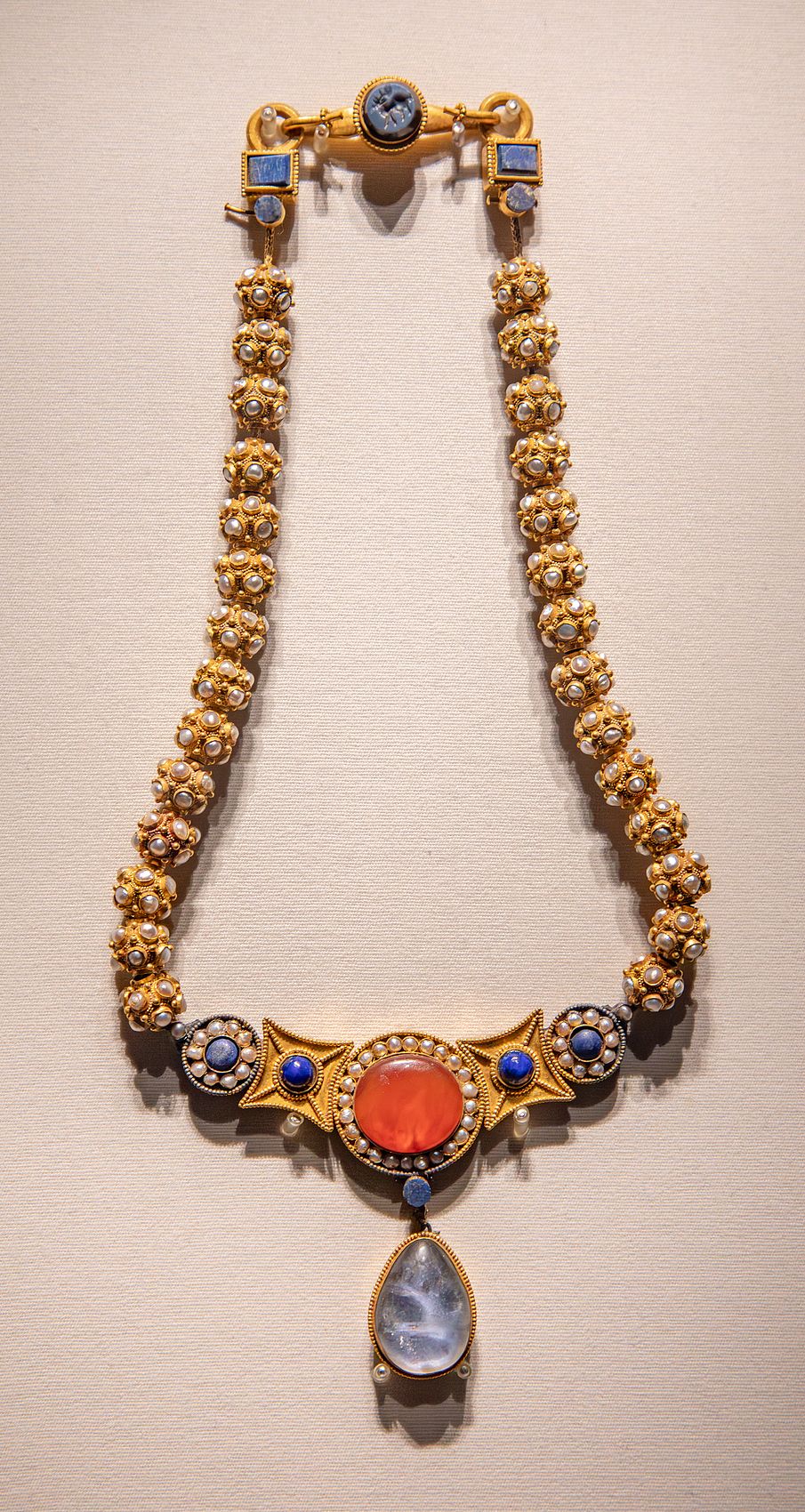
Inlaid with pearls and gemstones, the gold necklace excavated from Li’s tomb is crafted with exquisite workmanship that blends Central and West Asian styles of its period (VCG)
The burial goods were extremely extravagant. All 230-plus pieces were packed into the narrow space of less than three square meters between the stone outer coffin and the inner sarcophagus. Among them, the most enchanting piece was the gold hairpin with a “fluttering moth (闹蛾),” a fashionable accessory in the Sui court. The hairpin was crafted from thin gold sheets shaped into flowers, lotus leaves, and stems with a tiny moth on top formed from twisted gold wire that trembled at the slightest movement. The name “fluttering moth” evokes the vivid imagery of moths flying toward the light on Lantern Festival night. The insect’s complete metamorphosis, emerging from its cocoon, is also associated with rebirth. The hairpin is the earliest known example of a gold wire‑inlaid moth ornament, representing the pinnacle of Sui goldwork.
Another remarkable discovery was a gem‑inlaid gold necklace. Forty‑three centimeters long and weighing 91.25 grams, it was strung with 28 gold beads, each made from a dozen tiny soldered gold rings forming a hollow polyhedron and inlaid with 10 pearls. The necklace featured lapis lazuli from Afghanistan, gems from Central Asia, and Persian-style goldwork, making it clear evidence of Sui’s Silk Road connections.
Also discovered was a white glazed twin vase in the highest standard of porcelain of the era, and 24 pieces of glassware, ranging from traditional high-lead glasses derived from Han dynasty (202 BCE – 220 CE) techniques to soda‑lime glass bottles made using the blowing technique introduced from Central Asia. These findings demonstrate that Sui craftsmen had already mastered Western glass-blowing methods, providing important evidence of Sino-Western technological exchange.
These treasures have sparked a modern craze. The National Museum of China recently launched more than 40 cultural and creative products inspired by various artifacts associated with Li, ranging from fridge magnets of the moth hairpin to jewelry reproducing the gold necklace. Some items sold out almost as soon as they appeared.
The lavishness of the tomb makes the tragedy of Li Jingxun and her family all the more poignant. The year after her death, her grandmother passed away. A few years later, Emperor Yang of Sui, spurred by a prophecy that “a Li should become emperor,” suspected Li Jingxun’s father, Li Min, of plotting rebellion and executed him along with over 30 members of the Li clan. Her mother was forced to drink poisoned wine. Before long, in 618, the Sui dynasty was overthrown by Li Yuan, making the Sui the second-shortest unified dynasty in Chinese history.
More than 1,400 years later, both the Li family’s glory and the Sui dynasty have faded. What remains is Li Jingxun’s stone sarcophagus and treasures, quietly resting in the display cases of the National Museum. The life of that nine-year-old girl remains a mystery, yet through this intact underground palace, visitors can still catch a glimpse of her significance and the turbulent era she briefly witnessed.
Related Articles