
1
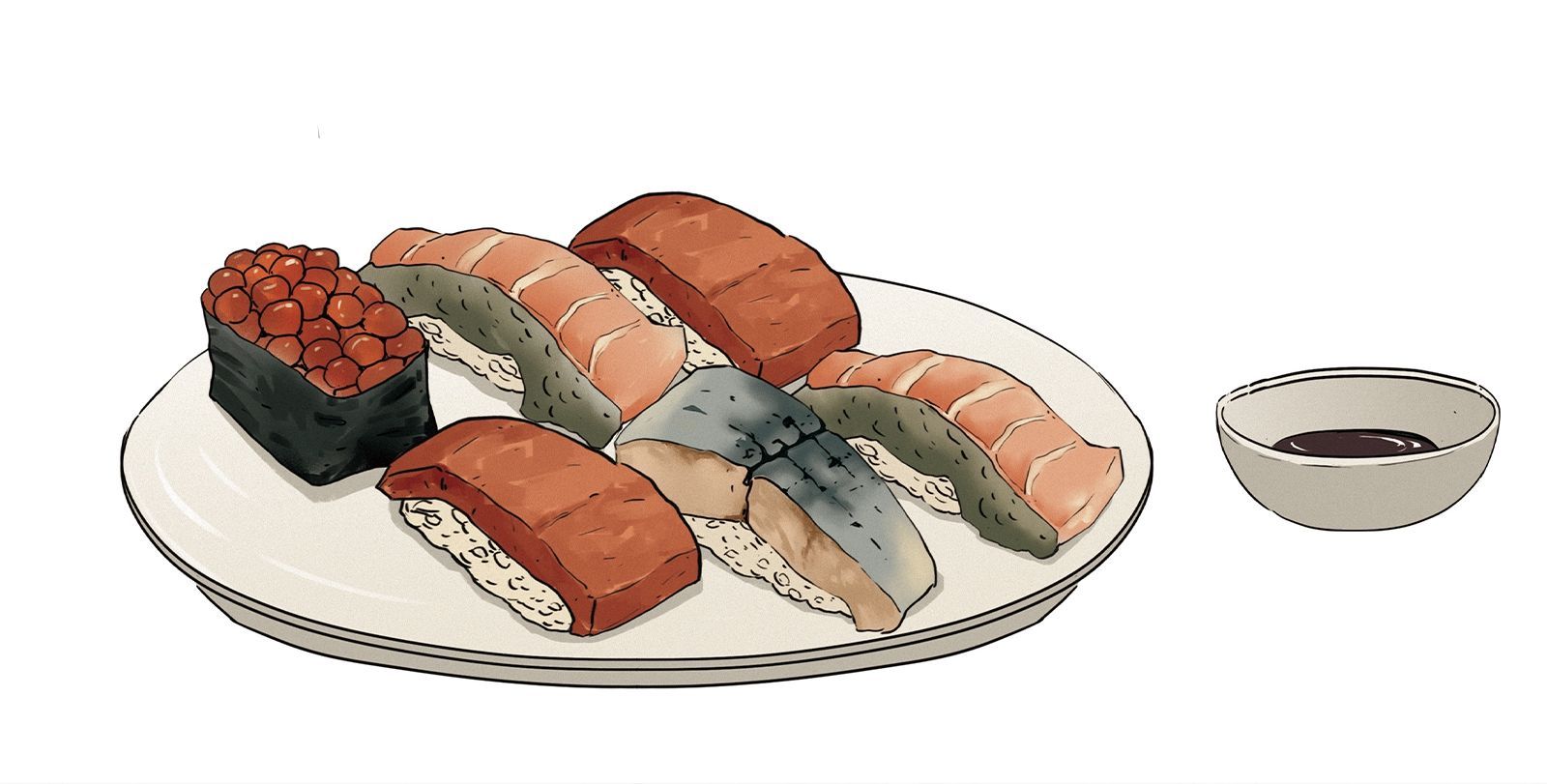
He was sitting across from me, wrapped in a down jacket. He might have eventually managed to blow a smoke ring he was satisfied with, had the waitstaff not asked him to stub out his cigarette. It was his birthday. He had flown a long way to celebrate it with me. I picked a sushi restaurant near the university. A Russian greeted us with an awkward, “Irasshaimase!”
He looked a bit annoyed. He tapped forlornly on the tabletop with the fingers that had previously been occupied by a cigarette. When the menu came, he pointed at the tuna, then the salmon, and I translated for the pretty, blonde waitress, who was clearly growing impatient with the process.
“If you’ve got some free time, do your old man a favor and ask around, will you?” he said. “Find out if there’s any work here.”
I nodded. I nodded and nodded and nodded, then finally cut him off: “Leave a phone number where I can reach you.”
Even if I was his biological son, I’d never gotten my father’s phone number. We kept in touch in other ways. We didn’t have the sort of relationship where he’d ring me up to say, like, “It’s getting late. Why aren’t you back yet? What are you up to?”
He’d only managed to track me down because of a heavy snowfall in Russia. One of my professors had helped me to find a part-time gig shoveling snow from the front of the school gate. I got through a week of back-breaking work for a pitiful few rubles. I checked the forecast every day, praying the snow wouldn’t come. The weather reports were wrong about everything else all year long, but they managed to predict snow with unusual accuracy.
When I got to work with my shovel, kids would run up and pelt me with snowballs. It was shortly after one of those ambushes, while I was brushing my back off with the snow shovel, that I looked up and saw my father getting out of a taxi.
He had a habit of appearing out of nowhere. He slipped away just as easily.
As we were polishing off the last of the salmon sashimi, I realized he still hadn’t given me his phone number. Instead, he kept pointing vaguely to the south.
He was pointing at the bathroom.
“It’s an expedition to the toilet this time, is it?” I said, teasing him.
He slapped his forehead. “The Indian Ocean,” he said. “It’s the Indian Ocean this time.”
“You going in for a little piracy—or maybe you’re going to conquer some little island in the Seychelles?”
He shook his head: “I’m going fishing.”
I know someone else might have anxiously demanded to know what their father was up to: “Fishing! Sounds dangerous. How long are you going to be gone?” But all I could think about was the salmon sashimi and how I wouldn’t be able to afford a meal like this for a while.
There was no birthday cake, so he made a wish over the sushi. He didn’t need candles to blow out, either. As long as the fish was fresh and delicious, he was satisfied.
I suppose my taste for raw fish probably came from my father. People liked to tease me for my habit of eating things raw. They called me a savage. They said I’d stalled somewhere in the evolutionary process. Maybe they were right about all that. Maybe that was also why I was so unperturbed by my father’s nomadic nature.
2
I saw him to security in Sheremetyevo International, and we stood around for a while, chewing gum, taking in the tearful farewells happening all around us.
As a child, I re-enacted those sorts of teary, reluctant farewells whenever I saw my father off, or when I was on my way back to boarding school.
But all of that changed on the day my mother told me that my father had gotten in trouble in Hong Kong: “He got in a fight with someone. The guy stabbed him. So, now he’s in the hospital. I guess he’s not going to bring back that little gift you wanted.” After that, I never wept when I saw him off. My mother had to fly all the way from the Northeast down to Hong Kong. For a couple of weeks, she was going back and forth, and back and forth. Finally, she showed up with my father again, cursing under her breath, with an armful of cosmetics.
I remember that we’d just moved from a bungalow to an apartment building. The walls were thin, so whenever anyone got into it, you could hear it clear as a bell. That night, my mother and father had a vicious fight. For a while, I stayed in bed and stuffed toilet paper in my ears. That didn’t work. So, finally, I ran out and called for the neighbors to come break it up. The tiny living room was suddenly packed with people. Even the little kids showed up. Some people were still in their pajamas, and others were barely dressed. My father got in one final smack across her cheek, which landed with a terrifying, sharp crack.
They went and got a divorce the next day.
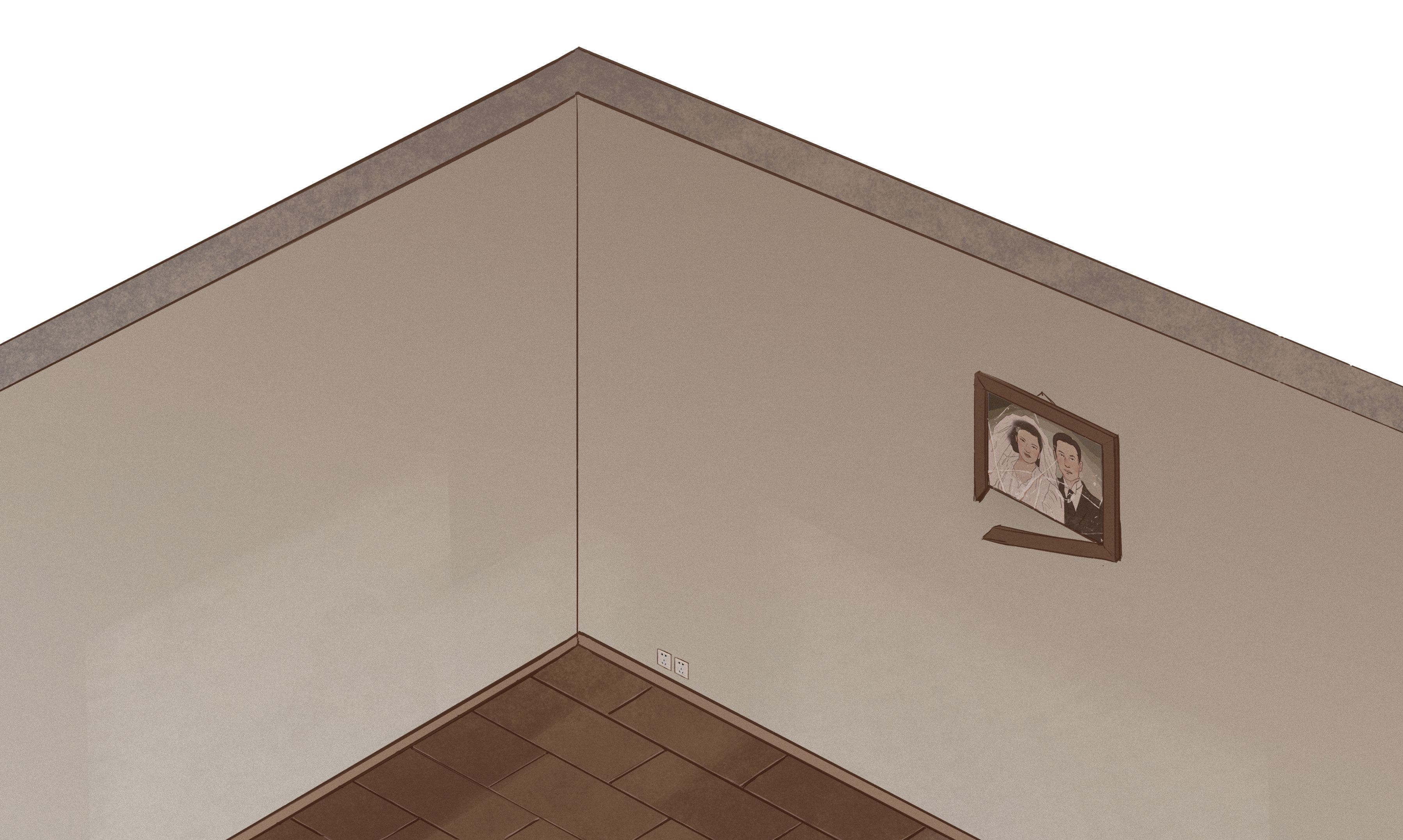
I was about ten, still in primary school. When my mother left, she stripped the apartment bare. She took the fridge with her, the TV set, and even the hair dryer and the iron. The only thing she left behind was my parents’ wedding portrait, still hanging on the wall, the glass in the frame smashed.
My mother didn’t want me, so I stayed with my father. He never held back from cursing her. It was “filthy whore” this, and “dumb bitch” that.
I remember one time, I was sitting there watching cartoons...There was a case on Black Cat Detective where a female praying mantis ate her husband, so I turned to my father and asked him why she’d done it.
He was drinking baijiu and eating peanuts. “That’s what your mother is—a praying mantis! The filthy whore took me for all I was worth, then ran off with some pretty boy.”
I knew I’d never get the real story from a male praying mantis, so I turned the TV off. He’d only replaced the set my mother took the day before.
I found out later what had really happened. While my father was doing business in Hong Kong, she’d been having an affair. After the fight and the stay in the hospital, she knew she was going to divorce him. The trips down to Hong Kong to bring him back had been opportunities for a few final shopping sprees.
I imagine a man in my father’s position might feel wounded. Even if he didn’t lose the will to live, he might spend a couple of months getting wasted. But my father didn’t. He replaced all of the appliances my mother had taken, then, without explaining what he was up to, prepared to go out into the world again to seek his fortune. He put me in the care of the old woman downstairs and left, leaving behind a photograph we’d taken together in Sanya the year before, when he’d taken me on a zipline. They charged fifteen yuan to snap your picture as you rode, which seemed outrageous, but my father had insisted we get a copy.
Like the miserable abandoned kid in every TV drama, I tucked the photo under my pillow. In the picture, we both had big smiles. I took it out to study whenever I missed him. I took it out whenever I missed my mother, too. I even took it out to look at whenever I was hungry.
He always brought me plenty of clothes and toys and food when he came back. The toys were never quite what I wanted. The clothes never fit. At least with the food, I could tell that he’d put some thought into his choices. It was always the sort of thing I’d never had before, like crocodile meat and smoked ostrich. There were all sorts of stuff. With my father’s snacks, I could taste the entire world. When my classmates made fun of my home life, I’d wave my crocodile meat under their noses and tell them how sorry I was for them, never getting a chance to taste it.
Another time, my father came home and immediately set to work in the kitchen. When I got home from school, I asked him what he was up to. He emerged from the kitchen with a plate of sushi. I’d never even heard of it before. He made it from scratch. He had learned the method from some Japanese people he ran into on the high seas off Shandong, while on one of his buying trips. The flavor was decent, even if the fish was maybe just a tiny bit off. The rice was a bit dry, but it gave his sushi a nice chew.
“Make it for me every day, Dad,” I told him. “Make it for me every day for a week—and then I don’t care if you go.”
He reached out and pinched my cheek. “You take after your mother, my boy. Little gluttons, the both of you.”
3
My father was a man who loved to wander. He had only one point of departure—our home—but so many destinations. I never knew where he’d be tomorrow. He said he didn’t know, either.
When I gave up on using my tears as a way to postpone his departure, I found plenty of other things were easier to take in stride. All the little tragedies of life became easier to swallow. Breakups, for example...
I was in my third year of junior high when I got my first girlfriend. She was my deskmate. We were pretty evenly matched when it came to schoolwork, and she’d even peek at my work when we had to write out poems from memory. I loved her sneaking glances. The way her eyes darted around was adorable. She looked like a kitten.
When I decided to ask her out, I brought her a container of homemade sushi. She agreed. We often held hands in English class, out of sight of the teacher. Her hands felt smooth and soft in mine, just like a slice of sashimi in my mouth. The deeper we fell in love, the lower our grades sank.
Eventually, our homeroom teacher caught us holding hands. He was peering in at the back door. He called us into his office. He wanted to see our parents, but I told him, with a tinge of regret in my voice, that I didn’t know where he was. I never expected him to show up the next day.
The atmosphere in the office for the meeting of our parents was not particularly pleasant. My girlfriend’s parents accused me of doing all kinds of things to their poor daughter. At this crucial moment, she betrayed me, too, accusing me of constant harassment. My father slapped me across the cheek. The sharp crack immediately brought back that night in our apartment, before my mother left.
The slap hurt so much that I considered taking the same road my mother had.
I lowered my head, my cheek burning. I saw that one of my father’s battered shoes had a big hole in it.
After that, my deskmate was switched to a new position in the class, far away from me. That was how we broke up. We became familiar strangers. Whenever our paths crossed, we avoided saying anything to each other. I cursed her under my breath, rubbing my still-smarting cheek: “Dumb bitch.”
When my father returned home from the meeting, he kept at me. I don’t know where he found it, but he started chasing me around with a tree branch. I’d never seen him so furious, even when he’d argued with my mother. I was terrified. I hit my knees in front of him, begging for mercy. He tossed his weapon aside, pushed me out of the way, and stormed out.
I didn’t see him again for a month.
When he finally showed up again, he still had on the same clothes he left in, as well as the old shoes with the hole in them. The only thing that had changed was that he seemed to have more white hair. I asked him where he’d been. From where he lay, sprawled on the sofa, he reached out to cup my face in his hands: “I’m done for, my boy.”
I only had a vague idea of what sort of business my father was engaged in. He sold leather and lumber sometimes. He dealt in oil and jewelry. He went out to fish. Another time, he was breeding Tibetan mastiffs. He kept sending me money, though. Sometimes it was a lot, sometimes a little, but it came steadily. He was dependable in another way, too: whenever he came home, it wasn’t long before he left again, back to his wandering.
But I never knew what was going on in his life at any particular moment.
I knew I couldn’t get an answer out of him. I could only study his sad face. He looked like a chimpanzee kicked out of the zoo.
He turned to booze with mad abandon. At home, he downed bottle after bottle of erguotou, spitting all over the floor. When I scrubbed up after him, I noticed blood in his spittle. He went out drinking with his gang and came home grinning like a young hoodlum, despite the shards of glass stuck in his neck.
He stayed home a whole month that time.
One night, when I got home just after midnight from a late study session at school, Grandma Wu rushed upstairs before I even had the chance to sit down. She told me my father had been in a fight and was lying out on the curb. I still had my school uniform on when I rushed out to find him. He wasn’t where Grandma Wu said he’d be, so I started searching for him. I went up and down every street in our little Northeast town, and finally found him lying beside a stinking drainage ditch.
Someone had cut his face open, and his neck and palms were full of broken glass. He was telling dirty jokes, laughing and scratching the cut on his face. His laughter echoed across the ditch and back again, right into my ear.
I cursed the old man under my breath and asked why he was fighting. A guy named Wang had taken his money, he slurred. The guy disappeared without a trace. My father had wound up sleeping on the street for three nights. As he spoke, he began to weep. His finger still waved about in the air.
“My boy didn’t have it easy,” he was saying. “Had to grow up without a mother. Came home to an empty house every day with his key around his neck.” His gesticulating hands suddenly failed and came to rest in the grass. “Don’t blame your father, my boy,” he said. “Your mother ran off with her man, but your father’d never abandon you. Even if he’s got nothing to his name, your father would never walk out on you.”
Tears ran down the wrinkles in his cheeks. As I struggled to help him up, I started to cry, too.
My father seemed to see me in the haze before his eyes. He reached out and stroked my cheek. “I’m not drunk, my boy,” he said. “I can still walk. But...but I just couldn’t find my way home.”
I put my arm around his shoulder. He stumbled and regained his footing. I suddenly realized then how much taller than my father I had grown. We walked home that night without saying a word to each other on the way. He didn’t notice that I was in tears.
I found out later that my homeroom teacher had called my father to come to the meeting. He was in Shanghai when he got the call, negotiating an important deal, but he’d rushed back as quickly as he could. When he got back to Shanghai, he found out that his savings and checking accounts had both been cleared out.
4
One day I came home from school to find the apartment completely bare, just like when my mother had walked out. The TV set, the fridge, the washing machine—they were all gone.
My father was holding something in his hand. He showed me that it was a pair of plane tickets. “We’re going to Japan next Monday,” he said.
I suddenly remembered: a little before, he’d pointed to a world map and asked me, “Where do you want to go? Point it out. Anywhere you like.” I drew a circle around that string of islands. I didn’t expect my father, jobless then, to sell everything in the apartment to buy us tickets. The place was entirely bare, with just our two beds left between the yellowed walls.
Back then, it still cost a lot of money to take a vacation out of the country.
It only took a couple of hours to fly from the Northeast to Japan, but we’d had to exchange every appliance in the house to afford a week there.
Once we got to Japan, my father took me out for some real sushi. I can still remember how it tasted. It was just like holding my girlfriend’s tiny hand under the desk: satisfaction and happy surprise spread through my entire body.
For that week or so, he told me not to worry about what would happen to us next, but simply to enjoy the moment.
My father shut his eyes and hummed a tune as he soaked in the onsen. “Why won’t you ever give me your phone number?” I asked him.
“I’ve got your number,” he said, then sank below the water.
When we got back to China, my father supported us with a job delivering parcels. He kept at it until I finished junior high and moved on to high school, but eventually he returned to his nomadic lifestyle. One morning, he disappeared without saying goodbye.
We started to see each other less and less frequently when I was in high school. His time spent at home became shorter and shorter. I had only a vague notion of what he’d been up to: business trips to India, driving a truck in Beijing, dealing in South Korean cosmetics...Things seemed to be improving. There was a new LCD TV set at home, then a fridge, and a washing machine.
He called me when there were about a hundred days until the college entrance exam. I asked him where he was. Yunnan, he told me, dealing in rice noodles. He said he planned to open a Yunnan-style noodle shop in the Northeast. I was at a loss for words, imagining the vast distance between us—from China’s southernmost province to its northernmost—and could only mumble, “Look after yourself.” After a moment, I added, “Come back as soon as you can. I want you to fly back. Don’t take the train.” And then I hung up on him.
I was used to living that way. I had been through a lot of changes. I’d seen my old man collapsed beside a gutter and riding on top of the world. So, it wasn’t a big deal when I failed the exam, and he sent me to Russia to study. I wasn’t afraid. I didn’t put up a fuss. Maybe it was because of some survival instinct I’d inherited from him.
5
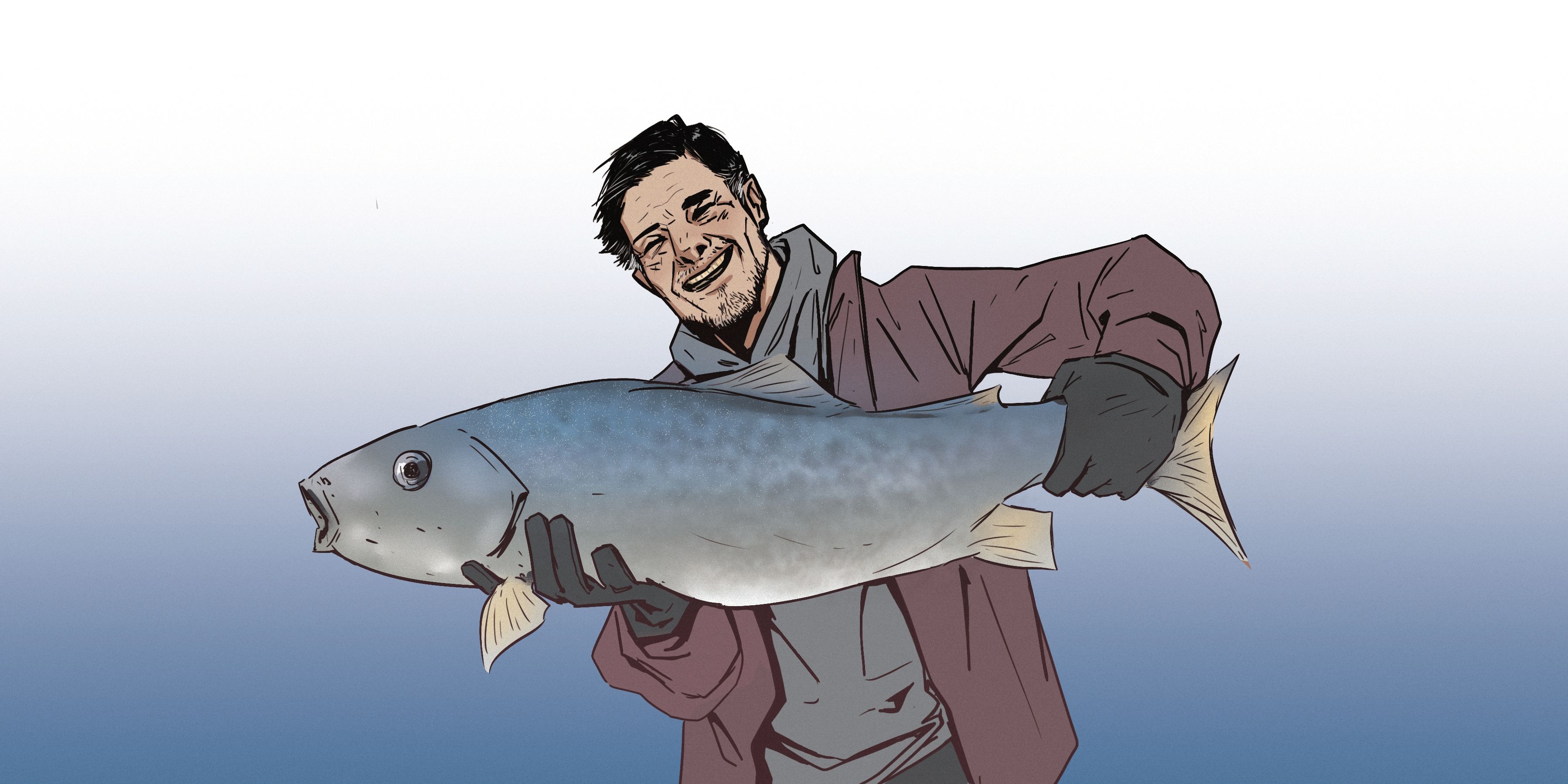
When my week of clearing the snow from the gate was done, I opened my email and saw a picture of my father, grinning broadly, holding a fish as long as his arm.
I thought again of that picture I’d treasured in my childhood, the one I’d look at under the covers, crying my eyes out. The only thing that hadn’t changed was that his teeth were as yellow as ever.
“I’ve got your number.”
It made sense at the time, but I know now it’s not quite so simple.
Author’s Note:
At 30, having come through a rough patch, I find myself entering a new phase of life. In this new chapter, writing has become an anchor as I rebuild a sense of order. It helps me push back against feelings of emptiness and loneliness while offering a space for self-reflection. I take my full-time job seriously, fully embracing the professional world. But I also seek a sense of freedom and ease in my creative work. The balance between these two worlds continually inspires me, allowing me to capture life as it unfolds. I’m happy with things as they are, and I hope that when I’m 60, I’ll still be writing.
Related Articles