
The character 权 (quán) is the ultimate symbol for power and authority in Chinese. Such power, or 权力 (quánlì), may stem from an incredible amount of wealth or prestige and reputation. But 权 is not just reserved for the rich and famous. 权利 (quánlì), though pronounced the same, means “rights”—something everyone can understand.
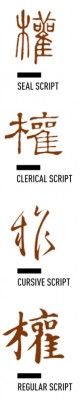
As to the origin of 权, some say its earliest form referred to a particular kind of plant, which was exemplified by the 木 (mù, wood, plant) radical on the left. The right radical used to be 雚 instead of 又, which was simplified in modern times, cutting all 17 strokes to merely two for easier usage.
For a more plausible explanation for the evolution of the character, we need to look at its other early meaning, which is as an instrument for measuring weight, or what would have been the sliding scale of a steelyard. It was also used as a verb, meaning “to weigh”. For instance, when philosopher Mencius was warning King Xuan of Qi in the Warring States Period (475 B.C.E.-221 B.C.E.) to be cautious of his decisions and rule with benevolence, he said: “By weighing, we know the weight; by measuring, we know the size. All things require study and reflection to learn, and motions of the mind are especially so.” (权,然后知轻重;度,然后知长短。物皆然,心为甚。Quán, ránhòu zhī qīngzhòng; dù, ránhòu zhī chángduǎn. Wù jiē rán, xīn wéi shèn.) He went on to beg the king to reconsider his decision of war and instead implement a benevolent policy to better his rule.
With the same root, the word 权衡 (quánhéng) originally referred to the sliding weight of the steelyard and its arm and now means “to weigh and assess”. 权衡利 弊 (quánhéng lìbì) means “to weigh the pros and cons”.
Because the scale, as an instrument that can measure definite weight, was considered authoritative, ancient Chinese began to use the steelyard as a metaphor for 权力. Officials with influence became known as 权臣 (quánchén), literally, “powerful officials”. Those in positions of great authority were given the name 权贵 (quánguì), or “bigwigs”.
The concept of authority and influence in power have continued into today. For example, 大权在握 (dà quán zài wò), literally, “to have great power in one’s palm”, which means to have total control over something, is a fitting word to describe dictators. Where there’s power, there’s struggle, hence 权力斗争 (quánlì dòuzhēng, power struggle). HBO’s sensational TV drama Game of Thrones is translated to “Game of Power” (《权力的游戏》 Quánlì de yóuxì) in Chinese.
In reality, there’s no lack of such games. “To usurp the position and seize power”, or 篡位夺权 (cuàn wèi duó quán), originally meant to wrest power and status from a monarch, now adapted to 篡党夺权 (cuàn dǎng duó quán), literally meaning “to usurp the Party and seize power”, a phrase used to condemn the notorious “Gang of Four” for their actions during the Cultural Revolution.
People with influence naturally dominate and have superiority over others, producing military terms like 制 空权 (zhìkōngquán, air supremacy), 制海权 (zhìhǎiquán, naval supremacy), and 主动权 (zhǔdòngquán, initiative).
The word 权利 is pronounced just like 权力, but has a different meaning. It is a combination of 权, “power” and 利, “benefits” and traditionally represents influence and wealth. However, in modern usage, 权利 indicates citizens’ rights, privileges and authority under the law, such as 生存权 (shēngcún quán, right to live), 生育权 (shēngyù quán, right to bear children), 宗教信仰自由权 (zōngjiào xìnyǎng zìyóuquán, right to hold religious beliefs freely), 隐私权 (yǐnsīquán, right to privacy), and ultimately, 人权 (rénquán, human rights)
Related Articles