Strange as it may seem, carving fruit pits—or drupes, pips, seeds, and nuts if you prefer—goes back centuries. Crafting peaches, apricots, walnuts, and even olives into Buddha gurines, jewelry, and landscapes has been practiced since the Spring and Autumn period (770 BCE – 476 BCE). What at first seems like the realm of the hipster is in fact the realm of the artisan.
Yun Peng (云鹏) adds his own style and imagination to his fruit pits. A post-80s generation artist; Yun graduated from the Art Department of Shenyang University, majoring in murals and frescos, woodcarving, and clay sculpture. In 2005, Yun started his fruit pit carving career, and in 2007 he founded his workshop Yiren Hequ (依人核趣), attracting many young artists to the art of pit carving, currently a popular platform for carving enthusiasts to communicate and share their works.
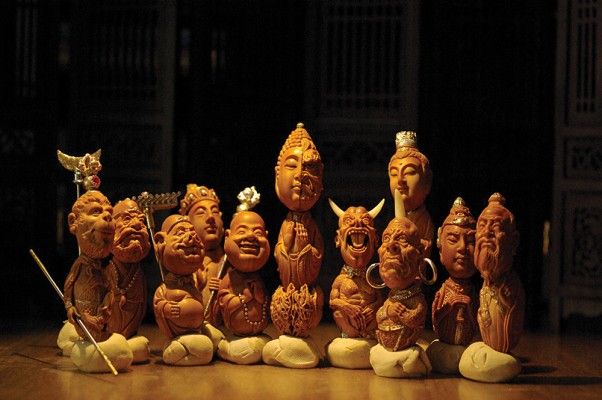
A New Journey to The West, 2013
Yun’s most famous pieces express a sense of active realism, often praised for the sense of life he gives to his subjects—sometimes even celebrities. Yun can lay claim to creating the split-carving (分体雕刻) technique, which allows him to compose a piece at scale while keeping the realistic details intact. Indeed, the medium is more malleable than one might think, even on such a small scale.
But Yun believes that an art work should be more than just imitation. Flawless technique is imperative, but that’s just the beginning. As an artist, you need to devote your feelings, explore your innovative techniques, and commit, he told TWOC.

Ninja Turtles, 2016
His intellectual ancestors would almost certainly agree. The earliest example of the art dates from the Song Dynasty (960 – 1279). However, it did not become popular until the Ming Dynasty (1368 – 1644). At that time, even the emperor owned master carvings, basic aristocratic decoration. It may have declined in mid-19th century, but the art is back in force in places like Suzhou, Weifang, Guangdong, and Liaoning.
Yun’s works have won many domestic and international awards. He feels proud of what he has done but says it is far from enough, with hopes that such a precious cultural relic will be recognized and loved by more and more people. In this aspect, Yun has done his part: creating the next generation of fruit pit carvers with the same dream.

Two Storytellers, 2014
“The World on a Fruit Pit” is a story from our newest issue, “Internet Celebrity”. To read the whole piece, become a subscriber and receive the full magazine. Alternatively, you can purchase the digital version from the iTunes Store.
Cover image is Yun’s Enlightenment, 2014
Related Articles