Newsletter
Popular

  • Society
  • Life
  • Business
  • Language
  • History
  • Arts
  • Literature
Podcast
Video
Magazine

  • China
  • International

  • About Us
  • Our Team
  • Join Us
  • Contact Us
  • Pitch to Us
Follow Us
Newsletter
The World of Chinese logo
Sign In SUBSCRIBE
Popular
Topics
  • Society
  • Life
  • Business
  • Language
  • History
  • Arts
  • Literature
Podcast
Video
Magazine
Shop
  • China
  • International
About TWOC
  • About Us
  • Our Team
  • Join Us
  • Contact Us
  • Pitch to Us
Subscribe
Cart
BOOKS

Interpreting ‘The Deer Park’

An analysis of 19 translations of Wang Wei’s classic poems has just been translated—back into Chinese

    author Sun Jiahui (孙佳慧)
Sun Jiahui (孙佳慧)
March 13, 2019
QQ图片20190313114026.jpg
Photo Credit:

Poetry often demands to be translated, but rarely is the process easy or the outcome sufficient. Take “鹿柴” or “The Deer Park,” a 20-character poem written over 1,200 years ago:

鹿柴

王维

空山不见人,

但闻人语响。

返景入深林,

复照青苔上。

Its writer, Wang Wei, was famous for composing in the shanshui (mountains and water) genre. Fellow poet Su Shi once reflected that “There is painting in his poems, just like poetry can be read from his paintings.” With its simple setting of a lonely mountain, and images of forest, moss, and sunshine, “The Deer Park” is a classic genre piece from a writer often known as the “poetry Buddha.”

Most pre-school kids in China can recite this short, simple poem. In translation, however, things become more complicated.  “The Deer Park” has been widely translated into several different languages, including English, Spanish and French, each with their own challenges and limitations.

Even the title “鹿柴” is open to interpretation—is it any park, a particular park, or even an abstract reference to the park in Sarnath, where Gautama Buddha first taught the Dharma? In translation, it’s impossible to convey all these meanings. Or take the second sentence (“the only voice can be heard (但闻人语响),” which, since nouns aren’t given singular or plural forms in Chinese, could refer to either a conversation or private monologue.

For American translator and writer Eliot Weinberger, this is all part of the charm of the job. Weinberger has collected different versions of “The Deer Park” from all over the world, and in his book 19 Ways of Looking at Wang Wei, chose a select number to introduce and review, from simple transliterations to Kenneth Rexroth’s highly loose interpretation. As Octavio Paz writes in an afterword to the book: “Eliot Weinberger’s commentary on the successive translations of Wang Wei’s little poem illustrates, with succinct clarity, not only the evolution of the art of translation in the modern period but, at the same time, the changes in poetic sensibility.”
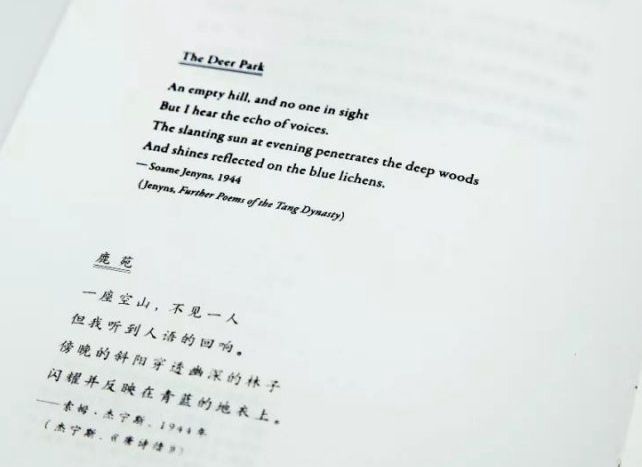
Now, Weinberger’s book has been translated back into Chinese, and published by the Commercial Press. Whether you are interested in Chinese poetry, or simply curious about the vagaries of translation, it comes highly recommended.

Tags:
TRANSLATION SU SHI THE DEER PARK WANG WEI

Related Articles

未标题-1 拷贝
BOOKS

Voice of the Masses: Su Tong’s Latest Translated Collection Reviewed

Bird Poacher: A bird stuck in a bird net
ENVIRONMENT

Catching China’s Bird Poachers

A Sabbath dinner held at the Jin family home in Kaifeng City, Henan Province (Jia Shuo)
SOCIETY

A Chinese Jew’s Journey to Israel

Lonely girl
LIFE

The Young Chinese Workers Struggling to Make Social Security Contributions

Related Articles

未标题-1 拷贝
BOOKS

Voice of the Masses: Su Tong’s Latest Translated Collection Reviewed

Su Tong’s new translated collection offers English-speaking readers a window into one of China’s best-known modern writers

Bird Poacher: A bird stuck in a bird net
ENVIRONMENT

Catching China’s Bird Poachers

”Why go to so much trouble for a bird?”

A Sabbath dinner held at the Jin family home in Kaifeng City, Henan Province (Jia Shuo)
SOCIETY

A Chinese Jew’s Journey to Israel

From Kaifeng to Jerusalem—a Chinese Jew tells her story of leaving for the Middle East and reflecting on her dual identity

Lonely girl
LIFE

The Young Chinese Workers Struggling to Make Social Security Contributions

With a slumping job market, young workers agonize over whether to pay their social security contributions or risk trading security now for an uncertain future

Subscribe to our newsletter

Scan to follow us on WeChat

Or add: Theworldofchinese

Topics

  • Society
  • Life
  • Business
  • Language
  • History
  • Arts
  • Literature
  • Photo Stories

Media

  • Magazines
  • Books
  • Podcasts
  • Videos

News and Events

  • Announcements
  • Events

About TWOC

  • About Us
  • Our Team
  • Join Us
  • Pitch to Us
  • Contact Us

PARTNERS

© THE WORLD OF CHINESE | 京ICP备05007371号-7