Modern China has a complicated relationship with homosexuality: It was decriminalized in 1997, but queer individuals continue to face social stigma and issues like conversion therapy and censorship of LGBTQ topics on Weibo.
Some historians, however, argue that the situation was much different in ancient history: In Chinese history, with Tamkang University researching Liu Deming even suggesting in a 2009 paper that homo-erotic relationships were trendy among noble and intellectual men during the Qing dynasty. There were also several emperors and kings in Chinese history renowned for their love stories with other men:
Emperor Ai cuts his sleeve
The last emperor of the Western Han dynasty, who ruled from 7 BCE to 1 BCE, was the inspiration of the idiom “Sleeve-cutting affection,” which refers to homosexuality. According to The Book of Han, Emperor Ai loved an official named Dong Xian, and one day, Dong fell asleep on the emperor’s shoulder. When the emperor wanted to get up, he cut his sleeve rather than wake his still-sleeping lover. Though the emperor also had a wife and several concubines, one of whom was Dong’s sister, records say that Dong slept in the emperor’s bed, and was rewarded with hair combs and baths like any imperial consort.
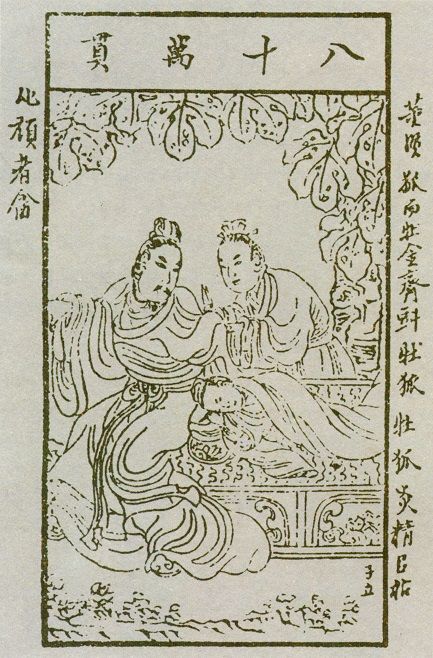
A Ming dynasty illustration of the “Cut Sleeve” story (VCG)
However, Ai’s favoritism had a cost: Dong was promoted to be a military commander in a very short period, creating discontent at court. The childless Emperor Ai even named Dong as his successor before his death at age 24, but an official named Wang Mang seized the throne and ordered Dong to commit suicide.
King Anxi and Lord Longyang
This king of the state of Wei, who ruled from the Warring States period, gave rise to another famous Chinese idiom about same-sex love: “Longyang’s affection (龙阳之癖).” According to the book The Strategies of the Warring States, King Anxi and his favorite courtier, Lord Longyang, went fishing in a boat one day. After catching ten big fish, Lord Longyang began to cry. King Anxi asked him what was the matter, and Lord Longyang replied, ” I was happy when I just caught one fish, but after I caught those bigger fish, I wanted to throw away the small fish. I am lucky to sleep on the same bed with the king today. However, within the four seas, there are many pretty girls. If they know I am spoiled by the king, they will use different ways to seduce Your Majesty, and I will be abandoned just like those tiny fish. How could I not cry? ”
King Anxi was touched, and issued an order, “Within these four seas, whoever dares to introduce me a pretty girl, I will exterminate their clan.” Though the edict was obviously tyrannical, no doubt Lord Longyang felt reassured.
Duke Ling eats a leftover peach
The Legalist scripture Han Feizi contains a story about Duke Ling of the Wei state, who admired a handsome young man called Mizi Xia. One day, when Mizi Xia’s mother was sick, he borrowed the king’s chariot without asking and went to visit his mother. According to law, such an act was punishable by cutting off the offender’s legs, but not only did Duke Ling not punish Mizi Xia, he praised his filial piety.
Read More
- Is Qianlong Emperor the Worst Poet in Chinese History?
- What’s Inside the Tomb of China’s First Emperor?
- Love for Boys’ Love
Another time, Mizi Xia and Duke Ling were strolling about a garden. Mizi Xia picked a sweet peach, ate half and gave the remaining half to Duke Ling. It would have been a great insult for anyone else to give their leftovers to their duke—but Duke Ling took it as a sign of Mizi Xia’s affection for him. Thus, the phrase “Leftover peach affection” (余桃之癖 ) also became a chengyu to describe a homosexual relationship (see a pattern?).
Emperor Wen’s lover mints coins
There’s some debate about whether Deng Tong (邓通), a lowly-born “male favorite” (男宠) of Emperor Wen of the Han, was really the emperor’s lover or simply a trusted confidante (some versions of the tale say that Deng resembled a god that Emperor Wen had seen in a dream, thus explaning the emperor’s attachment to him). Nevertheless, the two was so close to that Deng would help suck the pus from the emperor’s ulcers, and as reward for this disgusting task, Deng was given a mountain where he could mine copper and make his own currency, called “Deng Tong coins.”
However, after Emperor Wen’s death, Deng’s monopoly came to an end. The new Emperor Jing stripped Deng of his official position and confiscated his mine, and Deng died penniless, with his story becoming a parable for the ups and downs of fortune.
Emperor Wu’s male companions
Emperor Wu, the fourth emperor of the Han, is known for his many affairs with women, but the Records of the Grand Historian and the Book of Han also mention a courtier named Han Yan who slept and woke with him every morning. Their relationship was compared to that of Emperor Wen and Deng Tong. Han could freely enter the imperial harem, but was eventually put to death by the dowager empress for seducing a maid. Emperor Wu was also reputed to have been close with several other men, including Han Yan’s brother Han Shuo, and the musician Li Yannian; the latter, brother of the emperor’s favorite concubine Lady Li, also “slept and rose” with the emperor.
Related Articles