As a long-time history enthusiast, I took a road trip to Shouyang Mountain in China’s central Henan province over the Chinese New Year holiday to visit someone I love, who died 1,800 years ago—Cao Pi (曹丕), also known as Emperor Wen of Wei, who formally ended the Han dynasty and wrote poetry known for its melancholic tone.
I fell in love with Pi last year when I reread Records of the Three Kingdoms (《三国志》), the official history of the period. In his instructions to his own funeral arrangements, I was shocked to find: “From ancient times to the present, no kingdom has lasted forever, and no tomb has gone unlooted.” No founding emperor has been so acutely aware of his own mortality. Because of his attitude toward burial, there’s no mausoleum or even tombstone marking his grave. All we know is that he was buried at the southern foot of the Shouyang Mountain, northeast of the capital city, Luoyang. Despite this, fellow enthusiasts have identified a pavilion as his memorial spot.
Upon arrival, I saw a wide range of offerings dedicated to Pi: flowers, calligraphy scrolls, red banners with trendy catch phrases such as “Make Wei Dynasty Great Again,” or specific historical references with a sentimental personal touch, “Let me be the southwest wind, and lose myself forever in your arms”—a famous verse addressed to Pi by his younger brother Cao Zhi (曹植). There were also boxes of fan letters written by admirers from across the country. Postcards and badges were left for fans to take for free. The scene reminds me both of a theater’s backstage, where gifts and letters pile up, and, perhaps even more closely, a booth at a comic convention, where fans of ACG (animation, comics, and games) showcase, sell, or exchange their fan art.
Explore the hidden history of ancient China:
- What Video Games (Don’t) Teach Us About China
- The “Little Girl” Who Revealed an Empire
- Thespian Emperors, Mandatory Castration, and Deadly Poetry: Fascinating Facts About China’s Forgotten Age of Chaos
Visiting the graves of prominent historical figures and leaving creative offerings has become a recent trend among young Chinese, reflecting a renewed interest in history. Popular sites include the tomb of the warlord Cao Cao (曹操), who lived in the late Eastern Han dynasty (25 – 220), and that of the Tang dynasty (618 – 907) poet Li Bai (李白). Admirers have left various offerings at the two sites, including painkillers for Cao’s migraines and liquor for Li’s poetic inspiration.
But among these visitors, a special group of enthusiasts, dubbed shitongnü (史同女), or “history fangirls,” myself included, is doing more than paying respect. Driven by intense personal interest and drawing on both historical records and popular media portrayals, history fangirls actively research historical topics and create and consume fanworks, from fiction and art to short videos, memes, and more.
The term shitongnü derives from the Japanese word dojin (同人, tongren in Chinese), referring to fan works based on existing characters or settings from ACG, novels, television dramas, films, or even history. With young women at its core, the term highlights a distinctly female perspective on history that extends beyond the interests and practices typically associated with conventional history enthusiasts.

At the Tomb of Cao Cao in Anyang, Henan province, fans have left painkillers, flowers, letters and fan works as offerings to the late Han warlord (VCG)
I first found a strong resonance with a historical figure over a decade ago, after failing to gain admission to my dream university. Having grown up around the university campus, I felt an intense sense of exile. During the year I spent preparing for a second attempt, I became deeply drawn to Qu Yuan (屈原), the poet and statesman who lived during the fourth and third centuries BCE. Banished by his own state, he poured the grief and solitude of his exile into some of China’s most enduring poetry. Reciting his lines, “At dawn I drink the fallen dew from magnolia blossoms; at dusk I feast on the petals shed by autumn chrysanthemums,” I imagined him leaving his homeland and wandering along the banks of the Miluo River. I even visited the river myself, feeling that the landscape still carries his memory.
But the history fangirl community today is more influenced by pop idol fan culture, in which young women form devoted fan groups and support their chosen celebrities by frequently attending events with banners, collecting merchandise, posting on social media, sending gifts, and organizing fan activities. Likewise, history fangirls have jokingly referred to visiting the graves of historical figures as “meeting our underground idols.” One 26-year-old fan interviewed by Sanlian Life Weekly Magazine said she had visited 52 graves in a single year.
Beyond making such pilgrimages, history fangirls also express their admiration for historical figures through creative works, another practice that lies at the heart of the subculture. Through fan fiction, artwork, and other creative projects, history fangirls share their interests on platforms such as Lofter, China’s largest tongren community, and major web novel sites, including Jinjiang Literature City and Tomato Novel. These works even circulate on the international fan fiction platform Archive of Our Own (AO3), where the tag “Chinese history RPF (Real Person Fiction)” includes over 7,000 Chinese works.
In these fan fiction, besides reimagining historical figures’ lives or retelling historical events, writers also create modern alternate universes, placing historical figures in contemporary settings while preserving their personalities and relationships. In one comedic story on Lofter, Cao Zhi becomes an intern at his elder brother Cao Pi’s company, hoping to earn a promotion by winning his approval. The story draws on the real-life rivalry between the brothers over the succession to their father, Cao Cao. After Pi emerged victorious, Zhi wrote several poems that appealed to their brotherly bond and ultimately persuaded Pi to spare his life.
Rather than wild imagination, many fan works are grounded in meticulous research. Many of my peers and I read historical records, cross-reference sources, and debate interpretations for our writing projects, much like history students working on dissertations. But the fact that we call it “fiction” means we are not trying to faithfully reconstruct history, but to imagine “what if” possibilities within it. For example, what if the Shu strategist Zhuge Liang (诸葛亮) had succeeded in his northern campaigns against the Wei state and restored the Han dynasty?
While traditional history enthusiasts, like those of my father’s generation, tend to focus on historical verdicts, debating who was right and who was wrong, we history fangirls are drawn to something else entirely: aspects of the past that history books cannot objectively capture—the inner lives of historical figures. As a result, historical fan fiction frequently features romance but is not defined by it. Instead, we seek to fill in the gaps left by official records, imagining the private lives, relationships, and emotional worlds of historical figures.
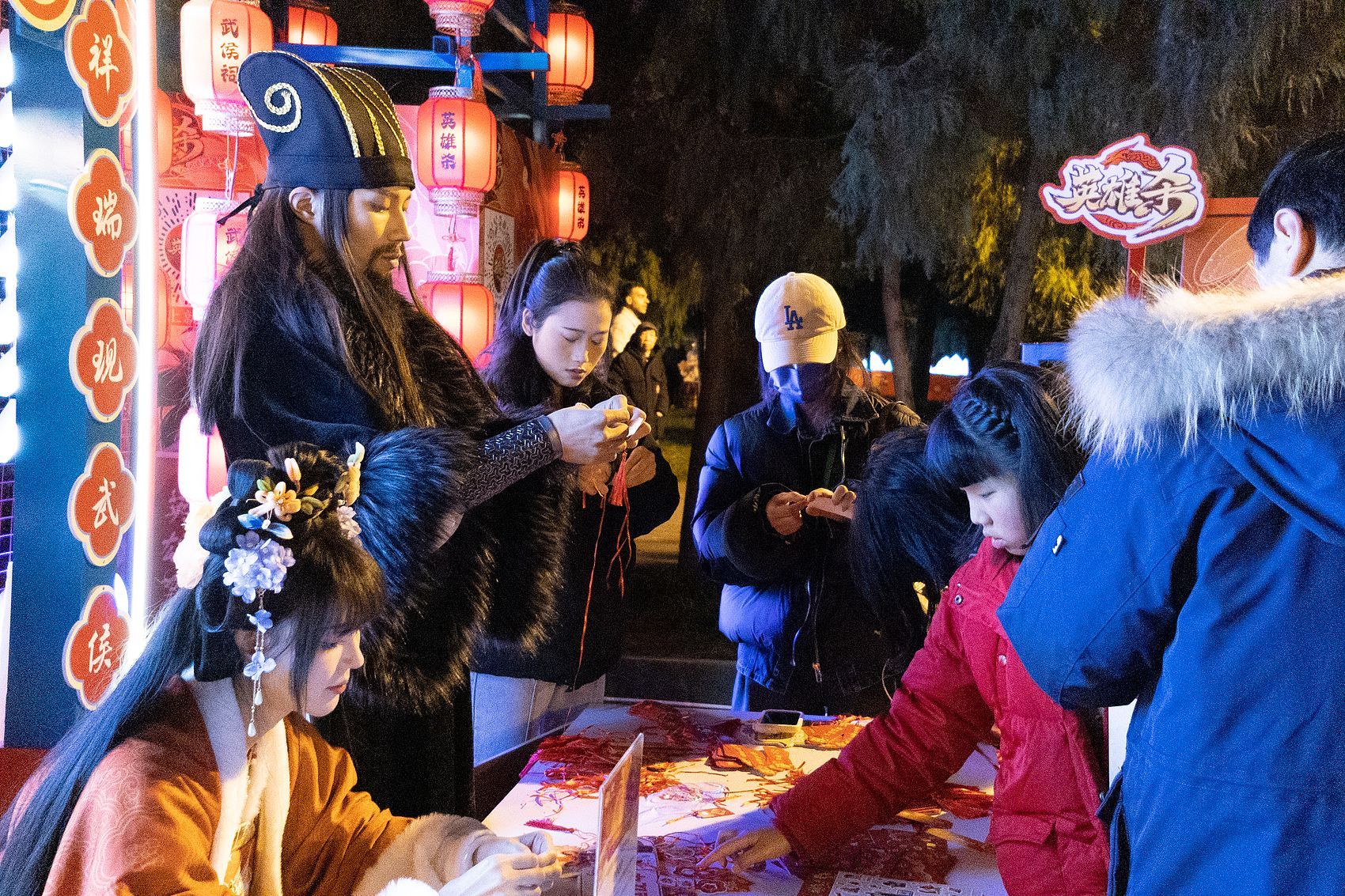
A staff member at Wuhou Shrine in Chengdu, Sichuan, dressed as Zhuge Liang to interact with visitors during the Lantern Festival in 2024 (VCG)
Historical tourist destinations across the country have also capitalized on this growing interest, embracing fangirl culture to attract visitors. Many heritage sites, such as the Tomb of Cao Cao, now display fan letters and gifts, while Wuhou Shrine in Chengdu, Sichuan, widely regarded as the premier site dedicated to Zhuge Liang, has staged performances aimed at history fangirls. During this year’s Lantern Festival celebrations, performers dressed as Zhuge Liang and his lord Liu Bei, one of the most popular duos in Three Kingdoms fan fiction, presented a duet dance that many described as tender and affectionate. Meanwhile, a group of performers dressed as Shu generals danced to rhythmic beats, staging the kind of modern alternative-universe scenarios fans have long imagined.
But like pop idol fan culture, where excessive devotion can become an issue, the growing popularity of grave-visiting has also created unintended problems. Many of these sites, such as the pavilion on Shouyang Mountain associated with Cao Pi, were never designed to be tourist attractions. Without dedicated staff for maintenance, the steady stream of offerings can accumulate as waste. “There is no one here to clean up,” wrote one Xiaohongshu (RedNote) user. “Food and flowers left here will rot into something disgusting. The banners were fun at first, but now there are too many—after wind and rain, they’re just trash.
The rise of history fangirl culture has also revealed tensions between popular engagement with the past and the authority of academic interpretation.
When Xin Deyong, a retired Peking University historian, criticized Zhuge Liang for the military campaigns he led against the Wei State in the north as a disservice to his own people and state, the uproar online led to the cancellation of his planned lecture at Wuhou Shrine. While some netizens argued that the topic belonged in a lecture hall rather than at a shrine honoring Zhuge Liang, Xin took to social media to call the cancellation “a victory for the mob” and lament that “fan culture has infiltrated everywhere.”
But ultimately, there is likely room for coexistence. The boundary between historical fiction and historical fan fiction is never sharply defined, and history is always open to alternative interpretations. Romance of the Three Kingdoms, the 14th-century novel, now considered one of the Four Great Classical Novels of Chinese literature, is itself a romanticized retelling of history, populated with vivid characters and memorable plots. Liu Bei, the founding emperor of Shu and a clear favorite of the author Luo Guanzhong (罗贯中), is depicted as a tearful, soft-hearted hero, though historical records suggest he was more likely a bold and battle-hardened leader shaped by years of military campaigns. The author also dramatically intensified the relationship between figures such as Zhuge Liang and Zhou Yu (周瑜), a statesman of Wu, transforming what was likely a brief historical acquaintance into a legendary rivalry. In doing so, Luo recast the heroic center of the narrative, shifting attention away from Cao Cao, the politically dominant figure of the time, who was instead cast as a villain. This act of literary imagination has shaped how billions of people understand the Three Kingdoms today.
History fangirls may not be historians, but in visiting graves, writing stories, and imagining the inner lives that official records never captured, we are doing something Luo once did, something Cao Pi understood well: claiming the right to tell their own version of history. Just as Cao Pi once wrote: “A man’s years are numbered, and his glory dies with him—these are the fates no one escapes. But writing alone knows no such limit.”
Becoming a “Fangirl” of History is a story from our issue, “I, Humanoid.” To read the entire issue, become a subscriber and receive the full magazine.
Related Articles