

Ancestry tests are on the rise in the still-controversial area of Chinese genetic testing
Xia Yidan had long been curious about her ethnic identity, at least according to gene-testing company 23Mofang.. “I am a Uyghur from Karamay, Xinjang…[but] people always say I don’t look like I’m from Xinjiang,” she writes in a WeChat testimonial for the Chengdu-based firm.
Curious to know more, she joined the growing number of Chinese who have taken a genealogy test, and got unexpected results: 54.1 percent Uyghur and 43.5 percent “European lineage.” “I am quite surprised to see my lineage is so pure, because I think it’s normal to have mixed blood in a multi-ethnic area,” Xia wrote. Besides her ethnic lineage, she claims, the test also revealed her risk for certain genetic diseases, her “nutrition requirements,” and the best way for her to lose weight.
In the US and elsewhere, the popularity of genetic tests has soared in the past decade—and now China is joining in. In 2017, the Chinese genetic testing industry was valued at 1.43 billion USD and is expected to reach 4.33 billion USD by 2023. 23Mofang, China’s largest provider, has so far tested 500,000 people, and plans to increase that to 50 million in the near future.
As standards of living improve, Chinese people are becoming more concerned about their health. Government mandates have educated and encouraged citizens to make healthier lifestyle choices, such as by eating less meat and exercising regularly.
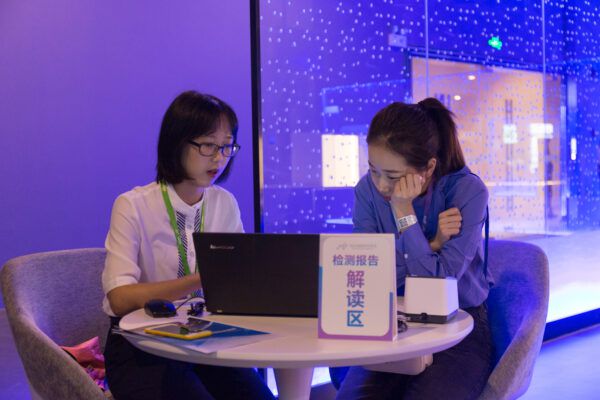
A sales representative explains the results of a gene-based health test to a customer at a testing center operated by nutrition brand By Health
Genetic tests—which can reveal inheritable health risks, confirm diagnosis of a disorder, and predict the likelihood of contracting certain diseases, and not yet officially encouraged—but appears to have become a fashion. “As soon as I got the box [containing the test] from 23Mofang, I posted pictures of it to my WeChat Moments,” the company quotes Xia as saying. “I also posted my results.”
Gene tests are also more affordable and accessible than ever thanks to technological improvements. The top international test-providers, Ancestry and 23andMe, offer their services for as low as 99 USD. 23Mofang, the largest provider in China, sells basic tests for as little as 449 RMB (64 USD).
In China, domestic providers such as 23Mofang, WeGene, and Novogene have the competitive advantage of catering their tests to East Asians. Gene tests from Western companies categorize Asians into broad ethnic groups such as Chinese, Korean, Japanese, Filipino—effectively meaningless to test-takers within China, where there are 56 ethnic groups (though 92 percent of the population are Han). Preferential policies and exemptions for ethnic minorities in areas like family planning and university admissions also entice the population to explore the nuances of their identity.
23Mofang also purports to tell customers if they have royal ancestors, or hail from north or south China. Lineage, though, is only part of the attraction, as many Chinese companies controversially offer genetic tests for aptitude and personality. 23Mofang claims to be able to assess traits such as altruism, one’s ability to handle pressure, and how prone one is to making mistakes.
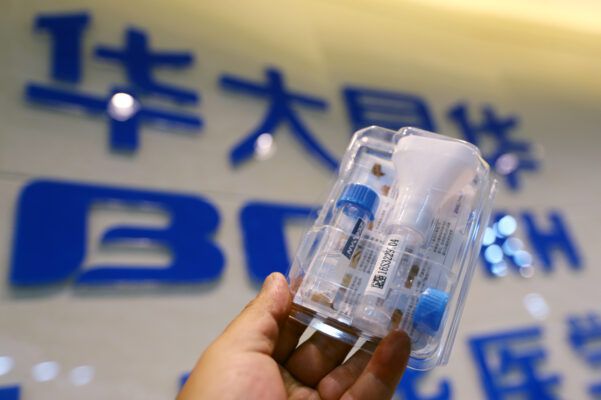
Staff demonstrate a blood sampling kit used by a Kunming-based gene-testing company
Other tests on the market claim to measures of talent in music, memory retention, sports, reading, and more, and are often advertised to parents hoping to give their children a leg-up in China’s ultra-competitive education system. In 2017, Chinese celebrity Ran Yingying paid Guangzhou-based DaAn Gene 6,500 RMB to have her son’s talents measured. Elementary schools in Shenzhen have even begun to use gene tests to dictate students’ coursework based on their alleged “strengths,” despite the flimsy science behind such tests.
Another big area of concern with genetic testing is consumer privacy. Last year, the Chinese Ministry of Science publicly denounced five biomedical companies and hospitals for sharing genetic information without consumer or government permission. Zheng Caogu, professor at the University of Hong Kong, warns consumers, “You don’t know what [gene companies] could be doing with your sample, and the scary part is that…without regulation, they can do many things that could constitute an invasion of privacy.”
Despite concerns, the chance to understand a bit more about oneself for a relatively low price is attractive, and the gene-testing industry continues to flourish. For customer Xia, the news that she might not need to begin a high-intensity exercise program in order to lose weight was greeted happily: “If I rely just on exercising, I won’t lose much weight…for any girl this is definitely the best realization.”
Cover image from VCG.
Related Articles