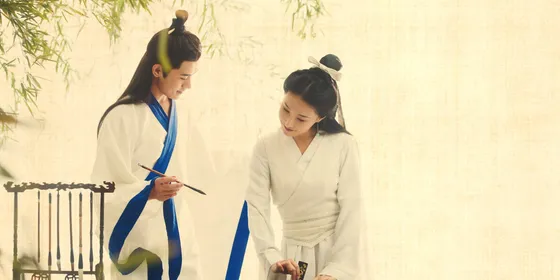
Couples all around China will face a unique challenge today: Celebrating Valentine’s Day in the time of coronavirus. Since health experts are advising people to stay indoors and avoid contact with other people, time-honored traditions like exchanging love tokens and visiting a wanghong restaurant may prove difficult.
Expressing one’s feelings with words, though, has always been in vogue. Even in ancient times, before there were cheesy posters one could share on WeChat, people wrote of their love in poems and other forms of literature. Here are some of the most romantic verses from classical Chinese poetry.
窈窕淑女,君子好逑。
Gentle and graceful is the girl/ A fit wife for the gentleman.
Young love can be bittersweet. “Guan Ju,” a poem in the Shijing, China’s oldest collection of songs and poems, describes a young man who falls in love with a pretty girl at first sight, and can’t fall asleep due to thinking about her. This famous line describes the young man’s thoughts, and is still often used today to express affection.
既见君子,云胡不喜?
Since I finally see the lad/ How can I be not happy?
If “Guan Ju” describes a young man’s one-sided amour, “Wind and Rain,” another work from the Shijing, depicts a scene where a young woman waits in the driving rain to meet her lover. When he finally shows up, she is nothing but happy.
郎骑竹马来,绕床弄青梅。
You came by on stilts and bamboo horse/ You walked about my seat, playing with green plums.
People always remember their first love, even if it doesn’t end well. Tang dynasty poet Li Bai’s “Chang Gan Xing” provides this classic description of the innocence of young love. Today, the chengyu “green plums and bamboo horse” is still used to refer to a boy and a girl who have grown up together since childhood.
山无陵,江水为竭。冬雷震震夏雨雪,天地合,乃敢与君绝。
Till mountains crumble/ Till rivers run dry/ Till thunder rumbles in winter/ Till snow falls in summer/ And the earth mingles with the sky/ Not till then will my love die.
“Till death do us part” is a common marriage vow, but for some people, even that isn’t enough to express their resolution. In this folk poem from the Han dynasty, the anonymous author listed five impossible events that would make them give up their love (i.e. never). This poem was even quoted by famous romance novelist Qiong Yao in her work Princess of Pearl, and became a meme in the 1990s.
两情若是长久时,又岂在朝朝暮暮?
If their love can last for an age/ Why need they stay together night and day?
Some couples can’t bear to be parted even for a second, but Song dynasty poet Qin Guan disagreed. In his poem “Que Qiao Xian,” Qin used this line to praise the bond between legendary lovers Niu Lang and Zhi Nü, who are separated by the gods and can only meet once a year during the Qixi Festival, believing that distance won’t affect true love.
还君明珠双泪垂,恨不相逢未嫁时。
I shed tears as I returned the pearls you gave me/ If only we could have met before I was married.
Not everyone is lucky enough to find the right person at the right time. Just like in the 1995 movie The Bridge of Madison County, where Francesca Johnson can’t be with her true love due to responsibility to her family, Tang dynasty poet Zhang Jie’s “On a Virtuous Woman” tells the story of a married woman who meets a man who gives her two precious pearls as presents. The woman returns them in order to stay with her family, and expresses her heartbreak with this line.
曾经沧海难为水,除却巫山不是云。
No water is wide enough if you crossed the sea/ No cloud is beautiful but that crowns the Mountain Wu.
The elegy (悼亡诗) is an important genre of ancient Chinese poetry. When talented poets lose their love, they often expressed their grief in verse. Among those countless mourning poems, Yuan Zhen’s from the Tang dynasty is the best known. In “Memory of my Wife,” Yuan writes this line to express that after his wife died, it was impossible for him to fall in love with another.
Cover image from pexels.com
Related Articles