

Game Science, the developer behind China’s blockbuster AAA hit Black Myth: Wukong, which stunned global gamers last year, unveiled a trailer for its new title, Black Myth: Zhong Kui, on August 20 during Gamescom, one of the world’s largest digital game trade fairs, held in Cologne, Germany.
The less-than-2-minute trailer quickly drew the attention of the gaming world and sparked lively discussions about the mythological figure at the heart of the game: who exactly is Zhong Kui?
Check out our recounting of the legendary “demon hunter” in Chinese mythology:
Head like a leopard, bulging eyes, stony expression, and a bushy beard…. It may not sound like your type, but according to Chinese legend, this is the perfect face for scaring away ghosts. This is the job of a Chinese deity called Zhong Kui (钟馗), who was once rejected by the emperor because of his strange looks.
According to the Comprehensive Mirror on Past Deities (《历代神仙通鉴》) from the Ming dynasty (1368 – 1644), Zhong Kui was a mortal man who lived near the Zhongnan Mountains of northern China during the reign of the Tang dynasty’s (618 – 907) first emperor. Adept at both the literary and martial arts, he went to the capital city Chang’an (modern Xi’an) to take the imperial civil service examination. The official examiners were so impressed by Zhong that they gave him the title of jinshi (进士), the name for a scholar who passed the highest level of the imperial exams.
Discover more about renowned historical figures in ancient China:
- The Dreams of Tang Xianzu, the “Shakespeare of the East”
- Qin Liangyu: Ancient China’s Unstoppable Female General
- Rediscovering Zhang Qian
However, when Zhong appeared at court to seek an official post, the emperor rejected him for being too ugly. Overcome with anger and grief, Zhong took his own life by striking his head against the palace steps. Moved by his death, the emperor granted him the honor of a red shroud, reserved only for officials, for his burial.
Decades after Zhong’s death, another emperor of the Tang, Xuanzong, came down with a spleen disease and couldn’t be cured for many years. One night, he dreamed of an ugly and rough man who caught a little demon, dug out its eyes, and ate it alive. The man in the dream yelled at the emperor that he was “the jinshi who couldn’t get a government post, Zhong Kui!“ When Xuanzong woke up, he was cured. The emperor immediately summoned the famous painter Wu Daozi (吴道子) to paint a portrait of Zhong Kui, which he hung in his palace to ward off evil spirits. He would also send paintings of Zhong to his officials at the end of each year as gifts.
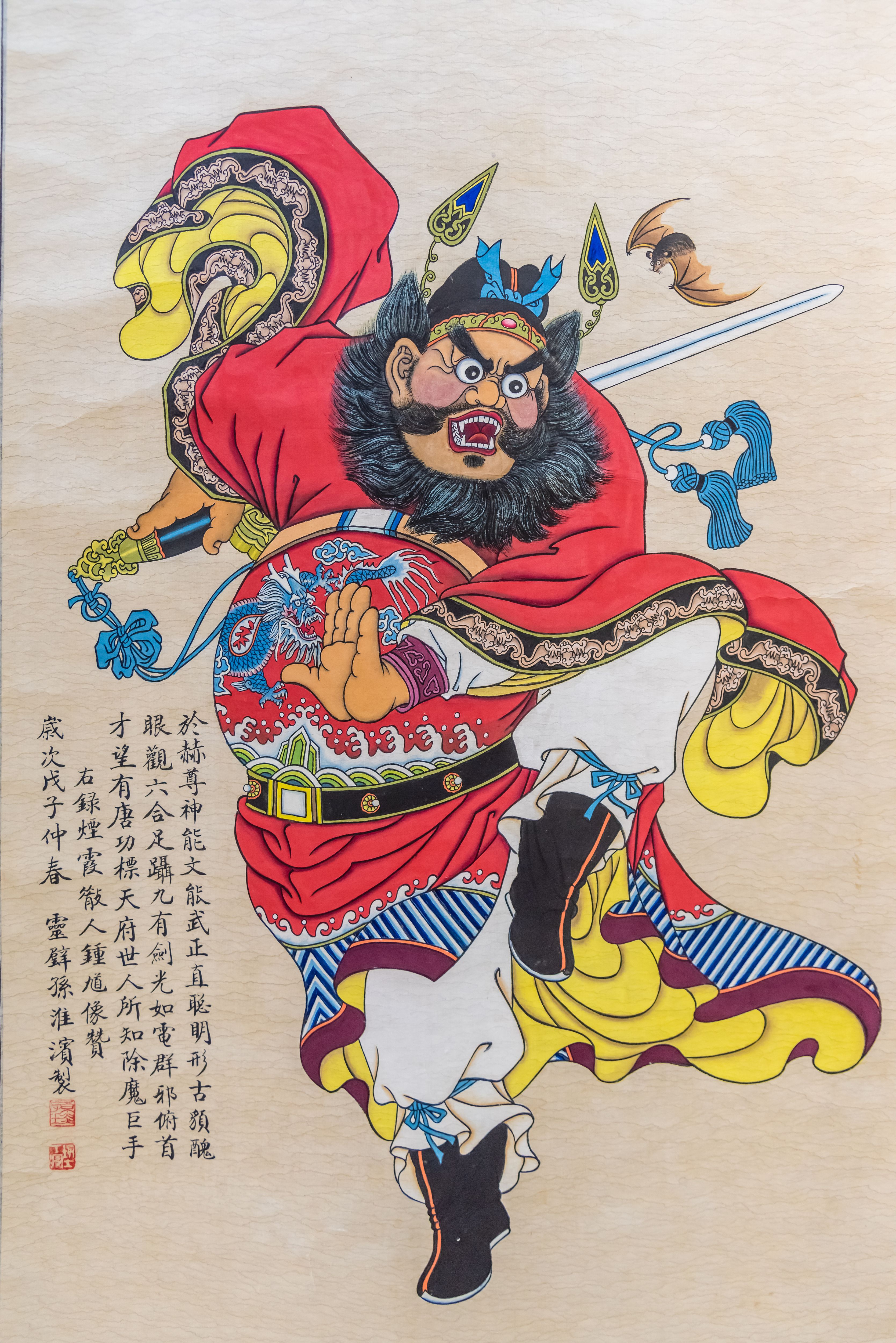
A depiction of Zhong Kui exhibited at the Anhui Suzhou Museum (VCG)
Apart from these historical documents, folk superstitions have also created tales around Zhong Kui. The story of him arranging his sister’s marriage was one. According to folklore, Zhong had a great friend, Du Ping, who supported him on his trip to the examination and buried him after he committed suicide. When Zhong became the king of ghosts after his death, he went back to his home during the New Year celebrations and married his sister to Du Ping to show his gratitude.
Because Emperor Xuanzong held Zhong in high esteem, hanging paintings of him gradually became popular among the common people. In Dream Pool Essays (《梦溪笔谈》), the 11th-century writer Shen Kuo recorded that since the Tang dynasty, it had been a custom to hang paintings of Zhong Kui on the outer doors of the home at the start of the new year. During the Song dynasty (960 – 1279), Zhong Kui became a deity in the Daoist pantheon. His image would be hung on the walls, and people would dress up effigies of him to perform rituals. In the Compendium of Materia Medica (《本草纲目》) from the Song dynasty, it was recorded that the ashes from burning a painting of Zhong Kui could cure malaria and relieve a difficult childbirth.
In most of the paintings, which are based on Wu Daozi’s version, Zhong Kui wears a red robe and carries a long knife in one hand. In his other hand, he is clutching a little demon and glaring at it with fiercely rounded eyes. Because of the legend’s popularity and Zhong Kui’s useful powers—who doesn’t want a supernatural protector against ghosts and demons?—the ghostbusting god and his stories have inspired countless Chinese folk tales and works of art over the centuries.
Even today, artists are still drawing inspiration from him. Zhong Kui appears in many regional Chinese operas, like Nuo opera, as well as movies, TV shows, and even video games. Not bad for a man once considered too ugly to be given a job.
Related Articles