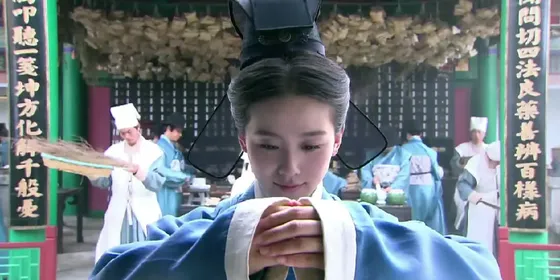
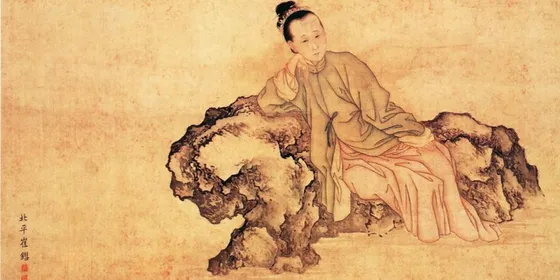
In an age when most people thought that an eclipse was a sign of angry gods, Wang Zhenyi (王贞仪) quietly wrote a book that said, “Actually, it’s definitely because of the moon.”
One of the few female scientists from ancient China to be recorded in the history books under her own name, Wang was an astronomer, mathematician, and poet who worked tirelessly to publish her discoveries about space and championed teaching math and science for all—a bit like the Neil DeGrasse Tyson of the Qing dynasty (1616 – 1911).
Wang was born in 1768, which wasn’t a great time to be a woman who loved learning. The mid-1700s were rife with Neo-Confucianism, a particularly conservative strain of social philosophy. Wang’s grandfather was a former district governor and had a preposterously large library for someone in the 1700s: over 70 books. Wang learned to read at an early age simply because books were ever-present in her home. As a teenager, she traveled extensively with her father around eastern China.
Although Wang was happily married at age 25, education was always her first love. Because she was almost entirely self-taught, Wang understood the importance of making math and science accessible for common people, so she revised other scientists’ work to make the wording more manageable—and simplified a few dozen mathematical proofs in the process. While most mathematical texts during the Qing dynasty were written in difficult, aristocratic language, Wang wrote two simple primers specifically for beginners. She even wrote a short paper describing gravity to laypeople and the reason why nobody falls off the Earth, even though it’s a sphere.
While myths and legends about space permeate Chinese history (and present-day), Wang approached her study of the skies with scientific vigor. Chinese scholars had been gazing at the heavens for hundreds of years, but Wang’s application of hard mathematics to her astronomy set her apart. Wang’s focus in mathematics was primarily in trigonometry, and she independently discovered and wrote papers on the Pythagorean Theorem for the scientific community. Her brilliance was so renowned, she even took on a few male pupils, which was unheard of at the time.
One of Wang’s most famous demonstrations showed why lunar eclipses occurred. After consulting decades of astronomical records, she measured and arranged several objects to mimic the conditions of an eclipse: a round table in the center of a pavilion as Earth, a lamp standing in for the Sun, and a mirror for the Moon. By moving them precisely to reflect the way the Moon and the Sun moved in the sky, she showed that lunar eclipses happen when the Moon passes into the Earth’s shadow. Her subsequent article, “The Explanation of a Lunar Eclipse,” is still considered highly accurate for its time.
Wang also wrote poetry prolifically. Most were about traditionally feminine subjects like scenery or her travels with her father, but she also wrote a few more subversive poems which advocated equality between men and women: quite a feat during the Qing dynasty. She believed that women and men had the same desire to learn, so people of both sexes should have equal access to education.
Unfortunately, Wang passed away from an illness when she was only 29—who knows what more she could have achieved if she had lived longer? Still, her contributions continue to be recognized in modern times: In 1994, the International Astronomical Union named a crater on Venus after her. While in the 21st century, people are still fascinated by space—continuing to research it, write fiction about it, and even search for extraterrestrial life— it was pioneers like Wang Zhenyi who worked to foster our natural curiosity about the cosmos into the body of knowledge we have today.
This is a story from our archives. It was originally published in October 2014, and has been lightly edited and updated. Check out our online store for more issues you can buy!
Related Articles