




April brought fickle alternations between fine and gloomy skies, bathing Junshan Island in Lake Dongting in magnificent spring sunlight, then wrapping it in tender mist. The wintersweet gave way to magnolia; the peach blossoms were replaced by apricot; the camellia was outshone by the paulownia; and, finally, a stunning array of roses and peonies took center stage. The southeast wind blew. Spring became a dream. The glorious profusion of flowers was unmatched under Heaven.
And so, returning across the water on misty mornings, when Junshan Island vanished into the fog, the early rising fishermen were guided by the perfume of the dawn breeze.
People said: “Abbess Huineng of the Formless Hermitage has cultivated her flower garden quite well again this year. When the petals fall, she steams them for perfume and then dries and preserves them. How much silver does she earn? It’s the sort of work fit for the Abbess. The nun had a reserve of zeal and plenty of time unoccupied. Could anybody else succeed in the same way? Those who do are as foolish as the man who thought the camel merely a horse with a swollen back. They could never learn her skills.”
The envy of those would-be gardeners was one thing. Others wished to land on the island on one of those fine days, to drink wine, to take intemperate leisure among the flowers. The ranking bureaucrats and scholars of Yueyang considered all the lands under Heaven the realm of their Emperor, so there was nothing to stop them from enjoying Lake Dongting as they saw fit. When the blossoms in the unrivaled flower gardens opened, they should be free, they thought, to enjoy them as they saw fit.
There was talk among them as well that Abbess Huineng, a woman in her thirties, was not only quite attractive but also well-read and had a profound understanding of Chan Buddhist principles. The desire scratched at their hearts like hundreds of tiny crabs. To rid themselves of these arthropods within, these scholars formed a Hundred Flowers Society, with Lin, holding a degree of juren, as the director, and Yang and Li, both possessing the lower gongsheng rank, as his assistants. The three men led around a hundred scholars in three or four boats over to the island. It was the fifteenth of March. They planned to admire the blooms, perhaps even invite the Abbess to sit and drink with them.
The party, swaggering in thin spring suits, stepped into the breathtaking scenery of Junshan. Before they could prepare bowls and chopsticks, lay out their braised dishes, fuss over pig’s trotters, pour the wine, and arrange their brushes, paper, and inkstones on the grass for some pretentious verse-making, a swarm of wild bees descended, turning the tranquil scene into a panicked frenzy. The mincing scholars, scrambling to shield themselves with their long sleeves, raced for safety, cursing their parents for bequeathing them such spindly legs. The vanguard was forced to retreat behind the rearguard: Lin, Yang, and Li, just setting off for the Formless Hermitage to request the company of Abbess Huineng, fled in a panic, cursing the bees and lamenting the difficulties they had to endure to meet a beautiful woman.
Dive into the world of “wuxia”:
The bandits of Mount Dahong heard of the scholars’ thwarted attempt to land on the island; five hundred outlaws gave five hundred scowls.
The leader of the bandits, Li Kui, made this statement: “These smooth-cheeked scholars, drunk on envy, thought that all the flowers under Heaven had been arrayed for them to lie among, chanting their poems. They decided that all of the women under Heaven were waiting to be claimed as drinking partners. Their strategies were poor, and they returned home as pockmarked as gunnysacks. Serves them right! A thought has occurred to me, my brothers... If none of you suspected it might bring misfortune to our stronghold, I will lead you to the island tomorrow and take this bald nun as my wife. As for the flowers, we’ll dig up what we can and bring them back to Mount Dahong, and torch the goddamn rest.”
The bandits all praised the wise words of their chief. Abbess Huineng, they decided, was born to be a bandit chief’s wife. They should have captured her long before! The bald head was no problem, after all. Given a few days, her hair would begin to grow back as lush as ever. By then, she would have been forced to give up her vows. As for the wild bees that had attacked the scholars, the bandits were unafraid. They didn’t care if their dark cheeks were left with red marks. They lived by the blade, not their good looks. Welts would only add to their intimidating mien. When they went raiding, anyone seeing their tanned, pockmarked faces would piss themselves on the spot. That would make their pillaging all the more convenient!
Li Kui agreed. However, after a moment of consideration, he decided he didn’t want to allow his men to become a pack of warty toads. While they might be helpful on raids, pockmarked cheeks would be an eyesore when they went to the tavern to drink. With this in mind, he sent some men down to the rice shops of Dahong Town to liberate five hundred gunnysacks. When they landed on Junshan Island, they would wear the sacks over their heads for protection. On the first day of April, with the weather clear, the five hundred bandits set off for their assault, riding five boats down the Hanjiang River, past Wuchang, into Lake Dongting. They landed on Junshan, taking advantage of the recent suppression of its local bandits, and made ready to burn the perfumery and seize the Abbess.
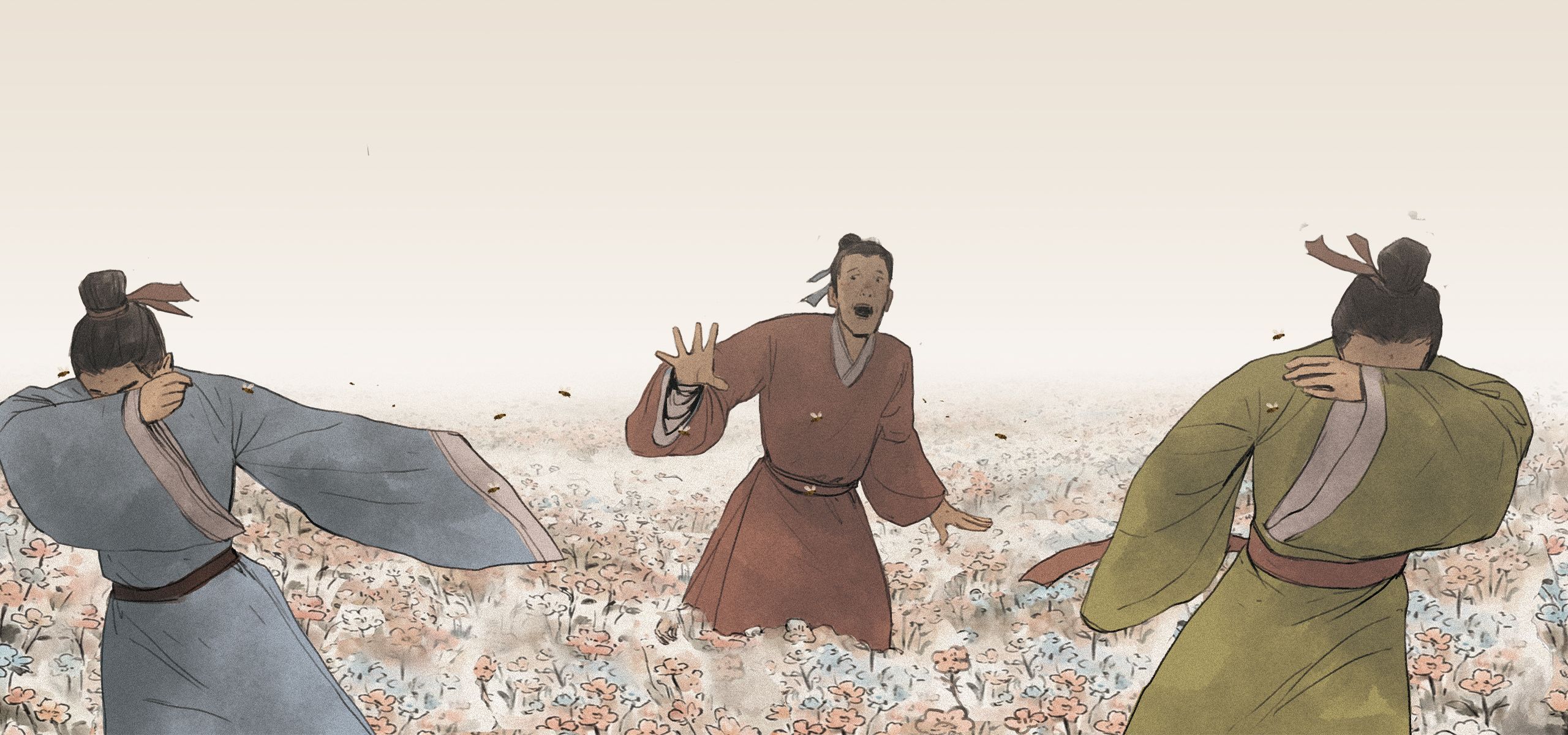
Illustration by Xi Dahe
On Lake Dongting, the warm south wind swept a mist off the whitecaps into the faces of the bandits, and they steamed inside their gunnysacks. When they clambered ashore, the bandits were not met by a swarm of wild bees. The sun shone down on them as warmly as the smiles of the women in Hankou’s brothel district. Row upon row, bunch upon bunch, cluster upon cluster, the flowers grew, tracing the undulations of the hills, rising and falling with the gentle breeze, as if waving an exultant welcome to the rugged brigands.
A sallow-faced man among the ranks called to Li Kui: “This nun throws out the welcome mat for outlaws. She’s got no time for those pretentious scholars. The woman’s got good taste! You know, I’ve never liked those romances about gifted scholars and beautiful ladies... What’s that one where the guy jumps over the wall? The girl’s name is Cui something. Romance of the something Chamber? If someone had just shown up to her place, dragged her out, and married her, she might have had a happy ending. She would never have gotten deflowered and jerked around by the scholar, right? The same deal with that nun, Miaoyu, in Dream of the Red Chamber. If she’d gotten along with that lunkhead like Lin Daiyu did, she wouldn’t have been bawling her eyes out. In the end, the Bodhisattva had to look after her. She sent some of our kind her way to kidnap her. She raised kids. She wound up happy. Women don’t want the kind of guy spinning rhetoric and sweating over eight-legged essays! They want the freedom of the greenwood.”
Although for many years now, this bandit had lived the shameless, kill-or-be-killed life of an outlaw, his own rhetorical skills were no less refined than those of a scholar. He had thrown in with the bandits just in time to escape a life of scholarship.
Li Kui was secretly delighted by his remarks. Like a thirsty dragon yearning for a pool, or like a pond fish dreaming of the ocean, he began to conjure up the charms of the Abbess. On that moonless night, with the Three Immortals auspiciously aligned in the heavens, he believed that the Abbess of the Formless Hermitage would realize her heart’s desire—to be a bandit chief’s wife!
“Good Heavens!” one of the bandits exclaimed, “Look at that stand of nine peach trees over there. The blossoms are like a roaring fire!”
This aroused the ire of the sallow-faced bandit who almost became a scholar: “Indeed, these are in fact the wood peach. It’s said that they bear fruit as big as a calabash. They are sometimes known as durian. In the Book of Songs, the lines go something like, ‘You gift me a wood peach; I repaid you with precious jade.’ The Abbess is likely sending a signal to our chief, although I’m sure he wouldn’t appreciate it. This nun is too refined for her own good.” The bandits breathed the wood peach’s aroma deeply and continued walking.
“Good Heavens!” another bandit cried out. “Do you see how tall those eleven cotton shrubs rise? Look at the flowers...They’re like funeral wreaths. How bizarre!”
The sallow-faced bandit meticulously sniffed their fragrance. “These are known as baihe (lilies),” he said to Li Kui. “Very auspicious!” Li Kui hooted.
“Baihe is short for bainian haohe—a hundred years of conjugal bliss! That’s what I’m looking for with this nun...But I don’t think the color of the flowers is quite right. I would much prefer red. That would be even more auspicious. But then they wouldn’t be baihe anymore, would they? Oh dear...I get twisted up in my words, and my head starts to hurt...”
The sallow-faced bandit bowed his head and muttered agreement. Having enjoyed the peculiar fragrance of the baihe, the bandits kept going.
As the bandits went on down the path, flowers and grasses grew even denser. The warm spring sunshine steamed their perfume into the air. When the path continued to twist and turn, Li Kui and his men worried that they had stumbled into a maze, but it was soon clear that they were still climbing into the hills. They crested a ridge on the Formless Hermitage’s blue tiles and white walls, above which rose the tops of a stand of giant trees. Their trunks were so thick that it took several bandits linking their arms to encircle them. In mid-spring, trees were budding, but their branches were already clustered with light purple flowers. Each tree had thousands of blossoms; the effect of looking upon the flower-bedecked grove was like the resonant ringing of the nun’s gong in one’s head.
Li Kui sat himself down on one of the rocks on the ridge and sighed: “Pour a drink under these trees would truly be a life of indulgence...”
The bandits had no time for their chief’s daydreams. They stood on the ridge, struck dumb, gazing down at the mountain scenery. The south wind swept the fragrance of flowers up their nostrils, filling them with it like a sack with sand.
“There are ninety-nine...” the sallow-faced bandit said, his face becoming paler. “Ninety-nine trees. Magnolia trees. They have lived nine thousand years. Each one has a spirit inside.”
He blanched, going as white as a funeral wailer. “They say that when King Fuchai of Wu vowed to build a magnolia palace for the great beauty Xi Shi, the men he sent to collect timber arrived at Junshan and found a grove. These must be the trees they discovered. They were under the control of the King of Chu, so the envoy went to ask his permission to cut them. But the King of Chu turned them down, saying the trees were meant for his own coffin. In the end, Xi Shi’s influence helped bring about the fall of Wu, and Chu was crushed by Bai Qi, so the trees escaped calamity. It remained here, blooming year after year.”
“You’re pretty clever, aren’t you?” Li Kui said, gaping. “I’ve always suspected you were an undercover scholar. You’re no real bandit! If I’m gone, you’d take over and turn Mount Dahong into a school that rivals the White Deer Grotto Academy.”
“Don’t be fooled by my complexion,” he told Li Kui. “I am getting as dark as my comrades. I’ve given up on my old ways, and there’s no turning back. Don’t worry about that. But right now, chief, you’ve got bigger concerns. She doesn’t look quite right.”
The sallow-faced bandit pointed, and Li Kui’s gaze followed. Abbess Huineng, tall and slender, strolling far off in the magnolia grove, seemed to float on a sea of purple blossoms.
“That’s Huineng,” the sallow-faced bandit said. “Do you still want to kidnap her to be your wife?”
Li Kui breathed deeply of the magnolia perfume. He shook his head. “Goddamn,” he said. “This is mighty strange. I charged up here thinking I would take her back with me, but now, I’m like a tiger staring down a potted plant. Lovely flowers, but nothing to suit the diet of a tiger. Forget about it. Just forget it. Why don’t I just go down to Dahong Town and find some pretty young broad with big tits and a nice ass?”
The sallow-faced bandit turned to one of the outlaws: “Once we get back, are you going to stay in the robbery business, brother?”
The man shook his head. “Farming sounds real good right about now,” he said. The sallow-faced bandit turned to another outlaw: “Do you still think you could stomach killing a man, brother?”
The other man shook his head. “I wouldn’t even kill a chicken to put on the table. My wife is going to have to do that.”
The sallow-faced bandit asked another outlaw: “Would you still go on a kidnapping raid with the chief, brother?”
The outlaw, wearing a pained expression, clutched at his crotch. “Wave after wave of perfume,” he said. “I’ve got a bellyful of it now. I feel like I’ve been scrubbed out inside. My heart is a silkworm. Winter is coming. Spring is far away.”
Li Kui’s face was as dark as a scorched pot. The pale-faced bandit muttered, “I suspected the Abbess was setting up a trick with the flowers and trees, likely a numerological scheme crafted from the elements of divination. I don’t think such things would be beyond me. If I lived on Junshan, I could build myself a labyrinth, too. But the Abbess was skilled in medicine, too. Each wave of perfume from these flowers was calculated, arriving in differing doses at different times…We breathed them in, and they drained our desires; they corrupted our fighting spirit. Our moods shifted as we got closer. The men that arrived at the Formless Hermitage are not the same as those that embarked on the quest to capture the Abbess. Chief, look! Do you see what is written on the stone tablet there? It says this place is called the Peak of Mental Clarity.
Li Kui turned to him, his eyes red: “If I had known, I would never have come to this goddamn place, this goddamn island...We came here as five hundred daring bandits, and now, under the assault of the flowers, we have become five hundred potatoes. Let’s go home! May the Goddess of Dahong grant us the courage and strength to be reborn.”
He took one last wistful look at the Abbess in the grove and led his crop of potatoes back down the hill. The setting sun beat down like a lash. Junshan’s flowers filled the air with a dreamlike scent.
This was something-something AD, sometime in the Song, during the reign of Shenzong. Yin and yang were in harmony. Peace ruled the land. On the thirteenth of May, Su Dongpo, who was serving out his exile at a minor post in Huangzhou, traveled upstream to Junshan Island to pay his respects to Abbess Huineng.
Before setting out to meet the Abbess, Su Dongpo went to visit Zhou Fengnian, the prefect of Yueyang, with whom he had long ago sat the imperial exam.
“Nobody expected that a single nun might change the fate of Yueyang prefecture,” Zhou Fengnian said. “When the mighty bandit Li Kui was driven out by the Junshan flower assault, word spread quickly. Minor scholars and bandits came from far away to row on Lake Dongting and to climb Yueyang Tower. Rumor has it that even royalty and prominent officials from neighboring states came to see the flowers of Junshan, traveling in disguise. A Grand Secretary has proposed that Yueyang be twinned as a friendship city with Provence in France. When that happens, Lake Dongting will be the world’s own little footbath. Big-nosed, green-eyed foreigners will come and go. The old women of Yueyang will set up stalls to trade their shaobing bread for Mexican silver dollars.” Zhou Fengnian was overjoyed at the flood of silver into prefecture coffers.
“But if Lake Dongting has the atmosphere of a county market, will the nun in the Formless Hermitage ever be able to find peace?” Su Dongpo asked. “Your intentions are fine, brother, but have you considered the consequences?”
“There’s no harm in people paddling around the lake. To land on Junshan is far more difficult. Those that could get past the wild bees would be lost in the labyrinth of flowers. They say the Abbess uses plants as bodyguards. On the island, she can alter time itself. Anyone that floats across to Junshan is likely to encounter what seems to be a void. The boatman will row right through it. So, in a sense, Junshan Island no longer exists as a physical place on Lake Dongting. It has passed through the looking glass. You can see the island in this mirror, but there is no way to row a boat over to it. Some say that the Abbess wants to turn Junshan into a Kingdom of Women. She would gather plant spirits and chase off all the men. She’d carve out the yang from the taiji diagram, which is why Junshan is full of yin energy. It’s become a mirror of emptiness.”
These strange theories, shared by Zhou Fengnian over cups of wine, stirred the curiosity of a clinically depressed Su Dongpo. He was determined to visit the Abbess that occupied the void of Junshan and ask her for direction through the labyrinth of life.
Su Dongpo did not encounter any wild bees. There were no floral assaults. He did not find a mirror of emptiness. He landed on Junshan and stepped out of the glow of the rising sun and into the shade of the magnolia grove. Abbess Huineng was preparing tea. She poured water drawn from the Liuyi Well into an earthen kettle. She rolled out silver needle tea gathered below the Peak of Mental Clarity and heaped pinches of it in two blue porcelain cups.
“Fine tea,” Su Dongpo said. “It’s delicate, composed, fresh, resilient. It calls to mind Confucius’ praise in The Analects for the music of the emperor Shun.” Springtime sun slanted into the small courtyard of the Formless Hermitage. The pomegranate blossoms opened and danced like flames.
The Abbess smiled: “Your poems are as fine as the tea picked before Qingming. I have read your work. I am familiar with the Crow Terrace Poetry Trial.”
“Then you know that I’m a pretentious scholar. Why not set your wild bees on me? I would be content to return to Huangzhou with welts on my cheeks.”
“I know that you are in charge of suppressing bandits,” Abbess Huineng said. “Maybe during your campaigns against the outlaws, some of their habits have worn off on you. I could lead you down the flower path that leads to the mountain and turn you into half a potato.”
“Potatoes stewed with beef might well be tastier than the Dongpo pork that’s become fashionable in Huangzhou of late,” Su Dongpo sighed. Abbess Huineng lifted her kettle and poured more hot water into his cup. She smiled but said nothing.
“It truly is fine tea,” Su Dongpo said. “Is it down to the water of Liuyi Well? When I was a young man, studying on Mount Emei, my teacher spoke of the well on Junshan. When heroes perfect their skills, they can pass through Liuyi Well, transform themselves into dragons, and enter the Dragon Palace beneath Lake Dongting. The water of Liuyi Well carries in it the dream of soaring dragons. It bears the aspirations of fish to become dragons. It can push any living thing to splendor, then allow them to lapse back into the ordinary.”
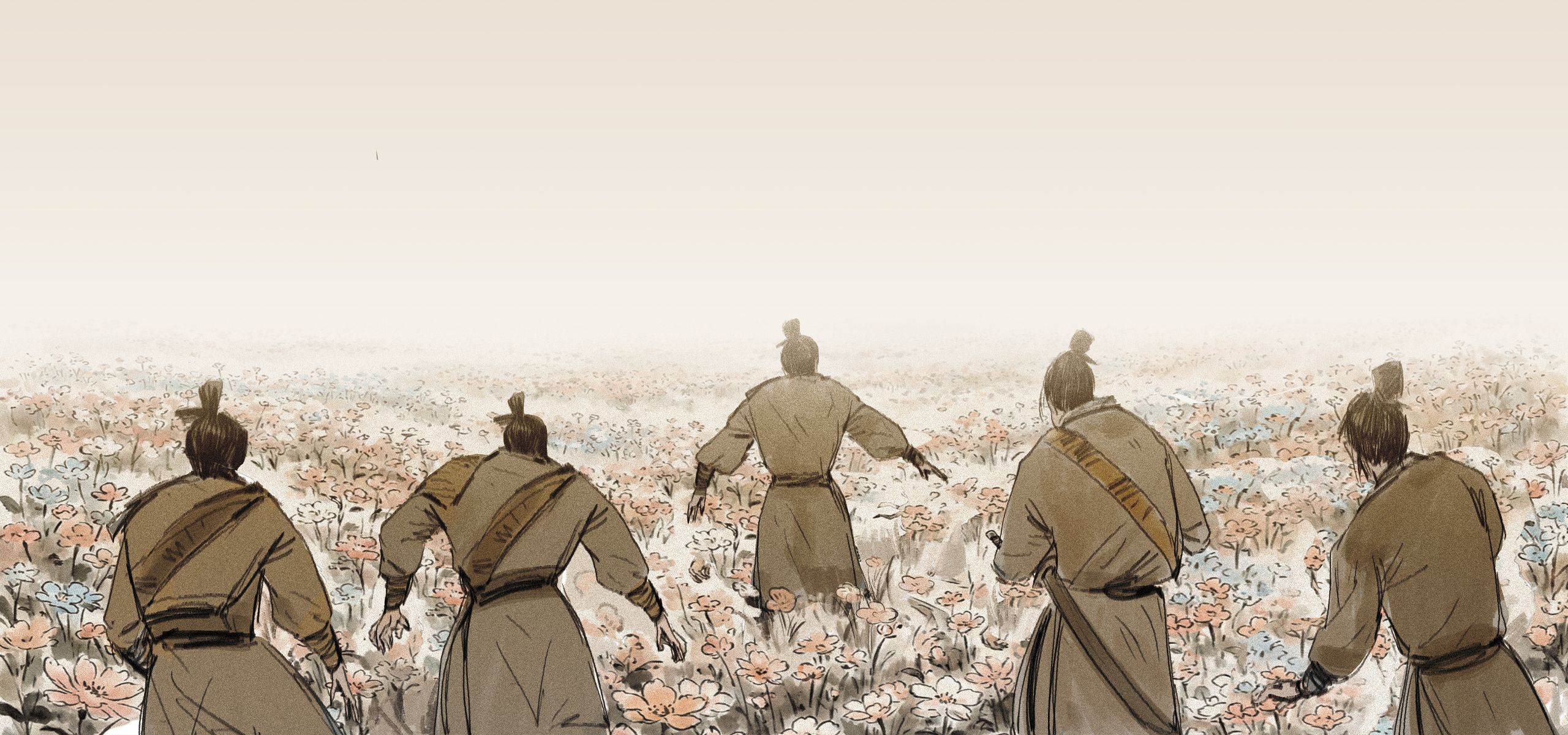
Illustration by Xi Dahe
Abbess Huineng studied her guest, her face betraying a hint of surprise. “For a man still muddled in the mortal world, you have not lost your sense of taste. That’s no easy thing. Some people drink tea every day and have forgotten the taste of fresh water. Some people believe the water they draw from their own pond is the finest under Heaven. The secret to this tea is not the water of Liuyi Well, but also in these tea leaves, which are each as fine as a needle.”
Su Dongpo nodded. “This tea is from bushes growing below the Peak of Mental Clarity, within the magnolia grove,” he said. “At dawn, they absorb the mist of clarity. At dusk, they are bathed in dew from the magnolia. Emptiness is form; form is emptiness. Junshan has been purified; the tea requires no words.”
“The mist of the Peak of Mental Clarity is all well and good,” Abbess Huineng said. “But the grace bestowed by the magnolia gives the tea bushes an inclination to longevity and a spirit of persistence. That is truly rare.”
Su Dongpo and Abbess Huineng spent the day drinking tea and talking. They did not notice the dusk drawing near. Morning sun became evening light. The Formless Hermitage was bathed in a warm, amiable glow. Finally, Su Dongpo took his leave. Skipping effortlessly over the Peak of Mental Clarity with a cloud vaulting technique that he had learned on Mount Emei, he soon arrived on the shores of Lake Dongting and found his boat. Abbess Huineng, standing before the Formless Hermitage, smiled as she watched the pudgy middle-aged man disappear across the lake. Her smile faded slowly, like the light of the setting sun scattered across the forest by clouds stirred by the evening breeze.
The Abbess stood until the bright moon of the thirteenth day of May rose, then turned and went to walk in the magnolia grove.
“Shunhua,” she called in a soft voice. The beautiful flower spirit Shunhua appeared, coalescing out of the perfumed void among the ninety-nine magnolia trees.
“I let him go,” Abbess Huineng sighed. “That will be the last time I see him. The silver needle tea of Junshan is the finest in the world, but it is too close already to the water of the River of Forgetfulness. As he sipped his tea, our karmic ties were undone. He will never find his way to the Formless Hermitage again.”
“Foolish woman, I would rather listen to you beat your clappers at the base of the wall than entertain this prattling,” the magnolia spirit said. Her expression was tender. In the eyes of the nine-thousand-year-old spirit, the wise Abbess was merely a mortal woman who had endured three lifetimes. “You waited an entire lifetime for this man, and when he blundered his way to your doorstep, you gave him a brief moment, drinking tea.”
Abbess Huineng went quiet. She listened to Shunhua’s lecture.
“Do you remember the first lifetime in which you were born in a woman’s body? You were reincarnated at an apothecary shop under a wooden bridge in Hangzhou. At eighteen, as you stood behind the counter, beautiful and enchanting, a young man ran in and asked to buy four kinds of medicine, one ‘as vast as Heaven,’ one ‘as deep as the sea,’ one ‘as sweet as honey,’ one ‘as bitter as goldthread’...You told him that a life-saving debt is as vast as Heaven, friendship among those undergoing hardship is as deep as the sea, conjugal bliss is as sweet as honey, and abandoning the commitment midway is as bitter as goldthread. Then he asked for something ‘three parts white, a little bit red, hung upside-down, and as fine as silk lanterns.’ He was teasing, you knew, but you still answered: lotus shoots reaching above the water are three parts white, their flowers are a little bit red, their leaves are hung upside-down by the wind, and their seedpods set on a stalk are as fine as silk lanterns. He then asked what to take with it. You told him to use an ounce of honest, a measure of good intentions, two lengths of forbearance, half a jin of conscience, and a heap of skillful means, chop with a knife of open-heartedness, stew until tender in the pot of broad-mindedness, grind in the mortar of forgiveness, sift out trivial things until it forms a fine powder, form pills the size of dried plums, and take six at dawn, washed down with the elixir of harmony. He was satisfied by this and left. You stood behind the counter, thinking that the bright-eyed scholar must surely be on his way to ask Matchmaker Wang to ask your parents’ permission to marry you. But autumn came and went with no word. You had no choice but to marry a tea merchant. That was how that lifetime passed.”
Abbess Huineng nodded. “I remember,” she said in a soft voice. “What became of that scholar I met at the apothecary in Hangzhou?”
“Not long after, he went to the capital to take the imperial exam,” Shunhua said. “He won the rank of jinshi. He married a girl from a family of successful bureaucrats. He could not become your husband, but he lived by the prescription you gave him.”
Abbess Huineng sighed. Shunhua went on: “And then you were reborn in the mountains of Dahong, into a declining landholding family. In those days, there were many bandits in the hills. There was one among them who was renowned for his kind heart and smooth cheeks. He was fond of wine and swordplay, and spent his cash without thinking twice. Every woman who lived there hoped to be kidnapped by him. You did, too. When you were eighteen and went to wash clothes beside the Hanshui River, you hoped that he might appear in a boat and see you. Your dream was that he would pull ashore, grab you around the waist, sweep you aboard, and carry you back to the greenwoods. All that would be left behind on the bank were your laundry mallet and your scattered clothes. One evening at dusk, he finally did arrive. The skies opened up and poured rain. Earth and Heaven were in chaos. As he came down the river, he gave a cry that shook the leaves in the forest, echoed in the mountains, and rippled across the water. You were unaware, crouched in your yellow dress, under a black umbrella, tapping away with your mallet against the rocks. By the time his boat passed, the bandit was already passed out in the cabin, drunk. The oars had already been cast aside. His cry had turned into snores. In the bright torrent of rain, he slept like a baby. You hesitated, wondering if you should wake him. As you pondered, the wind picked up and carried the boat away, further and further, until it was no longer visible. You never saw him again. Your parents married you off to a tailor who lived on the plains.”
“How did the sleeping bandit’s story end?”
“Soon after that day, he was caught by authorities and sentenced to death by beheading,” Shunhua said. “The night before his execution, he dreamed that he was drifting down the Hanshui River and saw a yellow crane fly from the forest. The crane swept over him, its feathers fluttering, and crossed the river. Rain poured like sheets. Earth and Heaven were in chaos. The crane gave a cry as clean and clear as gold and jade. When the bandit saw the yellow crane, the blood rushed to his head. He struggled to shake himself loose from the dream. When he awoke, he found he was still in the dreary cell in the Eastern Capital, ice cold on that winter night. He realized it was the same dream he had had that day, drunk and drifting on the Hanshui River, as rain clattered like pearls on the deck.”
This was a more recent lifetime. Abbess Huineng could still recall it. She lived in a village on the plains. Late at night, spinning or weaving, she indulged her fantasies about the smooth-cheeked bandit. The thread that never reached its end, the cloth that could never be woven, the never-ending crows for dawn and dusk—ah, how long life was, and how absurd!
“Whether in the apothecary shop or washing by the river, you felt as if fate was beyond your control,” Shunhua said. “You decided that in this life you should have your own island, your own retreat in the Formless Hermitage. You wanted to keep by your side the young man who asked for a prescription, and the bandit who drifted away in his boat. You poor woman...Why did his visit to Junshan to drink your tea have to end in disappointment, too? He is soon to be dispatched by his superiors to an even more distant wasteland. He will sail across the sea, and narrowly escape death. Whatever becomes of him, he will never return to Lake Dongting. He will never set foot on Junshan. You will never see him again.”
The Abbess leaned against a magnolia tree. Tears rolled down her cheeks. “Don’t cry, woman,” Shunhua sighed. “I have cultivated myself for nine thousand years and yet even I cannot control my own fate. To have lived three lifetimes is not enough. Xuanzang could not stay in the Kingdom of Women during his journey to the West. In his first life, your man was fated to sit the imperial exam, attain the rank of jinshi, and abandon you. In his second life, there was no way that he would escape being beheaded and leaving you alone. In this life, although he might linger on the grounds of the Formless Hermitage, there will be no mercy from his superiors when they dispatch him to the southern wastes. To let your youth pass in these remote green hills and to let your face remain only in the mirror is not a mistake.”
“What sort of Kingdom of Women is my Formless Hermitage?” Abbess Huineng asked. “So many men watch it from the lake. To them, it is a peculiar piece of scenery. I know that there is no place to build a Kingdom of Women, unless you go to the Moon. I will have to let those bandits and scholars return to Junshan.” She couldn’t hold back her tears and continued to weep.
The bright moon of the thirteenth day of May shone through the grove. Innumerable blossoms opened, like stars filling the sky. The evening dew fell. The nine-thousand-year-old flower spirit, distressed by the tears of the nun, who had only endured three lifetimes, wondered whether or not she should have held her tongue. But the moment was drawing near when the spirit and the nun would go their separate ways, when there would be no chance to have such intimate conversations again. The spirit was reluctant to part.
“I must say goodbye to you, woman,” she said. “I have endured nine thousand years. My cultivation has been sufficient to rise from the world of plants to that of the wisest of all creatures. It is time for me to cast aside what remains, and to ascend.”
The Abbess dried her tears. “I knew this day would come,” she said, “but I didn’t think it would be so soon.”
“Nine thousand years passed for me like a single day in your life,” Shunhua said. “He planted me in this mountain valley nine thousand years ago, never to return again. Each year, I bloomed, grew, and endured the frost and snow. He was an unimaginably famous man out in the world. But did he know that the ninety-nine magnolias he planted here had cultivated themselves into spirits, or that they, too, admire him, and longed for him?”
The Abbess smiled: “You have spent nine thousand years trying to undo this injustice, but I have only had to endure mine for three lifetimes. You say I’m bent on creating a Kingdom of Women, but you have been trapped in your own Kingdom of Women for nine thousand years. How many scholars and bandits, and officers and troops have passed through the hills of Junshan in your time? How many wretched, detestable, tragic men have been within your reach? You never tried to tempt them. You never stole them away. Instead, you devoted yourself to dew drinking, whiling away the years... Maybe you are the one who is cursed.”
The nine-thousand-year-old flower spirit blushed as red as a Lake Dongting crayfish. “Waiting for him, I will endure as many trials as necessary,” she mumbled.
“Spirit, if you really are all-knowing, then you must know whether or not he really is coming. Nine thousand years ago, his name was Shun. But after so long, after so many reincarnations, even if he does come, how will you recognize each other?”
“He will come,” Shunhua said. “He’s coming tonight.”
“What are you two going to do? If you need the Formless Hermitage, I can sleep out in the grove.”
“He’s coming to cut down the grove,” Shunhua said.
The bright moon of the thirteenth day of May was neither waxing nor waning. The stars in the sky were neither too few nor too many. The night breeze on Lake Dongting was neither gentle nor harsh. From beyond the magnolia grove came the sound of hoofbeats. A handsome scholar appeared, astride a black donkey.
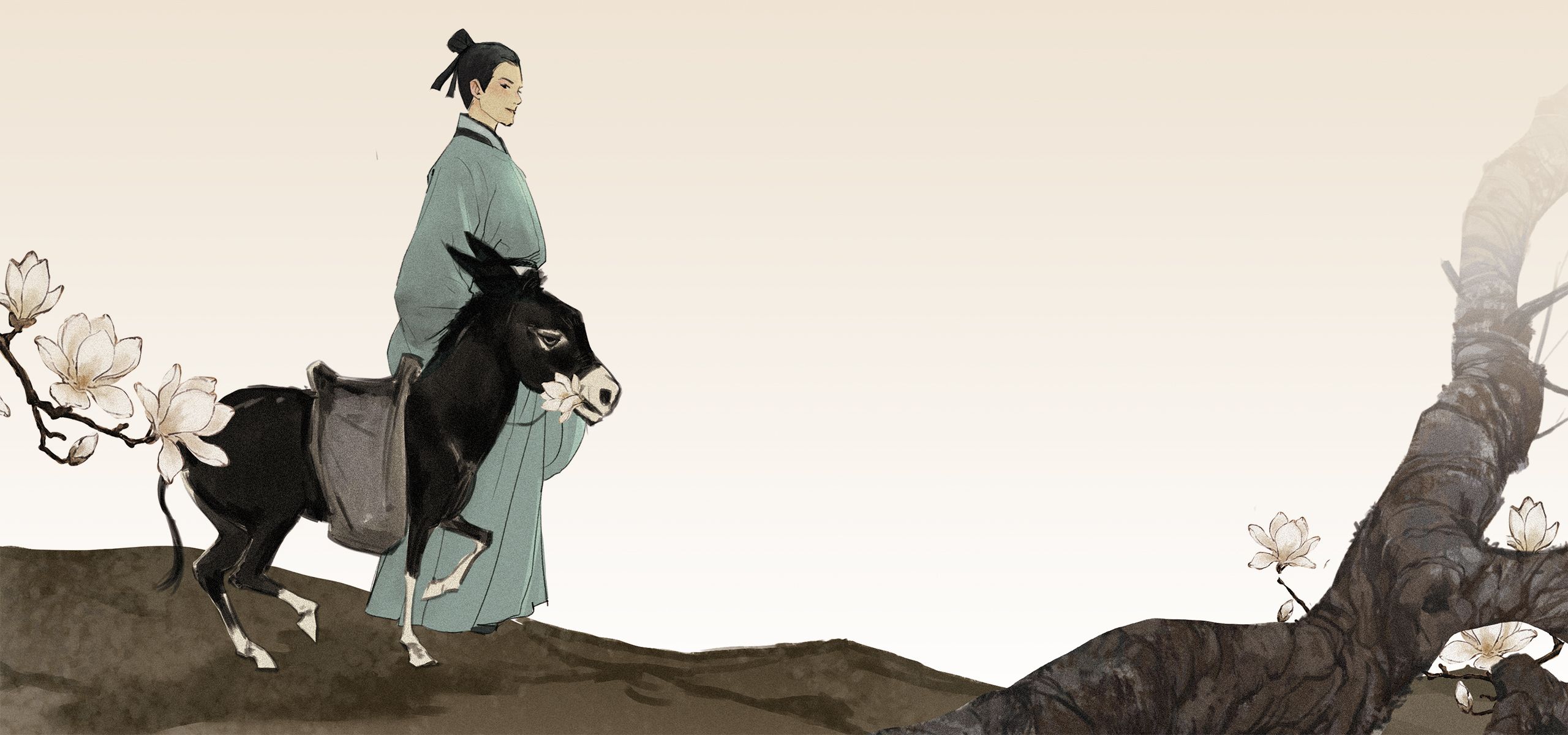
Illustration by Xi Dahe
“Still hungry, old boy?” the scholar called to his mount. “You’ve already eaten blossoms off the wood peach and the baihe. All that wasn’t enough for you? Don’t think you’re going to nibble the magnolia blossoms. They’re tiny, prickly things, not good for a donkey’s stomach.”
“You think you’re going to be able to knock down the whole grove in a day, swinging that dull chopper of yours? I have to eat slowly. Anyway, I might as well take advantage of stumbling on these magnolias in bloom at least once in the nine thousand years they’ve been here.”
“I can’t find fault with much, black beast—you can even manage to talk like a human these days—but eating flowers is a nasty habit. I already told you, flowers aren’t food! They’re for looking at, or sniffing, or for putting vases and decorating your house when you’re too broke to buy anything else. But you—you want to slurp them into your donkey guts! You think you can eat enough to turn your manure into pretty little perfumed lumps? As long as I’ve lived, I’ve never seen a miracle like that.”
“The wood peach blossoms taste like smoked meat. The baihe taste like rock candy. As for these magnolias, well...How should I put it? You are not a donkey; how could you know a donkey’s joy? You don’t eat flowers, do you? Ha! You barely enjoy picking them! How could you know the joy of eating them?”
“Eat up, then! Just don’t stuff yourself to death. Tonight, we’ll sleep in the grove. Tomorrow morning, we go in search of Abbess Huineng to discuss cutting down the magnolias. I don’t think she’ll decline the offer. After all, the reputations of some renowned swordmen are at stake...”
“I think they’re going too far with the whole thing. Why do they need to build their boat out of magnolia from Lake Dongting? They have to drag the lumber all the way to Meizhou Bay in Fujian. What a pain in the ass!”
“They say that magnolia won’t rot or sink at sea. Whales are supposedly quite fond of it, as well. The aroma lures them in. They come racing through wind and waves. So, these guys might finally get their wish of sailing east.”
“If the magnolia blossoms taste this good, I bet the lumber is quite a treat, too. It’s a pity you won’t let me take a nibble. I’d love to try...”
At midnight, soft voices carry; the moon sinks like a golden basin. As rich dew settles; will you hold fast to your vigil? The incessant chatter of man and donkey floated out through the forest. Shunhua listened carefully, smiled blissfully. Yes! It was him. He had finally returned to the place where he had planted the grove, nine thousand years before. Back roaming my old haunts, sentimental men might laugh at me—my hair already turning white. Abbess Huineng turned back toward the Formless Hermitage, accompanied by the friend who had been by her side since childhood.
“Who is he? After nine thousand years, who did the Great Shun reincarnate as? The scholar or the black donkey—or the scholar and the donkey together?” Shunhua smiled but made no answer. Her form gradually faded into the grove’s morning mist.
Yes, blue dawn was breaking. Fourteenth of May. Clear weather. South wind. Auspicious activities: felling trees, breaking ground, beginning a long journey, bathing. Inauspicious activities: conjugal relations, official business.
This story is inspired by the myths of the Great Shun. It also contains references to the poetry of Su Dongpo. Apologies: allusions are not noted in the text.
Author’s Note:
This story is selected from my wuxia anthology The Journey of Ruan and contains a hint of playful satire aimed at Su Shi, also known by his nickname Su Dongpo. Su is one of the most beloved figures in Chinese classical literature. Around a thousand years ago, he was demoted and exiled to Huangzhou, Hubei, about 50 kilometers from where I currently live. While there, he wrote many immortal verses, including the two “Odes to the Red Cliffs.”
The Record of the Magnolia Grove | Fiction is a story from our issue, “New Markets, Young Makers.” To read the entire issue, become a subscriber and receive the full magazine.
Related Articles



