When the rest of the country went on holiday during the Spring Festival, the real work began for the Xiaxi Cloth-horse Dance Troupe.
Over the past month, this all-female troupe, which specializes in a traditional dance performed on a horse made of bamboo and cloth, has been invited to perform by both national and provincial television stations in honor of the Year of the Horse. They’ve traveled to Beijing and Guangzhou, where their dance was recorded for the annual Spring Festival TV Gala. Their calendar is just as full with parades and performances to bless businesses in the first lunar month after the New Year.
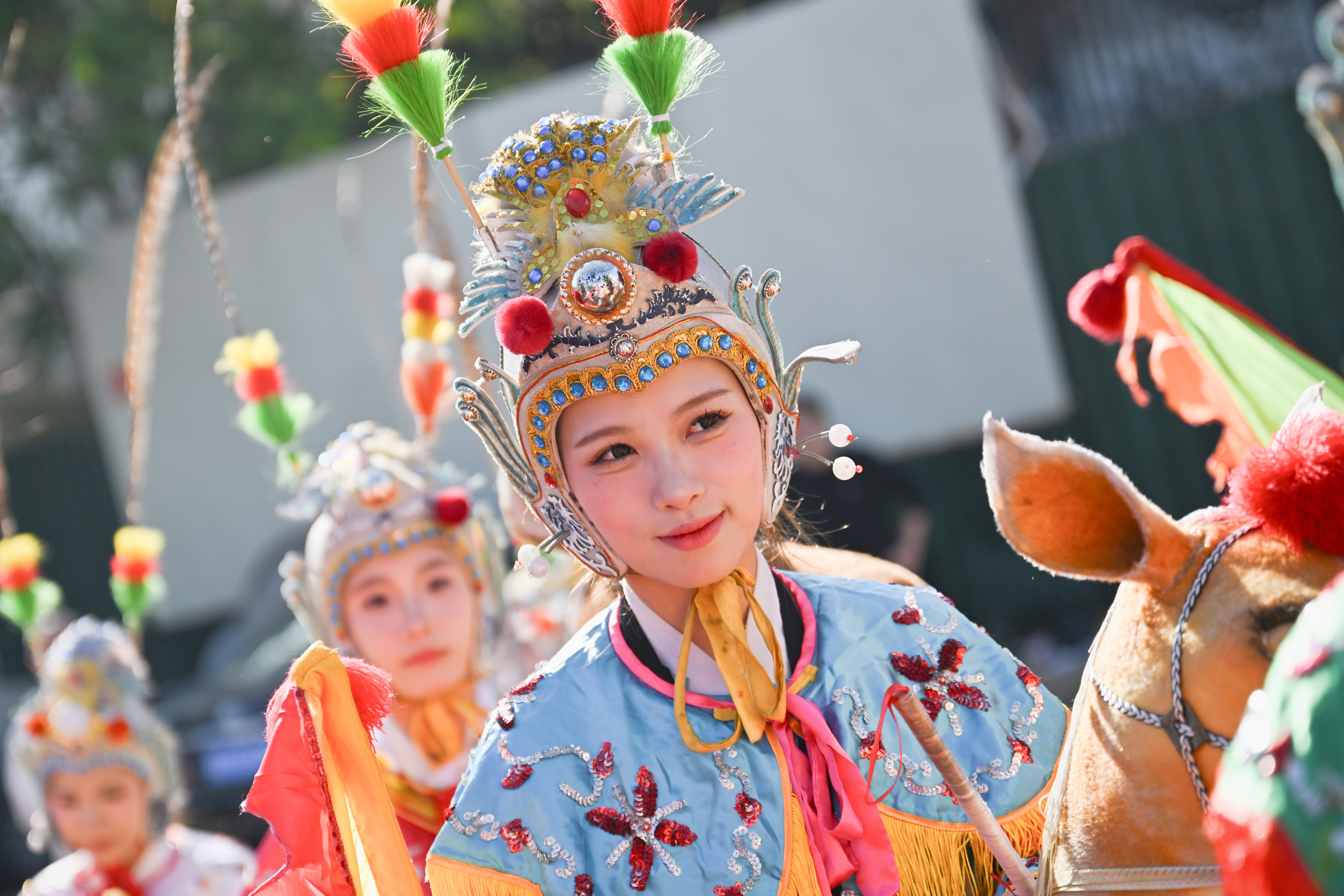
The troupe comprises 24 female performers, all in their 20s (Jayvon Wu)
“I’ve had to coach three different performing groups a day. I barely have time to glance at my phone,” Liu Shuzhao, the troupe’s dance coach, tells TWOC of the run-up to the New Year.
The cloth-horse dance (布马舞), also known as the bamboo-horse dance, was introduced to present-day Raoping county in Chaozhou, Guangdong province, from Jiangxi during the 13th century. It is part of a bigger tradition called the “Parade of Gods,” common in the southern coastal provinces, such as Guangdong and Fujian. During traditional festivals, especially the Spring Festival, people would carry statues of deities around the village, accompanied by a large procession of percussion ensembles, flag bearers, and various dance troupes, to seek blessings and protection from the gods.
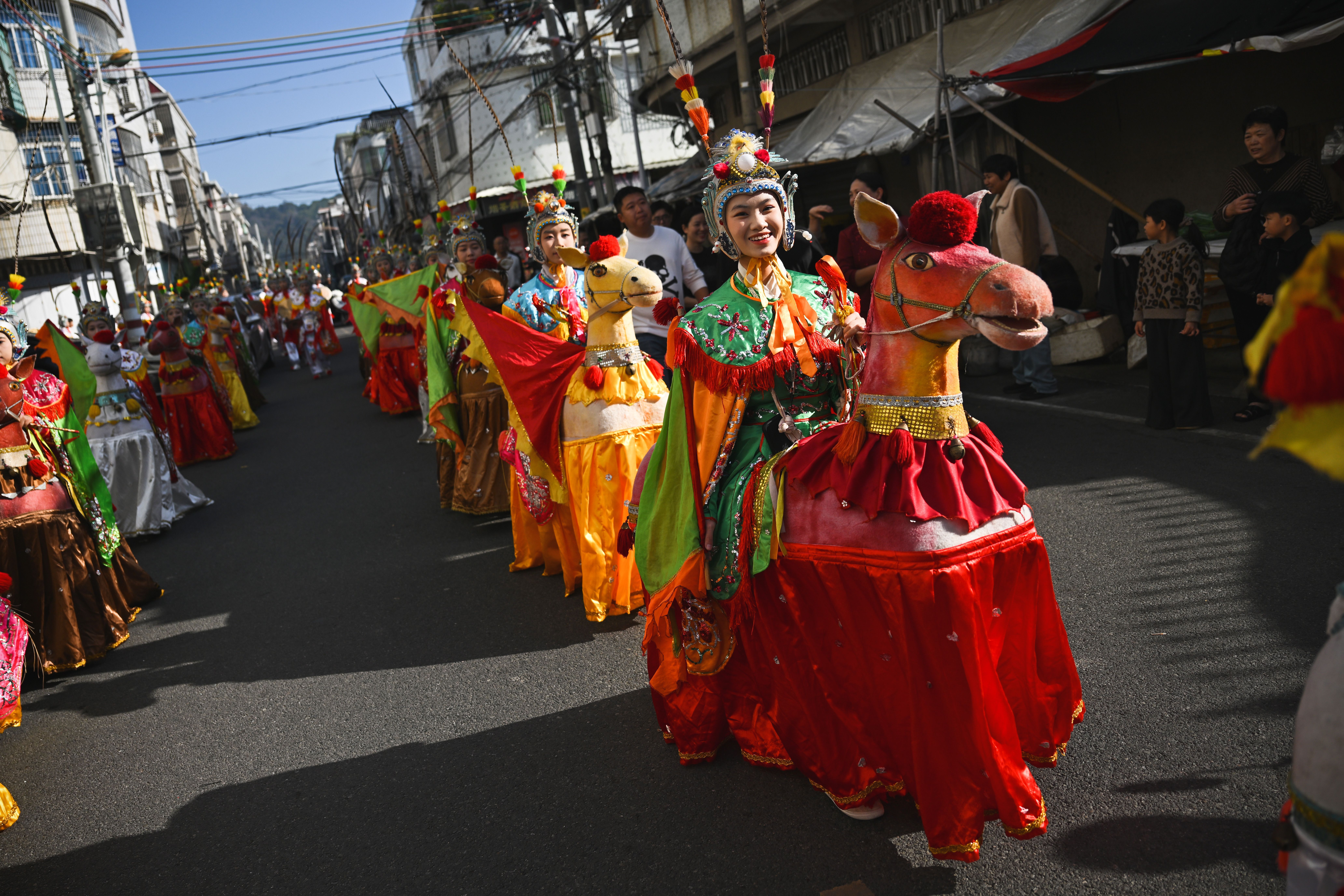
The cloth-horse parade has been a staple of local festivals for centuries (Jayvon Wu)
In Raoping, the gods happen to be paraded alongside horses. Dancers hoist the colorful cloth-and-bamboo horse statue upon their shoulders, wielding whips and flags while dancing to musical accompaniment. Twenty-four horses gallop or amble in each performance, portraying ancient female warriors on the battlefield. The troupe from Xiaxi village, Raoping county, is the most well-known.
Learn more about traditional Chinese performances:
- The All-Female Opera Reimagining Freedom, Love, and Fantasy
- The Changing Face of Yingge Dance
- Make ’Em Laugh: How a Northeast Folk Performance Escaped Decline
Zhang Xiuling, aged 20, is one of the troupe’s younger members. Though only in her second year as an official member of the troupe, Zhang’s connection with the dance began during elementary school. For many years, Xiaxi Elementary School ran a “pony” team made up of students, and many troupe members got their start in this junior group.
The sudden outbreak of the pandemic and the high school entrance examinations postponed Zhang’s dream of joining the troupe, but the foundations she laid down in childhood paid off. She mastered the dance in just one week after joining.
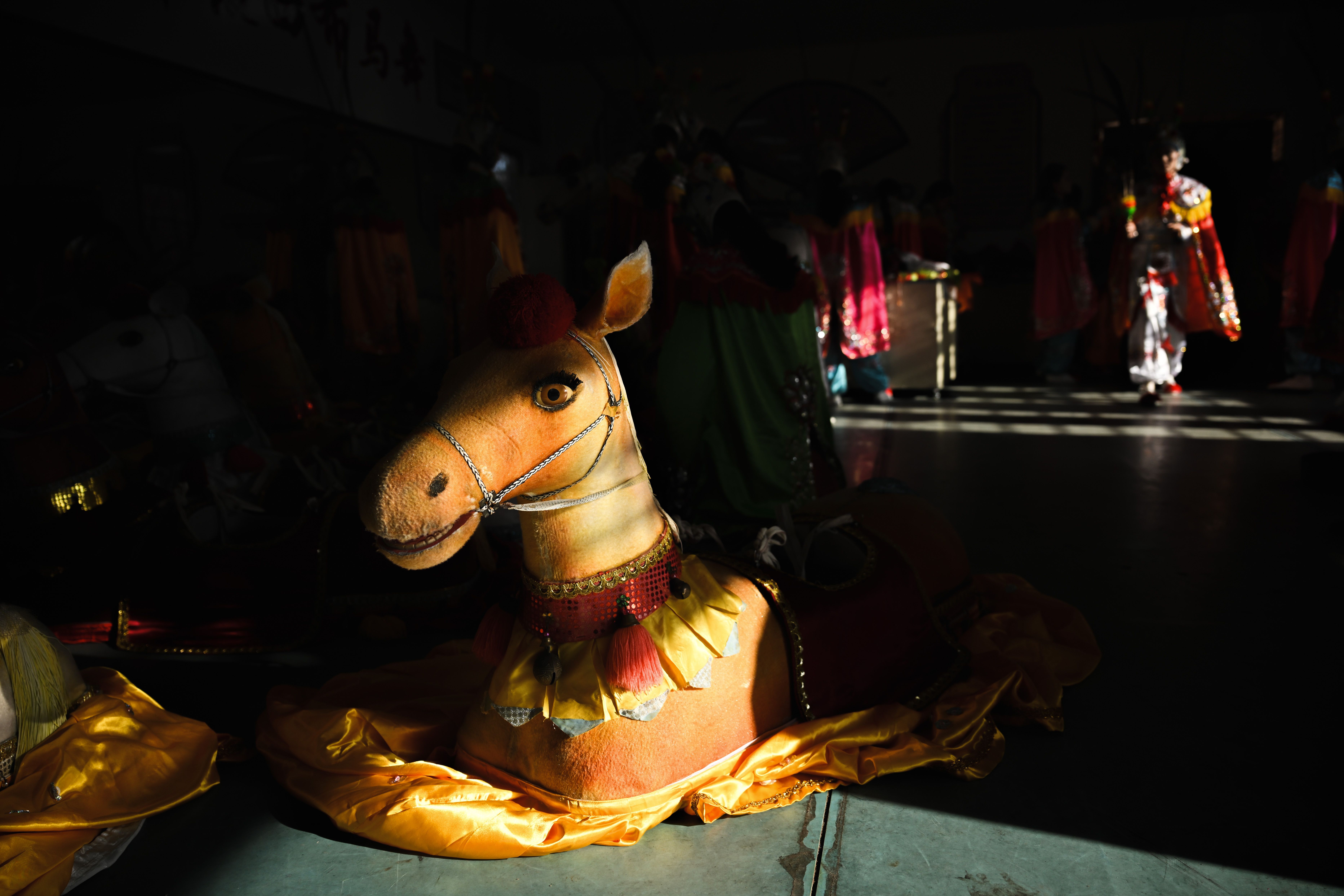
The horse statue is made of bamboo and cloth, brightly decorated, with a silk skirt draped around the bottom (Jayvon Wu)
Performers execute intricate footwork concealed beneath the cloth skirt draped at the bottom of the horse statue. “If your steps are off, your horse won’t come to life,” Zhang explains.
Though the horse statue, crafted from bamboo and fabric, appears lightweight, performers need to shoulder approximately 4 kilograms, in addition to the weight of their thick costumes, for roughly 10 hours of walking from start to end of each parade. To simulate the horse’s rhythmic gait, performers must continuously bend and straighten their knees to make the horse statue rise and fall.
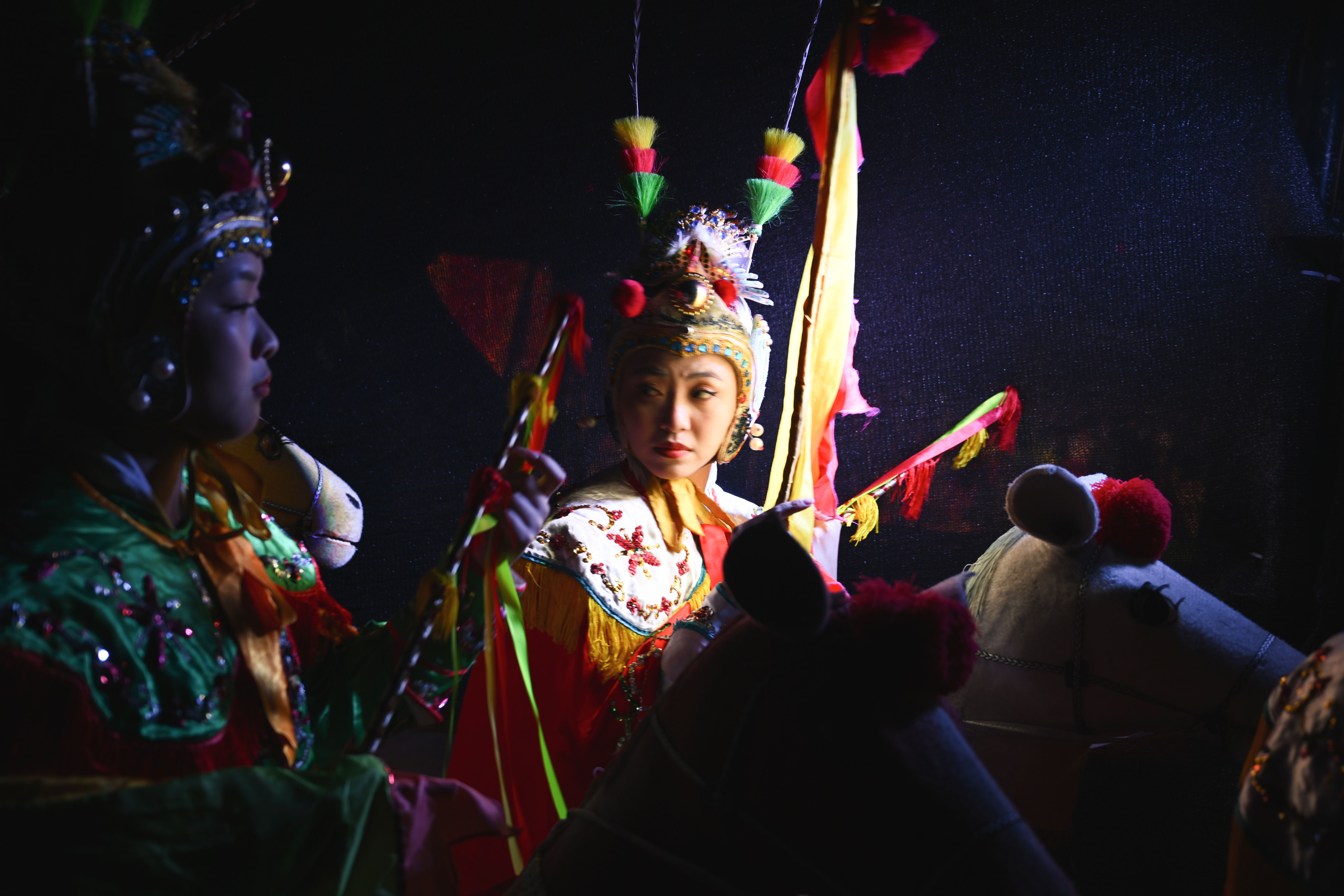
Performers waiting backstage to participate in the Spring Festival gala (Jayvon Wu)
Zhang’s favorite footwork sequence is the Seven-Step, which can be broken down into three parts. First, the performer steps right with the left foot, then pivots left on the left foot while stepping one pace with the right foot. Second, the performer steps the left foot back while simultaneously raising the right knee. Third, the performer repeats the first two parts with the opposite feet. At the end of this sequence, performers raise the horse’s head high to depict the female warriors pulling back the reins. The cloth horse is halted abruptly, and its front hooves lift high.
“This is the most difficult movement in the dance,” says Zhang. “During training, less experienced dancers often trip over their skirts.”
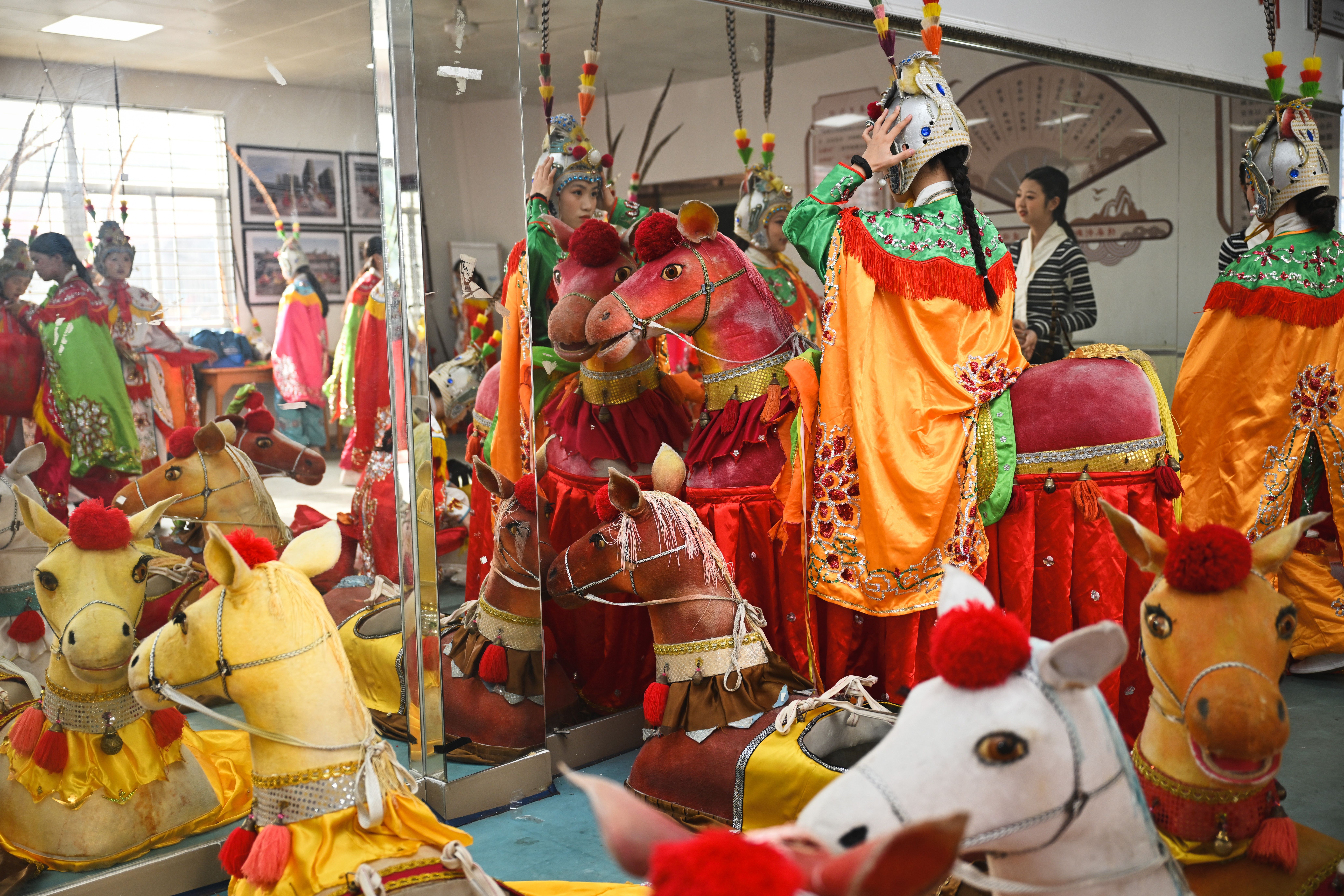
Performers getting ready in the training room before a parade (Jayvon Wu)
Initially, the cloth-horse dance was performed by men, depicting ancient male-centered narratives such as “Top Scholar’s Parade”—a story of the scholar Wen Tianxiang (文天祥) returning to his hometown after achieving top honors in the imperial examinations.
In the early to mid-19th century, drawing on local folk opera, the cloth-horse dance incorporated more complex movements and formations, expanding its repertoire.
After the founding of the PRC, an official campaign sought to reform traditional art forms and create new works that combined historical themes with contemporary values. During the Spring Festival of 1980, a mixed-gender troupe performed “Zhaojun Goes Beyond the Frontier” for the locals, depicting the journey of the Western Han court lady to join a historical marriage alliance intended to secure peace.
The success of such productions encouraged greater participation by female performers and richer artistic expression in folk dance. In 1989, an all-female troupe staged “Mu Guiying Takes Command,” inspired by legends of a female general who led resistance to invaders during the Northern Song period, thereby solidifying the image of the dashing, heroic female figure in cloth-horse dance.
Today, female performers account for over 60 percent of participants in the folk performance, according to a 2016 survey conducted in Raoping, with stories of heroines like Hua Mulan and Mu Guiying taking center stage. This follows the trend in other traditionally male-dominated arts, such as the lion dance and Yingge dance, which have seen a rise in female performers and even all-female troupes.
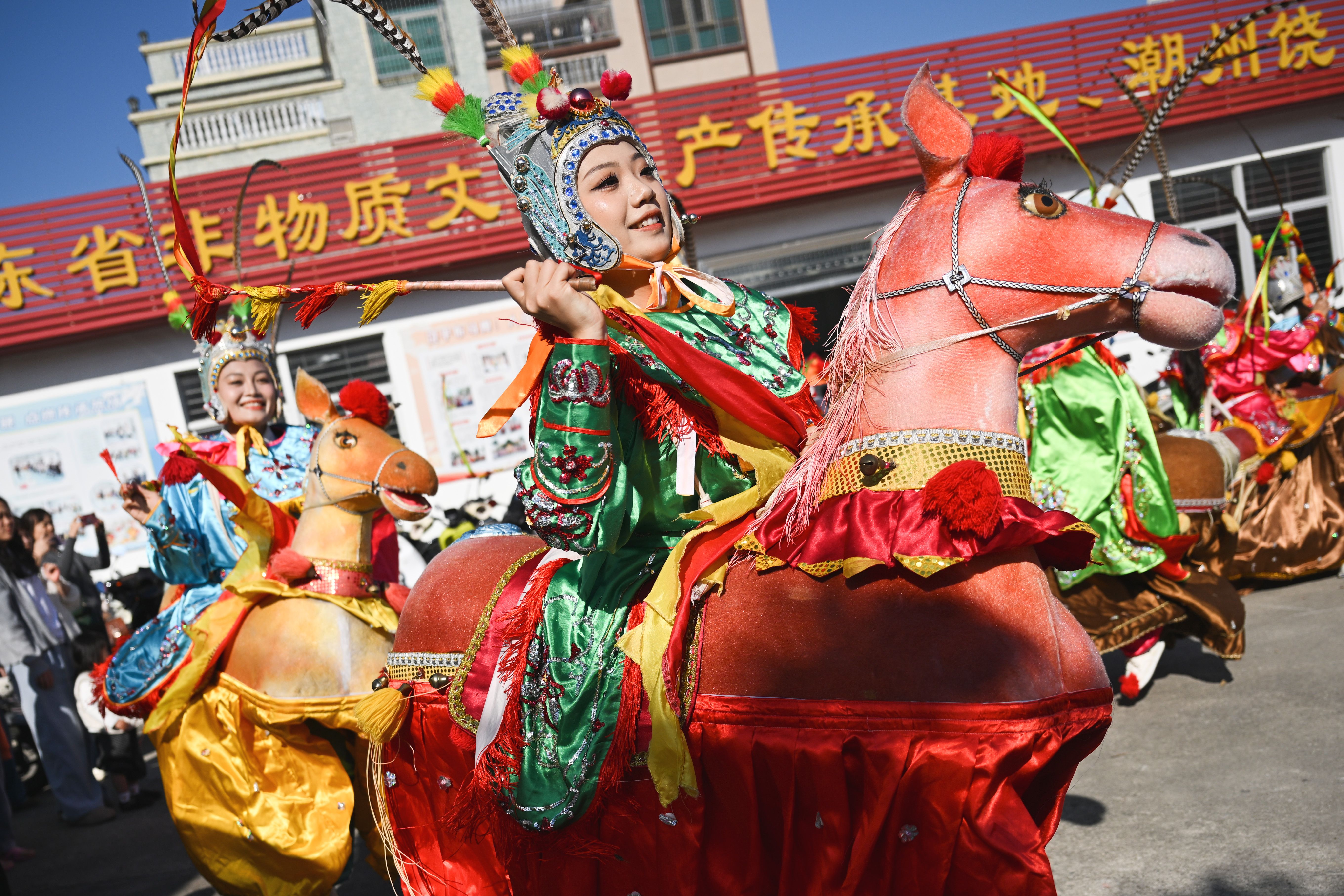
Originally featuring narratives such as the “Top Scholar’s Parade,” the cloth-horse dance now showcases dashing female warriors (Jayvon Wu)
Though the dancers may catch all the attention, musicians and coaches are also an essential part of the team. Zhang Yuanyuan, aged 17, has wanted to put on the horse skirt ever since she first saw the dance at age 5, but joined the troupe four years ago as a gong player.
“I’m not tall enough to put on a horse costume, but I’m satisfied being part of the troupe,” she says with a smile. “I can’t remember how many performances I’ve been part of.”
Coach Liu developed a deep fascination with the cloth-horse dance after witnessing a performance as a child. He joined the troupe 30 years ago as a flag-bearer.
“If we cannot innovate our dance, we shall be surpassed,” Liu concludes after 12 years of coaching.
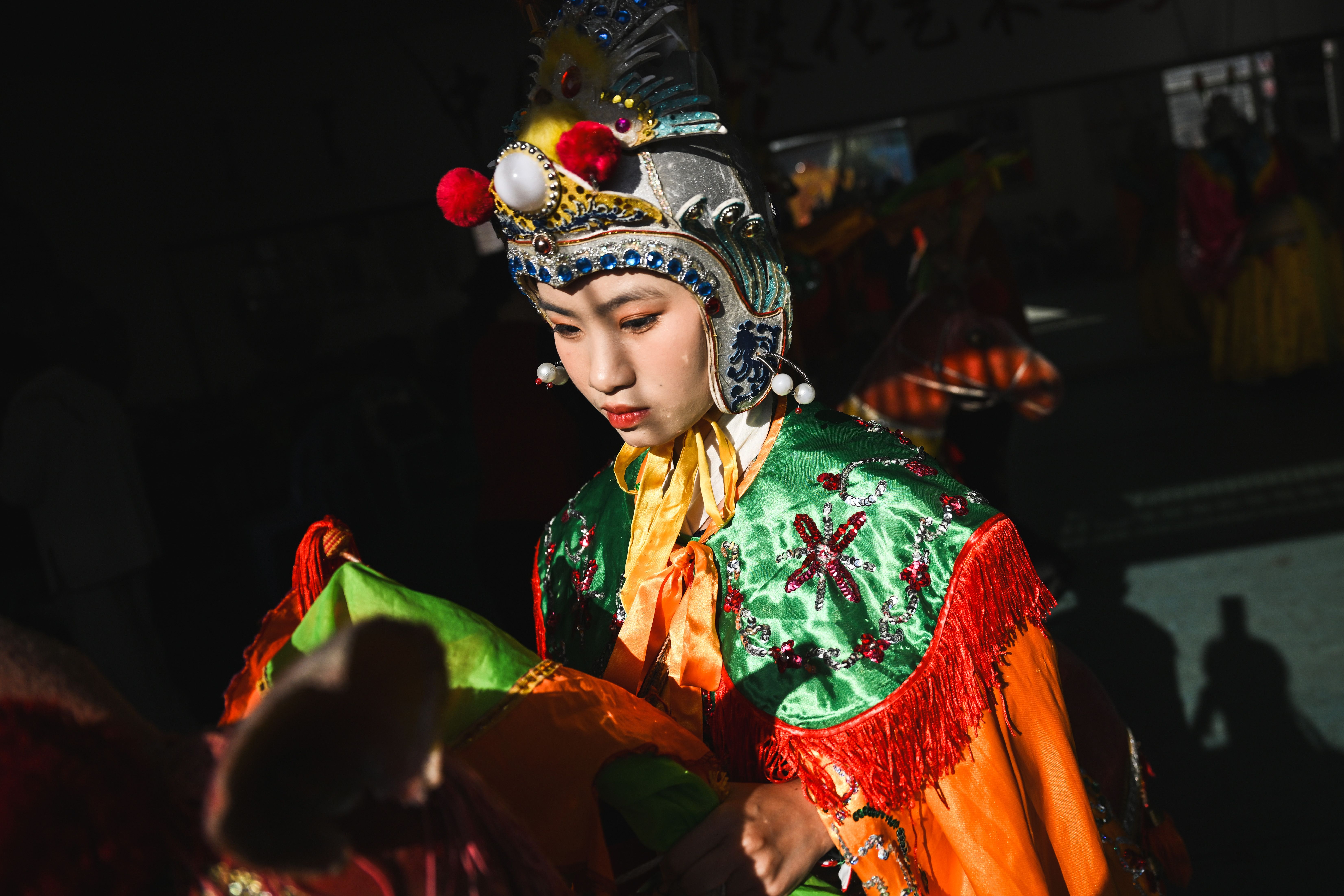
With dexterous footwork and graceful body movement, the performers bring vivid steeds to life—an endeavor that is physically demanding (Jayvon Wu)
Drawing from his musical background, he applies his expertise to choreographing the dance. He fuses the “triple meter” from traditional folk music with the tempo of the Viennese waltz, creating the distinctive “sextuple meter.” The Seven-Step was also created by Liu, incorporating elements of Mongolian dance movements.
“The experienced members in the team have been with us for over eight years now. I’m confident they could excel in no time if they want to take over my role as coach,” says Liu. He expresses full faith in her troupe’s abilities and anticipation over how they will help this ancient art form grow. “I hope more young women will join me in preserving this intangible cultural heritage.”
Related Articles