

In ancient China, travel credentials assumed many shapes—tokens, staffs, and records on bamboo slips—yet how did the modern passport take over?
In the classic Chinese novel Journey to the West, there is a recurring scene: each time the monk Xuanzang and his disciples enter a new kingdom on their way to ancient India to obtain authentic Buddhist scriptures, their first task is to proceed to the royal palace and present their travel permit, or tongguan wendie (通关文牒)—a booklet-like document issued by Emperor Taizong of Tang. The ruler, after verifying its authenticity, would take out the royal seal to sign and stamp the rescript. Only then did the monk secure legal permission to traverse that country.
For international travelers today, this is a familiar scene, not unlike the one faced at immigration gates the world over. Out comes the passport to be inspected by a steely-eyed agent, who possesses the all-powerful stamp allowing entrance into their land.
In fact, although the passport in its modern sense was not formally established until after World War I, a system of travel credentials had existed in China for over two millennia. Whether for military deployment, diplomatic missions, commercial trade, or personal travel, specific credentials were required to verify one’s identity and authorize their passage.
Ancient China wasn’t always united under a single central government as it is today. For much of its early history, multiple states and regional regimes coexisted (sometimes under a nominal central authority). As such, historical travel credentials were established to authorize travel among these areas.
The earliest travel credentials were issued to officials on duty—a token known as a jie (节) paired with a detailed travel document, known as zhuan (传). According to the Rites of Zhou (《周礼》), a second-century BCE classic on Zhou governance (1046 – 256 BCE), those who were found traveling without a token would not only fail in their attempt to pass checkpoints but also be jailed.
Read more about life in ancient China:
- Rebellion, Corruption, and the Lychee: The History of Chinese Couriers
- A Trip in Time: How Did People Travel in Ancient China?
- A Short History of Pirates in Ancient China
Early jie tokens were small objects, slightly larger than a palm, crafted from materials such as jade or bronze. Their forms ranged from tigers to dragons, depending on the issuing state, while zhuan was typically written on bamboo or wooden slips, or on silk. With greater resemblance to modern travel documents, zhuan recorded the traveler’s name, purpose of the journey, points of departure and destination, and even specific mountain passes and transportation.
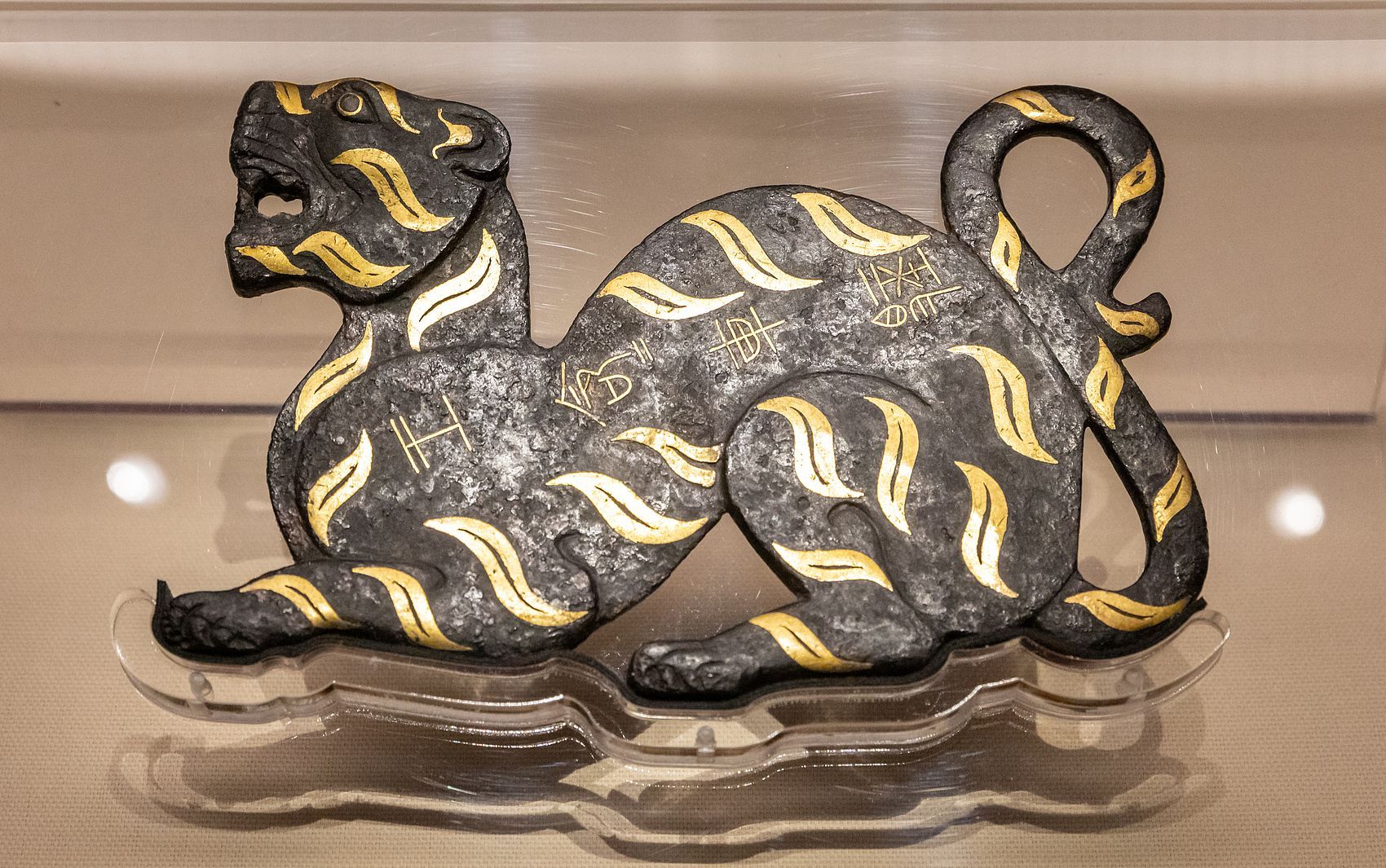
A copper tiger token, or hujie (虎节), inlaid with gold, from the Nanyue Kingdom, a small state that existed in southeastern China between the third and second centuries BCE (VCG)
While zhuan served a practical purpose, the jie had a symbolic function: when granted by the ruler to an envoy, it authenticated the bearer’s identity and mission, effectively making the holder the sovereign’s personal representative. Today, over 2,000 years later, the term shijie (使节) still denotes a diplomatic envoy—literally, “one who holds the jie.”
In traditional Chinese narratives, one shijie in particular is cast as an emblem of patriotism and perseverance. The Book of Han (《汉书》), published in the first century, records the story of Su Wu (苏武), who was dispatched by the Han emperor in 100 BCE as an envoy to the Xiongnu confederation, then ruling the Eurasian Steppe. Carrying the “Jie of Han,” a yak hair-adorned bamboo staff approximately two meters long, as his sole credential as the representative of the Han emperor, Su led more than 100 men on a diplomatic mission to secure peace.
The Xiongnu chieftain, however, attempted to force Su to surrender. He imprisoned Su and later exiled him to the desolate “North Sea” (today’s Lake Baikal), tasking him with herding sheep and declaring that Su could only return when a ram bore lambs. During his 19-year exile, Su “leaned on the Han jie while herding sheep, holding it whether awake or asleep.” The yak hairs of the staff gradually wore away, yet Su never capitulated. When he finally returned to the imperial capital of Chang’an, holding the bare staff, the entire nation was deeply moved. “Su Wu’s jie” thus became the ultimate symbol of unwavering fidelity and integrity.
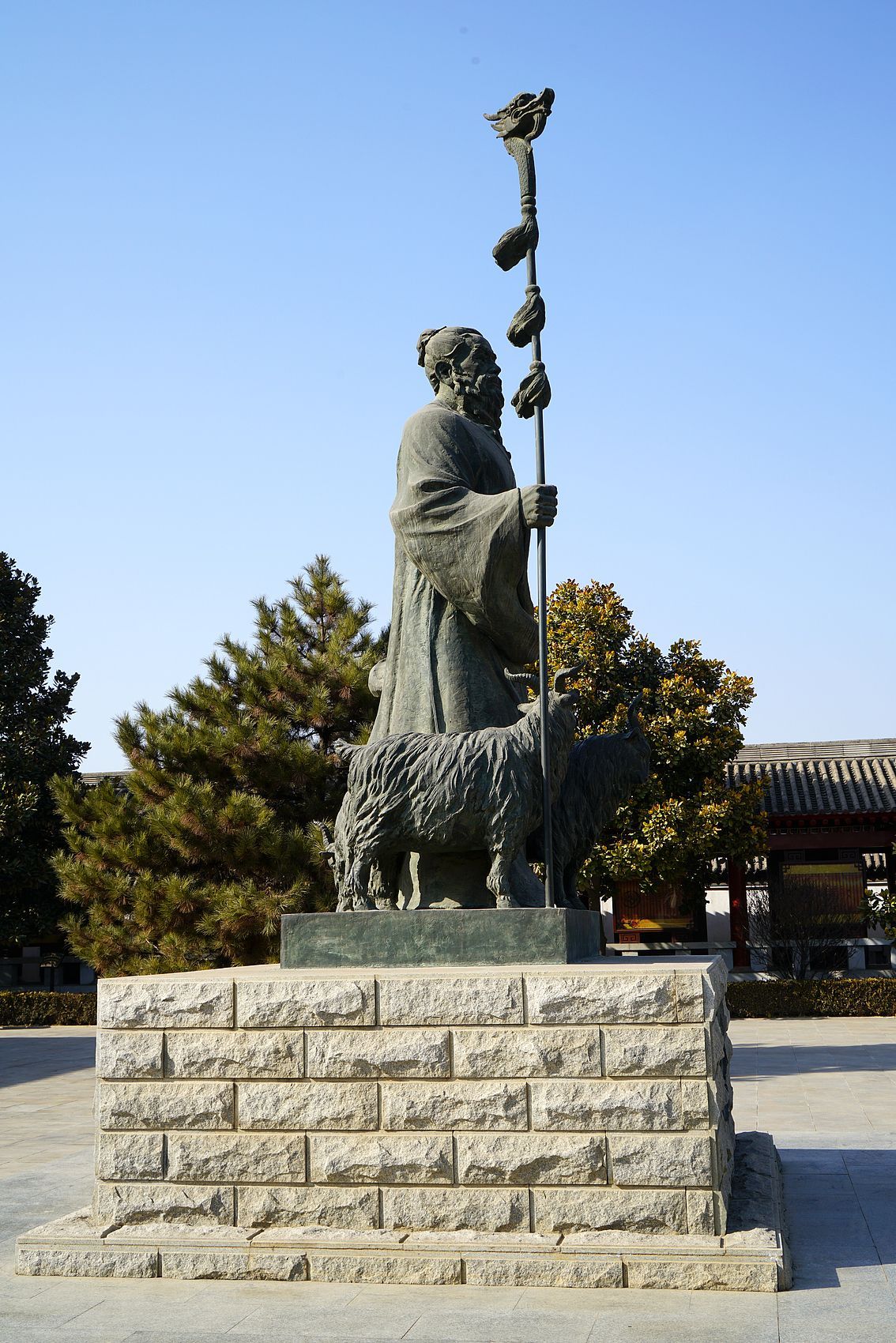
A modern statue depicts Su Wu herding sheep during his 19-year exile in Siberia, holding on to his bamboo staff (VCG)
Less chivalrous is the story of Lord Mengchang, who during the Warring States period (475 BCE – 221 BCE) committed one of China’s earliest acts of passport forgery. Lord Mengchang was a prominent statesman who briefly served the Qin state but later fell from favor and faced political backlash. The lord, however, possessed a generous nature, which attracted a retinue of loyal followers, who one night accompanied him on an escape to the border fortress of Hangu Pass. One retainer skillfully altered their zhuan, fabricating new identities and purposes for the entire party—an ancient analogue to passport fraud—while another mimicked the rooster’s crow so convincingly that the guards opened the gate before dawn. The ruse succeeded, allowing them to pass the checkpoint and escape.
In the unified dynasties that followed, travel within the country was tightly controlled by authorities to prevent evasion of taxes and labor obligations, making travel documents essential for civilians as well. The Han dynasty (206 BCE – 220 CE) travel document is known as guosuo (过所, literally “pass-for-place”), a bamboo slip ID that stated the traveler’s information, purpose of travel, itinerary, and manifest. The application procedure for a Han guosuo was quite stringent. An applicant had to petition the local official, who had to confirm that the person had no involvement in official lawsuits or conscription duties before issuing a guosuo.
The guosuo system during the Tang dynasty (618 – 907) was even stricter. Travelers without official travel documents could be sentenced to penal servitude. An interesting historical fact is that the real-life monk Xuanzang did not have a guosuo for his famous pilgrimage, contrary to what is depicted in Journey to the West. A seventh-century biography of Xuanzang records that the monk applied for a guosuo but never received approval, making him an undocumented migrant. He had to depart in secrecy and was even subject to a government order for his arrest. When he returned 18 years later as a learned Buddhist master, Xuanzang petitioned the emperor for a pardon, which was granted before he reentered the country.

A staff member dressed as a commander of Jiayu Pass at the western terminus of the Great Wall issues souvenir travel permits, known as guanzhao (关照) during the Ming dynasty (1368 – 1644), to tourists (VCG)
In the Song dynasty (960 – 1279), as commercial activity flourished, the focus of the travel credential system shifted towards regulating trade and merchant travel rather than restricting the movement of the general population. The primary document for this purpose became the gongyan (公验, public certification). There also seemed to be no distinction between a passport and a visitor’s visa under this system, since all foreign merchants were issued a gongyan to facilitate their travels around the country, according to the Draft Compendium of Song Institutions (《宋会要辑稿》), an official record of the institutional and legal system of the Song dynasty. The documents were also issued to ships authorized for overseas commerce.
The passport in the modern sense emerged in China in the early years of the Qing dynasty (1616 – 1911). In 1689, the Qing government signed the Treaty of Nerchinsk with Russia, which settled border disputes along the Heilong (Amur) River region and established a defined frontier between the two empires. The treaty included a provision allowing individuals holding certificates from their home countries to enter either domain and engage in trade. In practice, however, such documents were issued only to Qing officials traveling beyond the frontier on official business, and they took the form of letters of protection. This treaty marks the earliest recorded use of the term huzhao (护照, literally “protection certificate”), the modern Chinese word for passport.
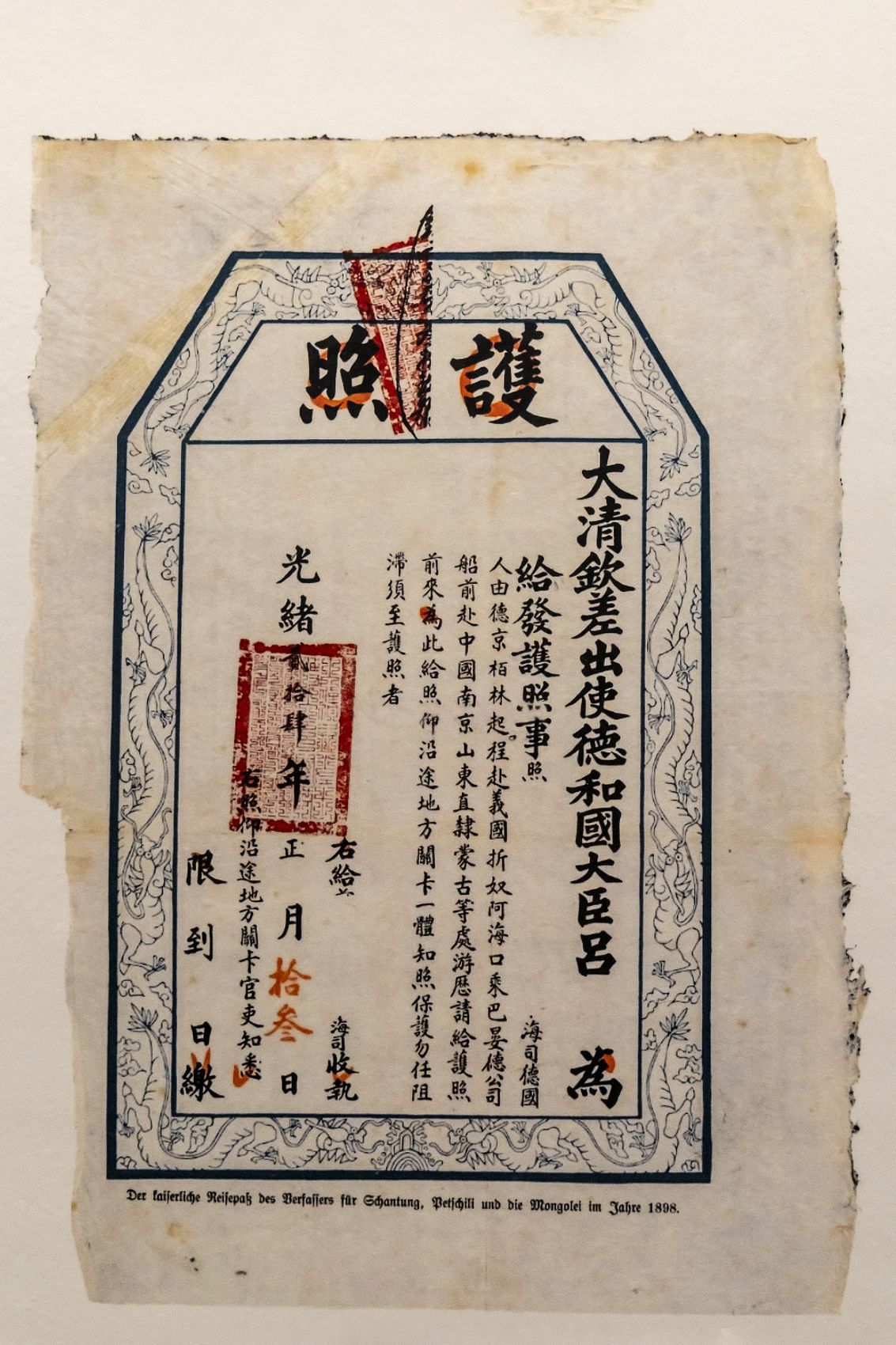
A letter of protection issued in 1898 to the Chinese Minister to Germany, stating: “This document is issued accordingly, instructing all local passes and checkpoints along the route to take due notice, to afford protection, and to permit no obstruction” (VCG)
As the Qing dynasty was reluctantly drawn into the modern international order after the Opium War in 1840, its passport system underwent significant change to accommodate a growing number of travelers—ranging from officials on diplomatic missions to migrant workers heading to Europe, North America, Southeast Asia, and other destinations. Initially issued as collective passports listing the names of group members, the Qing government soon shifted to “single-person, single-sheet” passports.
The global passport system as we know it today was developed in 1920, following World War I. China quickly signed on to the system, and the first passport booklet in China was issued in 1922 by the Ministry of Foreign Affairs of the Beiyang Government. Typically comprising 16 pages and valid for three years, these passports devoted roughly half of their pages to translations in eight languages, which reflected the fragmented international standing and diplomatic challenges China faced during that era.
The PRC’s first edition of passports was issued in 1950, categorized into diplomatic, official, and ordinary passports. Most outbound travelers during the early years of the PRC were officials, government-sponsored students, foreign-aid specialists, and engineers, but after reform and opening-up in the late 1970s, demand for traveling abroad increased across the board. While only around 210,000 passports were issued from 1949 to 1979, as of 2025, 160 million Chinese citizens hold passports, according to the National Immigration Administration.
A passport not only certifies identity but also enables mobility. Currently, over 40 countries grant visa-free entry for Chinese passport holders, while China grants visa-free entry to citizens of over 70 different countries. From a symbol of tight control to the key enabling journeys afar, the little paper has certainly come a long way.
Related Articles