


Brimming with romantic images of what awaited her—an endless icy wilderness, the shimmering dance of the aurora, a mysterious culture forged between East and West—Zhang Yutong boarded her first flight to Russia.
A different reality greeted her when she landed. Despite taking precautions to ensure a smooth arrival, Zhang was met with immigration lines stretching endlessly ahead, unfamiliar Cyrillic letters everywhere she looked, and a SIM card that might or might not connect to the local network, leaving her unsure whether she would be able to contact her prearranged driver. In that moment, she realized this was only the beginning.
After Russia introduced a policy on December 1, 2025, allowing Chinese nationals visa-free entry for up to 30 days, a wave of tourists has flooded the country, embarking on so-called “hardcore travel” where awe and frustration intertwine.
Learn more about tourism trends in China:
- The Quest for Quiet: Can “Reverse Travel” Save China’s Tourists From Holiday Crowds?
- Behind the Fame: What Makes a Viral Travel Destination?
- Ting Bu Dong? China’s Surging Demand for Foreign Language Tour Guides
In an interview with Xinhua News Agency this February, Maya Lomidze, CEO of the Association of Tour Operators of Russia, said the number of Chinese visitors to Russia this summer may be up to 30 percent higher than during the same period last year.
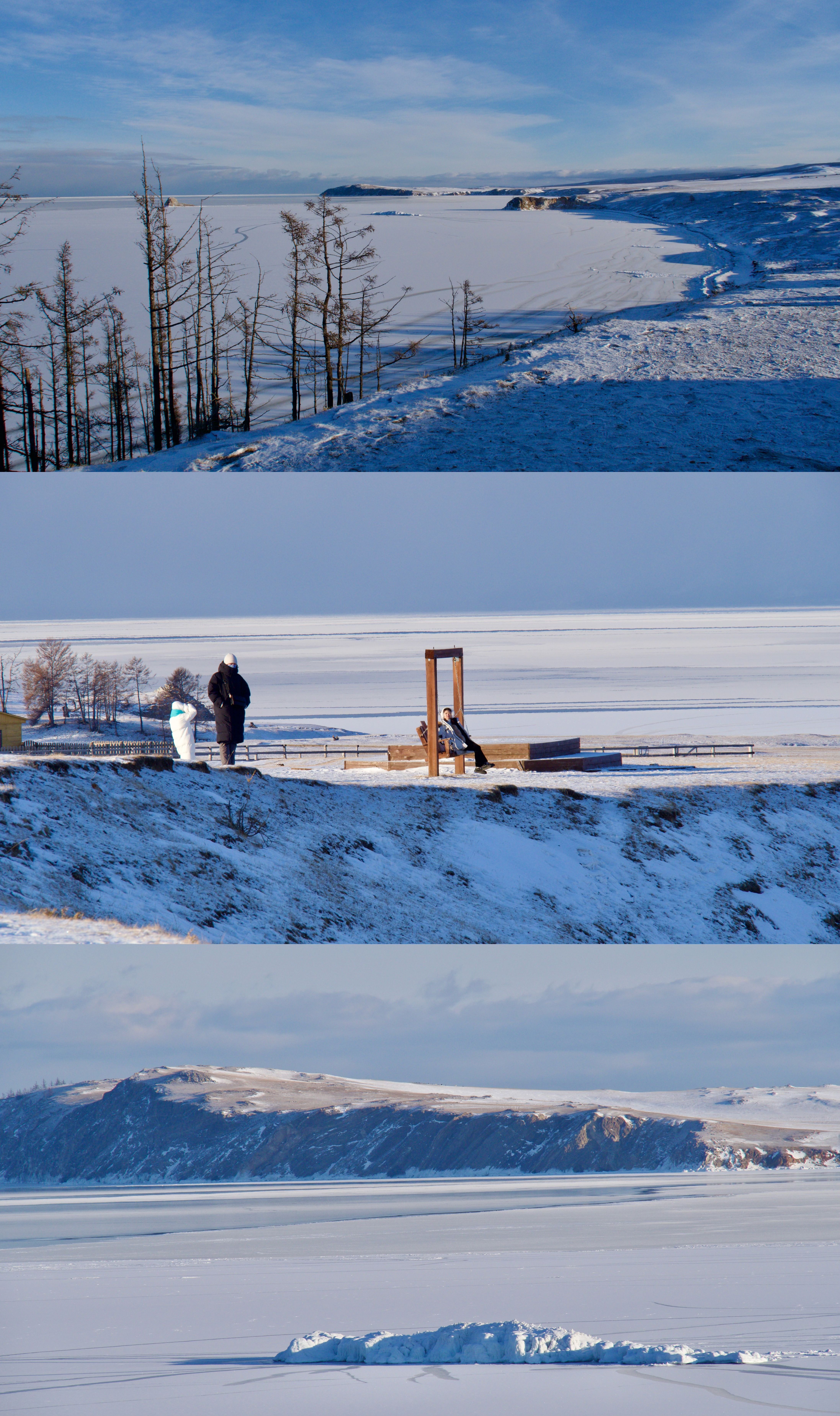
Russia’s Irkutsk Oblast, where the frozen Lake Baikal serves as a major winter attraction, has seen a surge in Chinese tourists, many of whom share exquisite photos of their trips on social media, further fueling the trend (Zhang Yutong)
Long before the new policy, Russia was gradually gaining a reputation among Chinese travelers as a “value-for-money paradise.” Posts on social media platforms such as Xiaohongshu (RedNote) and Douyin, China’s version of TikTok, tout the country as “Europe’s affordable alternative” accessible for “just a few thousand yuan,” further cementing it as a seemingly irresistible low-cost destination.
That enthusiasm has only grown with online storytelling—Chinese social media is filled with polished photos of Moscow’s Red Square and St. Petersburg’s Winter Palace, evoking the country’s historical elegance. In descriptions, people recite Pushkin’s poetry, idolize Tchaikovsky’s ballets, and play up the Chinese public’s emotional connection to the Soviet era. As one oft-repeated online refrain puts it: “[Russia’s] not as distant or expensive as Western Europe, yet not as familiar as Southeast Asia—there’s just the right amount of mystery and romance.”
For Lin Jianfeng, owner of the White Bear Guesthouse on Olkhon Island—the spiritual heart of Siberia’s Lake Baikal, the deepest freshwater lake in the world—the surge of Chinese visitors is no longer an abstract statistic but a part of daily life. Lin arrived on the island in 2019, when it “simply wasn’t on most Chinese travelers’ radar,” he says. “Over the past two years, tourism has exploded. Now, around 60 to 70 percent of visitors on the island are Chinese, with the rest mostly Russian tourists.”
Among them, young thrill-seeking Chinese travelers make up the majority. What lures them is Russia’s uniquely wild, frostbitten on- and off-road experiences. These include taking icebreakers into Siberia’s frozen seas, driving Soviet-era T-80 battle tanks through muddy terrain, dismantling AK-47 rifles, or even firing rocket launchers—activities that “awaken your fighting spirit,” as one person on Xiaohongshu exclaimed. Despite some visitors noting that the military equipment encountered during these activities is often archaic and that the experiences are unpolished, even more demanding challenges lie beneath the made-for-virality nature of these adventures.
The most immediate obstacle can be getting online at all. Zhang’s trip took place after Russia introduced a SIM blackout policy under which foreign SIM cards—or those belonging to travelers returning from abroad—are barred from using mobile internet and SMS services for 24 hours once detected on a Russian network. The measure is intended to prevent foreign-linked SIMs from being used in drones or other remote-controlled devices in potential attacks. Even after reading advice from previous travelers on social media about sending advance messages or switching network operators, Zhang was unsure whether she would be able to contact her driver after landing.
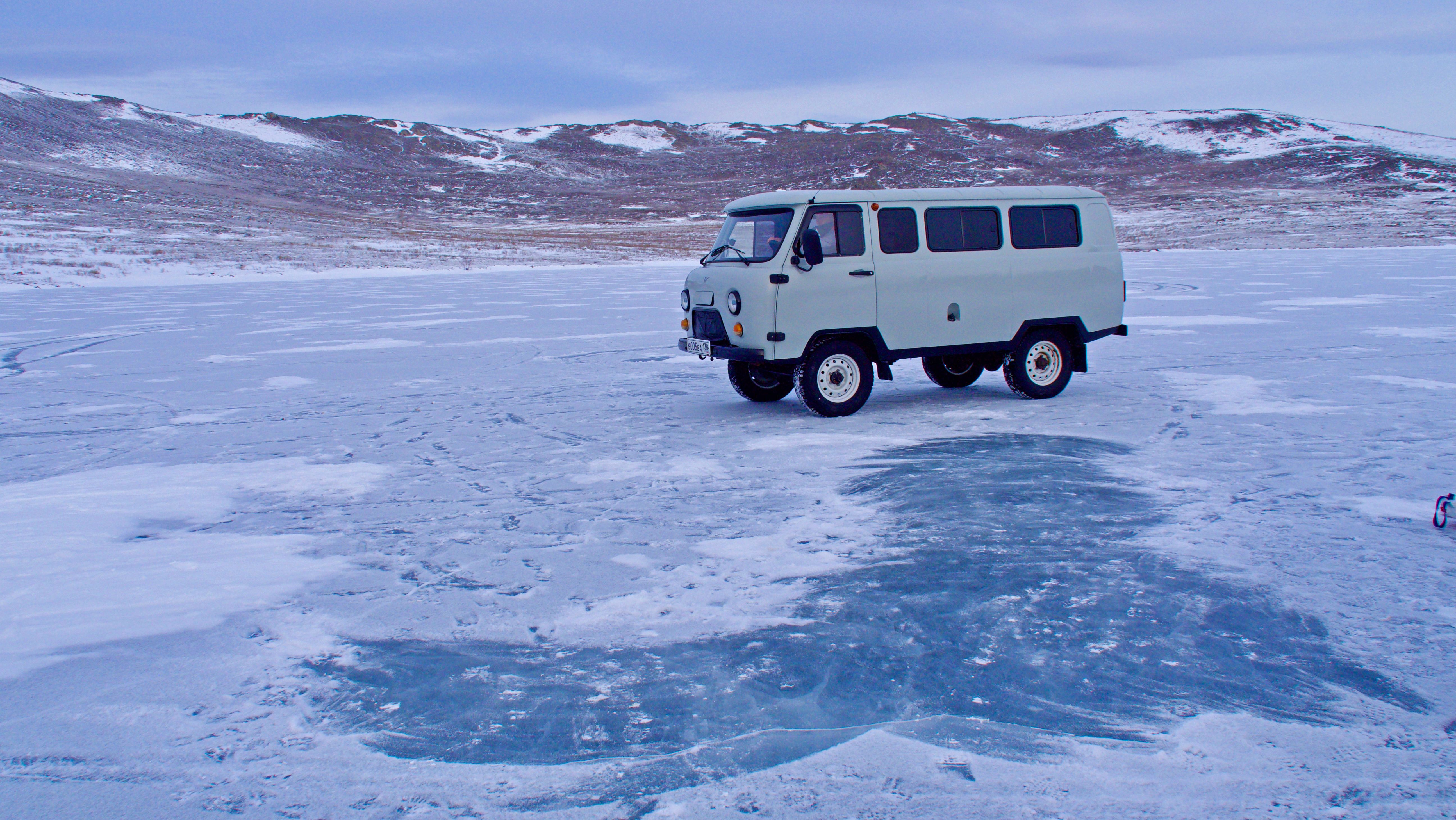
January to March is the blue ice season at Lake Baikal, when crystal-clear ice draws photographers from around the world. Yet ice cracks remain dangerous: two tragedies involving Chinese tourists have occurred since the start of the year. (Zhang Yutong)
Even more frustrating is that free Wi-Fi hotspots in malls and restaurants often require a Russian phone number for verification, effectively locking out foreign numbers and hobbling those reliant on online maps and other travel apps.
Then there are issues with payments. Due to international sanctions, Visa and MasterCard are both blocked across Russia, meaning travelers must exchange enough cash in advance to cover nearly all their expenses, from food to transportation. For Chinese travelers accustomed to a fully cashless lifestyle, this can feel like stepping back in time.
Despite careful preparation—including exchanging sufficient cash in Beijing, where only 5,000-ruble notes were available—Zhang nearly went hungry when presented with her first meal in Russia, as the roadside restaurant her driver chose refused to accept large bills.
The language barrier is also higher than many expect. Even in the comparatively cosmopolitan hubs of Moscow and St. Petersburg, English proficiency is limited. Finding young people who can communicate in basic English is a bonus—expecting taxi drivers or shop assistants to do so is unrealistic. As one tourist summarized, “Here, a translation app is more reliable than your English.” While body language and smartphone apps help bridge the gap, the lack of internet often means translations can’t be accessed at all.
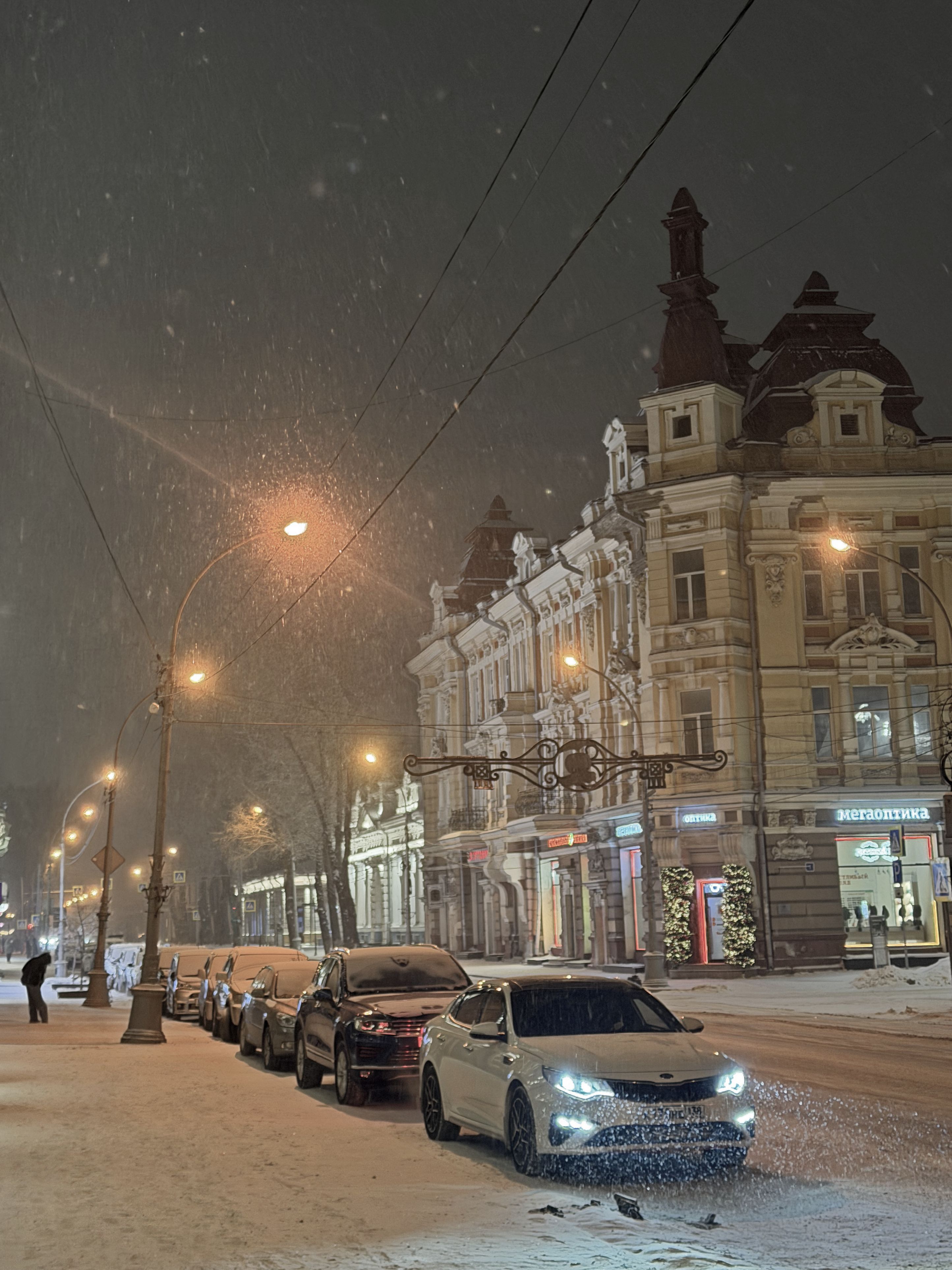
Young Chinese travelers face many challenges on their trips in Russia, from language barriers and limited public facilities to safety concerns (Aria Zhang)
For those chasing natural wonders, transport uncertainty poses yet another risk. Winter trips to Murmansk or Teriberka in search of the aurora in Russia’s deep northwest are especially vulnerable to snowstorm-triggered road closures. “Roads are closed so easily—and once they do, it’s often for more than two days,” recalled one stranded traveler on Xiaohongshu. “We were stuck for five days, and when the road reopened, it was only for one day before closing again!” Such disruptions can upend entire itineraries and trigger cascading losses in flight and accommodation fees.
Zhang’s adventure to Lake Baikal turned into what she called “a journey full of obstacles (全障碍出行).” Ordering food at restaurants was frequently a challenge because menus lacked pictures, translations were unreliable, and staff were bemused. After boarding a retrofitted Soviet-era buhanka, or “loaf” van—a rugged vehicle used around the island named for its bread-like shape—she discovered that her seatbelt was broken. “I was jolted around for the entire day,” she says.
Zhang was one of the lucky ones. Not long after her trip, in late January, a Chinese traveler died when a vehicle carrying tourists overturned on Lake Baikal’s frozen surface. Then, on February 20, seven Chinese tourists drowned when their van fell through the lake’s ice.
While such tragedies are rare, everyday inconveniences can also catch travelers off guard. Public toilets are scarce on the streets of Moscow and St. Petersburg, and when they do exist, users can expect to pay between 50 and 200 rubles. Metro stations—unlike those in China—rarely have facilities, and restrooms inside attractions often have long lines. Online, Chinese travelers laugh off the inconvenience, jokingly referring to paid public restrooms as Russia’s “toilet economy,” but the term also reflects gaps in infrastructure for the growing number of tourists.
Despite these hurdles, when night falls and travelers watch the aurora wash the Arctic sky in vivid green, stand immersed in a frozen wonderland on the blue ice of Lake Baikal, or wander through centuries-old galleries steeped in history, many still feel the trouble is worth it. For them, Russia’s appeal lies in its rawness and authenticity, offering an unpolished yet powerful travel experience shaped by historical weight, untamed nature, and cultural otherness—a unique blend not easily found elsewhere. But as the travel boom cools, can the country leverage its deep ties with China to continue attracting visitors?
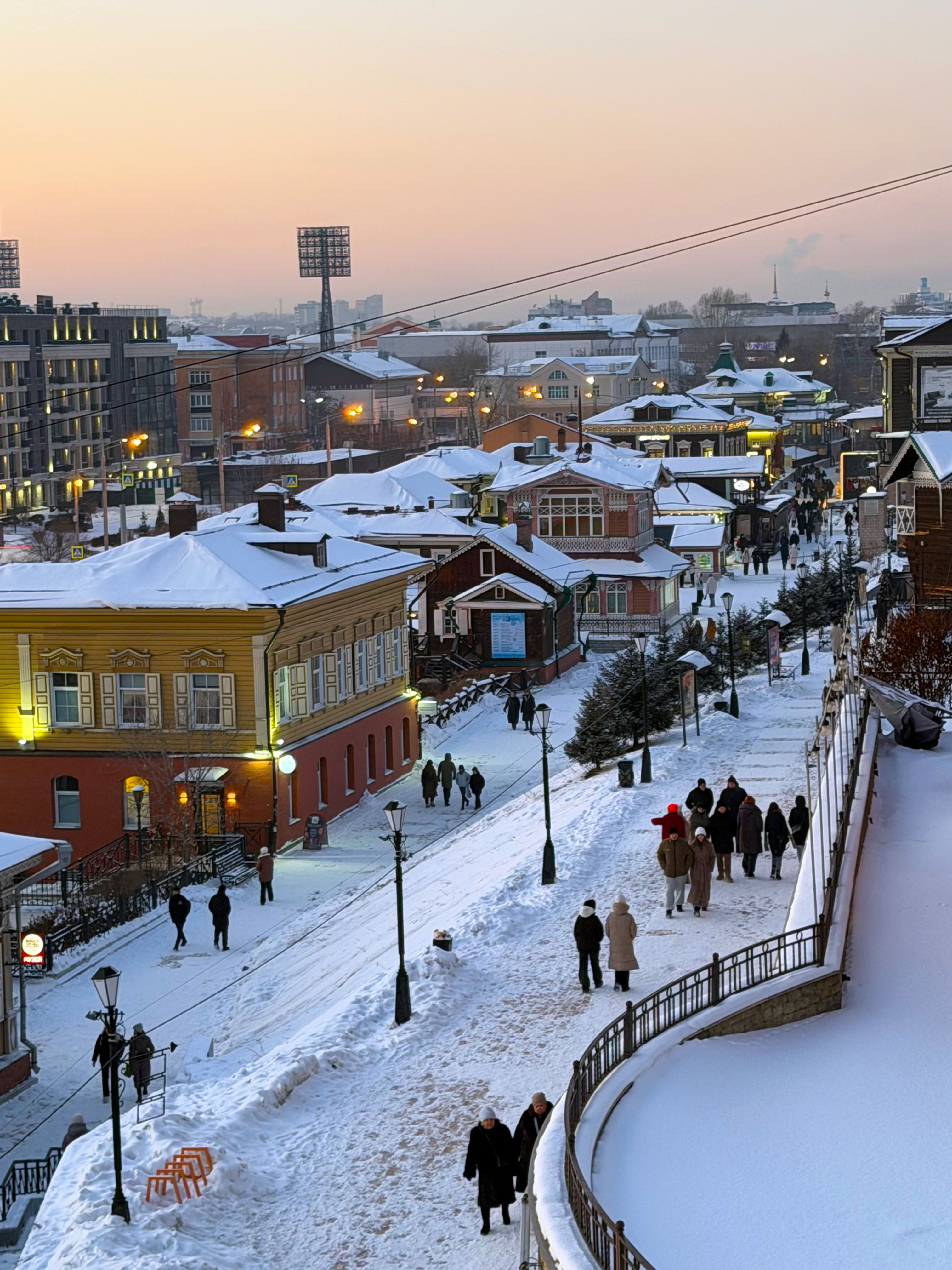
Twilight settles over Irkutsk, where an increasing number of young Chinese tourists take in the wooden Siberian-style houses and historic streets. Despite the obstacles, many are still drawn to the unique experience of traveling through Russia that cannot be found anywhere else. (Aria Zhang)
While Zhang hopes Russia will take steps to better regulate its tourism industry, she mentions the country’s remarkable art and architecture as reasons she would return. “Next time, I’ll have to prepare even more thoroughly—and bring along someone who can speak Russian,” she sighs.
Guesthouse owner Lin remains confident that things are improving. Following the January accident on Lake Baikal, he assisted the local immigration office with translation and post-incident procedures. He says authorities then launched a weeklong campaign to crack down on overloaded and speeding passenger vehicles.
Meanwhile, cities such as Moscow have also been gradually improving tourism services related to language assistance, signage, and payments. At Sheremetyevo International Airport in Moscow, Chinese-language signs walk tourists through key procedures, from customs and security checks to baggage claim.
These small improvements suggest that Russia—both familiar and strange, and in all its complexity—still has much to offer Chinese visitors. “We truly want to introduce this place to the world,” Lin says. “It’s incredibly beautiful. It’s a long-term effort, but it’s a direction worth working toward.”
Related Articles



