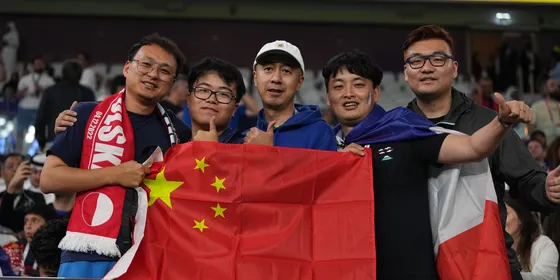
When the World Cup kicks off, Chinese fans know one thing for certain: their team won’t be playing, but they will be watching. It has always been this way except for 2002, the first and only time the Chinese team qualified. Without a national team to support, fans have developed their own strategies for enjoying the tournament.
The “privilege” to choose a team
When the tournament kicked off last month, a Chinese fan messaged South Korean actor Lee Dong-wook on a fan platform: “Which team are you supporting in the World Cup?” Lee, naturally expecting the answer to be obvious, replied in bewilderment: “What kind of question is that?”
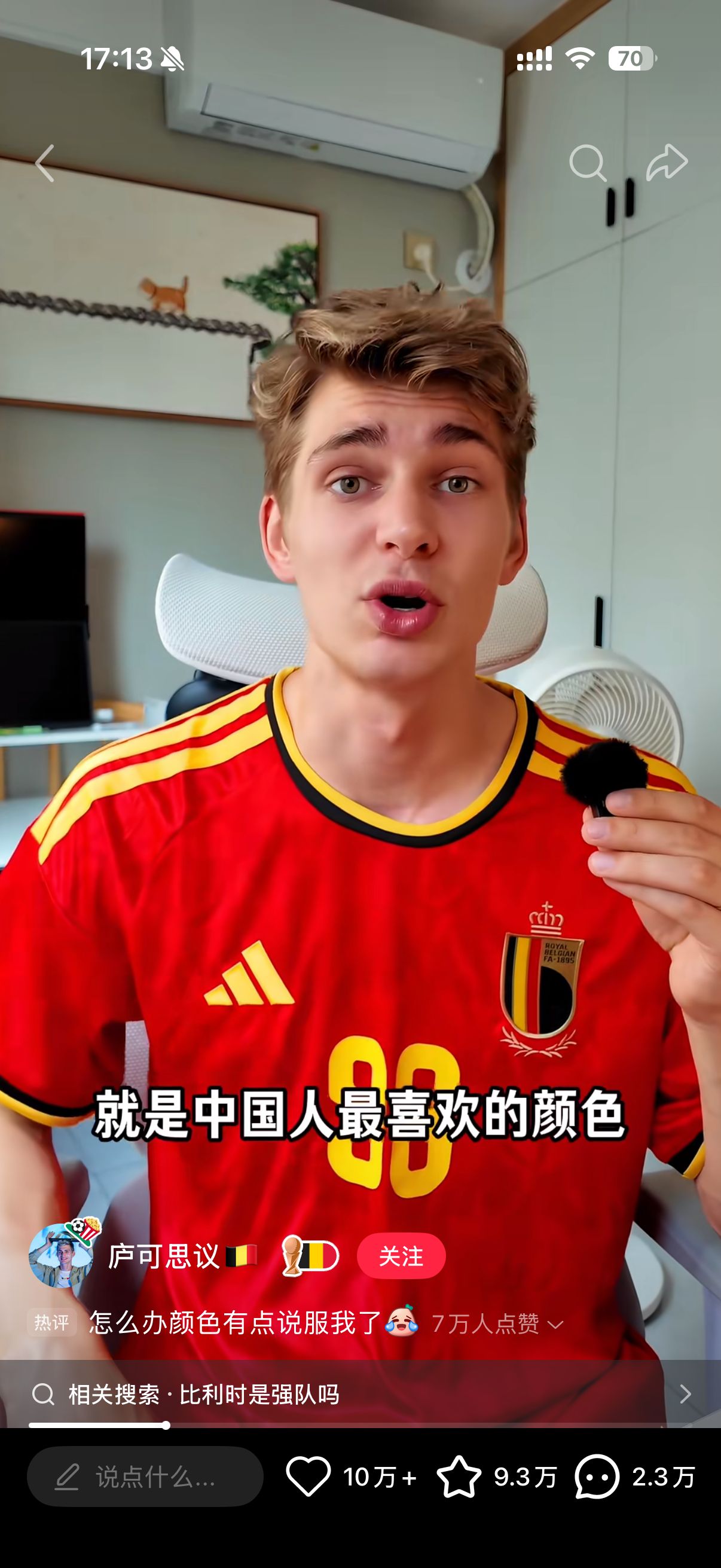
Belgian influencer Lucas Decker’s video trying to convert Chinese fans to root for his home country has become his most-viewed content on Xiaohongshu (screenshot via Xiaohongshu)
The exchange quickly went viral on Chinese social media. Many Chinese users, so accustomed to not having a national team to cheer for, didn’t even get the joke at first. They later quipped that being able to choose any team to support is a privilege in itself. Xiaohongshu (RedNote), one of the World Cup’s official broadcasting platforms in China this year, even lets users add the flag of their chosen team to their account handles—a lighthearted feature many joked might be hard to imagine on many other countries’ social platforms.
Some foreigners living in China have taken advantage of this vacuum by trying to recruit Chinese fans to support their national teams. During the group stage, Belgian vlogger Lucas Deckers posted a short video on Chinese social media urging viewers to back Belgium. His reasons? The Belgian team uniform is also red and yellow—just like China’s national flag—and Belgium knocked Japan out of the 2018 World Cup. Chinese fans embraced the joke, enthusiastically reposting the video. In the round of 16, after US President Donald Trump called FIFA’s president to overturn the suspension of US striker Folarin Balogun—a move many saw as unfairly rigging the game—Belgium thrashed the US 4–1. Fans flooded back to the vlogger’s comment section, joking that following his advice to support Belgium had turned out to be the right choice.
Where the loyalty lies
All jokes aside, most Chinese fans aren’t picking teams at random, nor are they merely neutral spectators. Over the years, several teams have built up sizable and devoted followings among Chinese fans.
A study by Warwick Business School found that England had the highest support rate among Chinese fans during the 2006 World Cup. Spain’s sports newspaper AS argued in a report this year that Argentina, thanks to Lionel Messi, could “sweep up” neutral fans, including those in China. On Chinese platforms, including the sports forum Hupu and the social media platform Xiaohongshu, Portugal, Argentina, and Brazil all have passionate followings.
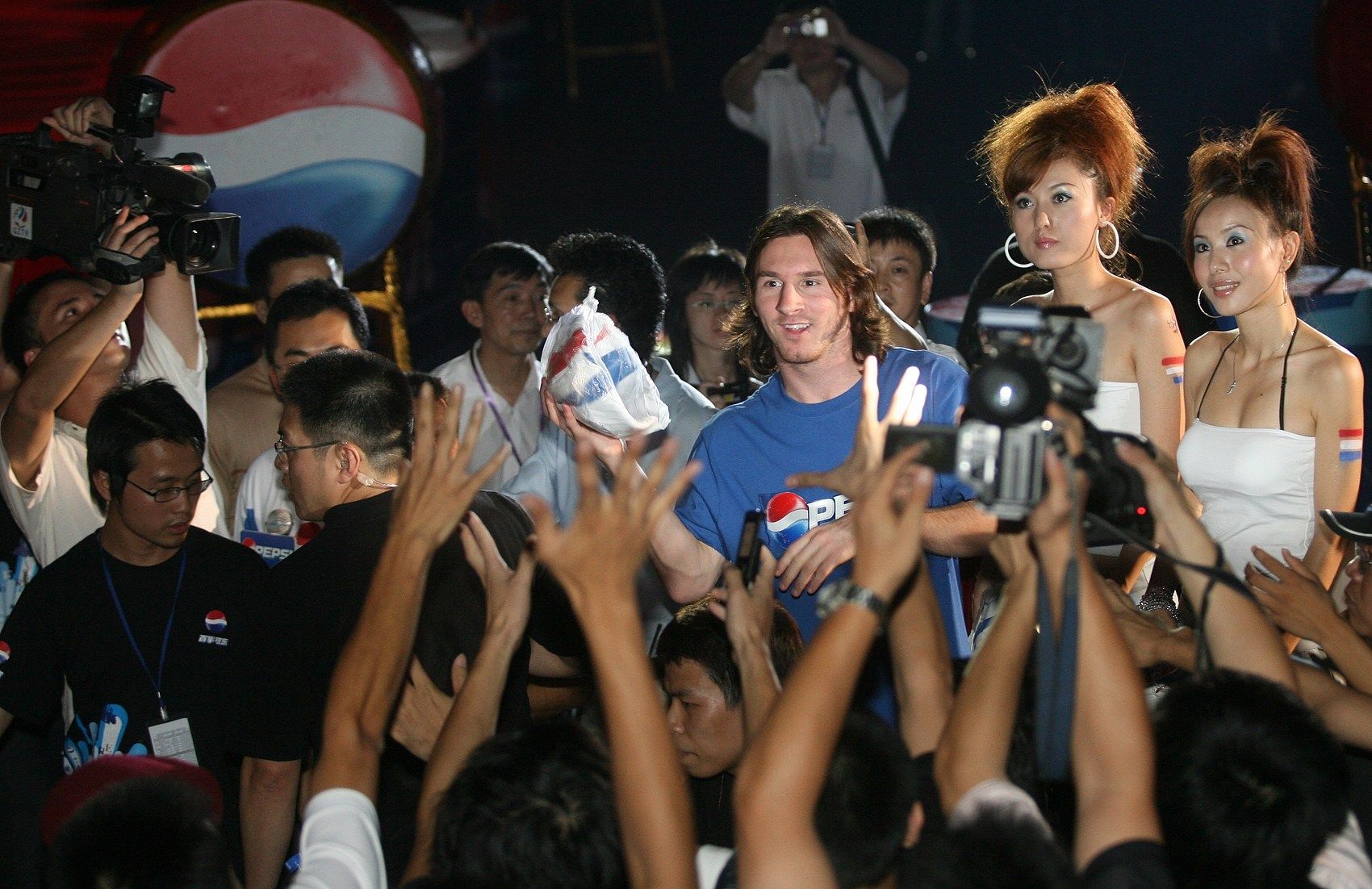
With a huge following in China, Argentinian soccer star Lionel Messi has visited the country seven times over the past two decades. The picture shows him at a fan meeting in Guangzhou in 2007. (VCG)
In fact, Chinese fans’ loyalties are deeply connected to when soccer entered their lives.
In 1978, China Central Television (CCTV) broadcast the World Cup for the first time, and Argentina won it on home soil. Televisions were still rare in China back then, but those who watched became the country’s earliest fans, and many of them became Argentina supporters. After that, from Diego Maradona and Gabriel Batistuta to Messi, each generation had its own Argentine icon.
In 1989, CCTV began broadcasting Italy’s top league, Serie A. It was the first European league regularly shown in China, producing the country’s first generation of international club fans, many of whom became loyal Italian supporters.
Similarly, in 1995, CCTV started showing the Bundesliga, Germany’s most-watched league. Three years later, Chinese soccer player Yang Chen joined Eintracht Frankfurt, becoming the first Chinese player to appear in a top-five European league. His presence gave countless fans their first emotional connection to a foreign team, laying a foundation for Germany’s popularity.
In 2002, the only time China ever qualified for the World Cup, China was drawn in the same group as Brazil, which went on to win the tournament. That shared moment, along with the joy and freedom of Brazilian soccer, won over a large following for Brazil in China.
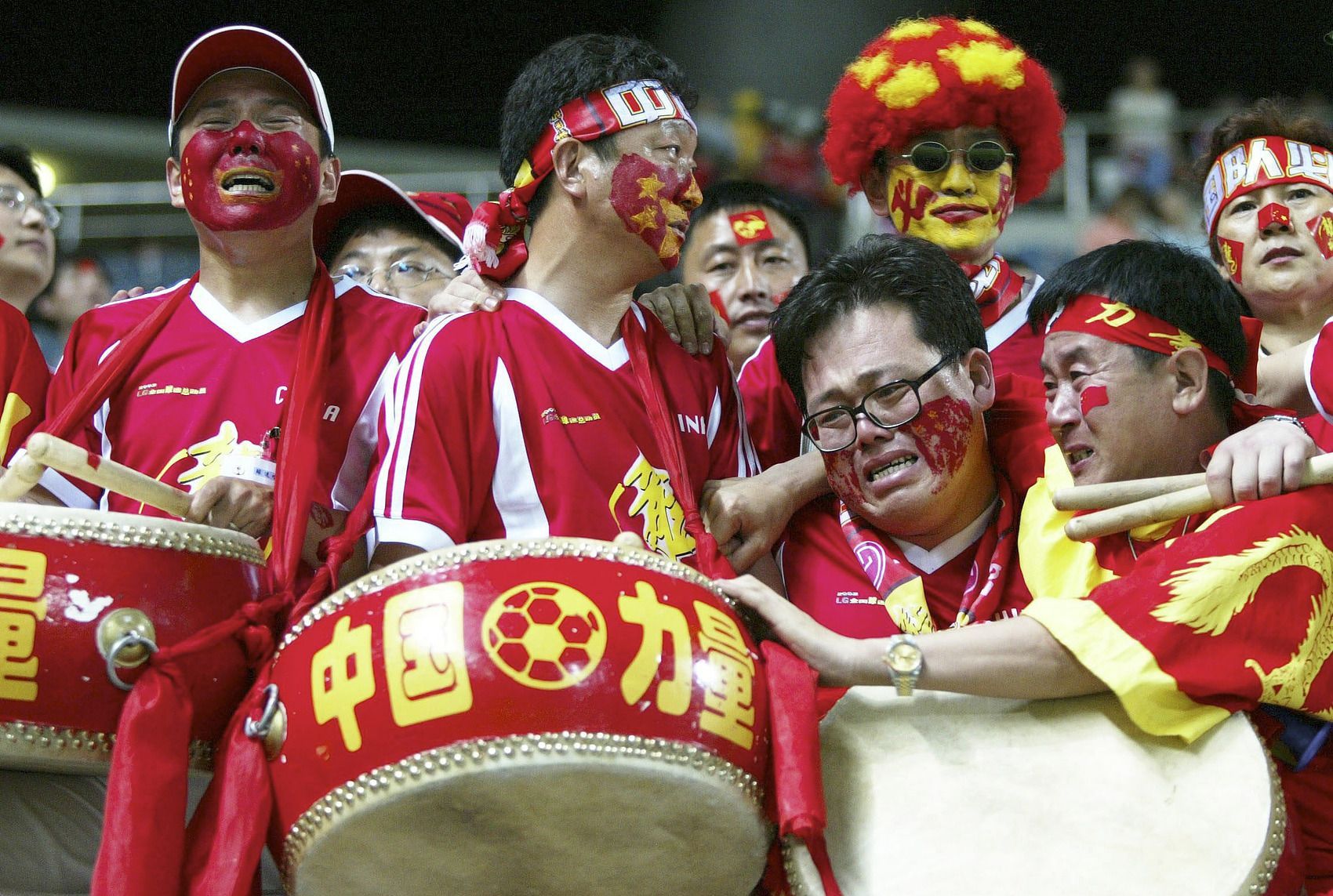
Chinese fans weep as the national team’s 0–4 defeat to Brazil ends China’s 2002 World Cup campaign, capping a tournament without a point or a goal (VCG)
England’s fan base, meanwhile, grew alongside the rise of David Beckham. His good looks and high-profile marriage to Spice Girls’ “Posh” Victoria Beckham drew in countless casual viewers who weren’t necessarily soccer fans. As a result, England supporters are often teased online as “plastic fans (塑料粉)” more interested in Beckham than the sport itself.
Today, the era of TV-driven fandom is fading. Italian football has lost much of its former star power, and the Bundesliga is no longer a Saturday night ritual for many Chinese fans. Even Marcello Lippi, the Italian coach who once vowed to raise the Chinese men’s national team to Italy’s level, is now the butt of an online joke: technically, he succeeded—Italy has failed to qualify for the last three World Cups. Even Argentina fans, after Messi finally lifted the World Cup trophy in 2022, seem to have mellowed.
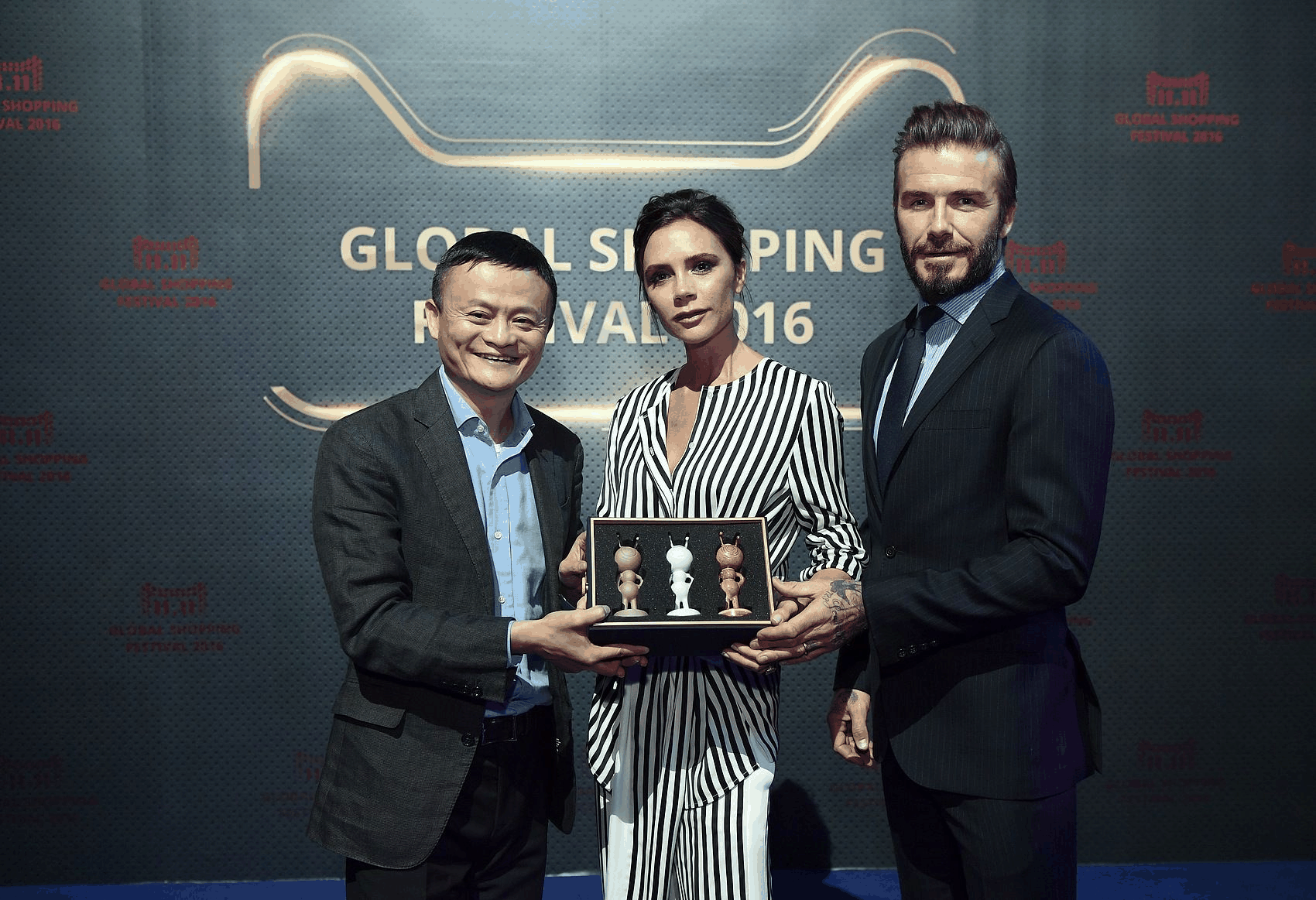
David Beckham has been to China at least a dozen times. He and his wife, Victoria, even made a TV appearance at the 2016 Double 11 Shopping Festival Gala and were photographed with Alibaba founder Jack Ma. (VCG)
This World Cup has been called the “twilight of the traditional soccer giants” by Chinese fans—Messi has confirmed he will retire afterward, and Cristiano Ronaldo is also likely to be playing in his final tournament. Luka Modrić, at 40, is almost certainly playing his last World Cup; Neymar, at 34, has previously hinted that this would be his final dance. The farewell is collective, as a generation of soccer’s finest is taking its final bow on the same stage.
Fortunately, a new generation of soccer stars is also rising. Erling Haaland has broken through to mainstream attention during this tournament with his impressive skills and quirky personality, gaining millions of followers on Chinese social media. Kylian Mbappé, Vinícius Júnior, and Jude Bellingham have also drawn huge crowds of new fans, giving younger viewers their own heroes to cheer for.
The Chinese presence
In 2010, Yingli Green Energy, a Chinese solar panel manufacturer, became the first Chinese company to sponsor the World Cup. It opened the door to a wave of Chinese corporate sponsorship. By 2018, seven Chinese companies had contributed a total of 835 million US dollars in sponsorship. In 2022, Chinese firms topped the global sponsor list with 1.395 billion US dollars. This year, despite the unfavorable viewing time and the broadcasting rights dispute, they still hold four of the 16 global sponsorship spots, investing over 500 million US dollars in total.
Instead of just putting their logos on the pitch, Chinese companies are putting their technologies into the game itself. The Chinese tech giant Lenovo served as the official technology partner for this tournament, providing AI-powered systems for referee cameras and 3D offside visualization. Hisense, the electronics maker, is the official VAR display partner, supplying the high-definition screens used by referees for video reviews. The official soccer ball, implanted with sensor chips, is also designed and manufactured in China.
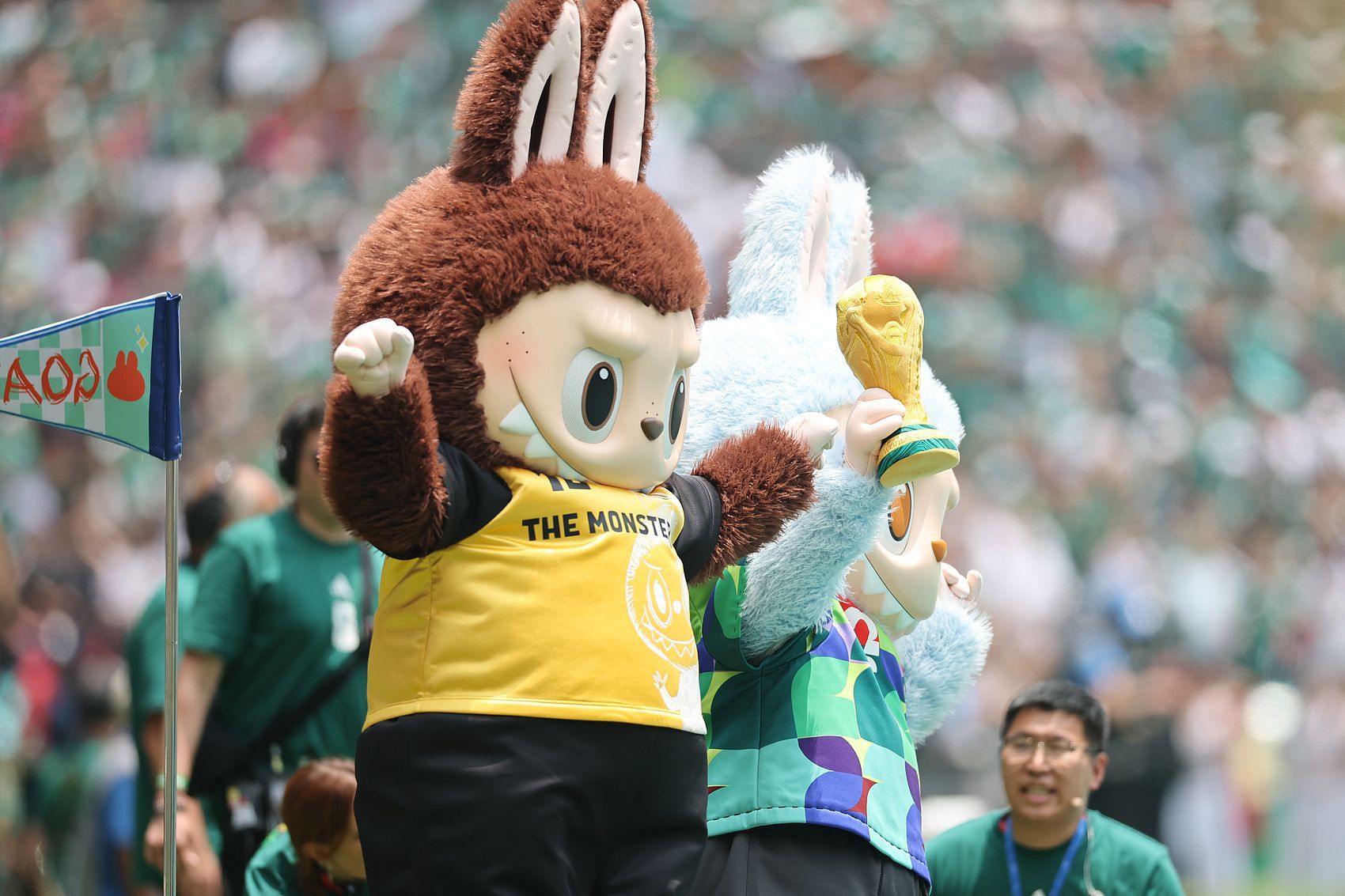
Pop Mart’s Labubu mascots are spotted courtside during the 2026 World Cup opening ceremony in Mexico (VCG)
Meanwhile, Pop Mart brought Labubu mascots to the opening ceremony and the official music video. Other Chinese brands joined the fray by betting on teams and star players: coffee chain Luckin sponsored Spain and Portugal; electronics and TV maker TCL backed Spain, Germany, and Argentina; dairy company Yili signed five national teams. Chinese herbal tea brand Walovi selected Haaland as its brand ambassador—the delightfully wacky ad campaign quickly became a meme on Chinese social media.
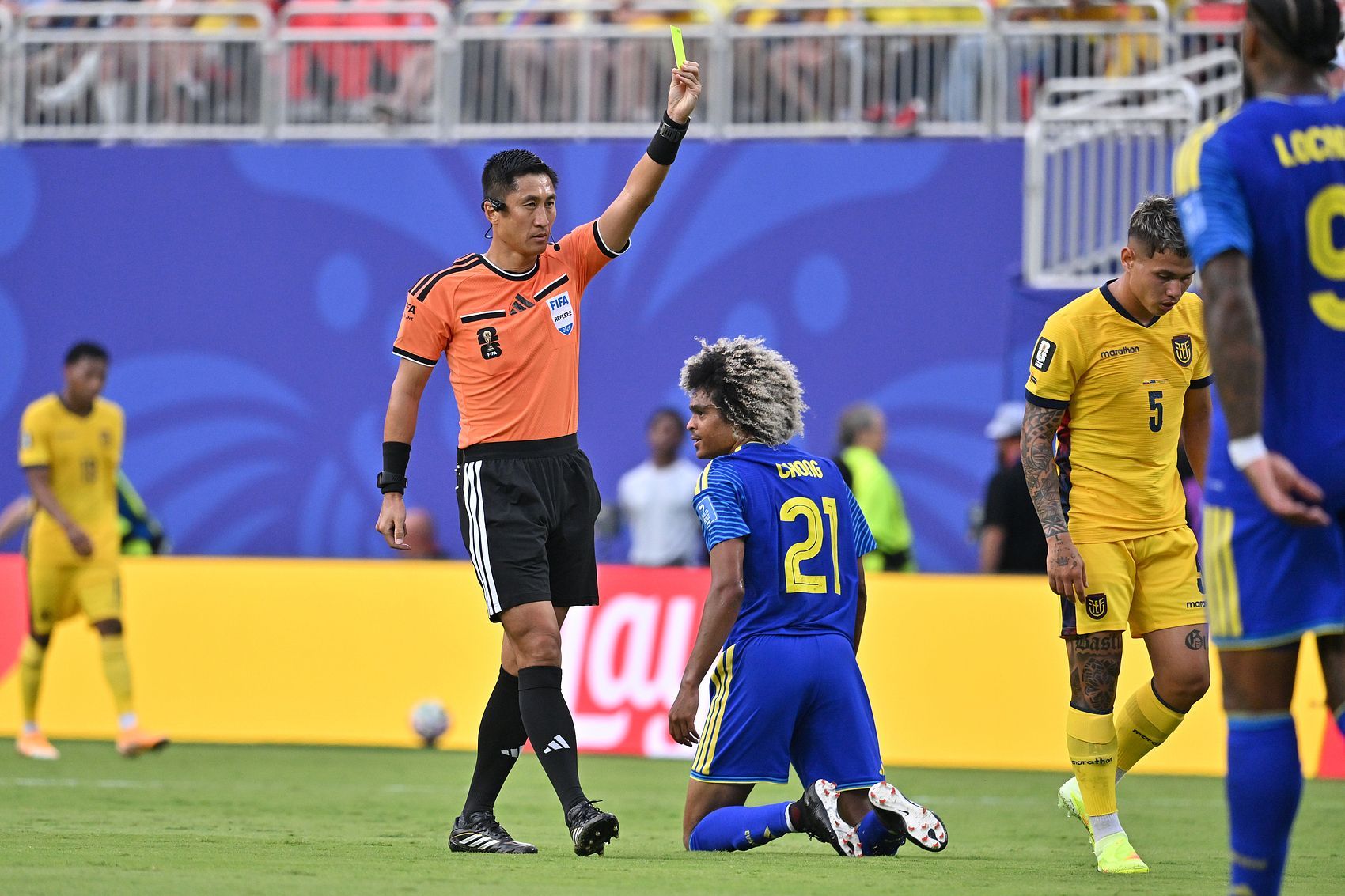
Chinese referee Ma Ning issued six yellow cards when officiating the game between Ecuador and Curaçao during this World Cup (VCG)
The only Chinese faces on the pitch, meanwhile, belong to the three-man refereeing team led by Ma Ning. On June 20, Ma officiated the group-stage match between Ecuador and Curaçao, becoming the first Chinese referee to take charge of a World Cup match in 24 years. Nicknamed the “Card Master (卡牌大师)” by Chinese fans for his strict officiating in the domestic league, he issued six yellow cards during his first game and inspired a new World Cup joke: with no Chinese team to protect, he’s free to hand out cards to everyone equally. Some even made fan edits of Ma’s best moments, prompting jokes that he must be the first referee to inspire that kind of treatment.
Anyone still watching?
In 1978, CCTV broadcast the World Cup for the first time. Strictly speaking, it used international satellite feeds without official authorization from FIFA for broadcasting. In 1982, CCTV began formal coverage, with commentator Song Shixiong sent to a studio in Hong Kong to call the matches as he watched the screen. These broadcasts became the earliest collective memory for Chinese fans.
When China qualified for the World Cup for the first time in 2002, CCTV sent a reporting team of over 40 people to South Korea and Japan, and the viewing figures were staggering. The group match between China and Brazil was watched by two-thirds of the country’s TV audience—more than 700 million people. That year, the final match drew a 32 percent rating, a record that still stands.
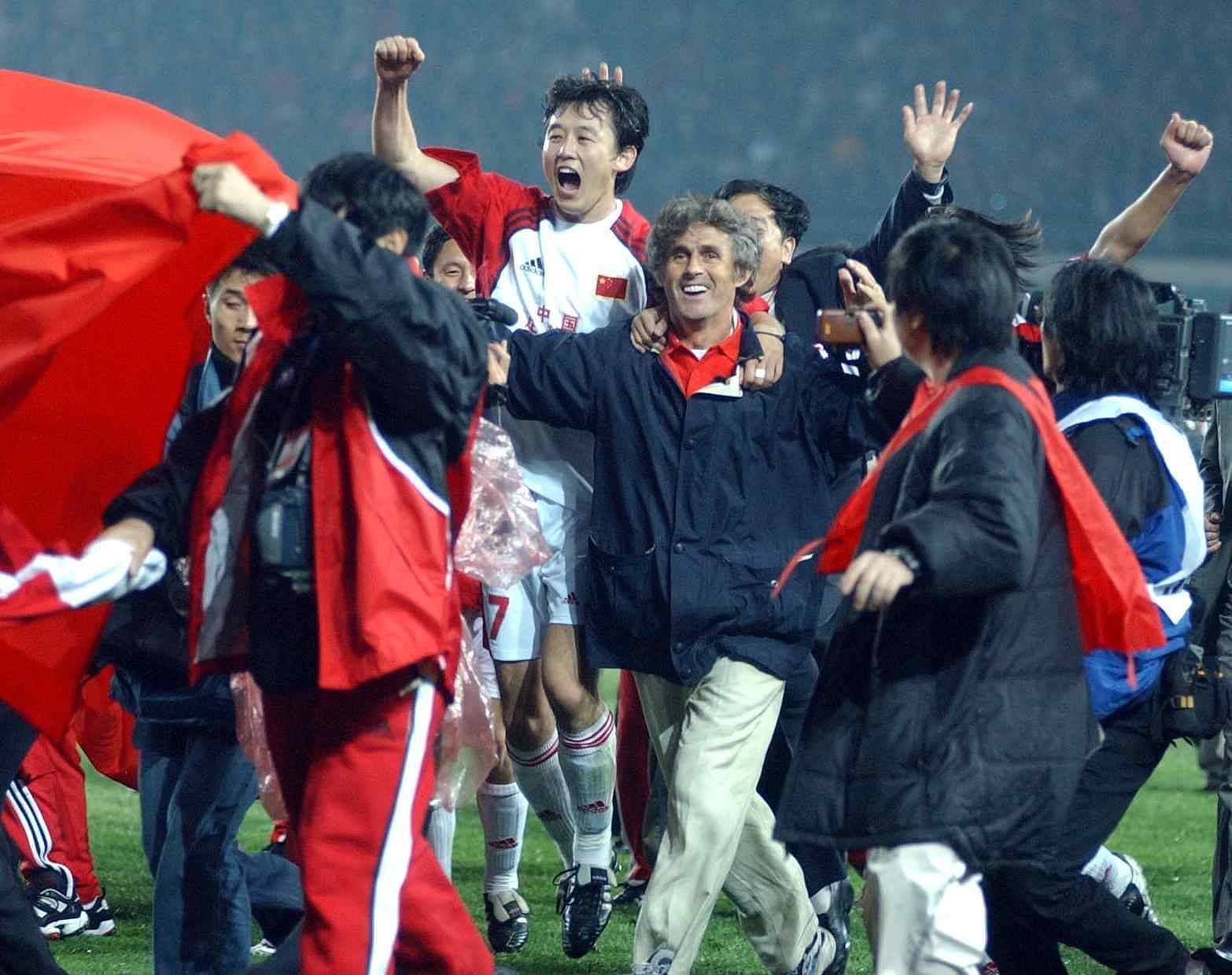
The whole country went into celebration mode after China defeated Oman 1–0 in Shenyang, Liaoning province, on October 7, 2001, securing the country’s first-ever qualification for the FIFA World Cup (VCG)
As internet access became widespread, streaming platforms such as Migu and Youku joined the list of broadcasters, allowing fans to watch matches on their phones. The rise of short-video platforms then reshaped the viewing experience. In 2022, Douyin, China’s version of TikTok, reportedly paid CCTV more than 1 billion yuan for the tournament’s broadcasting rights. This year, Xiaohongshu replaced Douyin as an official streaming platform, creating an all-in-one viewing ecosystem where fans can watch matches, post bullet comments, share memes, and join fan communities without leaving the app. Many questioned the decision, given Xiaohongshu’s reputation as a female-dominated platform. But the gamble appears to have paid off. Data released after the tournament’s first three days showed that opening-day livestream viewership reached a record 55 times the platform’s previous high. World Cup and football-related content amassed 2.7 billion views, while fans posted 90 million interactions in livestream chat rooms.
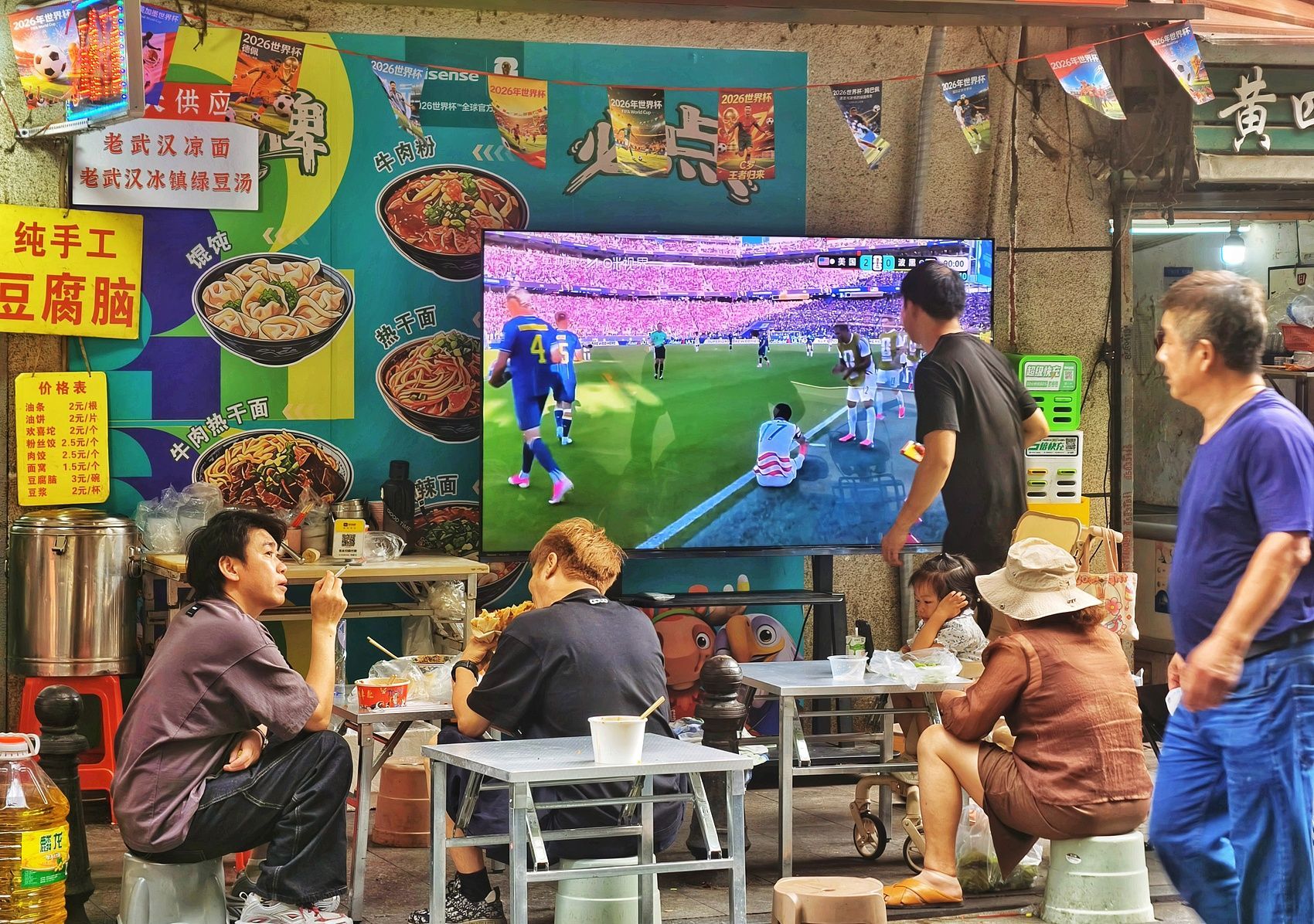
Due to the time difference, many World Cup matches this year kicked off in the early hours of the morning in China, prompting breakfast vendors to set up TVs so customers could watch the games while they ate (VCG)
However, this World Cup still drew a noticeably cooler response than previous editions. The highest-rated group-stage match—Tunisia versus Japan—managed just a 1.84 percent TV rating, a far cry from the tournament’s heyday in 2002. The time difference was unkind to Chinese audiences, and viewing habits have splintered across streaming platforms and social media. But the deeper reason may be that, after more than two decades of absence, China’s failure to qualify has gradually eroded even casual fans’ emotional investment.
Yet that doesn’t mean the tournament has lost its place in Chinese popular culture. If anything, it has simply found a different one. For a generation that grew up with the national team absent from soccer’s biggest stage, the World Cup has become less about patriotic anticipation than about shared rituals: picking an adopted team, trading memes, debating referees, and gathering online in the middle of the night to watch history unfold somewhere else. In an odd way, not having a team to root for has made the experience less about national pride and more about soccer itself.
Related Articles