Shi, a 31-year-old tech worker in Shanghai, wanted a pet—something small, quiet and suited to apartment life in one of China’s busiest cities. After recalling a famous essay by contemporary Chinese writer Feng Jicai that he had read as a student, he contacted a breeder online in February 2024 and chose a zebra finch (珍珠鸟, literally “Pearl Bird”) with a missing toe. The bird, named Sesame Cake, quickly became his daily companion.
The move-in was a mutual adaptation as Shi gradually learned his new roommate’s avian language. Chirps at first light, sometimes five in the morning, were a wake-up call. A peck on the hand might signal displeasure with the room temperature, since tropical birds struggle below 20 degrees Celsius in winter and above 30 degrees in summer. A peck on the finger, meanwhile, could indicate gratitude, either for the daily offerings of food and water or a cage freshly cleaned.
Sesame Cake also began to change how Shi saw the world outside his window. He learned that birds fly into glass, something he’d never thought about before, so he covered his windows with stickers to protect those nearby. He started noticing more and more the creatures overhead—not as a generic blur of feathers but as distinct species and individuals. He set up an observation spot, making space in his morning routine to watch them come and go. A trip to the gym, a short commute, a quick run to the supermarket could all end with him stopped under a phoenix tree listening for calls. “Before birding, I only knew there were these things called birds,” he confides. “Now I can tell you ‘that tree has a light-vented bulbul, that grass has a red-flanked bluetail, and that flock over there is a group of vinous-throated parrotbills.’ It’s like a whole new world has opened up.”
For Shi, a self-described introvert who finds crowded social events draining, birdwatching offers him a form of solitude that is neither lonely nor antisocial. “I like to walk alone, stop, and just listen to the birds around me,” he says. “I raise my binoculars and enter a state of flow. Everything else fades. It’s a healing ritual.”
The Pokémon-like experience of birding, which sees watchers discover and collect new species on daily adventures while memorizing a raft of Latin names, has rapidly attracted a vibrant community of young participants in China. A 2025 trend report on Xiaohongshu (RedNote) showed that birding-related searches had surged 19-fold year-on-year over the past month, while birding posts in the past year exceeded the total from the previous decade combined.
Read more about birds in China:
- Birds and Their Meanings in China
- Catching China’s Bird Poachers
- Behind the Peace Doves That Took Flight at Today’s Military Parade
In May, the indie virtual birdwatching game Birdwatching Notebook, born from the idea of an avid birdwatcher, even climbed Steam’s new-release charts, earning a 97 percent positive rating. It sees players customize their virtual balcony or windowsill, set out feeders, and wait for pixelated birds to flock in. When birds visit, players can photograph them, collect fallen feathers, and slowly fill out their notebook. “If you click on a bird in the game, it flies away,” Shi says, thrilled to find in the game the same existential solace he has found in real-life birdwatching. “Click a few more times, and it disappears from the screen entirely. That’s exactly what happens in reality.”
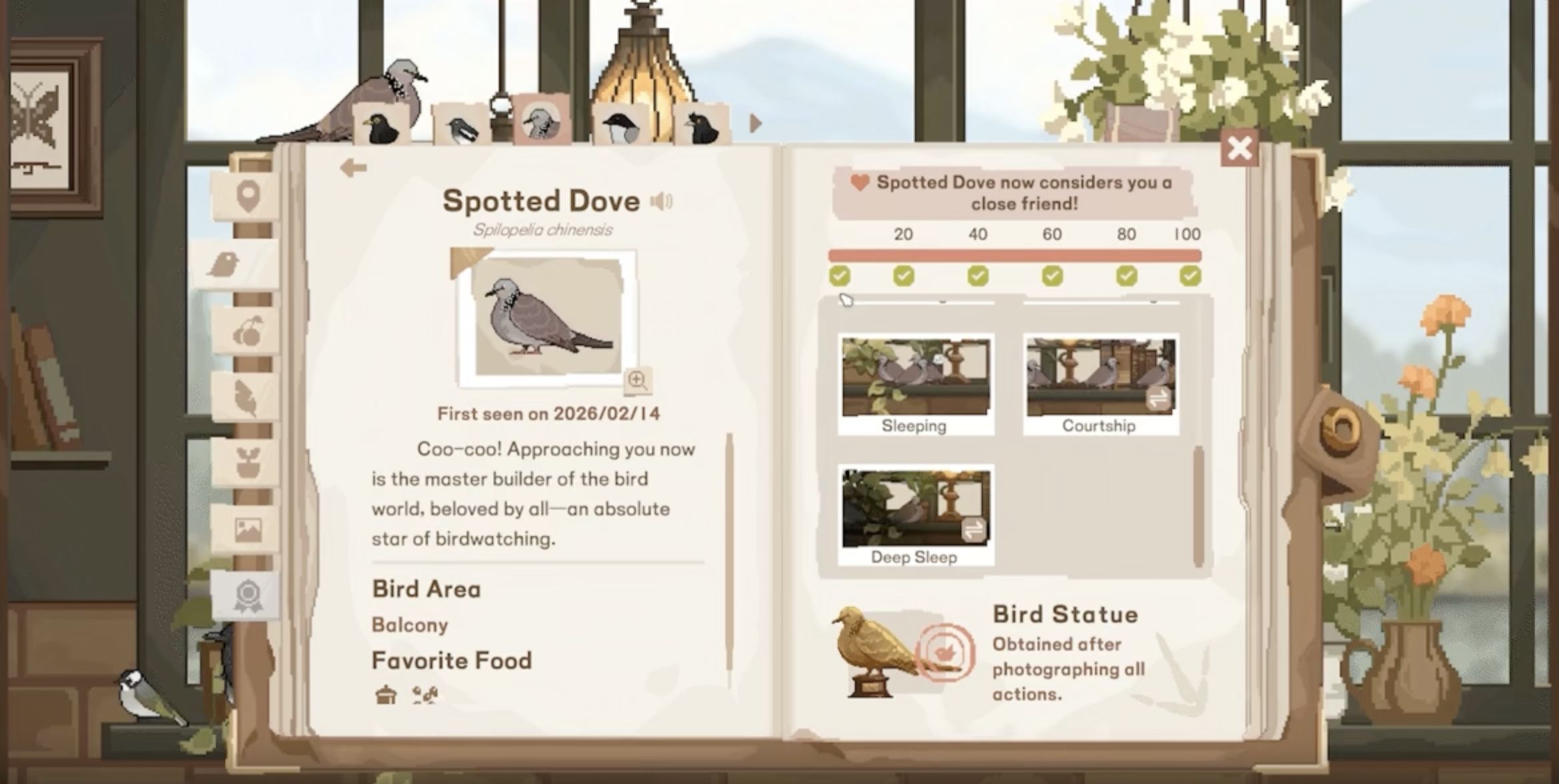
The game Birdwatching Notebook has also been praised for its educational value (screenshot via Xiaohongshu)
The game’s cozy soundtrack and atmospheric vibe, as well as its ability to run quietly in the corner of the screen while players work or browse, turn birdwatching into a comforting desktop companion. Across social media and Steam reviews, many players who once knew little about birdwatching have discovered a new appreciation for birds through the game, and some even share their real-life birdwatching photos with the game’s community.
Nature photographer Xu Keyi has also witnessed firsthand this growth in interest in birding among young people. According to Xu, in the early days, it was a small network of enthusiasts, mostly men, defined by the stereotypical retired grandpas wielding gigantic cannon-esque lenses. The shift became visible around 2020, when young people on the microblogging platform Weibo began describing birdwatching as a “healing hobby.” Not long after, birding guides started appearing on Xiaohongshu, a sign that the demographic was shifting toward this younger online cohort. The trend shows no signs of slowing, with the Xiaohongshu report noting that the average age of users posting birdwatching content dropped by a decade in just two years, from 2023 to 2025.
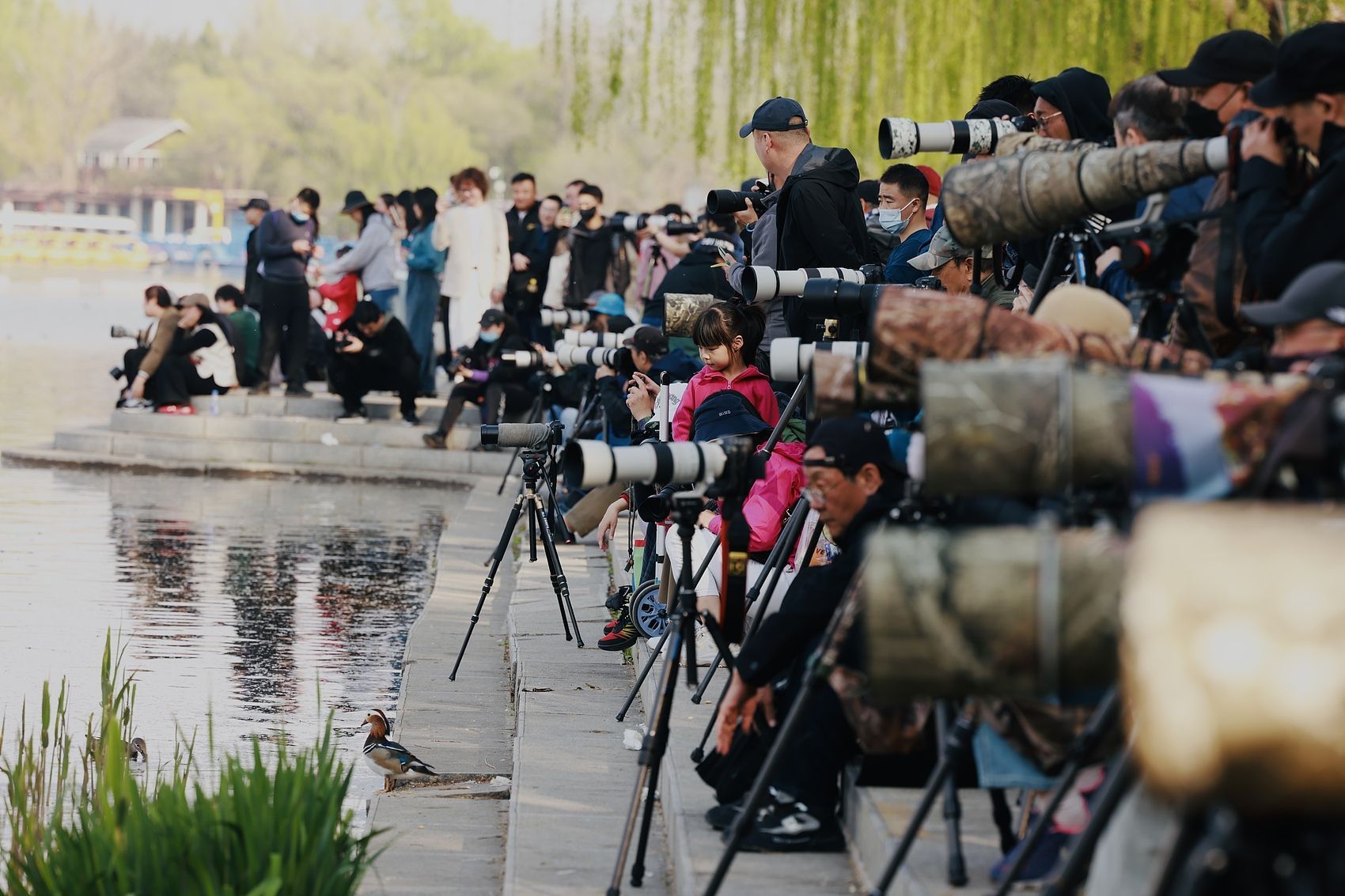
Birding was once predominantly a pastime for retirees, who had the time and financial means to invest in equipment and birdwatching trips (VCG)
The data from influencer Xu Keyi’s more than 2 million followers on Weibo tells a similar story. A significant portion of her audience is aged between 20 and 35, while women make up 60 percent of her viewership.
“My followers are now mostly young women,” she says. The atmosphere in these online spaces is welcoming; posts that once served to show off gear or rare sightings now encourage participation and playfulness. “They’re asking, ‘What equipment do I need? Where can I go? Can you identify this blurry photo I took?’” says Xu. “There’s a new kind of excitement—these girls are like baby birds cracking their shells, learning to speak the bird language from the first chirp.”
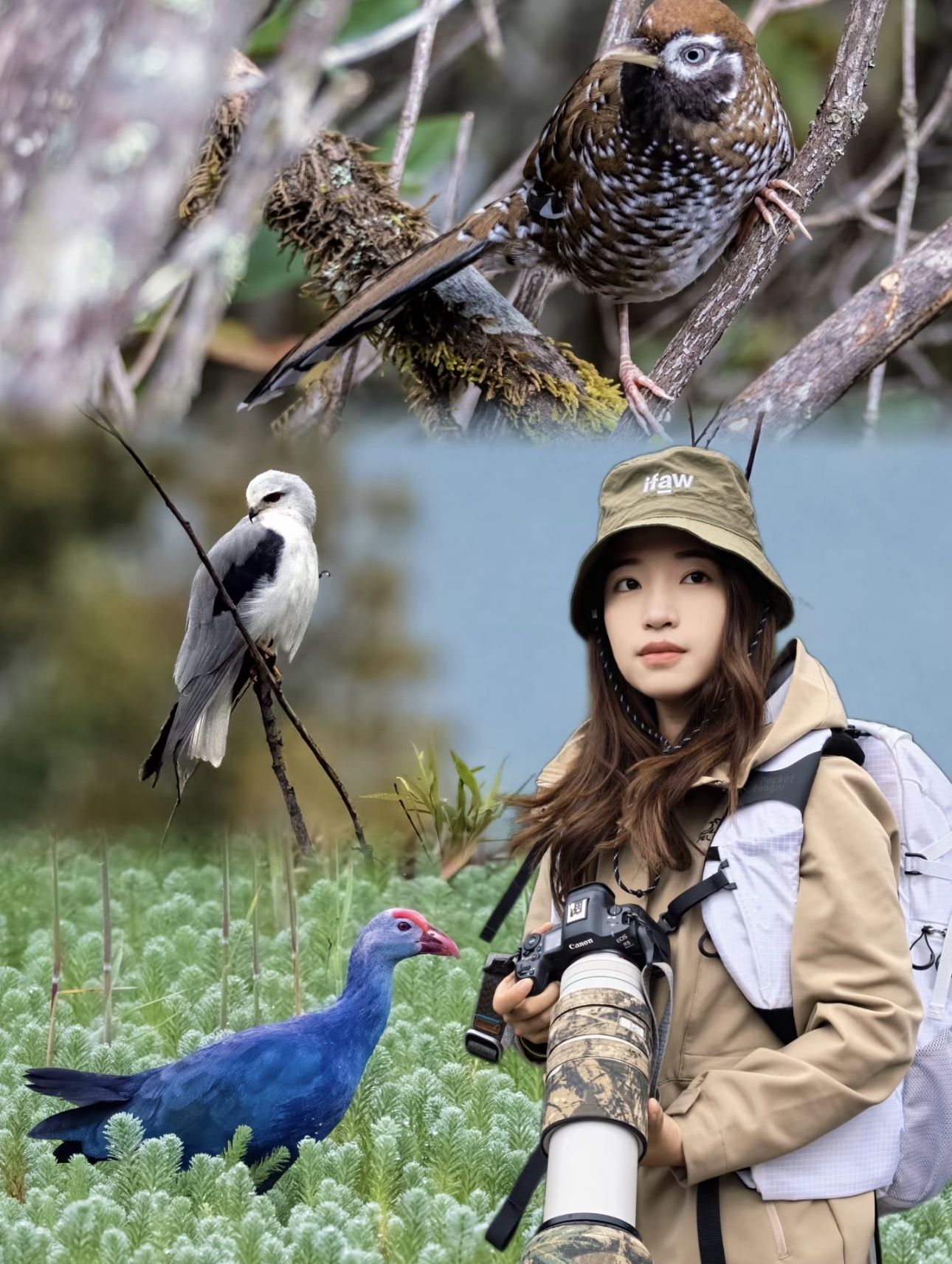
Xu Keyi often shares birding knowledge and bird photos she has captured online with her fans (screenshot via Xiaohongshu)
The community has largely rejected the performative ethos that defines other urban outdoor trends, focusing instead on the simple joy of exploring nature. “One of the biggest charms of birding is watching creatures who cannot be controlled, who exist on their own terms,” says Wang Pan, a 35-year-old English teacher-turned-amateur birding influencer. “Humans are just one species among millions. If we go through life only interacting with our own kind, we’re missing out.”
Wang became a bird enthusiast three years ago after purchasing a pair of binoculars that would change his life. “I have been curious about insects since I was a kid but knew little about birds. Once I started looking closely, I realized how beautiful they are, how diverse,” he says. Wang slowly began to recognize calls and memorize names, building a mental map of the species around him. It started as a private pleasure, a way to make his commute more interesting and fill weekend mornings with something other than screentime, but soon his new passion demanded to be shared.
He began uploading introductory videos on Xiaohongshu, a habit formed during his teaching days at New Oriental Education and Technology, explaining each bird’s name, habits, and appearance for novices in the same position he had been in: clueless, curious, and too intimidated to ask. Wang’s approach is deliberately casual. His videos are short and plain-spoken, more akin to a friend pointing up at a tree than a lecturer at a podium. “I’m not providing a science lesson,” he says, “I’m just sharing some fun animal facts.”
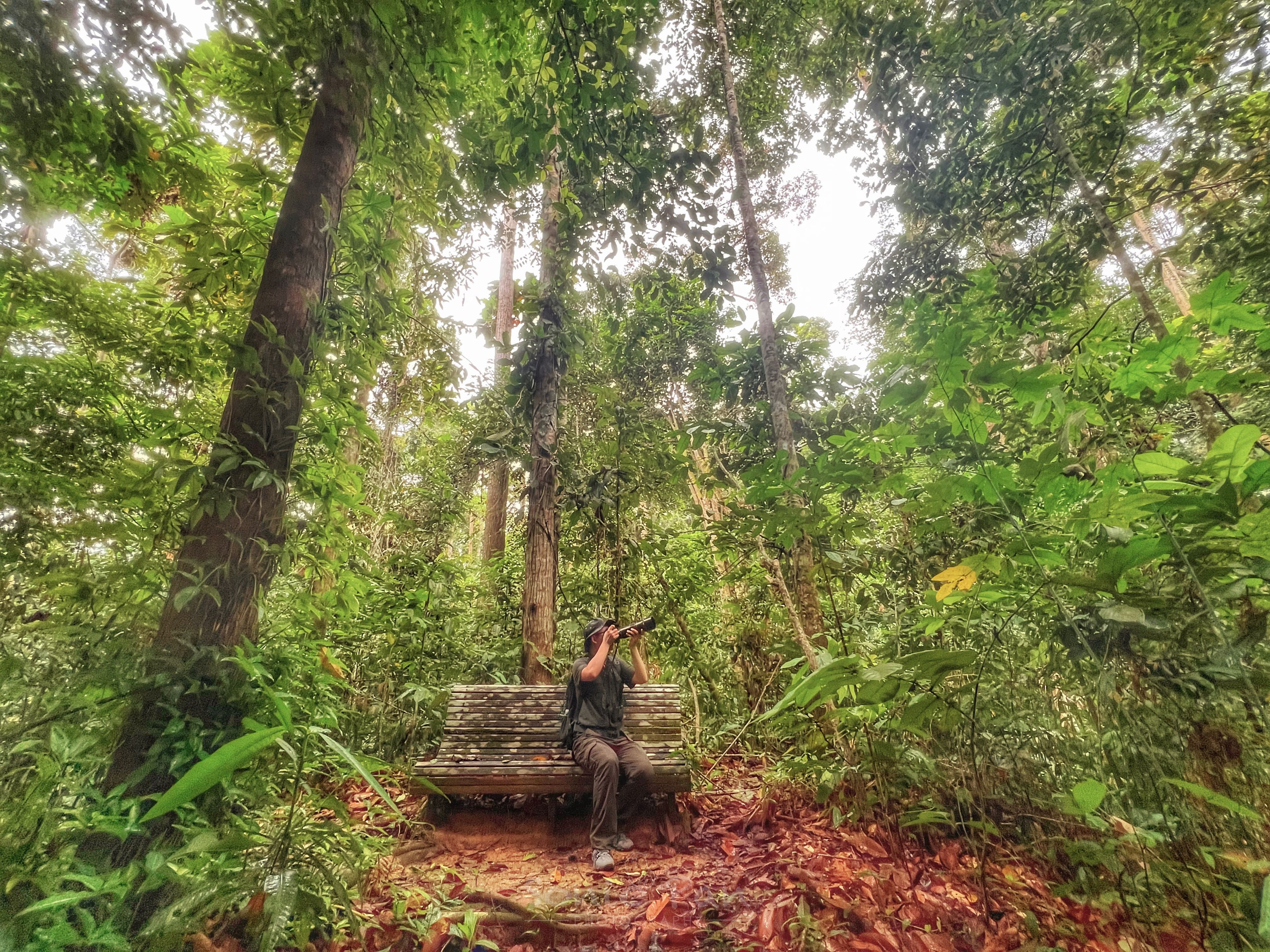
Wang Pan during a birding trip in Malaysia (courtesy of Wang Pan)
This low-pressure approach is characteristic of China’s online birding community and a large part of the appeal for a young, often overworked digital generation looking for meaning offline. Xu herself spent her early career in corporate communications, meeting luminaries and navigating office politics. “My office was on the 19th floor,” she says. “During breaks, I’d watch birds fly past the window and realize how far I’d drifted.” At 30, she walked away to become a wildlife photographer and has since worked with Canon and China National Geographic. “Nature doesn’t judge you; it just is,” she says.
Although Xu set out to document the beauty of her subjects, she is now using her enhanced profile to advocate for their survival. She has promoted bird-safe window stickers, photographed Beijing swifts for banding projects, and helped lead a campaign to remove an art installation at Hunan’s Dongting Lake because of the danger it posed to migratory birds.
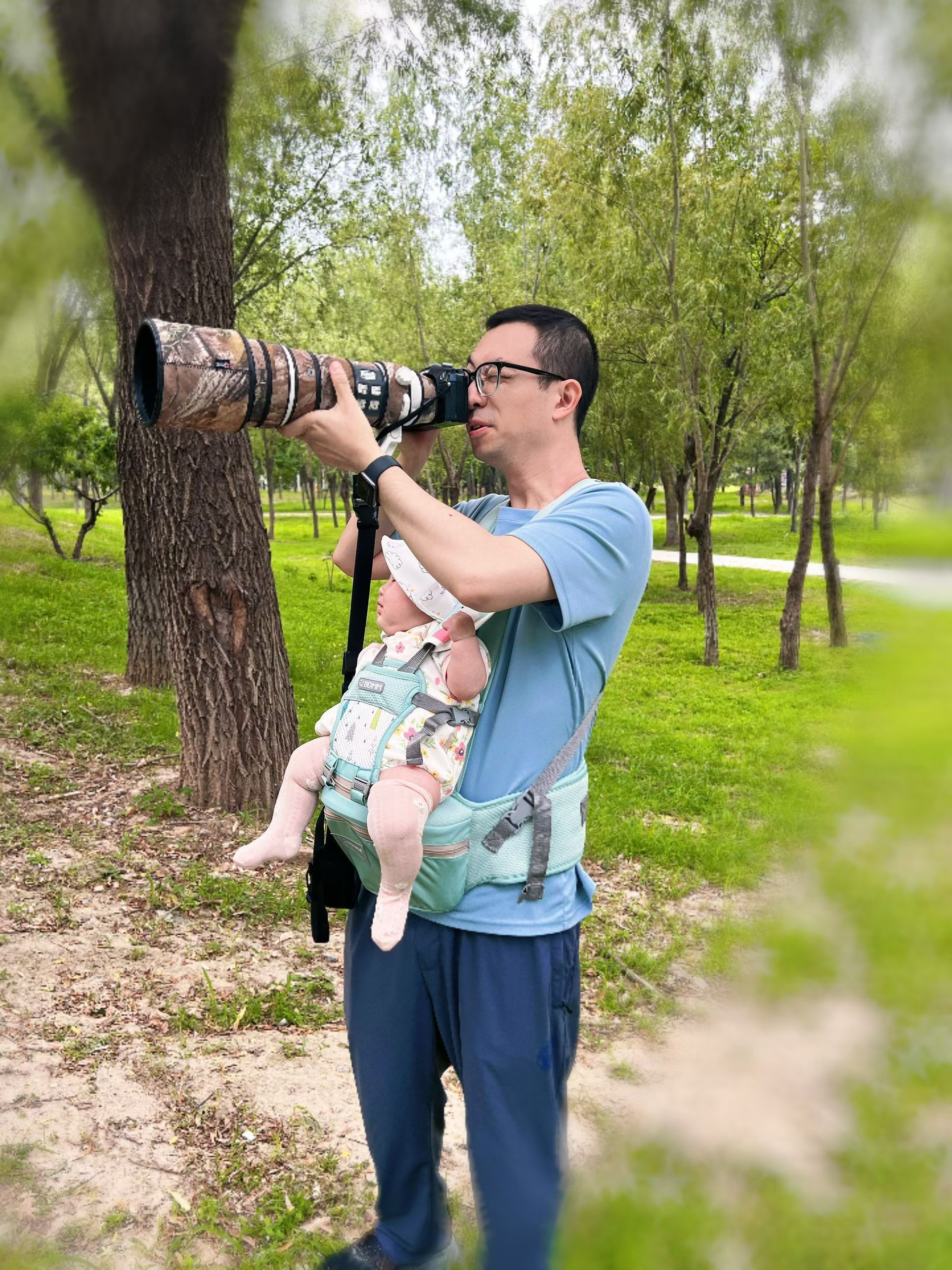
Wang Pan likes to take his infant daughter birdwatching in nearby parks (courtesy of Wang Pan)
On a recent outing to a wetland park, she took her 5-year-old daughter along. With binoculars in hand, the girl tracked birds on her own, and when a television crew asked what she thought, she clenched her tiny fists and declared, with total sincerity, “I want to protect the wetlands and protect these lovely birds.” For Xu, that moment demonstrated how participation is the key to empowering the next generation. “I don’t expect her to become a birder,” she says, “but she’s learning that the natural world is worth paying attention to—and worth protecting.”
For Wang, too, parenthood has brought a new perspective to birdwatching. He stopped posting videos during a busy period at work, but since becoming a father, he’s started again—this time not for followers, but to share this way of birding with his daughter. On weekend mornings, before the city wakes up, he straps her into a carrier and walks to the nearest patch of woodland. She can’t speak yet, but she follows the birds with her eyes, quiet and intent. “I’m essentially rediscovering the world with her,” he says.
Wang recalls his own childhood in a small village, where he would climb onto the roof of his home and stare off at the distant mountains. Those formative experiences left him with a longing he couldn’t describe. “I didn’t have the resources or the knowledge back then,” he says, “but I had that longing. Now I want to pass that feeling on to the next generation.”
Related Articles