“I’m disappointed with neo-Confucian scholars from the Song and Ming dynasties onward, because they were hostile to change, and much of their scholarship was often disconnected from reality,” says Professor Han Yuhai of Peking University, who specializes in contemporary literature, human geography, and the history of modern Chinese thought.
His revised book, with an updated preface and a new introduction reflecting current affairs, Under Heaven: Inclusive China, originally published in 2006, details these scholars’ fallacies, such as the creation of a civilization-barbarism dichotomy between China’s central areas and the frontier regions. Instead, the author highlights an alternative historical narrative proposed by the late Qing dynasty (1616 – 1911) enlightenment thinker and scholar, Wei Yuan (魏源). One of the first intellectuals in China to open their eyes to the world, Wei compiled the Illustrated Treatise on the Maritime Kingdoms (《海国图志》) in the mid-19th century, a Chinese gazetteer that introduced foreign countries, covering topics related to their politics, economics, military affairs, history, geography, and culture. Wei used the term haiguo (海国, “maritime kingdoms” or “maritime states”) to refer to the technologically advanced Western countries at the time, whose influence and threat reached China from the sea.
The author also cites two concepts from Wei’s works—xingguo (行国, “nomadic states”) and juguo (居国, “sedentary states”)—arguing that ancient Chinese civilization was shaped by exchanges and interactions among multiple cultures, rather than a Confucian- or Han-centered narrative. He further suggests that a challenge for China’s late imperial rulers was how to incorporate a maritime dimension into imperial governance, and failing to do so ultimately led to the empire’s demise.
Through a collection of reflective essays spanning history, politics, economics, and travel writing, Under Heaven adopts a holistic view of history, situating China’s reform and revolution within a broader context while emphasizing cultural interaction, regional diversity, and inclusion as part of a renewed historical narrative. The World of Chinese spoke with Professor Han about some of the ideas explored in his newly updated book:
TWOC: How should we understand tianxia (under heaven), and how does it differ from the traditional Western worldview?
Han Yuhai: There are both similarities and differences between the two. If we were to summarize it at a fairly general, abstract level, I would say that traditional Western thought tends to view the world as an object to be illuminated, discovered, and expanded into—an external space to be explored and conquered. The traditional Chinese worldview, by comparison, sees the world as made up of multiple centers that interact, blend, and converge inward.
China is often imagined as a self-centered, centrally organized empire, but archaeological findings in the 20th century have shown that the ancient Chinese civilizations were not characterized by a single origin but emerged independently in multiple regions. For instance, archaeologist Su Bingqi, who taught at Peking University from the 1950s to 80s, grouped these regions into six major cultural zones, three of them bordering the ocean and three facing Eurasia. Viewed inward, they converge to form China within the world; viewed outward, they link China to the world.
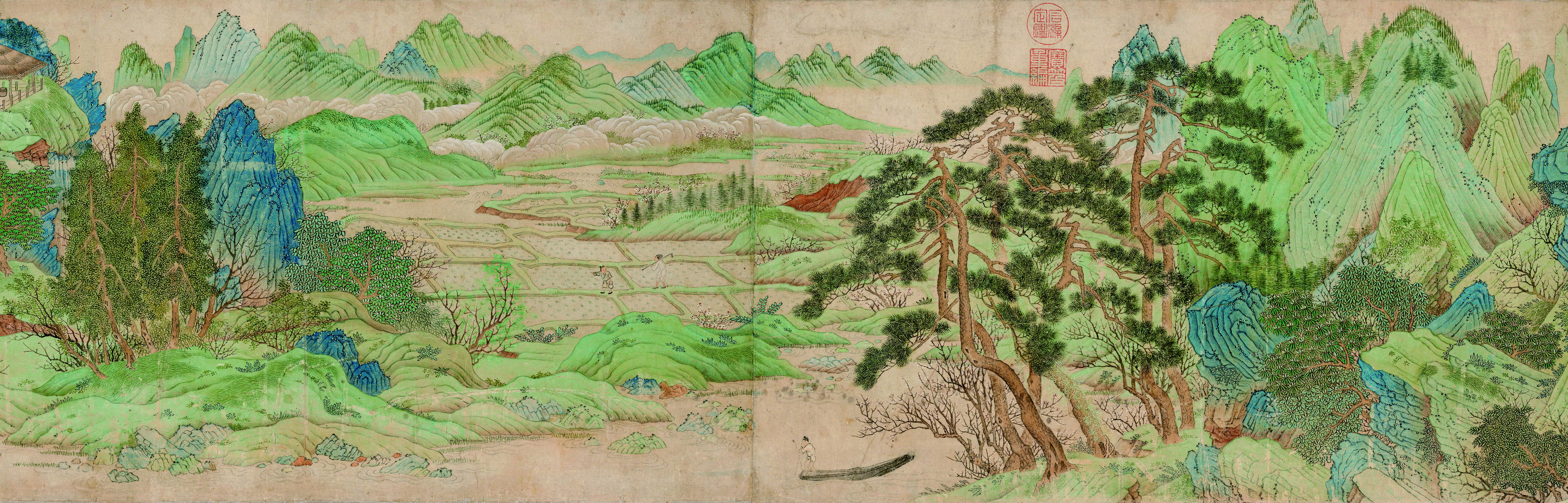
“Peach Blossom Spring” by Ming dynasty painter Qiu Ying (仇英) depicts a peaceful and bountiful farming valley in ancient China
For instance, my book opens with the first cultural center, formed around the Hindu Kush mountains, a region where Chinese, Persian, Greek, and Indian civilizations interacted, blended, and coexisted. Another center of Chinese civilization lies in the northwest around the Tianshan Mountains and the Amu Darya and Syr Darya river systems, connecting to Central Asia.
In the south, the expansion of the canal system since the Tang (618 – 907) and Song (960 – 1279) dynasties made the Yangtze River delta region an important economic zone. From here, China increasingly turned toward the sea. During the Ming dynasty (1368 – 1644), a maritime culture emerged with diplomatic voyages to Southeast Asia and beyond. From the Liao (907 – 1125) and Jin (1115 – 1234) dynasties through the Qing, northeast China formed another major center, connecting to Northeast Asia.
In this view, the Chinese civilization is an organic living system formed through the interaction and exchange between these multiple centers. This is my understanding of tianxia: the mutual inclusion and interaction of what Wei Yuan called the “sedentary state,” “nomadic state,” and “maritime state.”
Q: Modern Chinese revolutionaries sought to understand what constitutes a modern state. How does this compare with the concept of tianxia?
Han: What is a modern state? This reminds me of a famous article by the pioneer revolutionary Chen Duxiu (陈独秀) in 1904, titled “On the State,” in which he distinctively summarized the core of Western philosophy and the social sciences as the study of the state. He wrote: “This is a profound field of learning…with an enormous body of literature, far too much to discuss in a short time. What matters most is explaining what qualifies as a state.”
He then went on to lay out the three essential elements: The first is land, the national territory. Territory, he says, is like a house. The second is the people, who are the owners of the house. The third is sovereignty. Chen explained: within a country, matters such as building military forces, conducting foreign affairs, constructing railways, mining resources, and opening shipping routes—all such affairs of state—must be handled entirely based on sovereignty. No foreign country should be allowed to interfere in the slightest. Only then can it be considered an independent state.
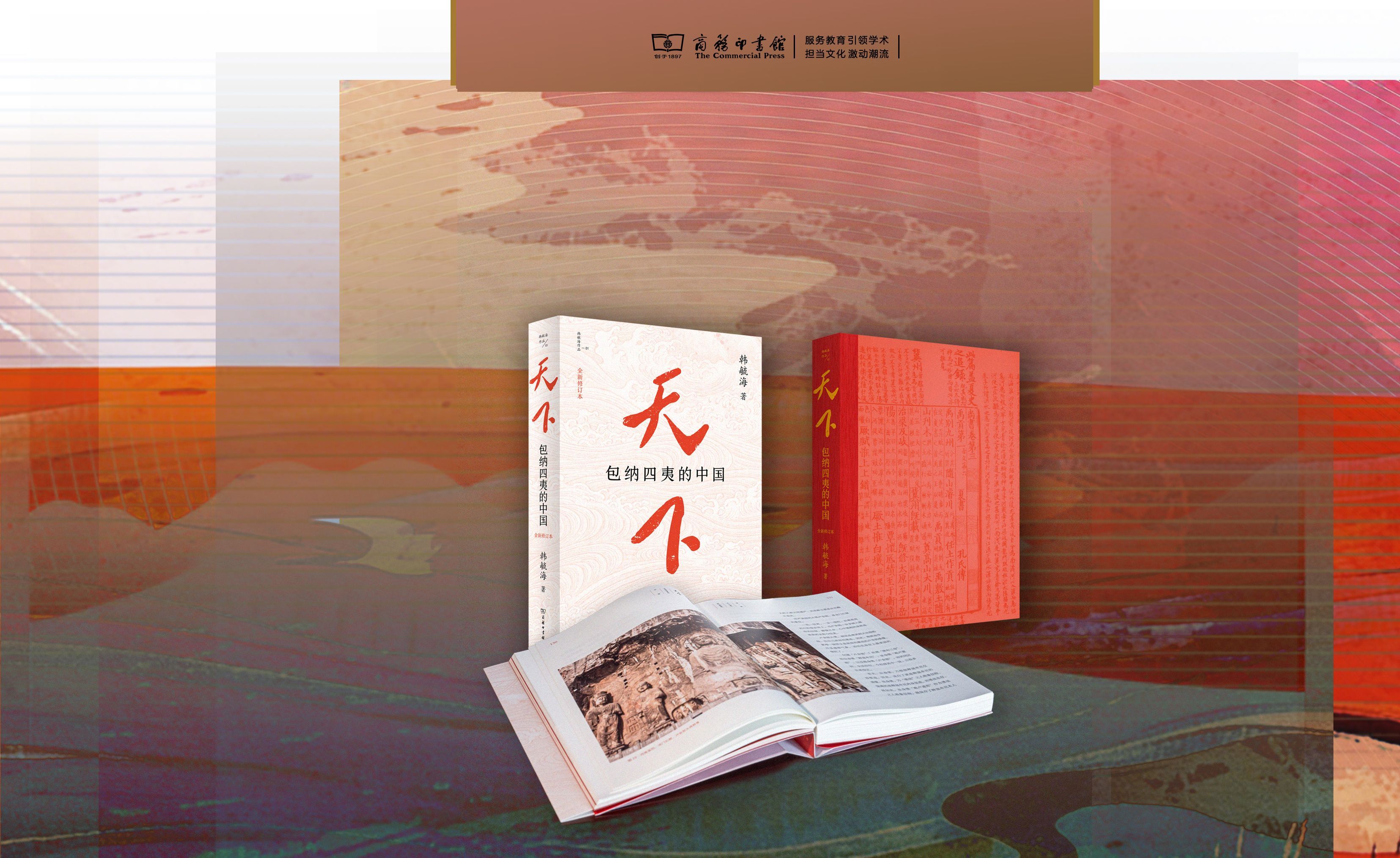
Under Heaven: Inclusive China is published by the Commercial Press in early 2026, featuring an updated preface and introduction
For this analysis, I consider Chen’s article to be a significant text in the history of China’s revolution. However, he also has his limitations. For instance, to him, “the people” equals “the nation” based on the assumption of a mono-ethnic nation-state. He also lacks a broader worldview in which China is tightly connected to the world through its vast borders, and has to maintain openness and inclusiveness. When it comes to sovereignty, China’s greatest challenge in the mid-19th century was indeed its loss, as Chen stated above. More specifically, the most crucial dimension of this loss is monetary sovereignty—the loss of control over public finance, taxation, currency, and the financial system. I discuss this topic in depth in my other book, Who Made the History of the Past 500 Years.
Q: In China’s pursuit of sovereign independence, and later, reform and opening-up, what are some new developments of the traditional ideal of tianxia?
Han: The spread of Marxism in China among progressive Chinese thinkers and revolutionaries transformed the concept of the nation-state, integrating Marxist internationalism with the traditional Chinese tianxia worldview. In addition, China’s unique path of revolution since the early 20th century, particularly relying on its people, its rural areas, and its frontier regions to fight for independence, has contributed to our renewed understanding of the concept of tianxia today. In my view, tianxia consists of the people, the land, and the governing system whose ultimate goal is to safeguard people’s livelihoods.
More than just a concept, it has now been incorporated into the nation’s flagship initiatives. We see this with China’s Belt and Road Initiative, proposed in 2013, which aims to connect Central Asia, Europe, and beyond through overland economic corridors and maritime shipping routes. Likewise, the Hainan Free Trade Port, first proposed in 2018, is an important gateway to a new era of opening-up. Tianxia is no longer an abstract concept, but a concrete development of the nation.
Civilization and Governance: A Conversation on an Inclusive China is a story from our issue, “I, Humanoid.” To read the entire issue, become a subscriber and receive the full magazine.
Related Articles