A young man with a face that’s a mixture of Timothée Chalamet in Dune and Logan Lerman in Percy Jackson flashes a confident smile and summons an axe. An army of wooden vines, spiky and lethal-looking, twist and intertwine to form a wolf. With a deadly howl, the wolf charges forward. The male lead, with amazing speed and dexterity, leaps among the deadly tangle of vines and starts chopping through them, each strike creating a bolt of lightning like Thor’s hammer.
And thus begins the epic opening sequence of the vertical micro-drama, The Wolfless Carpenter Rules the World. Only five months ago, creating scenes of this magnitude would have been impossible to even imagine. Everything—from the budget to finding the right locations and navigating safety concerns, to actor training, filming, computer-generated imagery (CGI), and post-production—would have presented insurmountable challenges. Today, however, with AI video generation models such as Seedance, all it takes is a couple of well-written prompts and, of course, as many tokens as necessary. In just a few minutes, you can have something approaching a Hollywood-level production, which is exactly what I’ve been doing for the past few months.
Since 2023, I’ve been writing scripts for English micro-dramas, targeting overseas audiences. Although the booming micro-drama industry originated in China, it has gained increasing viewership outside the country in the last three to four years. While it can still be considered nascent in many aspects, drastic changes to the industry over these few years, especially during the past several months with the onslaught of AI content, have repeatedly shaped and reshaped what it’s like to be a screenwriter on the inside.
The start of the journey
I had never studied film, and I couldn’t write a script. After majoring in linguistics in college, I wrote web fiction for overseas readers—until 2023, when my company transitioned to producing micro-dramas for the same audience. Out of curiosity and a wish to challenge myself, I joined a four-person team working on what would later become one of the most popular international micro-drama platforms, DramaBox.
I learned everything from scratch. From the basics, such as how to use related software and write screenplays to a standard Hollywood format, to how to create fast-paced dialogue that contains only the essential information or reveals character motivations. In those three years, I rewired my brain to think like a screenwriter.
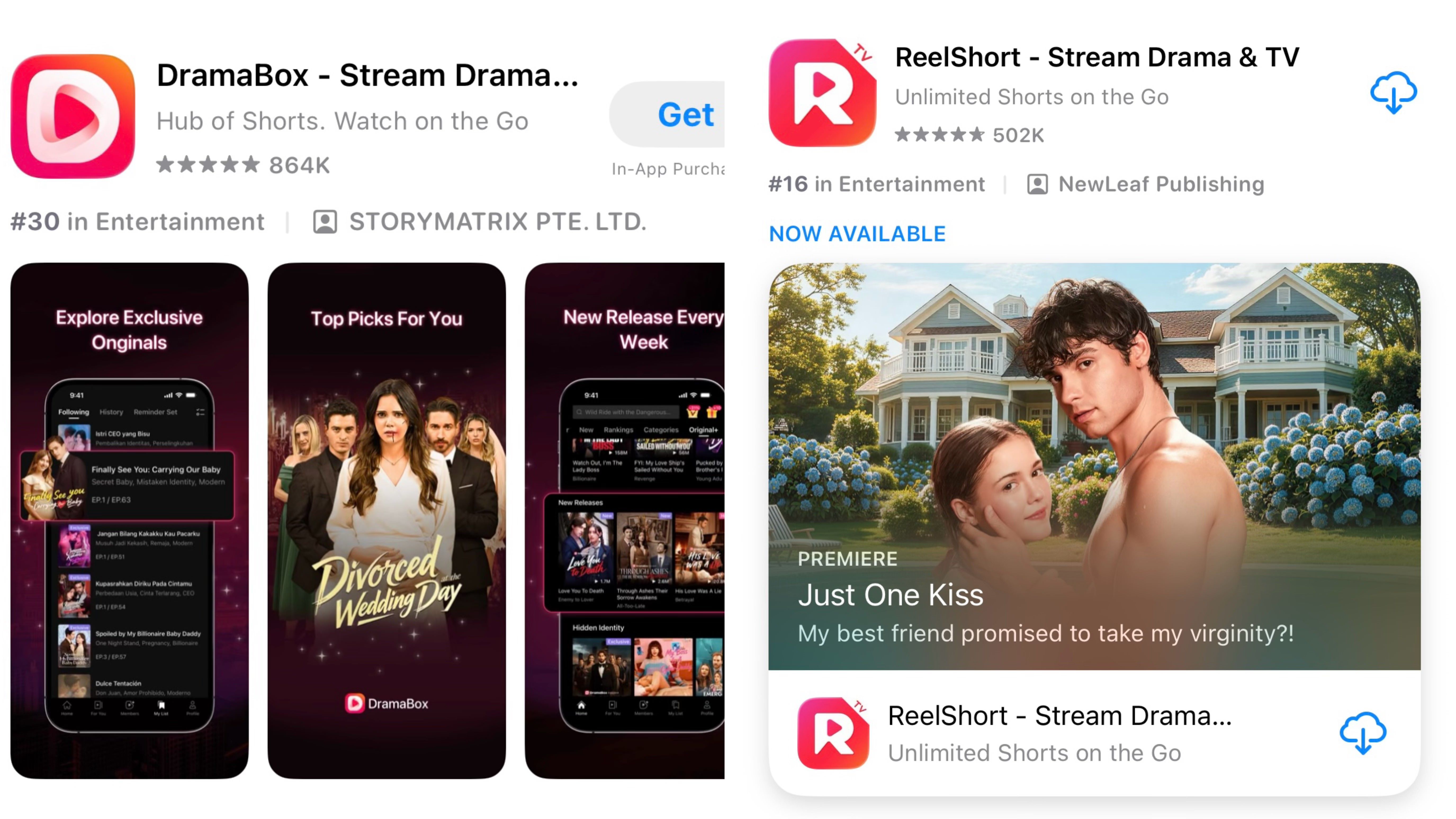
DramaBox and ReelShorts are two of the leading micro-drama platforms overseas (screenshot via Apple App Store)
Although we follow Hollywood standards, the production size is far from what you’d find in Tinseltown. Fast-paced, bite-sized dramas are unique for achieving a lot with very little, a constraint that can sometimes make them the subject of ridicule. Here, a project costs around 150,000 to 250,000 yuan and takes about three months to go from concept to release.
Because of the limits on budget, time, and personnel, micro-dramas are finely tuned to cut expenses. We learned to minimize expensive scenes, like those set at night, in the rain, or in public places like hotels and busy streets. We were encouraged to limit the number of locations, saving most of the budget for big-draw scenes, such as those in big, old-money-looking mansions where coldhearted billionaire CEOs spoil their muses. We were also taught to limit actions that may require special training for the actors, like riding motorbikes or diving into water to save another character. I can’t recall how many times entire scenes needed to be rewritten because the actor couldn’t perform the stunt.
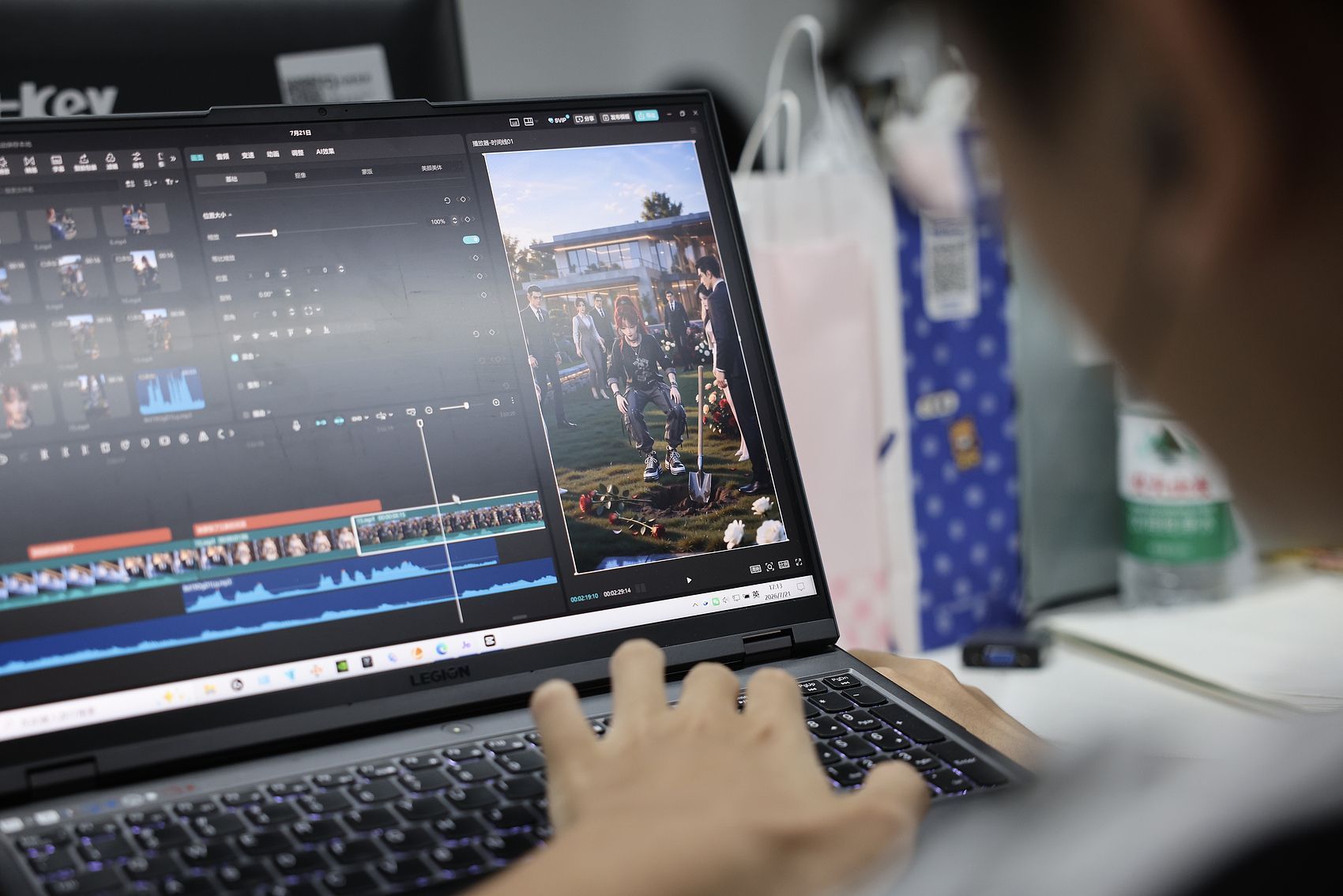
Zhejiang province’s Jiaxing has brought together dozens of micro-drama companies. With policy support and AI technology, the city has built an end-to-end ecosystem spanning scriptwriting, industrial-scale production, and global distribution. (VCG)
With a 12- to 15-hour time difference between our production crew, usually in LA, Atlanta, or New York, and us in Beijing, communication could also be difficult. Sometimes the directors would have to wing it on the spot because there was no time for feedback. It was a gamble on both sides.
We only called upon AI occasionally during this time. Many writers use AI models to translate their Chinese scripts into English. However, text-based models like ChatGPT couldn’t yet write entire ready-to-shoot micro-drama scripts without human intervention. As such, we mostly turned to AI only for story ideas or inspiration on how to construct a particular scene or moment, but nothing more. We sometimes used video-generating software like Sora to enhance scenes in post-production, while voice-generating tools handled last-minute fixes, like patching lines an actor flubbed or forgot. These small, controlled adjustments and additions, used as a last resort, outline the extent to which AI existed in micro-drama production before 2026. That was soon about to change.
The great shift
On February 12, 2026, ByteDance released Seedance 2.0, an AI video-generating model. It immediately blew up for its hyper-realistic generations, with one viral prompt showing Brad Pitt and Tom Cruise in a ferocious fistfight on the rooftop of a dilapidated skyscraper. The model unlocked countless creative minds, inspired by what they could create with fine-tuning inputs rather than days spent wrestling with cumbersome software. It also marked the start of the micro-drama industry’s overhaul.
In mid-February this year, two days before Spring Festival, our company announced that all projects moving forward would be made exclusively with AI. I was working on a script about an unbeatable poker player known as the “Gambling Goddess” and fretting over my chief editor’s feedback on the flashy card tricks I had written into the story: “Don’t make the card handling too complicated. The actor isn’t a card magician—we don’t have time to train her to master all those tricks.” After the policy change, nothing seemed complicated anymore. On the contrary, my original script was deemed “too bland.” I went back through scenes I had carefully toned down months earlier and rewrote them to be spectacular enough for our unflappable virtual actors.
In that moment, all the rules and limitations I had learned to work with over my initial three years in the industry seemed irrelevant. It felt like being gifted an infinite army of people at my disposal, people who can work an inhumane number of hours and never complain; people who never cause any trouble or scandals on set; people who can perform any stunt, no matter how difficult or dangerous.
“But at what cost?”
The change also rewired my screenwriting instincts as well as how I see my work. My job title stayed the same, but now I work with AI directors, a newly created title. My time is no longer spent negotiating impossibilities on set, but rather saying things like: “I have made our female lead; can you check to see if she is the way you imagined?” It gave the impression that we’d become gods.
The stories changed too. Before AI, many micro-dramas depended heavily on romance and the chemistry between the male and female lead. Now I see stories moving toward spectacles: huge opening sequences, epic fantasy worlds, deities, and monsters. Writers may think bigger, but the shows haven’t necessarily become better. The underlying conflicts, character archetypes, and narrative structures still follow a formula, just in more dazzling worlds.
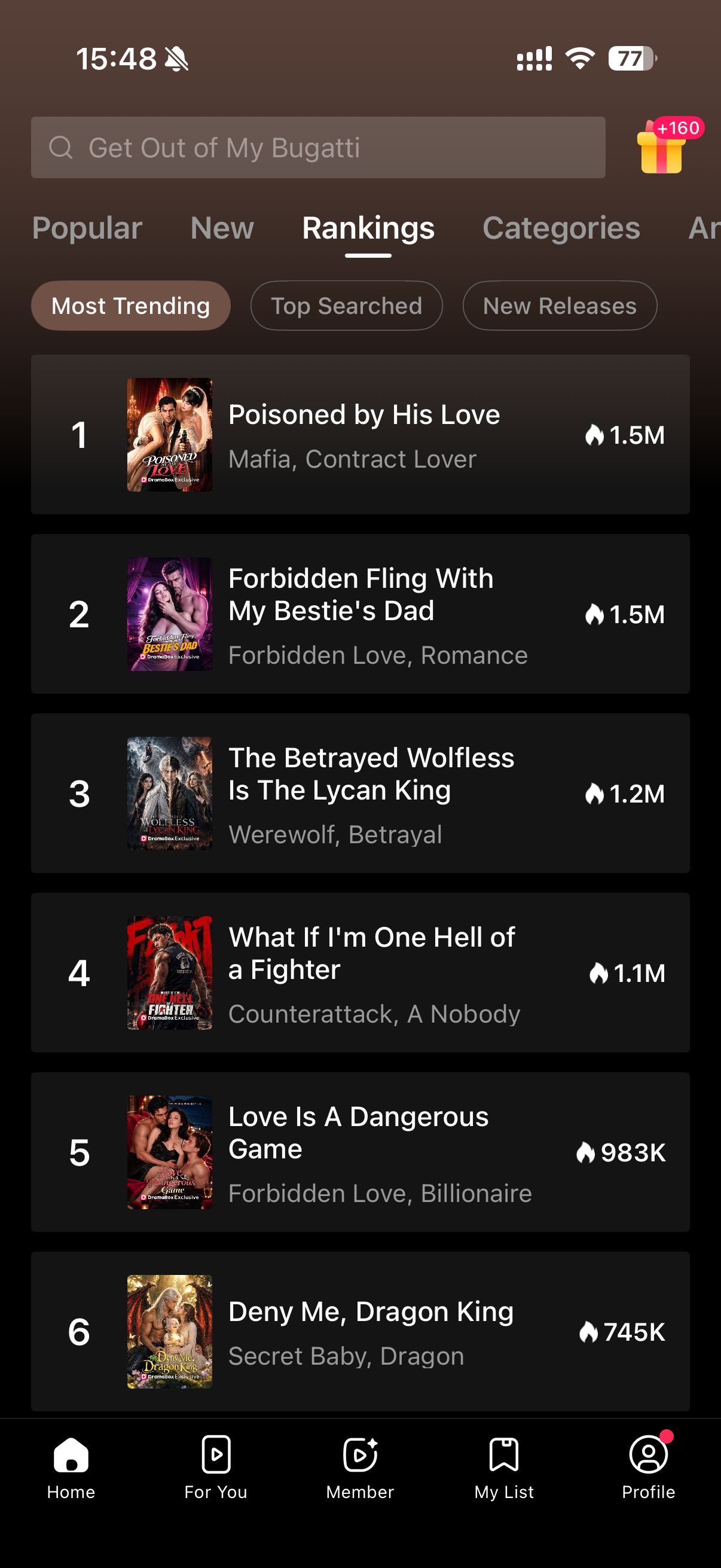
While AI production has given screenwriters more creative freedom, popular shows on major platforms still largely stay within established genres such as romance, mafia, and werewolf stories (screenshot via DramaBox)
That’s likely in part because we’re now encouraged to use AI for our scripts. It does make writing faster, but we’re also expected to finish scripts sooner while mastering new technologies almost immediately. After learning how to describe prompts to produce movement and emotion with much greater precision, I now find myself constantly regenerating and refining outputs to get a scene right. AI is fast, but instead of making my job easier, it has simply shifted the workload elsewhere and reduced the time we have to figure out how to achieve what we want.
Increasingly, I feel like I’m writing instructions for a scene rather than actions. Yes, there’s much more creative freedom, and budget is no longer an issue because each project costs just a few thousand yuan. I no longer need to participate in table reads, but I occasionally miss sitting in a room or on a Zoom call with actors and directors for meetings, even when they were long and tedious. I could never predict what kind of chemistry two actors might have, or an idea blurted out that could improve a scene in ways I would have never thought of. These interactions are what made screenwriting exciting to me.
I can still recall when the director finally called “It’s a wrap!” on set for a DramaBox production in 2024; everyone hugged, cried, and took pictures together. The female lead had all the other actors sign her copy of the script and later posted it on Instagram.
The story was nothing groundbreaking—just the familiar “girl meets the man who spoils her after being dumped” trope—but the time everyone spent together was still the highlight of the whole process.
Those are the moments that have mostly disappeared from our day-to-day operations, yet still remind me of the human side of this cold, data-driven business.
Epilogue
Over the last four to five months, I have accepted the fact that I may never sit in a table read, watch casting reels, or go location scouting again. I guess that is the reality that many micro-drama screenwriters must now live with. And as more and more companies have adopted AI, the industry feels more crowded than ever. From the outside, it may seem like business is booming because the barriers that once kept people out are disappearing. But it also means that more people are competing for the same audience, making it harder for any single project to stand out and to turn a profit.
As for why I am still here, part of the answer is because I still love writing. The tools may have completely changed, but the pleasure of putting an idea into words and then watching it come to life remains. However, while scrolling through old project folders recently, I found my original script for the “Gambling Goddess,” and those difficult card tricks that were too complicated for a human actor but AI brought to life effortlessly. I should feel satisfaction. After all, I successfully created the exact thing I imagined. Yet I find myself wondering: Is that it? Is that the future of this type of storytelling?
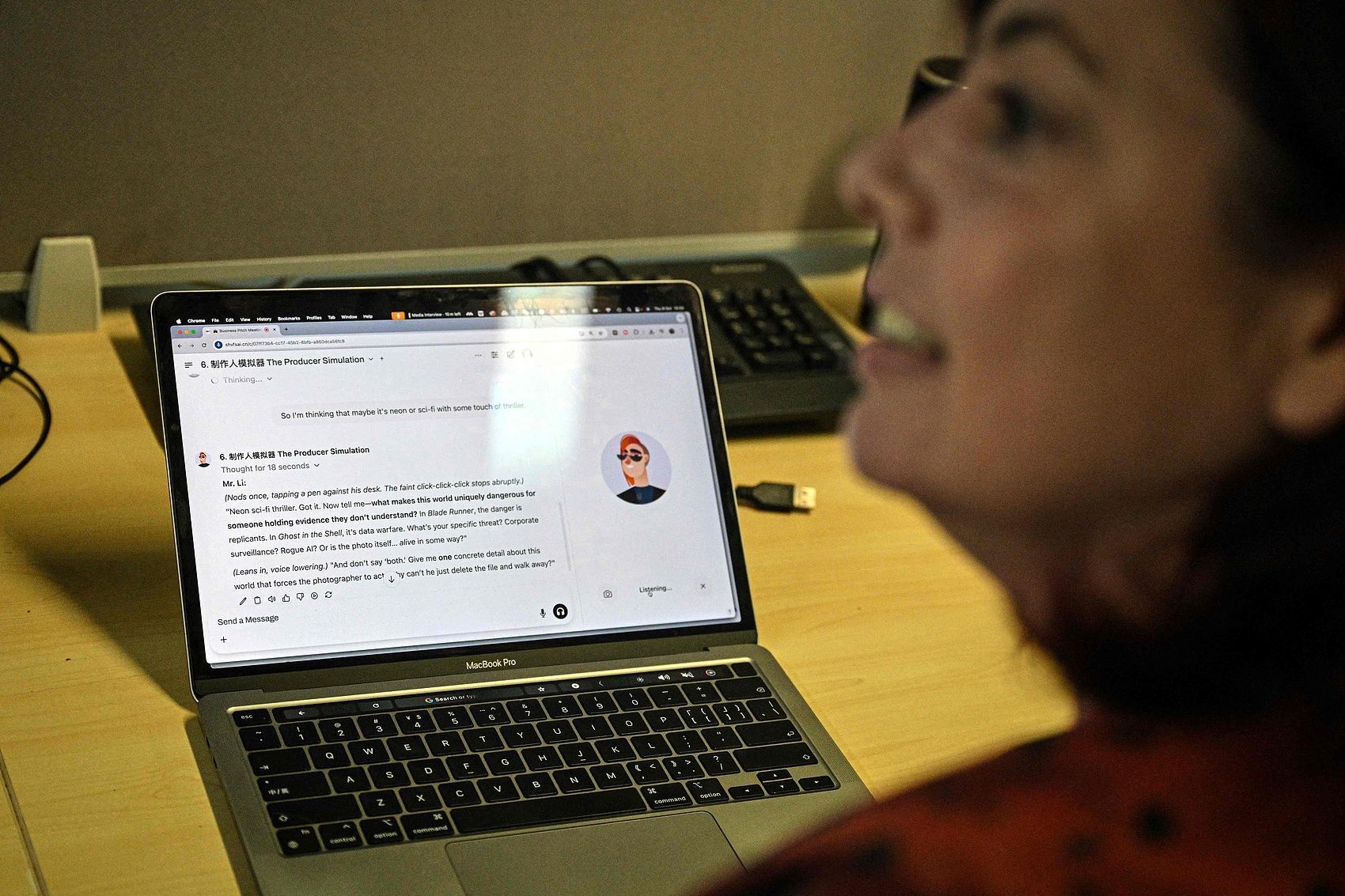
Odet Abadia Gomez, the head of the AI Future Imaging Research Center at the Shanghai Vancouver Film School, demonstrates how to use AI tools to write story pitches for producers (VCG)
I study my AI female lead. She has a pretty face, one that reminds me of a thousand celebrities and none of them at the same time. I watch her say my line, her mouth moving in a way that makes me sure the prompt includes keywords like “angry,” “emotional,” and “decisive.” Frankly, she is doing a good job at all of them. She has the right expression, timing, and intensity. And maybe that’s what bothers me.
When I used to watch real actors perform one of my scenes, they might pause half a second longer than expected, deliver a line with added emphasis, or make a facial expression that I never imagined when I wrote the character. Sometimes they got it wrong. Sometimes they misunderstood my intention. But occasionally, that misunderstanding became something better than what I had written. That unpredictability used to be part of the job. Now, we can simply prompt unpredictability away.
Like most of my coworkers, I have learned to adapt, because at this point it is the only option if we want to remain in the industry. I know the decision to pivot to AI is bigger than what I, my chief editor, or even the company may want. The power lies in the audience. As long as they keep watching, AI content will keep coming. Maybe one day it will go back to how it used to be. Maybe viewers will eventually miss the imperfections that made these stories feel human. Or maybe they won’t. Maybe the next generation will watch these AI dramas and never understand why people like me felt uncomfortable about their encroachment, how something was missing.
For now, I ponder the perfect scene on my screen. It looks exactly the way I wanted it to. I just wish I could remember why I wanted it so badly in the first place.
Related Articles