The recent hit costume drama Against the Current contains a shocking scene. After the Shen clan, an official household, is toppled in a political purge, the women of the family are sentenced to an institution called the Court Entertainment Office, or Jiaofang Si (教坊司).
As the Shen women gather in the dimly lit room where they are being held, the family matriarch explains the reality of their punishment: “This is the Jiaofang Si. They may call it a place of music and dance, but in truth it’s nothing but a state-run brothel.” The women, including two young girls, decide to take their own lives—“We’d sooner die with our honor intact than live in disgrace,” the matriarch says.
The intense episode has sparked heated discussion online: Why would the Shen women rather die than train in the performing arts, albeit under duress?
More on Art, Entertainment, and Courtesans:
- Stars in Their Eyes: How China’s Ancient Fans Expressed Their Devotion
- Five Rare Traditional Chinese Instruments
- Wine, Women & Song
In many dynasties, the Jiaofang (教坊) was a government office responsible for organizing court performances and training entertainers, but the drama’s claims do have some historical basis—at certain times, its remit overlapped with the world of courtesans and sex work. So how did an ancient institution devoted to court performance also become tied up with prostitution and political punishment?
Entertaining the emperor
The Jiaofang as a specialized office first emerged in the Tang dynasty (618 – 907), but government institutions for training musicians and rehearsing music existed long before.
The Rites of Zhou (《周礼》) describes an official known as the Grand Director of Music who was responsible for teaching music and dance to noble youths, as well as organizing music for state rituals. Later, during the Qin (221 – 206 BCE) and Han (206 BCE – 220 CE) dynasties, court offices such as the Music Bureau arranged music for temple sacrifices and collected regional songs. Later dynasties continued to develop music administration—the names and duties changed, but the court always needed people to preserve repertoire, train performers, and arrange performances.
Yet people working within these institutions did not always share the same status. Officials held ranks and received salaries, while some performers were low in status and bound to compulsory duties. During the Northern and Southern dynasties (420 – 589), historical records refer to “music households,” families registered for singing, dancing, and other musical roles, in some cases because they or their relatives had committed crimes. Their status and obligations passed from generation to generation and they were sometimes forbidden from marrying outside of their social class. This system lasted until all the way to the 18th century. The court needed their skills, yet society often looked down on them as a low-status group.
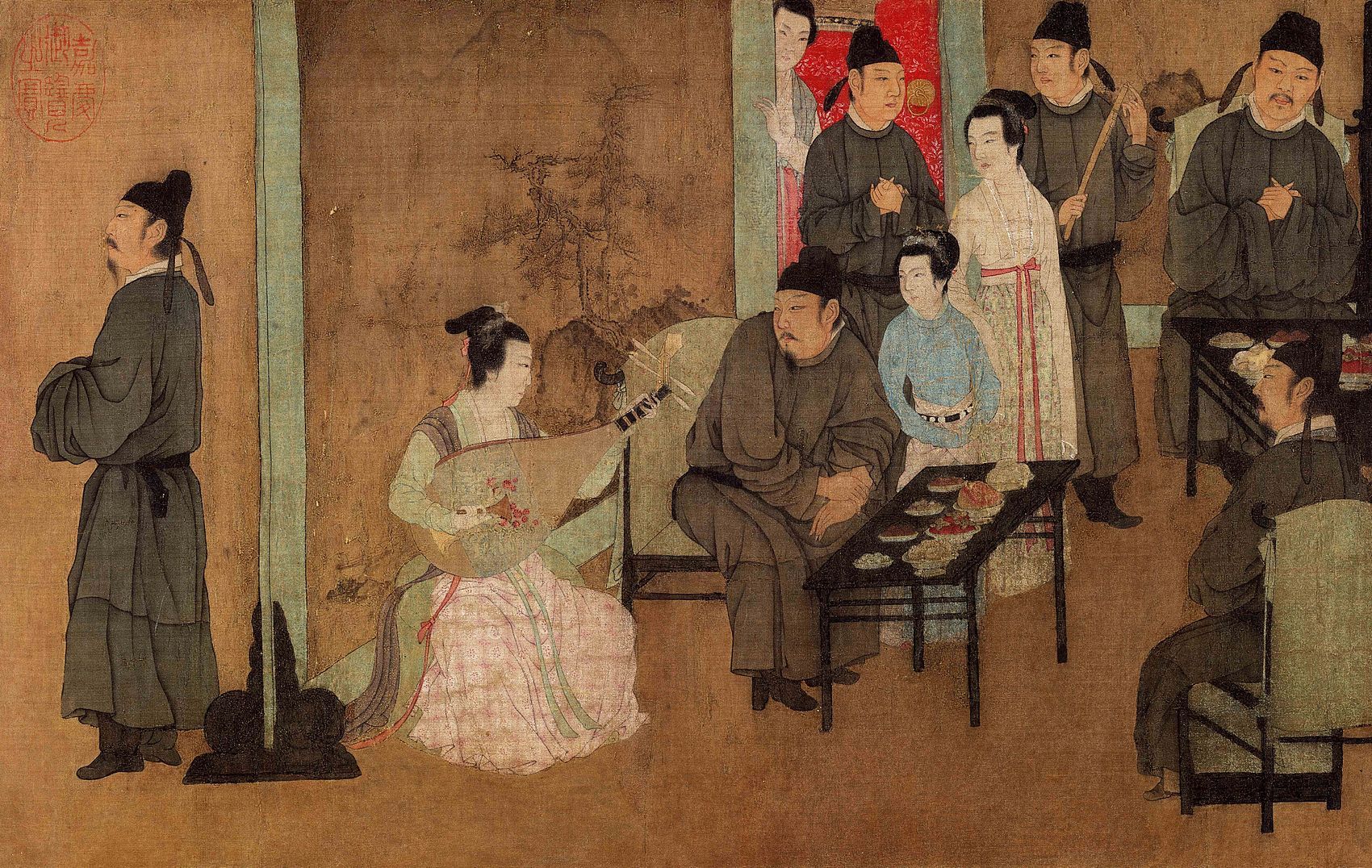
Lady Li (the woman at the center left), an accomplished musician and younger sister of Li Jiaming (the man in the right foreground), deputy director of the Southern Tang’s Jiaofang (937 – 975), plays the pipa at a banquet in this 12th-century copy of “The Night Revels of Han Xizai” (VCG)
The Tang Jiaofang took form under the music-loving emperor and had its own hierarchy. According to Cui Lingqin’s (崔令钦) Records of the Jiaofang (《教坊记》) written in the eighth century, the highest-ranking entertainers were called “inner performers” or “those in front” because they performed before the emperor himself. They enjoyed special privileges, such as the right to wear fish-shaped insignia and receive visits from female family members on special occasions, like birthdays. Beneath them were “palace performers,” whom the same text bluntly calls “base servants,” and lower still were women selected from outside the palace and trained to play stringed instruments.
The distinction between Jiaofang performers and courtesans was not always clear. According to Sun Qi’s (孙棨) Records of the Northern Quarter (《北里志》) written in the ninth century, courtesans in the capital Chang’an were registered with the Jiaofang and court officials had to obtain official authorization before the women could be brought to banquets. These women lived beyond the palace walls in Chang’an’s Pingkang Ward, a sign that the Jiaofang’s reach extended into the capital’s wider world of entertainment.
Tang poet Bai Juyi’s (白居易) poem “Song of a Pipa Player” depicts a former Chang’an courtesan who joined “the first division of the Jiaofang” in her youth. Her musical prowess impressed wealthy male admirers, who showered her with gifts. She describes the splendor of these banquet scenes as she recalls “beating time with my gold-inlaid silver comb until it broke; the blood-red skirt was stained with spilled wine.” Yet with age, her popularity diminished and the poem finds her alone on a boat, unhappily married and wistfully reminiscing on the glories of her now distant former life in the capital.
The Jiaofang continued to stage impressive spectacles into the Song dynasty (960 – 1279). Meng Yuanlao’s (孟元老) The Eastern Capital: A Dream of Splendor (《东京梦华录》), written in the 12th century, captures a grand banquet celebrating the emperor’s birthday. Before the music began, Jiaofang performers stood on a high platform and imitated the calls of a hundred birds. Meng describes stunned silence in the hall as birdsong echoed above, followed by singing, dancing, acrobatics, and zaju (杂剧), a form of musical drama, as each round of wine was served.
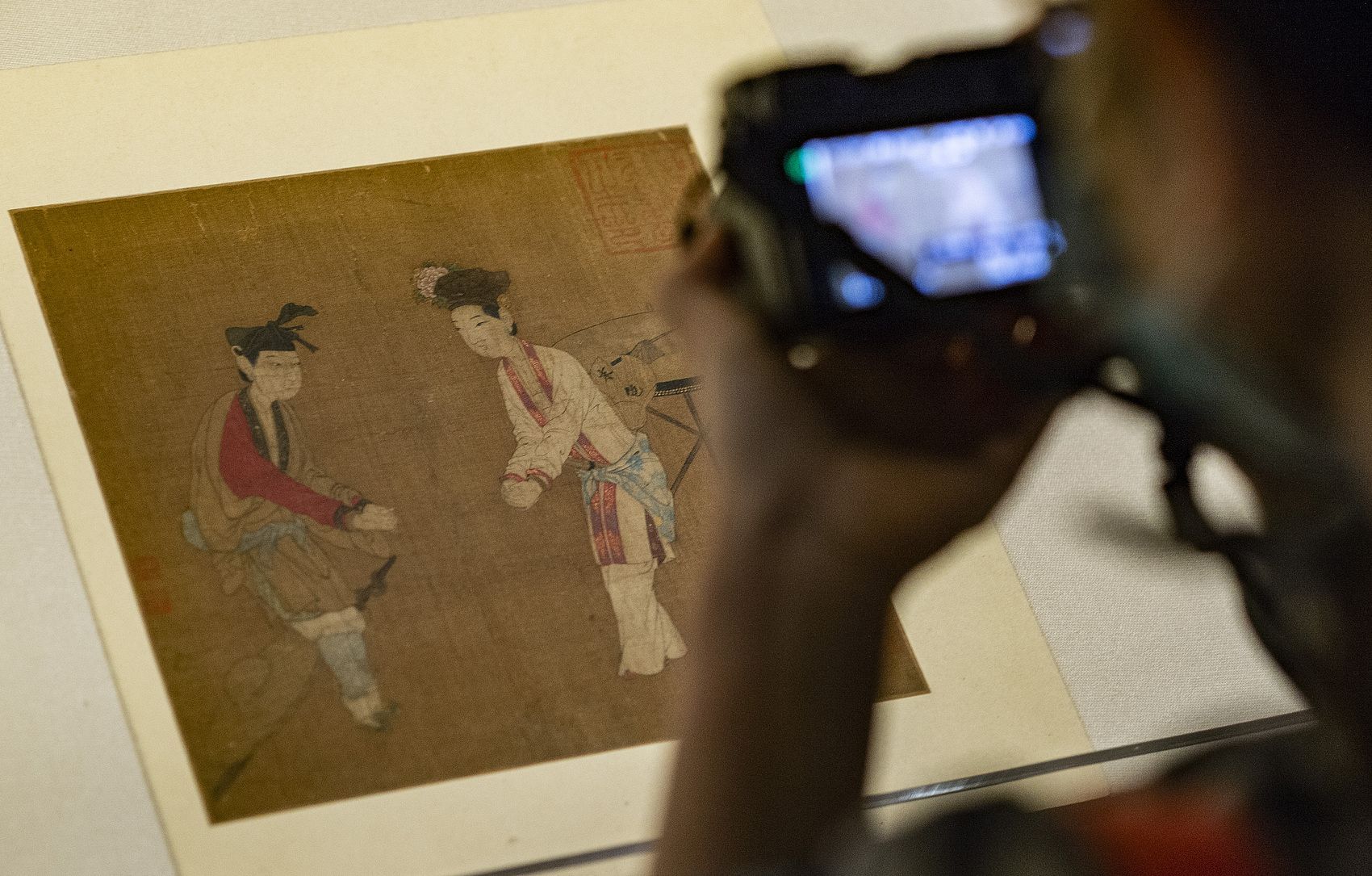
A painting depicting a zaju performance from the Southern Song dynasty, on display at the Palace Museum. Also known as “comic drama,” zaju was a popular form of entertainment during the Song and Yuan dynasties. (VCG)
It was the Jiaofang’s responsibility to organize these many elements into a complete performance, a task that required extensive preparation. Meng records that the female performers rehearsed a month before the event, while other Song accounts describe 13 separate Jiaofang divisions, each with its own departmental head, covering everything from acrobatics and singing to dance and zaju.
As the world of court performances grew more elaborate, it sometimes became embroiled in politics. When the powerful minister Wang Anshi (王安石) pushed through his controversial New Policies, Jiaofang performer Ding Xianxian (丁仙现) allegedly mocked the reforms repeatedly at court banquets. While other officials were demoted for opposing Wang’s policies, Ding was able to ridicule them publicly through his Jiaofang routines. Eventually Wang demanded Ding’s execution, but the emperor personally intervened, hiding Ding in one of the royal residences. A saying circulated at the time, recognizing the idiosyncratic power of the Jiaofang: “The censors were no match for the court entertainer.”
The Jiaofang was disbanded after the Southern Song (1127 – 1279) retreated to Lin’an (present-day Hangzhou). It was briefly restored, then abolished again, with urban performers instead hired from the city for specific occasions. The institution was later revived under the Yuan dynasty (1206 – 1368) as the Court Entertainment Office (教坊司), or Jiaofang Si, with regional offices beyond the capital to manage entertainers, music households, and courtesans.
The price of performance
In 1402, after seizing the throne from his nephew, the Ming emperor Zhu Di (朱棣) ordered female relatives of the defeated emperor’s supporters to be sent to the Jiaofang Si. Among them was the four-year-old daughter of an executed official. Ming sources describe the aftermath, including accounts of the mistreatment and sexual abuse suffered by these women. The Jiaofang Si had become part of a machinery of political retaliation and the punishment of those involved presents a grim historical parallel to the opening episode of Against the Current.
Throughout the Ming dynasty (1368 – 1644), the court continued to maintain the Jiaofang Si, even as it became more entangled with prostitution. The late-Ming scholar Xie Zhaozhe (谢肇淛) wrote in his Five Miscellanies (《五杂俎》) that prostitutes in various places “lived by selling sex,” adding that “The Jiaofang in the two capitals collected taxes on them, called ‘powder-and-rouge money.’” The Jiaofang’s administrative scope now directly extended into the sex trade.
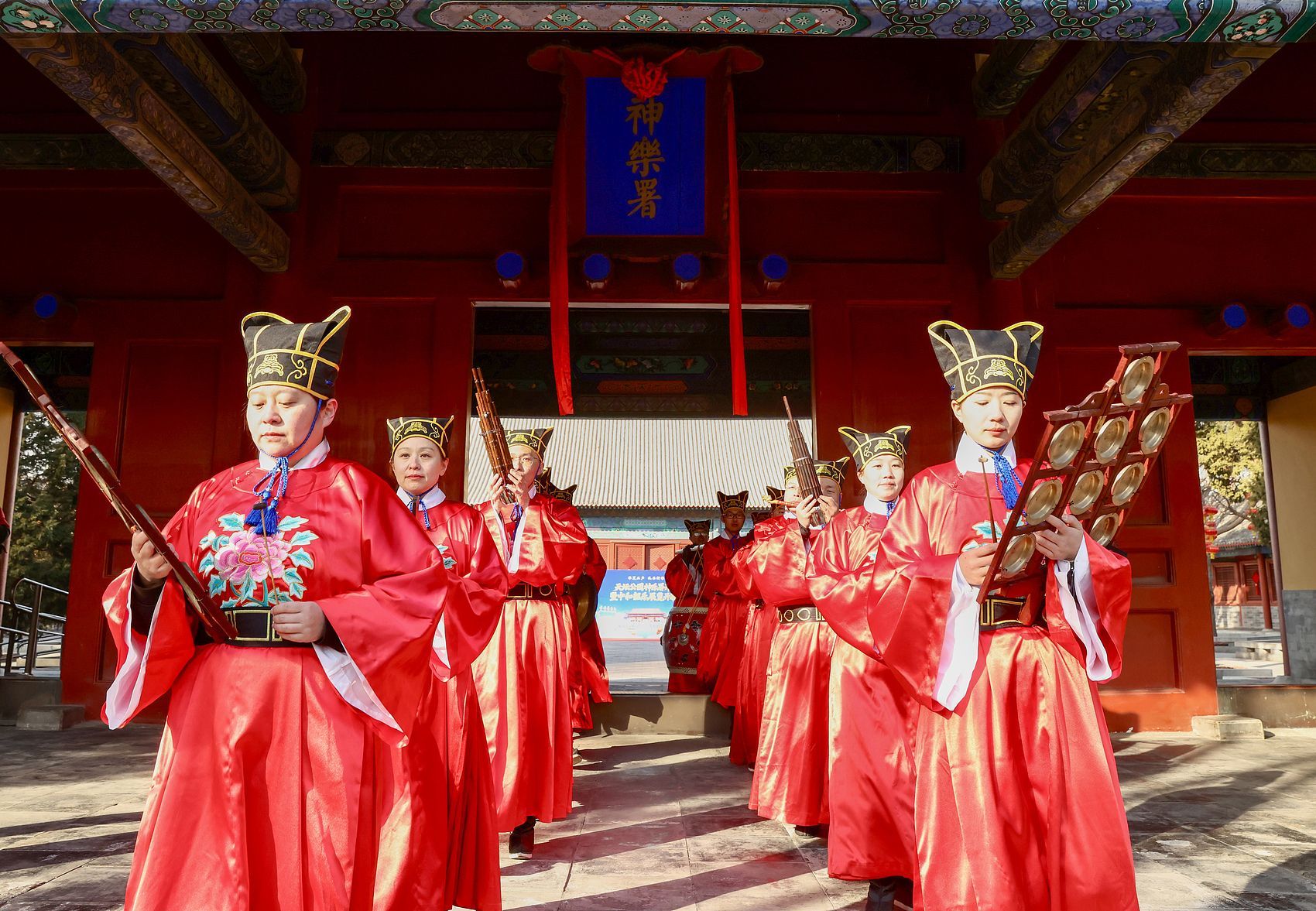
While the Jiaofang Si managed court entertainment at imperial banquets, celebrations, and other court functions, imperial sacrificial music was overseen by a separate institution. During the Qing dynasty, this was known as the Shenyue Shu (神乐署), or Divine Music Office, staffed by young men from noble families. (VCG)
The literature of the time portrays this entanglement. In Feng Menglong’s (冯梦龙) collection Stories to Caution the World (《警世通言》), a young man, Li Jia, visits the Jiaofang Si compound where he encounters a famous beauty, courtesan Du Shiniang. They fall in love and Du hopes to buy her freedom so they can start a new life together, but Li Jia protests that removing her name from the Jiaofang register would cost too much. Du nonetheless negotiates with the brothel keeper to pay 300 taels of silver to secure her own freedom.
By the time of the Qing dynasty (1644 – 1911), the negative associations of the Jiaofang had become an issue for the authorities themselves. In 1723, the Yongzheng Emperor abolished the music-household registration system, and in 1729 the Jiaofang Si was renamed Hesheng Shu (和声署), or the Harmony Office. Records suggest that the old name had become so disreputable that few musicians would serve under it.
The Qing scholar Zhou Shouchang (周寿昌), in his Daily Notes from the Hall of Reflection (《思益堂日札》), mused on the significance of the change: “Renaming the Jiaofang Si to the Hesheng Shu not only washed away the vulgar practices of the Ming, but also permanently abolished the name Jiaofang inherited from earlier dynasties. One might call it a thorough cleansing of the realm.” The institution may have continued under a different title, but the original name, along with a millennium of associations, faded into history.
Looking back, the Shen matriarch’s line to her doomed sistren is not entirely unfounded, but the Jiaofang was never simply a synonym for a pleasure house.
From coercive labor to associations with the sex trade, the office’s long and varied history could be dark, but it was also central to an entertainment culture capable of producing extraordinary artistry and impressive spectacle. The Jiaofang was a different entity to different dynasties—it leaves a legacy that is difficult to capture in a single name.
Related Articles