In the fourth century, the Chinese scholar Wang Huizhi (王徽之) moved, temporarily, into someone else’s vacant house. Upon arrival, he immediately had bamboo planted outside. When asked why he had gone to the trouble for such a short stay, Wang pointed directly at the plant and replied, “How could I be without this gentleman even for a single day?”
Wang’s obsession may sound eccentric, but his feelings reflect a long tradition in China. For millennia, bamboo has been regarded as a functional everyday material; its hollow, jointed stems, rapid growth, and impressive flexibility have proven useful for everything from tools and construction to musical instruments and writing.
Yet from this practical relationship, bamboo has also become a potent symbol in the Chinese cultural imagination, admired by people from politicians to poets, who have found in its physical characteristics a reflection of human values and emotions, such as integrity, resilience, and sorrow.
Read more about plant symbolism in traditional Chinese culture:
- Poetic Blooms: Chinese Flower Meanings
- Emblematic Blossoms: Major City Flowers in China
- Chinese Trees and Their Meanings
Bamboo records
The Chinese attachment to bamboo runs deep. In the 1950s, excavations at the Qianshanyang site in Zhejiang province uncovered more than 200 woven bamboo objects from the Late Neolithic period, including baskets, mats and fishing gear, proving that more than 4,000 years ago, local people were already using bamboo for storage, bedding, and tools.
Alongside its use in the creation of everyday objects, bamboo has also long served as a medium for music and ideas. In ancient China, musical instruments were classified by their materials: “silk (丝)” referred to stringed instruments made with silken strings, while “bamboo (竹)” was a byword for wind instruments such as flutes known as xiao (箫). The Book of Rites (《礼记》), a collection of texts that describe aspects of life in the Zhou dynasty (1046 – 256 BCE), states that “metal, stone, silk, and bamboo are the instruments of music,” and over time “silk and bamboo (丝竹)” became a general term for traditional instrumental music.
Before paper became widespread, bamboo was also an important surface for writing. The stems were cut into narrow strips and used to inscribe letters, books, and government records, often bound together with cord to form longer documents. Examples include the Liye slips from the Qin dynasty (221 – 206 BCE), excavated in 2002, and the Warring States bamboo slips acquired by Tsinghua University in 2008
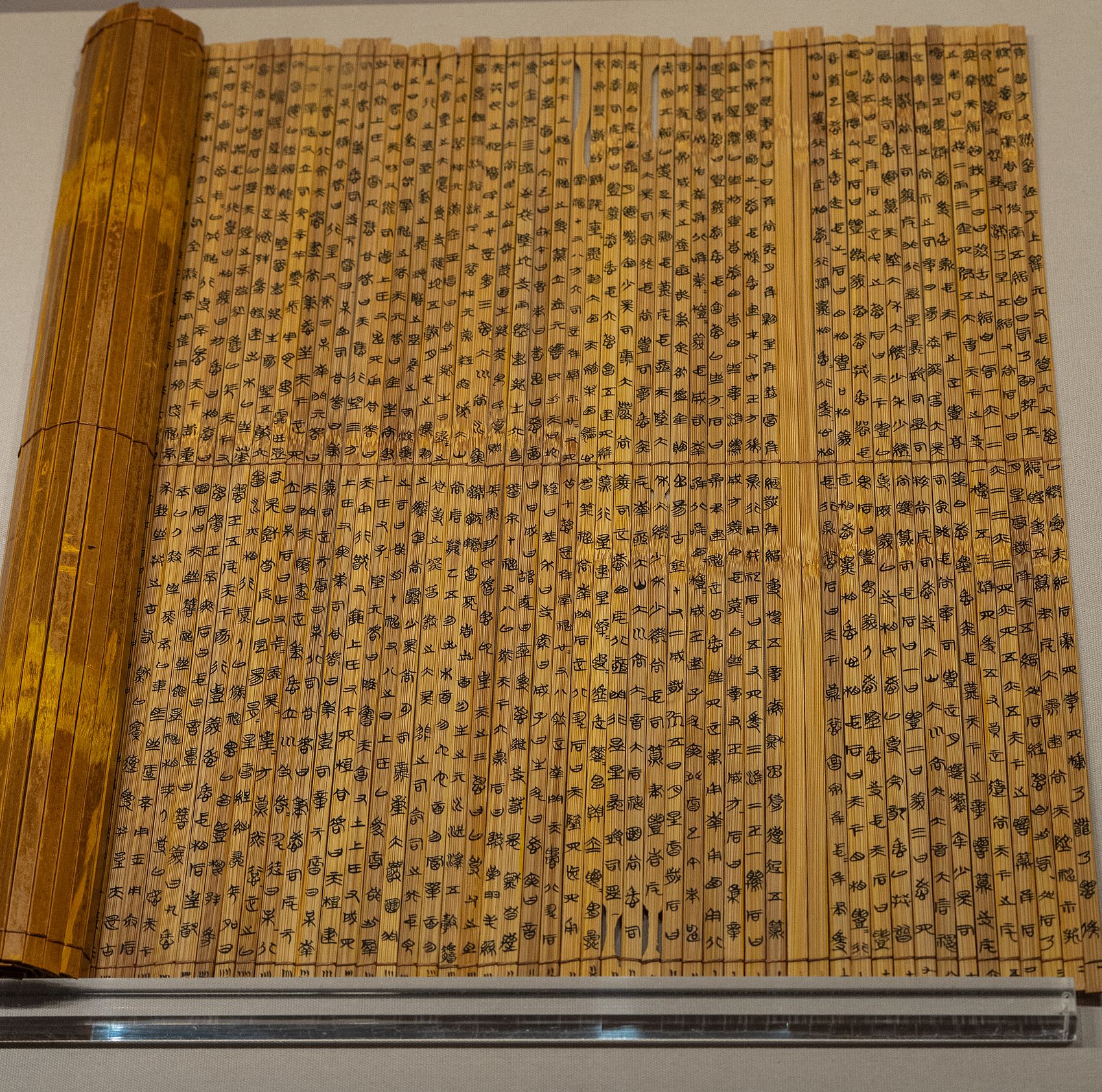
A replica of the bamboo slips acquired by Qinghua University on display at Anhui Museum in August (VCG)
These bamboo slips were made more durable and easier to write on through a process known as “killing the green (杀青),” in which they were heated to remove moisture and the green outer layer was scraped away. The term survives today to indicate that a film or TV production has finished shooting. As the bamboo was heated, moisture rose to its surface like sweat, giving rise to another phrase—“sweating green bamboo (汗青)”—which later became a literary stand-in for the historical record. In the Southern Song dynasty (1127 – 1279), the patriotic poet and politician Wen Tianxiang (文天祥) famously used the expression in the line:
Since the beginning, who has ever escaped death? Let me leave a loyal heart shining in history.
A gentleman and a scholar
In China, the association of bamboo with the literati and the figure of the gentleman or junzi (君子)—the ideal of a noble, morally cultivated individual—is well established. But it did not begin with Wang Huizhi. The connection can instead be traced back to China’s earliest poetry anthology, the ancient Classic of Poetry (《诗经》), in which the poem “Qi Yu (《淇奥》)” connects the two figures in the same aesthetic frame for the first time:
Look to the bend of the Qi River, where the green bamboo grows lush. There is our elegant gentleman, like ivory finely carved, like jade carefully polished.
Later, more specific moral meanings were vested in bamboo, part of a cultural tradition in which the qualities of natural objects were mapped onto human values known as “matching virtue.” The plant’s hollow center and jointed stalk became its most significant noble features. Unlike the English word “hollow,” the Chinese term xuxin (虚心) carries associations of humility and can describe a person free from self-importance and open to reason. The word jie (节), meanwhile, refers to both the joints of a bamboo stalk and a person’s moral integrity, symbolizing a noble character and firm principles. In an ode to bamboo, Tang-dynasty (618 – 907) poet Zhang Jiuling (张九龄) highlighted these associations in the line:
Its noble joints are revered by all; its humble heart is known to the world.
Bamboo’s ability to weather hardship while remaining upright has also invited natural associations with resilience and strength in the face of adversity. In a poem inscribed on his painting “Bamboo and Rock,” Qing-dynasty (1616 – 1911) artist Zheng Banqiao (郑板桥) captured this steadfast energy:
Gripping the green mountain, it will not let go; its roots set deep in broken rock. Though battered by a thousand blows, it stands firm still, no matter which way the winds may blow.
For the literati, being surrounded by bamboo in one’s courtyard or study became a matter of cultivated taste. After visiting a pavilion surrounded by green bamboo in Hangzhou, Song-dynasty poet (苏轼) expressed this idea with his typical wit:
One may eat without meat, but cannot live without bamboo. Without meat one grows thin; without bamboo one grows vulgar. Thinness can still be cured; vulgarity in a scholar cannot.
A world apart
If individual stalks became emblematic of gentlemanly virtue, bamboo groves came to evoke withdrawal from worldly constraints and a reclusive life away from officialdom and political struggle. This idea owes much to the story of the “Seven Sages of the Bamboo Grove,” in which seven scholars of the third century who, according to A New Account of Tales of the World (《世说新语》), “often gathered beneath the bamboo grove, drinking freely and indulging their whims.” During the political turbulence in the mid-third century, scholars could be incriminated for their actions or speech, so the Seven Sages’ unrestrained behavior amid bamboo carried a tone of resistance to ritual constraints and an escape from political pressure.
The symbolism of the Seven Sages is reflected today in contemporary wuxia cinema. Films such as Crouching Tiger, Hidden Dragon (2000) and House of Flying Daggers (2004) use vast bamboo forests in some of their most iconic scenes as settings for escape, travel and combat. Their directors, consciously or otherwise, draw on the bamboo grove’s ancient associations to imply that their characters are free to undertake actions beyond conventional social norms.
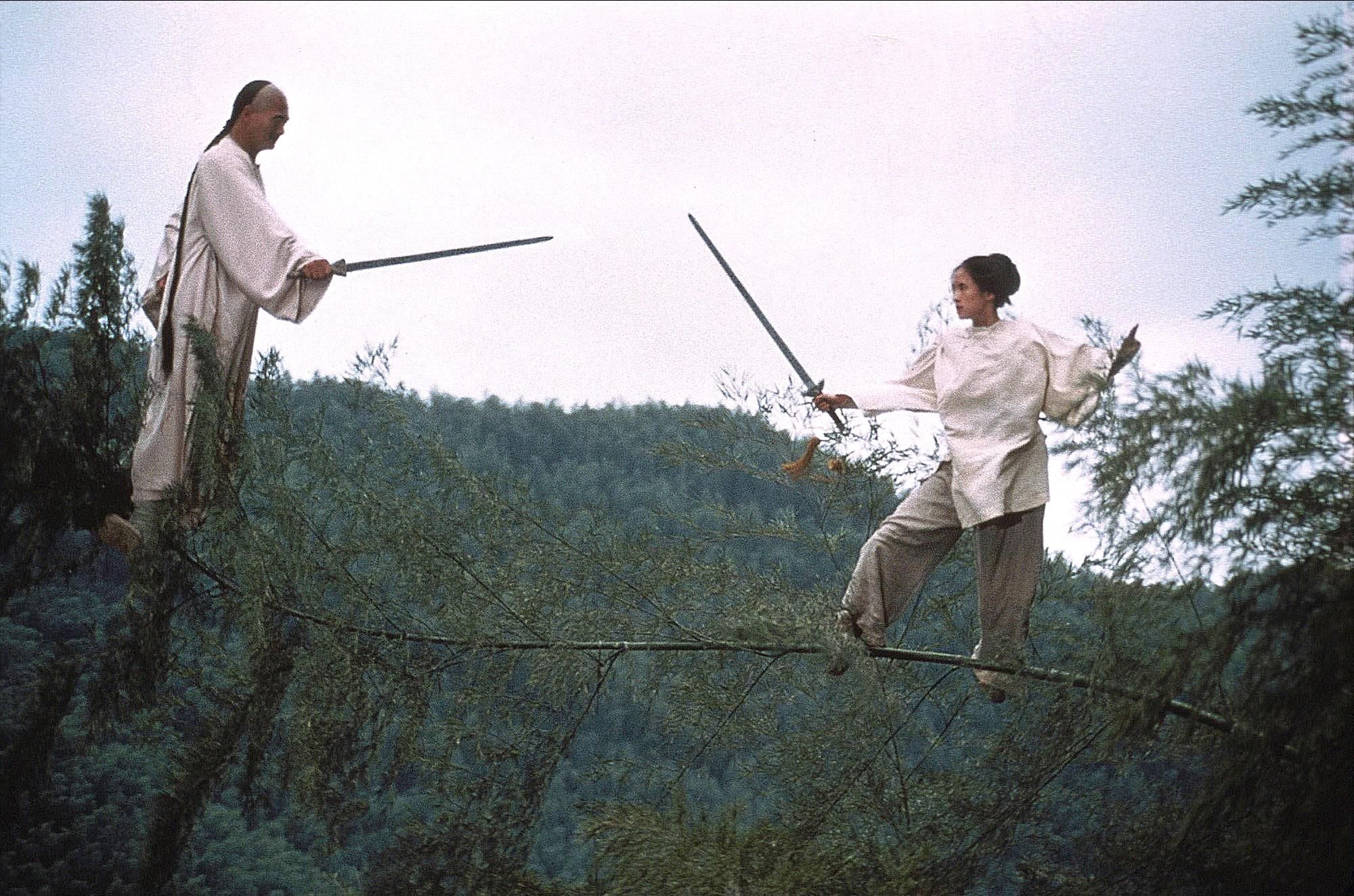
The iconic fight scene in Crouching Tiger, Hidden Dragon, filmed in the bamboo groves of Anji, Zhejiang, and Huangshan, Anhui, has turned these locations into popular tourist attractions (still from Crouching Tiger, Hidden Dragon)
Yet withdrawal from society was not the only form of separation that bamboo came to represent. Through literature, it is also linked to longing, parting, and deep affection, a connection with its roots in an old love story recorded by the third-century scholar Zhang Hua (张华).
According to Zhang’s Records of the Investigation of Things (《博物志》), the two daughters of Yao, one of ancient China’s legendary sage-kings, were married to his successor, a king named Shun. After Shun’s death, the two women wept in their mourning and stained the bamboo with their tears. Another version of the legend sees the sisters drown themselves in the Xiang River, transforming into goddesses known as the Xiang Consorts. Mottled variations of bamboo later became known as “speckled bamboo (斑竹)” or “Xiang Consort bamboo (湘妃竹),” with literary associations of devotion, mourning, and the sorrow of separation.
Now, bamboo remains an everyday part of Chinese life: its imagery and iconography abound everywhere from television to engineering, literature to visual design. Few go without encountering its presence—literally or figuratively—each day.
It is still common for many Chinese families to plant a few stalks of bamboo in their courtyards, atop their windowsills, or on their balconies. They may not all be thinking of Wang Huizhi, Su Shi, or the Xiang Consorts, but in doing so they nonetheless inherit and continue this millennia-old relationship between human and plant.
Related Articles