Riding out a dark storm, a battered junk breaks through waves and soars in the air. Its destination—Penglai, the celestial realm—comes in sight. Borne on the backs of four giant turtles, a land with towering green mountain ranges dotted with waterfalls, palaces, and bridges floats over the ocean, accessible only to those who have weathered the elements. This spectacular opening scene from the animated film All Wishes Come True! vividly brings to life a fantasy world known only through historical texts.
Yet it is also a place that feels strikingly familiar to a contemporary audience. Golden carriages run along cloud pathways, shuttling passengers around the city. A giant magic mirror broadcasts advertisements and announcements across Penglai. Inhabited by both humans and gods, the celestial realm is run by a vast divine bureaucracy. The deities must clock in, meet KPIs, and grant wishes on demand to keep their temples’ licenses—a heavenly order overlaid with the logic of corporate life.
Read more about traditional culture in popular media:
- Is China Creating Its Own Mickey Mouse with Ne Zha?
- Let the Wind Take You: Inside China’s Latest Sprawling Wuxia World | Review
- Black Myth: Wukong—How to Make a Billion Dollars from Chinese Folklore
Centered on the legend of the Eight Immortals, the animated film became a box-office hit this summer, surpassing 1.7 billion yuan at the time of writing and ranking among the top 10 highest-grossing animated films in Chinese film history. All Wishes is the latest in a long line of recent Chinese animation inspired by Chinese myths, legends, and classic literature. From Monkey King: Hero Is Back, the critically acclaimed 2015 hit based on Journey to the West (《西游记》), to Ne Zha 2, an adaptation of a Daoist myth and a mega box-office success last year, these films have proven the wide appeal of breathing new life into age-old stories.
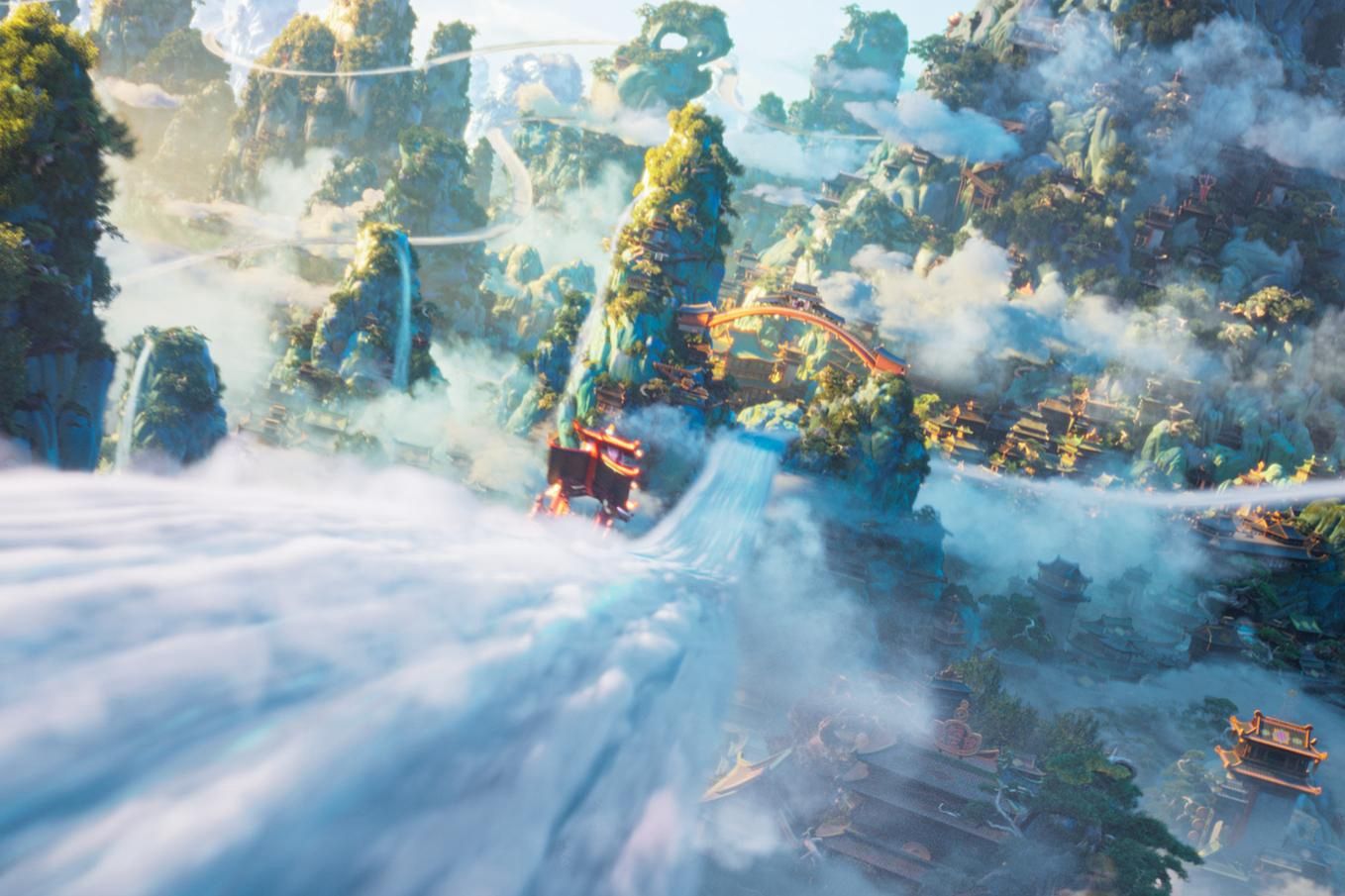
Penglai, the celestial realm, is portrayed as a bustling metropolis where humans and deities coexist
Lauded for its stunning visuals, tight pacing, spectacular battle scenes, and witty dialogue, All Wishes earned a respectable 8.2 out of 10 on the film-review platform Douban. However, like many adaptations, All Wishes also drew criticism for its plotlines and portrayal of certain characters, which were seen as disconnected from its original roots. Some viewers even attributed its commercial success to its adherence to a Hollywood formula, demanding true innovation in a Chinese story retold. The polarized reviews also reflect a broader dilemma: With Chinese animation drawing heavily on historical stories and legends for source material, can it still tell a compelling new story?
A story half-known
The cast of All Wishes is composed of the traditional Daoist deities known as the “Eight Immortals”—but with a twist. Instead of the familiar plot of “a hero defying fate to forge their own destiny,” seen in the Ne Zha series, the Eight Immortals are portrayed as ordinary people—somewhat dubious ones, at that—as they band together to sneak into a treasure vault in Penglai.
The film is loosely based on a household legend, in which these deities ride their magical artifacts across the ocean, from an iron crutch and a paper donkey to a flower basket. The story even gave rise to a Chinese idiom, “八仙过海,各显其能,” meaning “The Eight Immortals cross the sea, each showing off their unique abilities.” It describes situations where everyone plays to their strengths. But unlike the Monkey King from Journey to the West, the Eight Immortals’ backstories are obscure to most audiences. The group’s formation took centuries; some are based on real Daoist figures, such as Lü Dongbin, an eighth-century religious leader, while others may have been purely fictional. He Xiangu, the only female deity, was added to the group as late as the Ming dynasty (1368 – 1644), when the lineup we know today was officially set.
The Eight Immortals are often seen as grassroots deities drawn from all walks of life—young and old, rich and poor, men and women, including people with disabilities—an ensemble that reflects the Daoist belief that anyone, through cultivation, can become an immortal.
The absence of an authoritative text gave the filmmakers more creative freedom. Explaining his choice to portray these characters as ordinary people, director Mu Zhengyang told Beijing Youth Daily, “Chinese deities are usually calm and reserved, with an air of otherworldliness and a touch of mystery. The Eight Immortals are different. They are much more down-to-earth.”
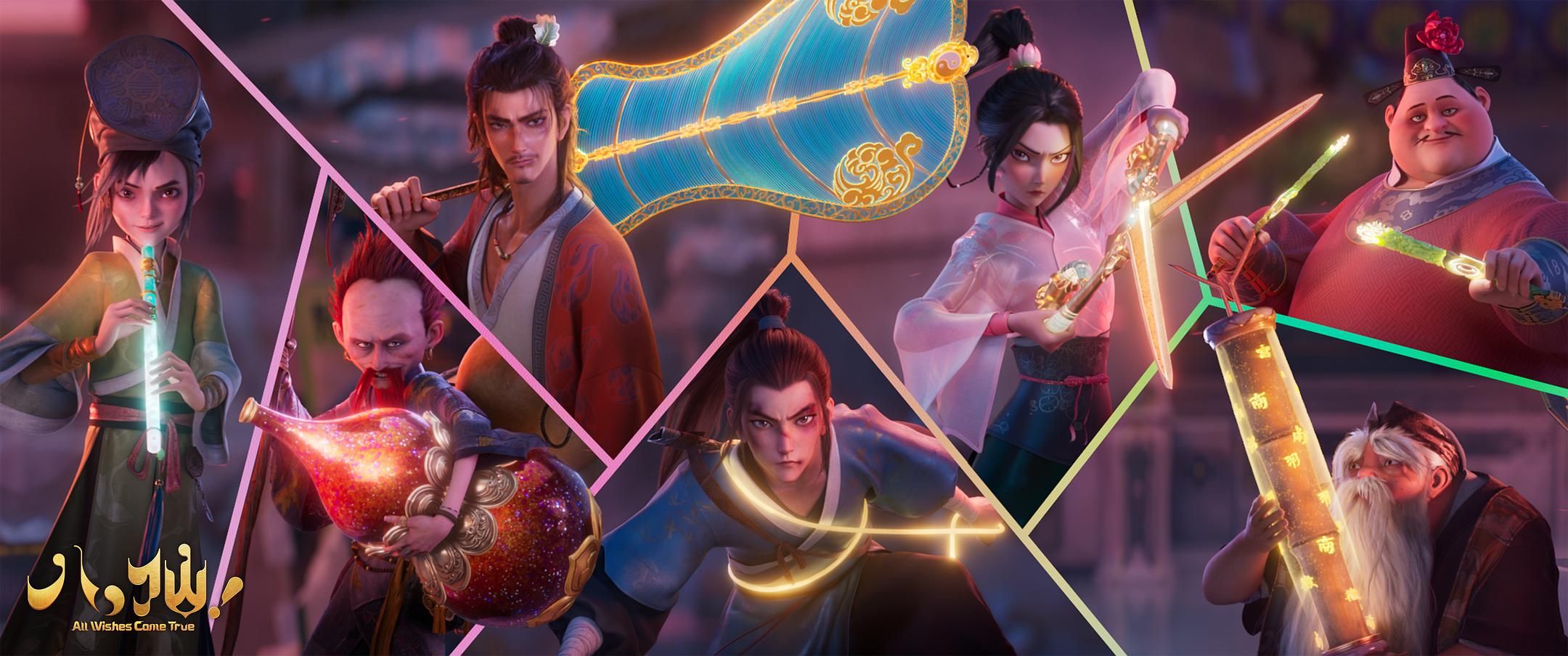
The film is loosely based on the well-known legend “Eight Immortals Crossing the Sea”
As a result, the Eight Immortals are boldly reimagined in the film. Revered Daoist master Lü Dongbin is portrayed as a young, cunning swordsman and treasure thief. Zhongli Quan, traditionally depicted as a boisterous, larger-than-life Daoist known for his long beard, bare chest, fan, and carefree demeanor, is reinvented as a handsome rogue and streetwise pickpocket. Han Xiangzi, originally a music-loving young scholar, appears in the film as a tech-savvy teenage tinkerer. Cao Guojiu, a nobleman and the younger brother of an empress, takes on the role of a low-level clerk and a source inside the bureaucracy governing the celestial realm.
The main storyline is where the most common criticism of All Wishes comes in: that beneath its Chinese mythological trappings lies a Hollywood-style heist formula. The team assembles and devises a plan to break into the treasure vault—by renting a temple nearby and digging an underground tunnel. A popular review on Douban pointed to familiar plots in Woody Allen’s 2000 crime comedy, Small Time Crooks, and Steven Soderbergh’s 2001 blockbuster Ocean’s Eleven. Although the heist trope has been used in countless movies and TV series, critics felt it was particularly out of place in a movie based on Chinese legends. “It borrows familiar figures and symbols from Chinese mythology…[but] strips these characters of their original identities, relationships, and spiritual essence,” wrote the review.
This is even more evident in the film’s climactic showdown, where the Eight Immortals face off against the primary antagonist, Yang Jian, the three-eyed warrior deity. The sequence is undoubtedly spectacular, featuring stunning fight choreography, visual effects, and a worthwhile surprise. Yet for Chinese audiences familiar with his legend, something feels off: Yang Jian, with purple skin, dressed in metal armor, and wielding energy beams, feels more like Thanos from the Marvel Universe than the warrior god. His legendary “third eye,” said to see through deceptions, past and future, is visually rendered more like a laser-scanning, data-retrieval device.
A vessel for shipping?
With an ensemble of characters, it is inherently challenging to develop a cohesive group narrative. All Wishes chooses instead to focus on two core characters, Lü Dongbin and Zhongli Quan. In some versions of the legend, Zhongli is Lü’s master, helping him attain immortality. The film dedicates an entire subplot to their growth as disciples of the same Daoist school, their bond, and their mutual redemption. Calm, composed, and dependable, Lü is the yin to the exuberant, playful, and wily Zhongli’s yang, yet both hold dear the ideal of sacrificing themselves for the greater good. Intentionally or inadvertently, this dynamic stokes viewers’ imaginations and sparks heated fan discussion about their CP, short for “coupling.”
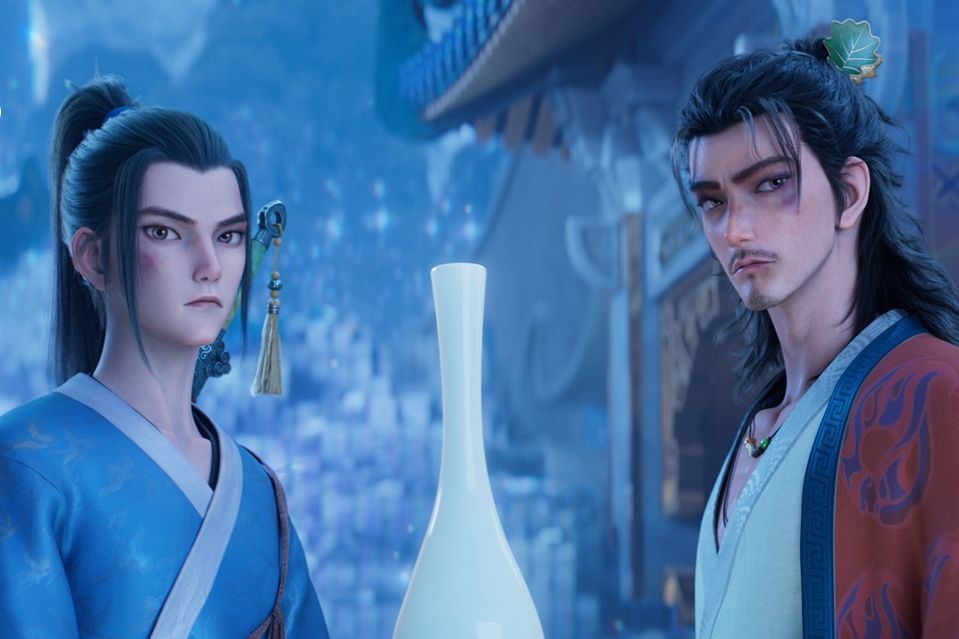
The subplot involving Lü Dongbin and Zhongli Quan, with its twists and turns, became a fan favorite, sparking a wave of fan “shipping”
Attractive duos in media that fans “ship” are nothing new. Recent animation hits like Ne Zha, and even Disney’s Zootopia, have inspired fans to speculate about the relationships between their protagonists—Nezha and Ao Bing, Nick and Judy—and imagine them as more than just friends.
All Wishes certainly hit the CP goldmine, judging by the reaction on social media. On Weibo, the “Bin/Quan” fan community—a portmanteau of Lü Dongbin and Zhongli Quan—has attracted more than 58,000 followers and garnered 140 million views, contributing significantly to the film’s online buzz.
On the one hand, a devoted fanbase certainly validates the character development and chemistry between these two roles. On the other hand, it also means that those expecting a more complex ensemble story are likely to be disappointed. Despite the film’s 144-minute runtime, the remaining characters are not fully developed. None has a solid backstory explaining who they are or why they ended up in Penglai. Instead, they are given their familiar traits to form a seemingly dynamic group: the old man Zhang Guolao provides comic relief; the child Lan Caihe adds a dose of cuteness; and the red-haired Tieguai Li delivers sharp-tongued quips in Sichuan dialect, while He Xiangu brings mystery as the dashing heroine. Beyond those surface characteristics, the film never develops a narrative strong enough to give all eight characters depth and allow them to make meaningful contributions to the plot.
All Wishes is therefore a work of contradictions. Behind its commercial triumph and critical backlash, some see innovation; others fail to find a compelling story. In 2025, 85 of the animated films registered for production—more than 46 percent of the total—were adaptations of Chinese mythology and folk traditions. With the industry showing a strong preference for traditional IP, the challenge for filmmakers remains: Beyond commercial success, can they create something truly immortal?
Not All Wishes Come True: Why an Animated Box-Office Hit Still Drew Controversy is a story from our issue, “Weight of the Nation.” To read the entire issue, become a subscriber and receive the full magazine.
Related Articles