On Beijing’s crowded Line 14 subway during morning rush hour, amid the sea of heads bowed over glowing smartphone screens, Guo Yabing’s hands move with a different kind of dexterity. As the train rattles forward, her needle dips in and out, patiently filling in the outline of a cartoon animal with cross-stitch thread. In a city that never seems to slow down, Guo is reclaiming her peace during her three-hour round-trip commute each day, stitch by stitch, in a quiet search for sanity.
“The pressure is like air now; it gets in everywhere,” says the 31-year-old erhu teacher, her hands never pausing, “You might not feel stressed yourself at first, but then you look at your phone, at all the ads, and they create anxiety for you.” Her schedule is a modern urban ballet of endurance: an 11 a.m. to 9 p.m. workday teaching erhu online from her company’s studio, and a rush home to relieve the grandparents looking after her kid for the night. Cross-stitching is the airlock between these two demanding worlds. When asked whether the stitching is hard on the eyes, she responds with a wry, rhetorical laugh: “Is staring at a phone any better?”
Find more youth trends in China:
- From Buy to Borrow: How Young Chinese Are Driving the Rental Boom
- Emotional Economics: Why China’s Adults are Playing With Plushies Again
- In a Digital Age, Young Chinese Women Are Turning to Nüshu, a Centuries-Old Script, to Reclaim Strength
The shift from passive digital consumption to active tactile creation is sweeping through China’s urban youth. On lifestyle platform Xiaohongshu (RedNote) alone, crochet and knitting topics have garnered 32.4 billion views and 9.83 million discussions by January; on Douyin, China’s version of TikTok, related hashtags have play counts in the billions. A search for “My first hand-knitted Ralph Lauren” on China’s social media would reveal countless posts showcasing painstakingly recreated cable-knit sweaters, some good enough to pass for the original brands.
But the trend is not about thrift—a ball of quality yarn can cost a small fortune—so much as a deliberate embrace of slowness in an era that prizes speed, optimization, and relentless hustle.
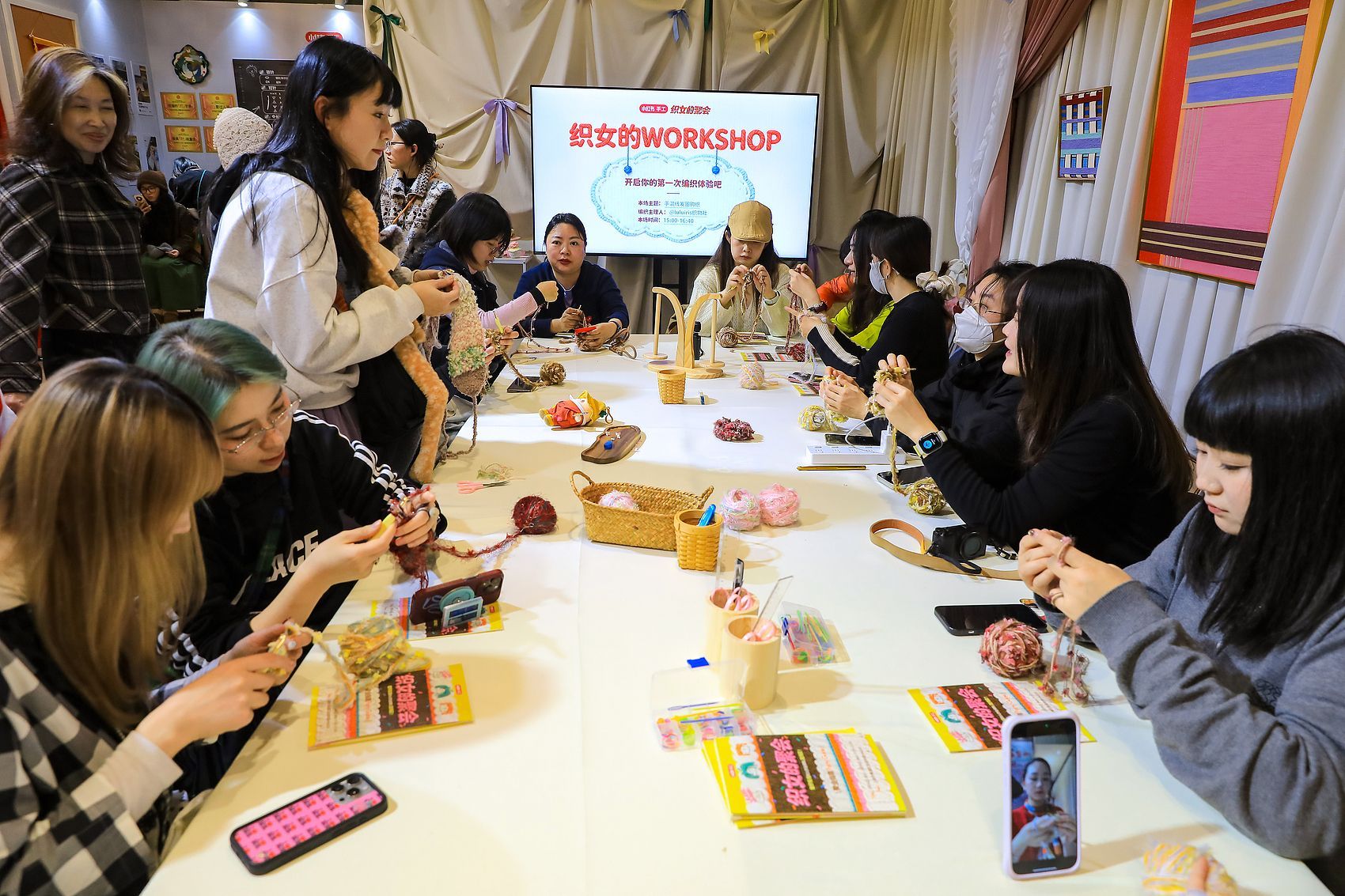
Xiaohongshu hosted a knitting-themed market featuring beginner workshops and exchanges of unused yarn and tools this January in Shanghai (VCG)
For Chen, a 29-year-old strategy consultant in Shanghai who only agreed to reveal her last name, pressure manifested as a profound, daily emptiness that would crystallize after clocking out: a wave of nihilism, wondering what the day’s work had amounted to, floating in mid-air, unsure of what comes next. Her old coping mechanisms—sitting blankly on the sofa or mindlessly scrolling through her phone—only served to amplify the noise. Then she found crochet.
The simple, repetitive motion demands total focus—a missed stitch count means starting over—and it surprisingly offers a kind of sanity. “Your brain has to concentrate on this one thing. It’s a cleanse, a massage for the mind,” says Chen. While her job dealt in abstract deliverables and endless iterations, crochet offered a clear, start-to-finish journey she could hold in her hands.
“The desire for tangible proof of one’s effort reflects the nature of modern knowledge work, which turns life into a series of transactions and leaves people in a state of constant anxiety and exhaustion,” says Qu Jingdong, a sociology professor at Peking University. “Handicraft, in its fully physical and maker-owned form, restores the link between a worker’s genuine, spontaneous interest and the fruit of their labor.”
Now, Chen picks up the needle whenever she feels tired. If energy allows, she occasionally challenges herself with a new technique. Her venture into stitching is a story of unlearning. Raised by a strict teacher mother in a high-pressure academic environment where “grades were everything,” she internalized a need for systematic, perfect mastery.
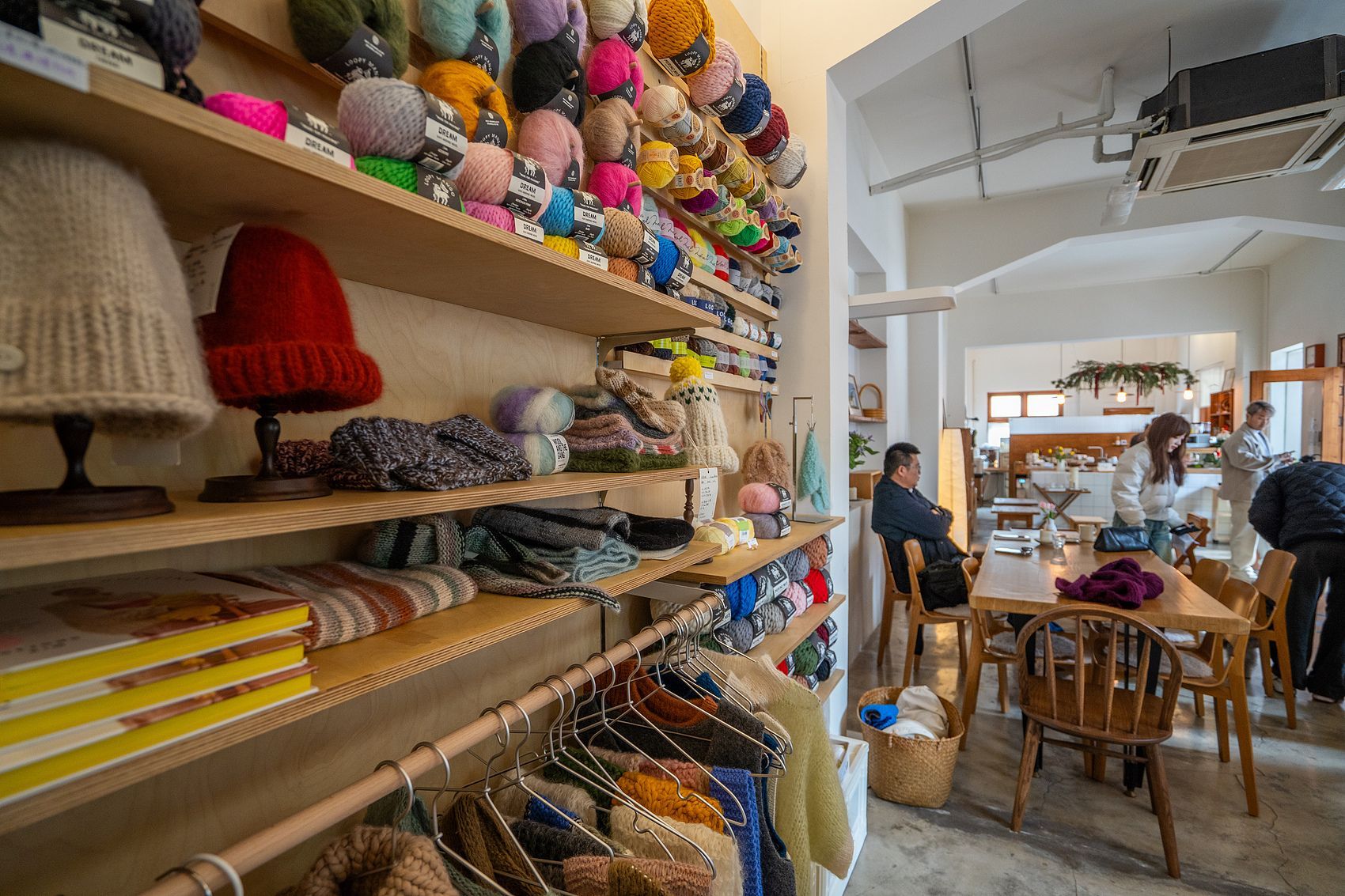
As more urban youth take up crocheting, some coffee shops have even set aside areas to display and sell crochet pieces (VCG)
“I am the type who had to learn everything from the most basic principles,” she admits. She initially approached crochet the same way, studying stitches and symbols from a textbook, determined to understand the theory before making a single object. It was tedious, and she soon gave up.
The breakthrough came months later, ironically, through letting go. On a long train journey, she followed a simple online tutorial for a bunny-shaped coaster, abandoning her quest for perfect foundational knowledge: “I just did it. And suddenly, I had this feeling of epiphany.” She compares this to the moment in school when a complex math concept finally clicks. All the stitches and symbols she couldn’t grasp before suddenly made sense. “I realized that by actually doing the thing, bumbling through it, making mistakes, you touch its true essence faster than any textbook can teach you.”
Growing up in an educational culture that optimizes against errors, many young people find that the forgiving nature of crochet becomes a quiet practice of self-compassion. Guo also remembers starting stitching back in high school, sewing small card holders in class when she was bored as a “mediocre” student’s respectful alternative to sleeping on the desk. “A wrong stitch can still be cute. I can sew a button over it, or just let it be and make something new from the mistake,” says Guo.
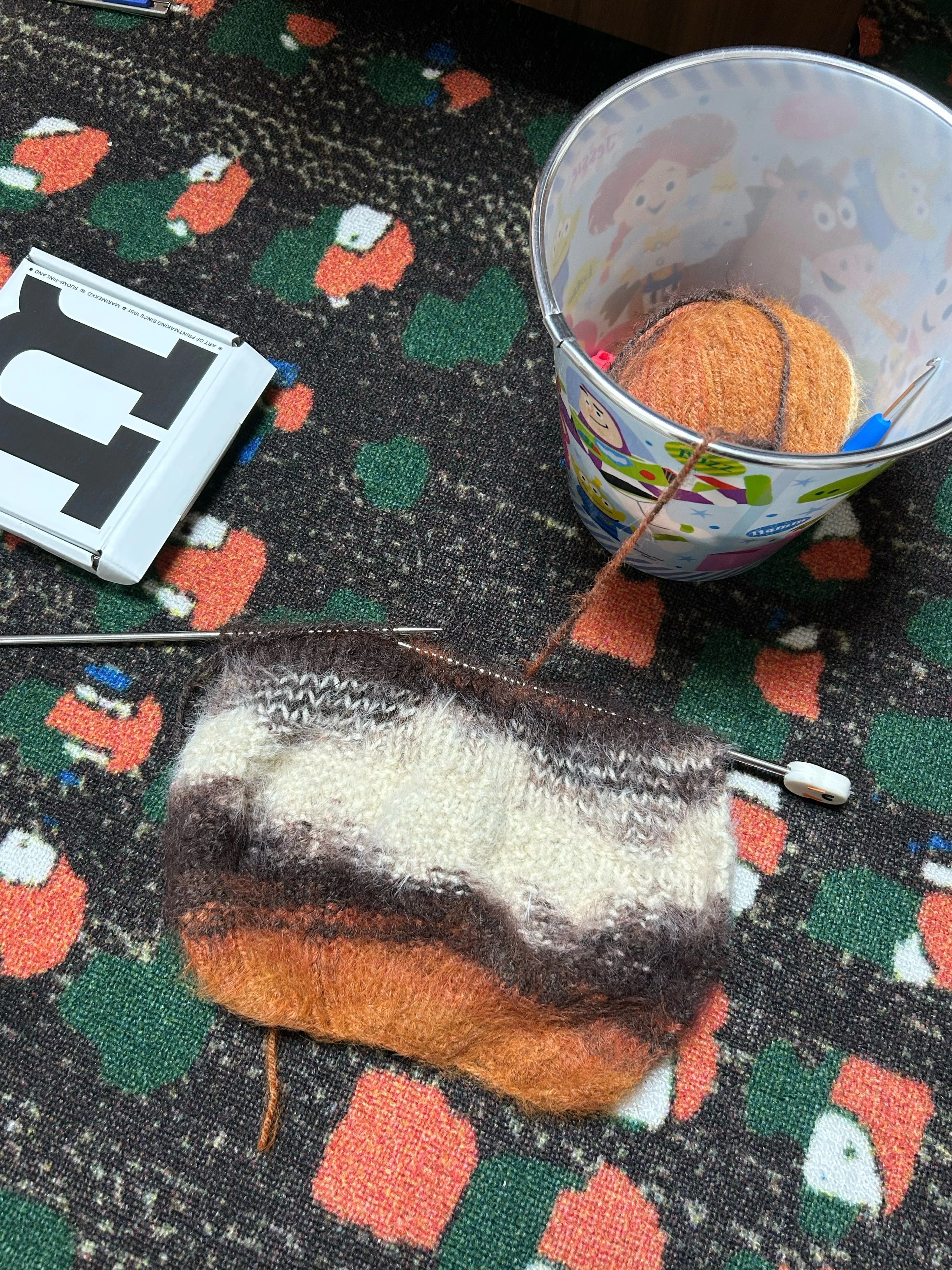
A scarf Chen is knitting with her mother (courtesy of Chen)
This philosophy of learning through error and trial now extends well beyond crochet to her parenting. Guo encourages her five-year-old daughter to enjoy the simple delight in picking up a new skill, like attending dance classes without thinking about winning trophies in competition. When she became curious about the cross-stitch, Guo didn’t shoo her away from the “dangerous” needle. Instead, she gave the child a blunt needle and a scrap of fabric. “You let them get poked once, and they learn how to use it,” says Guo.
Chen, too, finds crochet to be a good bonding opportunity across generations. Once, when she encountered problems with a stitch, she was stunned by her mother’s old tricks. Together, they dug out treasured, decades-old yarn from the bottom of closets. She was also surprised to find out her mother-in-law, a strong, career woman, knows how to knit. “It was like discovering a secret, gentler side to her.” Now, the two women often find time to knit together and have a playful debate in every loop. “She says I’m too slow, I say her stitches are too rough,” Chen laughs.
Yet, as with any grassroots movement that gains mass appeal, the specter of commercialization and contradiction looms. The very act that offers an escape from transactional hustle is being rapidly monetized. Nearly 7,000 new handicraft businesses were registered in China in 2025. Basic beginner kits sell hundreds of thousands of units.
With over 20,000 followers, the Fujian artisan behind the account “Sunny Side Up Egg Ah Xin” has built a vibrant crochet community. Under the tutorial videos the 23-year-old ceramic design graduate posted online, viewers reply with their finished pieces, “turning in homework (交作业)” to their teacher. When users flag confusion about a step, she would reply with a close-up photo.
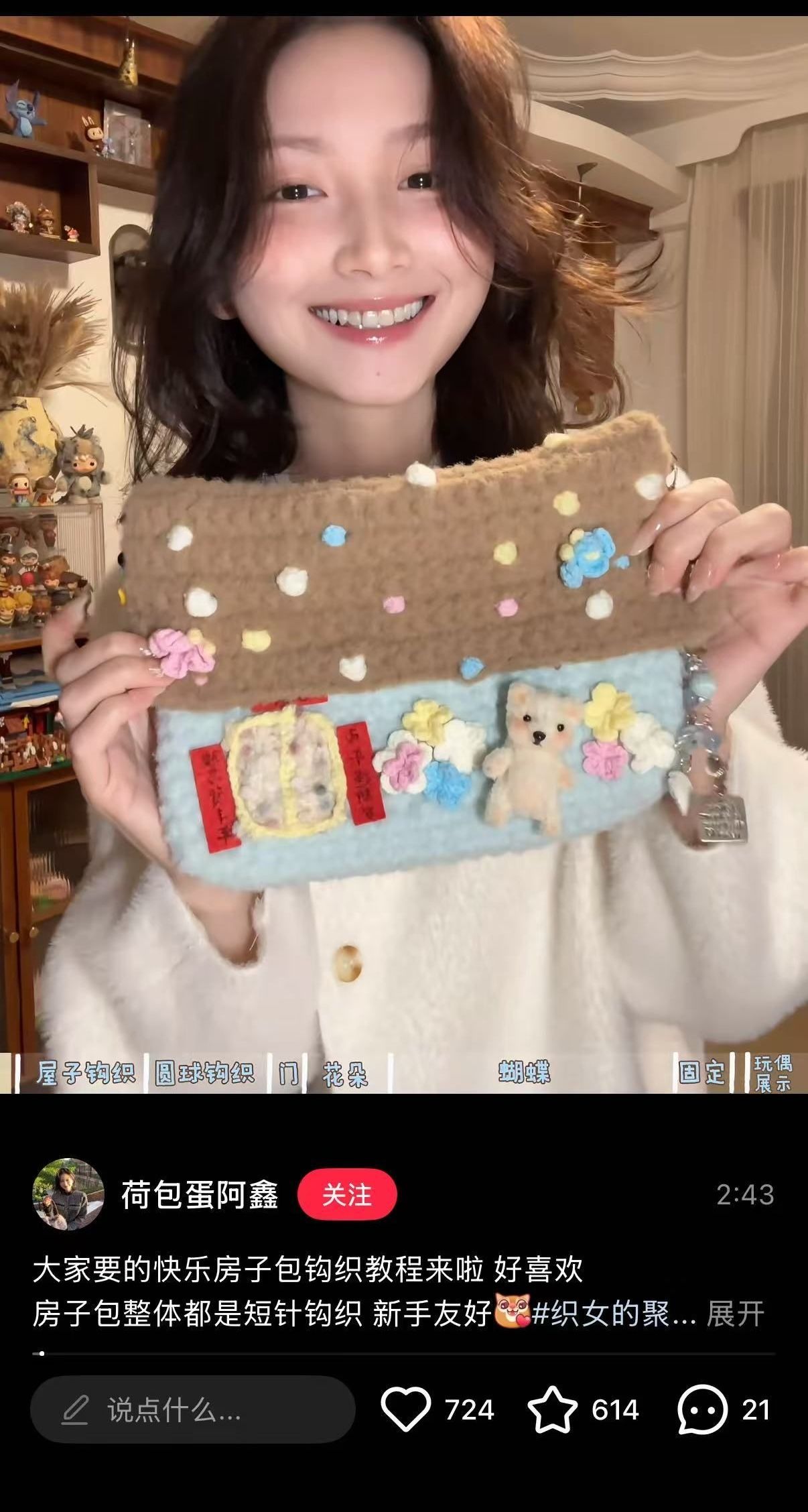
Fujian-based blogger Ah Xin shares tutorials for a wide range of crochet creations, from purses to small plush toys (screenshot via Xiaohongshu)
But Guo worries that the growing community could become another space for comparison and competition. “Online tutorials and communities that feel vibrant and supportive can quietly recreate the same performance pressures they’re meant to escape,” she says, “as the slow rhythm gets replaced by the need to post, share, and gain validation.”
The Fujian artisan admits that, as a full-time blogger, it’s natural to pursue more views and replies from followers: “Virality is my livelihood, but what matters more is whether people genuinely connect with the craft and the warmth it conveys.”
Chen isn’t opposed to commercialization either, acknowledging the economic opportunities it creates, especially for stay-at-home moms and retirees. “I’m willing to pay for handmade goods and don’t oppose monetization. Craftspeople deserve to earn well,” she says. But when her mother gently pushed her to make some money from crocheting, she remained ambivalent. “When something gets popular, it always feels like it loses some purity.”
Guo, on the other hand, keeps her craft stubbornly offline. She doesn’t post or sell her intricate cross-stitch pieces, but gives them away as gifts. The value is locked in the months of silent labor and unique intent, not the price tag.
As the train pulls into Guo’s station, she ties off her thread and slips the unfinished piece into her bag. Outside waits the city’s rhythm—instant messages, endless demands, the quiet pressure to want more, for herself and her child. “It’s all about wanting too much we don’t actually need,” she says. But for a moment, with a needle in hand and a simple pattern to follow, that pressure fades away. “I can just do my best and be myself.”
An Antidote to Speed: How China’s Urban Youth Are Stitching Their Way to Peace of Mind is a story from our issue, “I, Humanoid.” To read the entire issue, become a subscriber and receive the full magazine.
Related Articles