Whether crashing ticketing platforms for a concert ticket, stockpiling dozens of copies of the same album, or crowdfunding a Times Square billboard for a celebrity’s birthday, the actions of fans—devoted followers of actors, artists, and other notable individuals—seem to dominate the news on social media every day.
Yet despite being one of the most fervent collective behaviors of our time, star-chasing is not unique to modern times. A look back through history reveals that many fan types of today had their ancient prototypes, many of whom were no less zealous in their adoration for those whose music, art, poetry, or looks they admired.
Face fans
Fans whose adoration is based around an idol’s appearance are known as “face fans (颜粉 yánfěn),” and unsurprisingly they account for a considerable share of today’s fan communities. Their logic is captured in the tongue-in-cheek phrase “beauty is justice (颜值即正义 yánzhí jí zhèngyì),” and simply being good-looking is enough to make them scream and pay.
Public figures in ancient China had their share of face fans too, and in some ways their fervor was even more astonishing. Pan Yue (潘岳) was a scholar in the Western Jin dynasty (265 – 317) famous for his handsome appearance. According to the Book of Jin (《晋书》), one day when Pan was young, he drove his carriage through the capital, Luoyang. Women lined the streets and threw fruit into his carriage to show their admiration, giving rise to the idiom 掷果盈车 (zhì guǒ yíng chē), meaning “throwing fruit to fill a carriage,” used today to describe intense female attention for an attractive man.
Read more about ancient Chinese lifestyle:
- Written in the Stars: Astrological Signs in Ancient China
- Mockery, Sarcasm, and Roasting in Ancient China
- Best Beard Fashions in Ancient Times
For another good-looking scholar of the Western Jin, things didn’t turn out quite so well. Wei Jie (卫玠) was born into an official family, and although he became famous for both his talent and looks at a young age, he was frail and sickly from childhood. According to A New Account of Tales of the World (《世说新语》), Wei was visiting the capital when crowds, who had long heard tell of his comeliness, rushed to see him. As the masses “gathered [around him] like a wall,” Wei “could not bear the strain, fell ill and died.” He was only 27 years old. People at the time said that Wei Jie had been “stared to death,” giving rise to the phrase 看杀卫玠 (kàn shā Wèi Jiè), which later became an idiom for overwhelming public attention.
Work fans
While some love their idols for their looks, others admire them for their talent. Just as common as face fans are “work fans (作品粉 zuòpǐnfěn)”—those who care more about an idol’s creations than their appearance or personality. This group’s aesthetic preferences may appear less shallow, but their ways of expressing their appreciation can be equally hardcore.
In the Tang dynasty (618 – 907), a local from Jingzhou named Ge Qing (葛清) was a loyal fan of the politician and poet Bai Juyi (白居易). According to Miscellaneous Morsels from Youyang (《酉阳杂俎》), an eclectic Tang-era collection oflegends, folk customs, and local happenings compiled by Duan Chengshi (段成式), Ge chose to express his admiration by “tattooing Bai Juyi’s poems all over his body from the neck down.” According to Duan, more than 30 parts of Ge’s body bore lines and illustrations from Bai’s verse, which he could recite from memory, earning him the nickname “Bai Juyi’s walking poem chart.”

Modern-day admirers often visit Du Fu Thatched Cottage, a reconstruction of the poet’s eighth-century residence on the outskirts of Chengdu, Sichuan, to pay their respects (VCG)
Another Tang-dynasty work fan, poet Zhang Ji (张籍), was no less extreme in his displays of devotion. Zhang was a fine poet himself, but he admired Du Fu’s (杜甫) poetry above all and was willing to go to unusual lengths to attain some of his idol’s talent. According to Miscellaneous Records of Cloud Immortals (《云仙杂记》), a collection traditionally attributed to Feng Zhi (冯贽) of the Five Dynasties period (907 – 960), Zhang burned a copy of Du’s poems and mixed the ashes with honey to form a pudding which he ate, exclaiming, “Let my heart and soul be transformed from this day forward.”
Schedule fans
Schedule fans (行程粉 xíngchéngfěn) are those who follow their idol’s public itinerary, showing up at airports, hotels, and rehearsals, and seizing every opportunity to see or meet them in person.
The Tang dynasty had such a fan by the name of Wei Wan (魏万), who was an admirer of the legendary poet Li Bai (李白). To meet his hero, Wei once set out from present-day Henan and traveled through what is now Jiangsu and Zhejiang, including Taizhou, Shaoxing, and Wenzhou, before finally reaching Li in Yangzhou. The journey totaled more than 3,000 li (roughly 1,500 kilometers) and took half a year.
Moved by his commitment, Li not only traveled with Wei for a time, but also wrote the poem “Seeing Off Wei Wan, the Recluse of Wangwu Mountain, Back to Wangwu (《送王屋山人魏万还王屋》).” After his new friend entrusted him with manuscripts, Wei later compiled the Collected Works of Li Bai (《李翰林集》), one of the earliest collections of Li’s writing.
[Reminder: Stalking an idol and invading their private life is not a good idea today.]
Creator fans
Creator fans (二创粉 èrchuàngfěn) are those who are inspired to make something of their own after encountering an artist’s work. They write fanfiction, edit videos, and make fan art, expanding their inspiration’s creative world through their own means of self-expression.
Some ancient creator fans did this by composing poems in response to others, at times even using the same rhyme scheme as the original, a literary practice known as “responding poem.”
When Ming-dynasty (1368 – 1644) scholar Dai Guan (戴冠) received a collection of verse by the Southern Song (1127 – 1279) poetess Zhu Shuzhen (朱淑真), he felt deeply moved by her clear and elegant style. Carried away by inspiration one New Year’s Eve, Dai responded to each of the 26 works in Zhu’s collection with poems of his own. In his postscript, Dai explained his motive: “I wanted only to shed further light on Zhu’s heart, not to compete with her in skill.”
In modern fandom, creators, male or female, who produce influential fan works are respectfully called taitai (太太), literally “Mrs.” or “madam,” by other fans. By that standard, Dai would surely have earned the status of taitai in Zhu’s fandom.
Couple fans
Couple fans (CP粉 CP fěn) bring a different kind of creativity to their fandom. Instead of focusing on derivative works of their own, they are passionate about pairing characters or real-life celebrities and imagining a relationship between them, often called “shipping” in English.
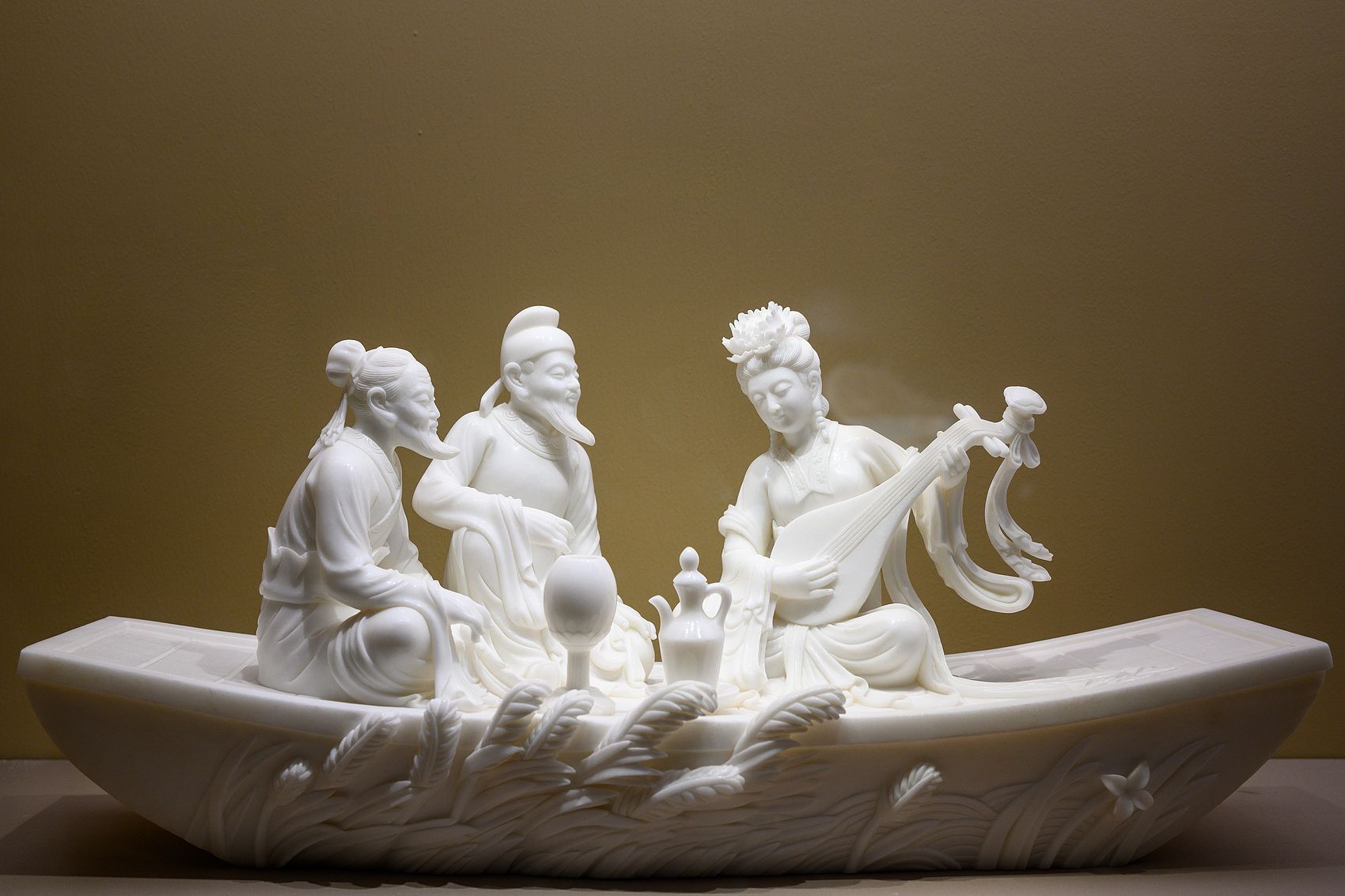
A contemporary stone sculpture depicting the poet Bai Juyi listening appreciatively to a pipa player during their brief encounter (VCG)
Ma Zhiyuan (马致远), one of the Four Great Playwrights of the Yuan dynasty (1206 – 1368), belongs to this type. His play Tears on the Blue Gown (《青衫泪》) can be seen as an ancient version of CP fanfiction, drawing on “Song of a Pipa Player (《琵琶行》),” a famous poem by Bai Juyi, whom we met earlier through another fan’s tattoos.
In the original poem, the poet, having recently been demoted, meets a virtuoso pipa player who has passed her prime on a river as each shares grievances about their respective fates. Beyond his admiration for her musical skills, Bai bore no romantic feelings towards her, as the poem’s famous lines suggest: “Both of us in misfortune go from shore to shore. Meeting now, need we have known each other before?”
Ma, however, reimagines the encounter as a full-blown love story: Bai Juyi and the pipa player, Pei Xingnu, meet and fall in love in the capital, but they are separated when Bai is demoted. Pei is tricked into marrying a merchant. The brief encounter depicted in the original poem becomes the climax of Ma’s “fanfiction” when the two meet again. In the end, like all good “ships,” she and Bai are reunited.
Spending fans
Whether paying for albums, endorsed products, or online votes, spending fans (氪金粉 kèjīnfěn) are willing to put down real money to show support for their idols. It is often the case that a fanbase’s spending power is taken as a significant marker of a star’s market influence, and in ancient China, too, admirers would demonstrate their allegiance through notable acts of consumption.
According to the Book of Jin (《晋书》), when the Western Jin (265 – 317) writer Zuo Si (左思) finished his famous essay, “Rhapsody on the Three Capitals (《三都赋》),” it quickly took off. Scholars praised it, and wealthy people competed to copy it, prompting a rush on paper in the capital, Luoyang, that caused prices to soar. The episode is the origin of the idiom “paper is expensive in Luoyang,” or 洛阳纸贵 (Luòyáng zhǐ guì), used today to praise a literary work.
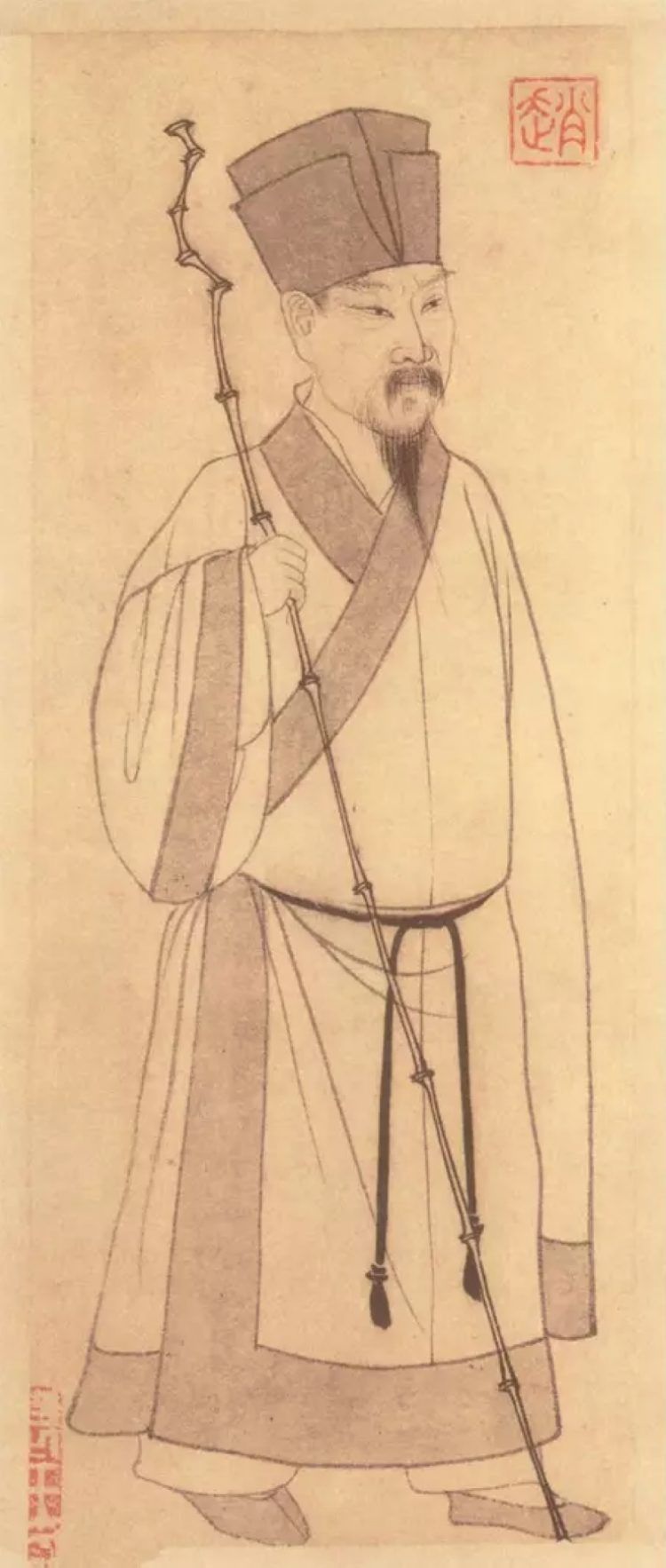
A portrait of Su Shi, courtesy name Zizhan, by Yuan dynasty painter Zhao Mengfu (赵孟頫), showing him wearing his namesake “Zizhan hat” (Wikimedia Commons)
Another celebrity with admirers willing to part with their money was Song dynasty (960 – 1279) poet and official Su Shi (苏轼). According to Records of Conversations with Teachers and Friends (《师友谈记》) by the Song scholar Li Zhi (李廌), Su was known for wearing a hat with a high crown and a short brim. Other officials rushed to imitate the style, and it became known as the “Zizhan hat (子瞻帽)” after Su Shi’s courtesy name. Unfortunately for Su Shi, he had no endorsement deals or online shop—his fans spent, but he never saw a cent.
Data fans
Data fans (数据粉 shùjùfěn) are always trying to raise their idol’s industry status and public profile by boosting their metrics, writing reviews, or promoting their work beyond the fandom. Ancient China arguably had a famous fan in this mold, who by doing “data work” may have even affected the course of Chinese literary history.
Although later generations would speak of Li Bai and Du Fu as equals, Du was less celebrated during his lifetime than Li. That began to change more than 40 years after his death, as Du’s grandson, who was preparing to rebury him back in his native Henan, asked Yuan Zhen (元稹), a leading literary figure of the time, to write the epitaph.
In the epitaph, Yuan Zhen praised Du for “mastering the forms and techniques of poetry from ancient to their times while excelling in areas that others specialized in individually,” and declared, “since the age of poetry began, there has never been anyone like Du Fu.” But Yuan didn’t stop there. He went further, arguing that Li Bai, whose verses are often unrestrained in style, fell far short of Du Fu in structure and rhythmic arrangement.
Such an act might earn Yuan the undesirable labels of “toxic solo stan (毒唯 dúwéi)” today, a fan who attacks or disparages their idol’s competition, or “combat fan (战斗粉 zhàndòufěn),” someone who starts social media wars to defend their idol’s reputation.
And Yuan’s epitaph did help fuel a debate that has lasted for over a thousand years: which poet was greater, Du Fu or Li Bai? One of the earliest declarations of Du Fu’s poetic supremacy, Yuan’s assessment was deeply influential. His epitaph arguably played a crucial role in Du Fu’s eventual canonization as China’s “poet sage (诗圣).” Perhaps that is the ultimate act of devotion a fan can show an idol.
Related Articles