

Husky Singaporean pop singer A-do’s 2002 song “He Must Really Love You” may be a classic, but a certain awkward phrasing brought unexpected comic relief to an otherwise melancholic ballad about the loss of love. The line “I should be under the car (车底 chē dǐ), not inside the car (车里 chē li)” has, over the years, bemused many, with some speculation that the songwriter chose the two phrases simply because they rhyme in Chinese.
A dictionary published this February may help lyricists avoid such embarrassment. The Contemporary Chinese Dictionary (Reverse Edition) has been compiled by the Institute of Linguistics at the Chinese Academy of Social Sciences, and published by The Commercial Press, China’s oldest modern publishing house and publisher of this magazine. The book quickly gained traction online after being humorously dubbed “a dictionary customized for rappers.”
Tracing the Evolution of the Modern Chinese Language:
- Letters of Revolution: The Failed Movement to Eradicate Chinese Characters
- Two-Way Communication: How China Adopted Japanese Terms to Discuss Modernity
- How China Adopted Western Punctuation
While the first modern English dictionary, A Dictionary of the English Language by Samuel Johnson, was compiled in 1755, the modern Chinese equivalent has a much shorter history. Since the early 20th century, along with the search for a modern national identity, intellectuals have sought to standardize spoken Chinese and replace classical Chinese with vernacular writing to form a modern unified language. The Contemporary Chinese Dictionary, first published in 1978, emerged from this quest for standardization—its more than 56,000 entries are a comprehensive standard for the language, setting the model for modern Chinese lexicography.
The new reverse edition is based on the seventh edition of The Contemporary Chinese Dictionary from 2016, with minor updates. Where the standard edition lists words in alphabetical order according to the pinyin (romanized spelling) of their first character, the reverse edition organizes multi-character entries, which make up the majority of Chinese words, according to the pinyin of their final character. For instance, the reverse dictionary collects 236 words under the character 心 (xīn, heart), including 耐心 (nàixīn, patience), 良心 (liángxīn, conscience), and 野心 (yěxīn, ambition).
For editor Chen Yuqing, who worked on the latest edition on and off over the past eight years, this broadens the reverse dictionary’s appeal beyond just literary reference. “It’s extremely functional, and fun to keep around,” says Chen, “you can even use it as an encyclopedia.”
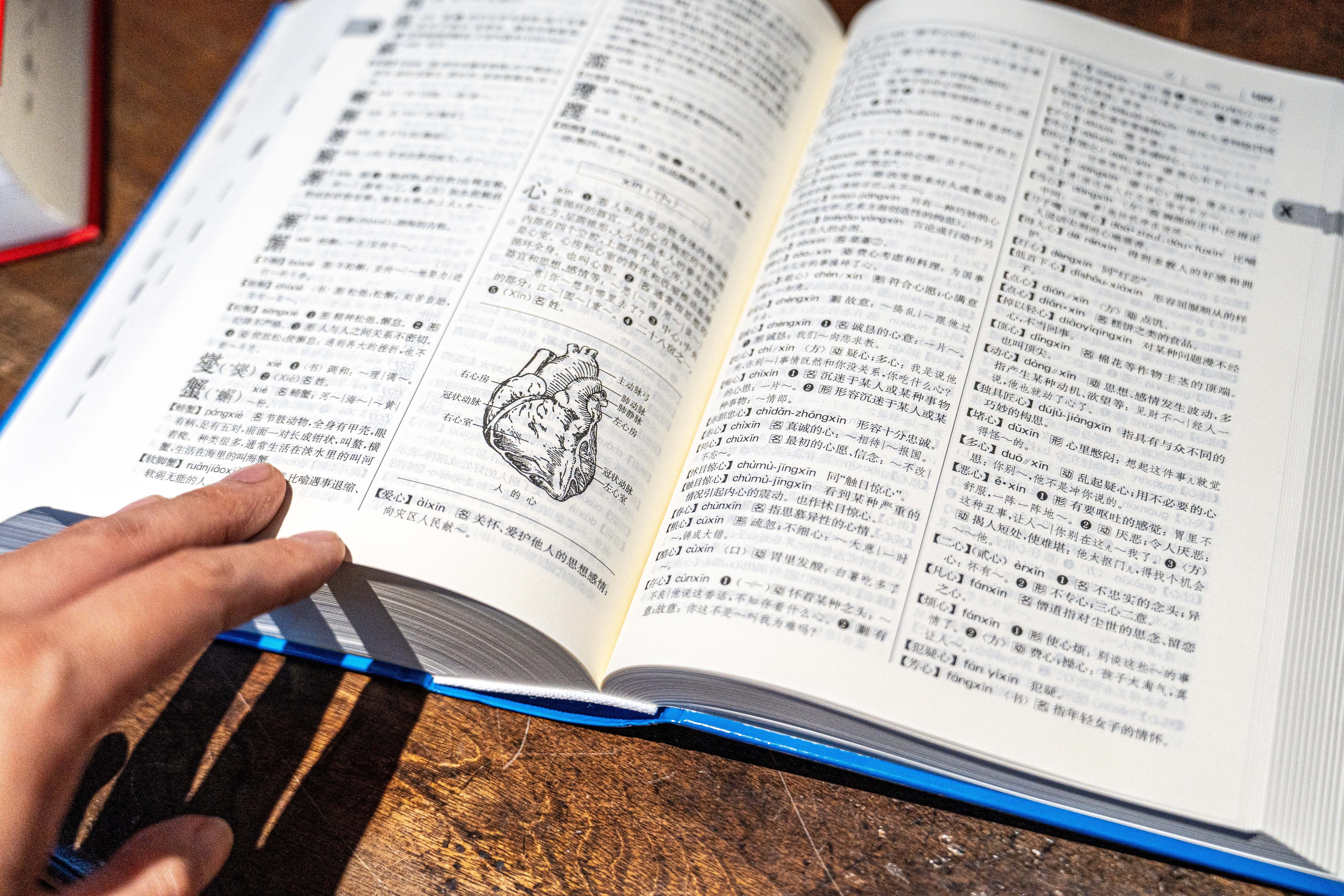
Under 心 (heart), related words ending in the same character are grouped together (Jiayu Zhang)
Li Yuming, President of the China Association for Lexicography and noted linguist, explained how this works in an April interview with Guangming Daily. Li notes that Chinese nouns often follow one of two structural patterns: a modifier preceding a head noun, as in 金 (gold) + 鱼 (fish) = 金鱼 (goldfish); or a lexical stem followed by a suffix such as 子 (-zi), as in 儿子 (son) and 妻子 (wife). Because the reverse dictionary organizes entries by their final character, all nouns with the same head and suffix appear together, essentially grouping related concepts and objects like trees, flowers, or horses. Looking up the character 星 (xīng, star), for example, opens up a world of celestial objects, from comet (彗星 huìxīng) and Mars (火星 huǒxīng), to supernova (超新星 chāoxīnxīng).
The reverse dictionary is also a powerful aid for poets and songwriters looking to create rhymes. China’s extended history of classical poetry comes with a long tradition of rhyming dictionaries, the earliest surviving examples of which date back to the seventh century. A particularly voluminous rhyming dictionary was compiled in the 18th century for literati to look up word origins and literary allusions, spanning 444 volumes and including around 10,000 characters across 1.4 million entries.
The first modern iteration, compiled in 1987, continued this ancient tradition. “It was by reader demand—people who wanted to write poetry or conduct lexical research,” explains Chen. In standard Chinese, a syllable consists of an initial (a consonant sound), a final (the vowel-based component that follows), and a tone mark. Words rhyme when they share the same or similar finals, regardless of the initial. Because the reverse dictionary includes a syllable index arranged by finals—such as gua, kua, hua—a writer can quickly find all characters and multi-character words that end with a chosen sound, making it much easier to find rhyming words that fit their work.
Compiling a dictionary of this scale and complexity is no easy feat. According to Chen, the six months leading up to release were intense, as the manuscript underwent more than 10 meticulous proofreading cycles. Since the launch, Chen has been monitoring the book’s reception online, much of which jokes about its usefulness for rappers who produce awkward bars, as well as examples, such as A-do’s notorious gaffe, of forced rhyming in pop lyrics. One netizen exclaimed, “Finally, rap lyrics could use such literary refinement.”
“We highlight a few aspects and explain how to use the dictionary,” says Chen, “but some readers have explored it on their own and uncovered things that, honestly, go even further than what we intended or noticed ourselves.”
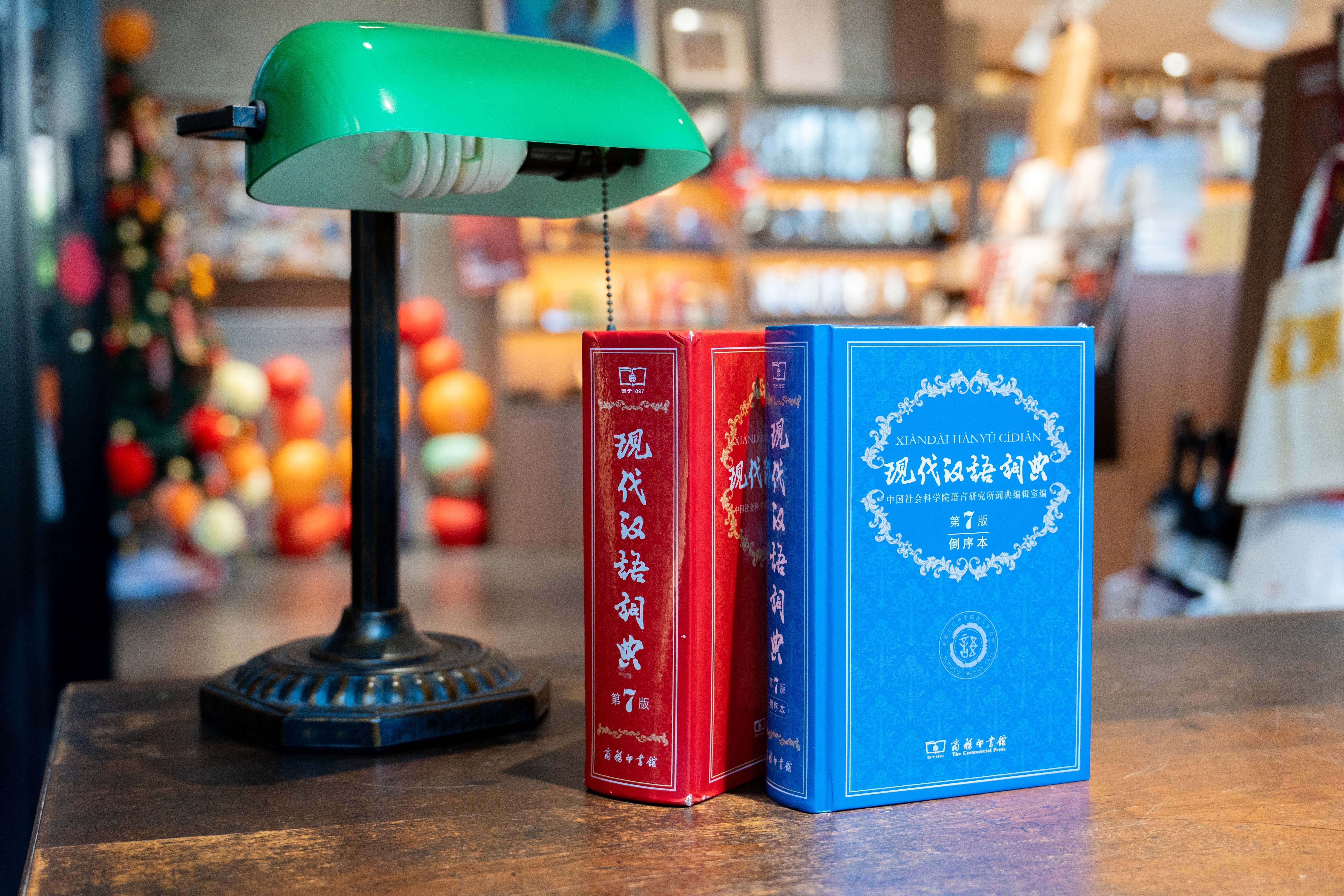
The seventh edition of the Contemporary Chinese Dictionary, released in 2016, added more than 400 new words and expressions, including terms such as 二维码 (QR code) and 人工智能 (artificial intelligence), along with nearly 100 new meanings for existing entries (Jiayu Zhang)
Xu Chen, an editor of eight years’ experience at Nanjing Publishing House, is among the dictionary’s earliest recipients. Specializing in classical Chinese texts, Xu finds the dictionary extremely useful. “Sometimes in my work, I come across words with an obscure first character, and the reverse dictionary is perfect for those situations.” The dictionary’s unique structure allows him to reference these words according to the more familiar second character, streamlining his work. “It pairs really well with the standard edition,” adds Xu, who keeps both editions on his desk. “My first reaction when I got the dictionary was to show off the set to my colleagues.”
Xu also shared his pair on Xiaohongshu (RedNote), receiving thousands of likes and hundreds of comments on the post. Some users were surprised to find out about the new edition, since the standard Contemporary Chinese Dictionary has been a household name in China for decades as an essential reference text recommended by schools. Others recalled their experiences using the dictionary, with one junior high school student admitting that her classmate enjoys reading it for fun as a break from homework during evening study sessions.
But alongside the nostalgia and intrigue are doubts about whether a print dictionary is necessary in the digital age. “You can look up anything with your phone,” remarked one commenter. While dictionaries and other reference books still hold ground in the Chinese book market—The Contemporary Chinese Dictionary has sold over 70 million copies since it was first published, with sales peaking every year before the start of the school semester—their overall market share is shrinking, giving way to digital dictionaries, free apps, and the broader internet.
Internationally, English dictionaries like Merriam-Webster have long faced similar operational challenges, from the early impact of the internet, which made answers to lexical questions readily available online, to the rise of AI models allegedly trained on their copyrighted content without permission.
For editor Xu, however, dictionaries in China are not easily replaced by AI models. “Right now, AI isn’t an authoritative source. Only when it earns that authority can we start talking about whether it might replace traditional reference books,” he says. “Until then, we should continue making authoritative reference books and constantly refine and improve them.”
Rapid technological change may one day threaten the future of dictionaries, but it also relies on them in its own way by giving birth to hundreds of new Chinese words each year. Just this March, the Chinese translation for “token” in the context of AI—the basic unit of text that an AI model reads and generates—was officially standardized as 词元 (cíyuán, literally “text unit”) by the National Data Administration and China National Committee for Terms in Sciences and Technologies. Each update to the dictionary serves not only to standardize the language that everyone in a society relies on, but also to document the era that produced it. In that sense, there will always be a need for dictionaries and the lexicographers who make them.
Ready to dive deeper into Chinese? Order your The Contemporary Chinese Dictionary set from The Commercial Press’s official JD store
The Last Word: Inside a Reverse Dictionary of Modern Chinese is a story from our issue, “I, Humanoid.” To read the entire issue, become a subscriber and receive the full magazine.
Related Articles