

Whether it’s Arnold Schwarzenegger being crushed by a hydraulic press in The Terminator or HAL 9000’s haunting elegy in 2001: A Space Odyssey, the fatal vulnerabilities of famous robots are a familiar trope in popular culture. But at a FamilyMart in Beijing, a machine struggles with a more unlikely foe: a bag of potato chips. Galbot G1’s grippers may not be suited to the particular challenge of a flimsy foil bag, but his ability to fetch drinks from refrigerators and pull sausages from warming ovens has customers lining up for a chance to be served by the 1.73-meter-tall humanoid robot.
The scene captures both the optimism and obstacles of China’s fast-growing humanoid robotics industry. After drawing nationwide attention with dancing automatons at this year’s Spring Festival Gala, the sector is now focused on the much harder challenge of teaching them how to operate effectively in the unpredictable physical world beyond the stage.
The disparity between the spectacular and the pragmatic was evident at the Beijing International High-Tech Expo in early May. Dozens of robots danced, played the piano, kicked soccer balls, and guided visitors through exhibition halls, yet several engineers and market representatives who spoke to TWOC agreed that the technology’s widespread adoption in factories, stores, and homes remains years away. But researchers, engineers, and data suppliers are stepping up efforts to close this gap.
“The applications are still limited, but the speed of development is very fast,” says Yu Guotao, a field application engineer at Galbot, the leading robotics company behind the Family Mart stunt.
He points to the industry’s rapid evolution from stage performances to marathon appearances, logistics experiments, and early commercial uses, even though most robots, for now, remain confined to industrial testing and public demonstrations.
Read more about the technology boom in China
- “Bumping” Into Adolescence: Kids’ Smartwatches and the Battleground Between Safety and Control
- Smart Earth: How AI Is Rewriting Rural China
- DeepSeek Sells: How AI is Revolutionizing China’s E-commerce Landscape
Open the pod bay doors
China’s android dreams trace back to a 4th-century BCE fable, in which artisan Yanshi (偃师) presents a life-sized automaton to sing and dance for King Mu of Zhou. Modern development truly began in the early 2000s, when the National University of Defense Technology produced China’s first bipedal humanoid robot. For decades, most robotics projects remained confined to laboratories and research institutes, many using simpler quadrupedal or wheeled systems. Some later found applications beyond academia, including wheeled machines used for material handling in factories.
The shift accelerated in 2023 with the rise of generative AI, which renewed interest in “embodied intelligence”—AI that learns and acts through a physical body, allowing robots to perceive, move, and make decisions in the real world. Investors, policymakers, and tech firms have since poured enormous resources into the industry.
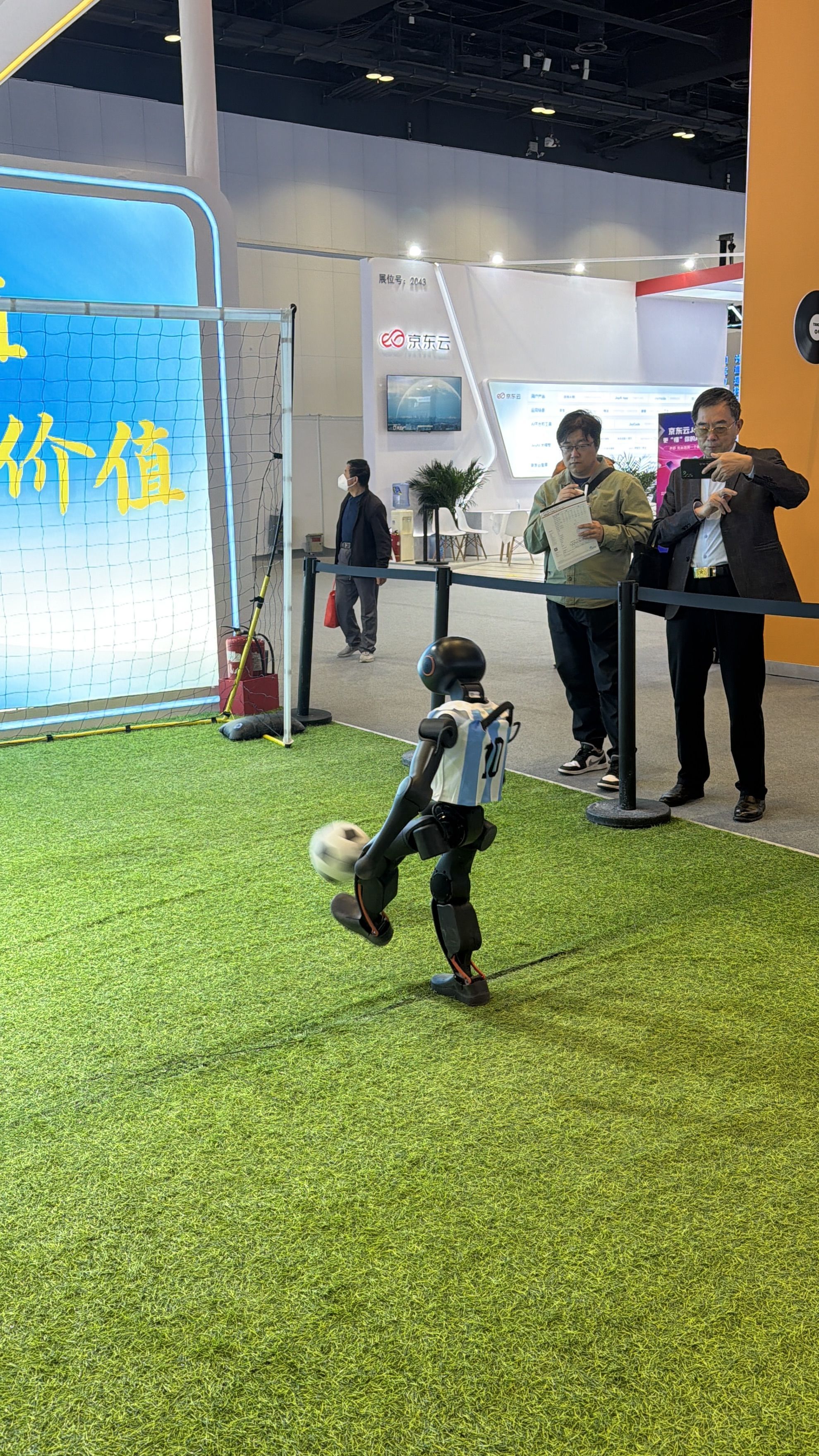
At the Beijing International High-Tech Expo in May, humanoids perform tasks ranging from visitor guidance to kicking a soccer ball, drawing crowds with a glimpse of the rapidly evolving capabilities of the robotics industry (Yang Tingting)
China now leads the world in the production of humanoid robotics. According to a Morgan Stanley report, Chinese robot makers accounted for approximately 90 percent of the 13,000 to 16,000 units sold worldwide, with annual sales estimated to reach 50,000 units in 2026. Policy support is supercharging the push: Beijing aims to reach 10,000 humanoids and a 100-billion-yuan industrial cluster by 2027, while Shanghai is promoting adoption across logistics, manufacturing, and retail.
For Lu, a 32-year-old accountant who asked to be identified only by her surname, the technology already feels part of everyday life, if still a little unrefined. Her experience ordering a robot-made coffee in Shanghai in April was novel but stilted: “You had to place the cup in a specific spot before it could move to the next step,” she says. “It’s not like the skilled hand of a human barista.”
I’m afraid I can’t do that
Despite the technical challenges, physical familiarities make humanoid robots an attractive proposition for researchers like PhD student Liang Qiwei at Hong Kong University of Science and Technology. “Since their form resembles ours, it’s easier to map human actions onto humanoid robotic systems, making training and deployment more efficient,” Liang tells TWOC. The 21-year-old robotics and autonomous systems student is known as Kivy on Xiaohongshu (RedNote), where he regularly shares industry insights with his 1,600 followers.
Yet for Liang, there is still a big difference between the stage and the real world. “A performance is limited to a few predefined actions in a given space; the robots just need to go through the motions gracefully without falling over,” he says. “Real-world manipulation is almost endlessly complex by comparison.”
Liang cites the range of everyday actions necessary for basic motor function, from grasping, pushing, and pulling, to opening, closing, and pressing. “Objects are not isolated; we need to understand their relationships,” he says. “When pouring water, the robot must grasp the connection between the kettle and the cup. The uncertainty is far greater than in a performance setting.”
Liang and his team are working with robotics companies on new AI systems that, rather than simply copying human movements, aim to help robots better understand how objects behave so they can complete tasks more effectively. “More researchers are shifting toward physics-based models,” Liang explains, “these help robots understand an object’s physical state, like the shape and condition of clothing.”
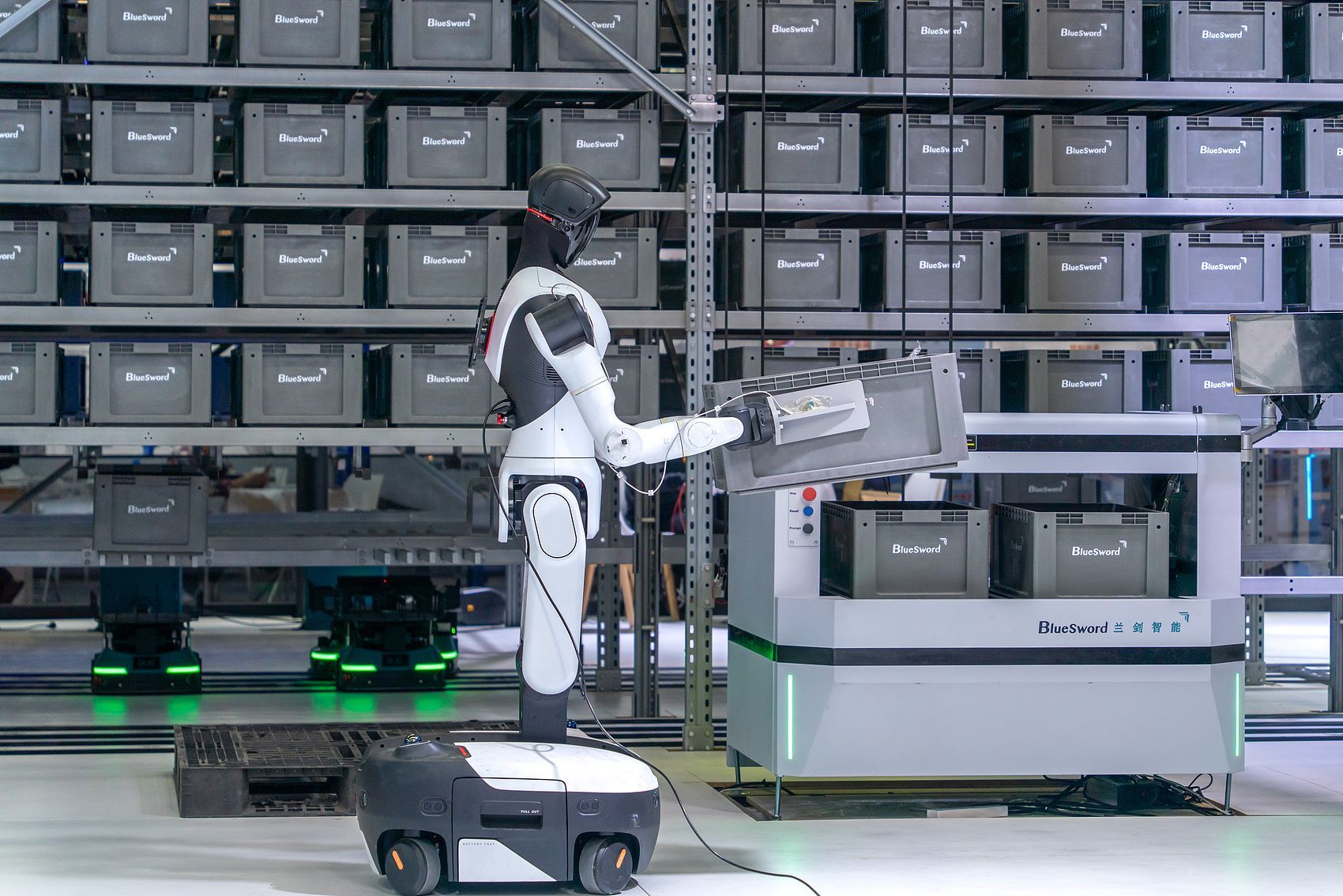
After years of training and testing, humanoids are beginning to move beyond labs, joining logistics operations in factories nationwide to help sort parcels and handle heavy lifting (VCG)
Folding clothes is a deceptively simple task that remains difficult for humanoid robots to master due to the variable properties of different fabrics. But failures, Liang says, are but another training opportunity. In his lab, when a robot gets stuck, human trainers step in to identify the problem and steer it toward the desired result. Through repeated corrections, the system gradually learns. “Over time, the model becomes better at handling similar situations on its own, and its success rate improves significantly,” says Liang.
As robotic technology improves, companies worldwide are experimenting with its commercial applications. After nearly a year of simulations in logistics centers, Beijing-based startup Robot Era had, by late May, deployed hundreds of robots across logistic hubs nationwide, reportedly achieving 90 percent of the efficiency of human sorters. In the US earlier that same month, Figure AI livestreamed its Figure 03 humanoid processing nearly 250,000 parcels in a 200-hour feat of robotic endurance. The video drew more than one million views on YouTube and sparked familiar concerns about machines replacing human workers.
Outside the warehouse, the home is emerging as another frontier for automation companies. In June, Wuhan-based GigaAI announced plans to deploy robots in 100 households for chores and companionship, while earlier in the year, Shenzhen-based X Square and lifestyle platform 58.com offered in-home humanoid assistance for 149 yuan per three-hour session. That the robot had to be accompanied by an engineer and a cleaner led some to joke on social media that it seemed like a good deal until you realized you still needed to hire two people to make it work. Others praised its capabilities despite apparent clumsiness, while concerns linger around privacy and data use.
What’s the problem?
Unlike text-based generative AI, embodied AI relies on a massive amount of data gathered from the physical world. As the race to build more capable humanoid robots accelerates, this kind of information has emerged as the industry’s most precious resource.
“Without high-quality data, even the most impressive robot demonstrations are castles in the air,” says Zhou Xinghao, business director at Anhui Shudian Information Technology. According to the 26-year-old, the industry’s focus has gradually shifted from algorithms and model design toward the collection of diverse material information.
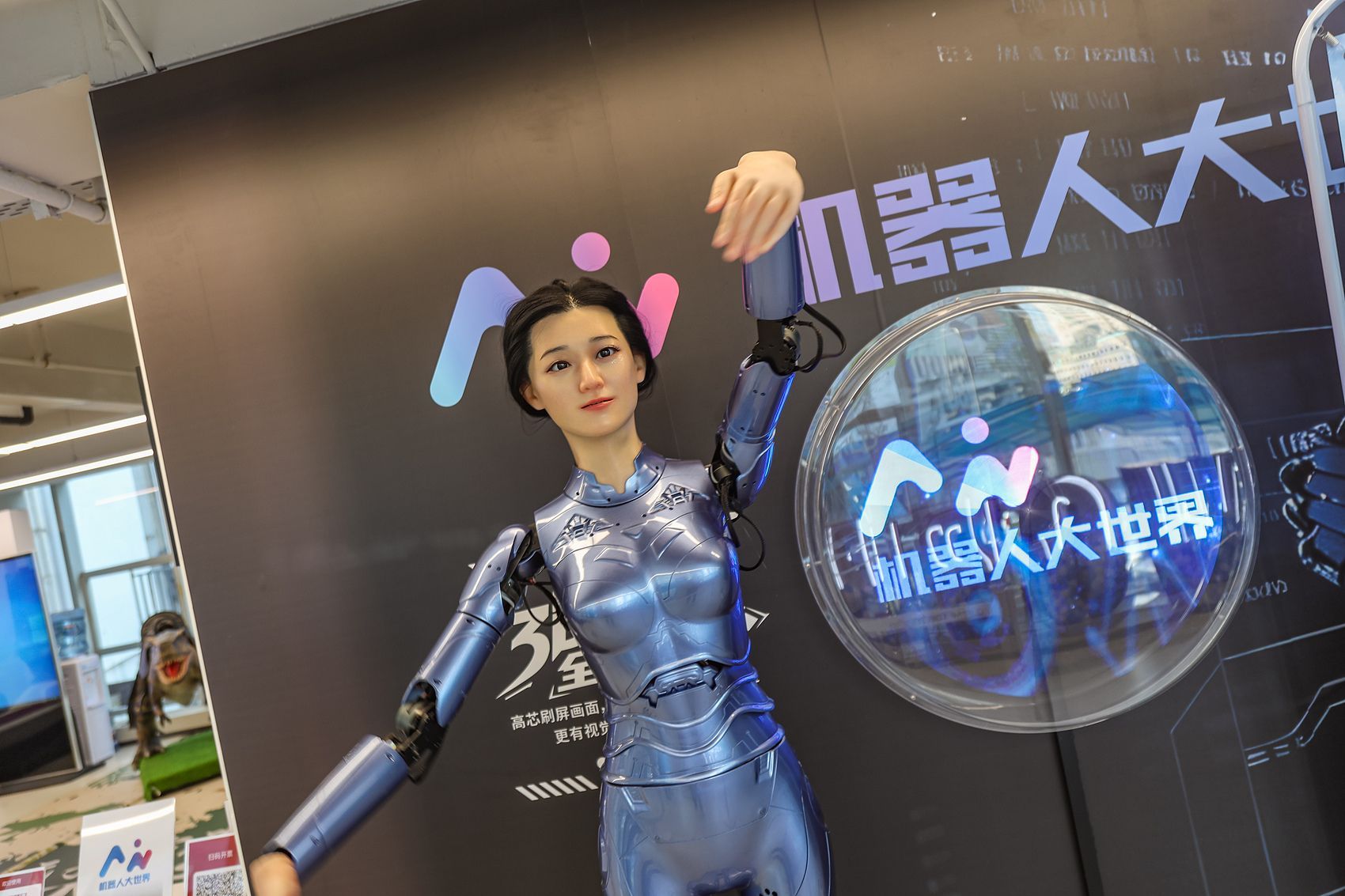
Beyond factories, humanoids are also entering homes as companions. Despite concerns over privacy and appearance, many still see them as future household assistants. (VCG)
“There are too many details for engineers to code. The only solution is to ‘feed’ robots massive amounts of real-life experience,” says Zhou. By way of example, he cites another seemingly simple task: clearing a dirty bowl from a table. “For humans, it’s effortless. Yet a robot must calculate exactly how to grip the bowl without it slipping, how grease affects friction, how to avoid nearby chopsticks, and whether water from the bowl will drip on the floor.”
Building on a shared pipeline of perception, prediction, and control, Zhou’s team switched its focus to embodied AI from autonomous driving. Rather than gathering data with robots themselves at a cost of tens of thousands of yuan, they instead rely on more than 100 human data collectors. Equipped with head-mounted cameras, they perform routine tasks such as watering plants, folding clothes, opening drawers, and picking up cups. The work is highly repetitive to ensure data reliability, with some collectors spending entire eight-hour shifts tying and untying shoelaces. “We’ve killed quite a lot of company plants,” Zhou jokes.
Training a robot to reliably perform a single action can take up to 60 hours of data collection, but even minor changes in conditions, such as rotating a cup or approaching it from a different angle, can confuse the system. Even collectors’ unintended behaviors, such as blowing on or squeezing a cup, can disrupt the robot’s interpretation of the task. “In those situations, it may no longer know what to do,” says Zhou.
To collect a more diverse range of data, Zhou’s team has harnessed the daily lives of ordinary people, such as college students and stay-at-home parents. “If you rely only on engineers, you are limited to labs, factories, and testing rooms, but these freelancers give access to real kitchens, living rooms, and supermarkets,” he says. “Rather than asking people to perform scripted actions, we just want them to do their usual activities while wearing a camera.”
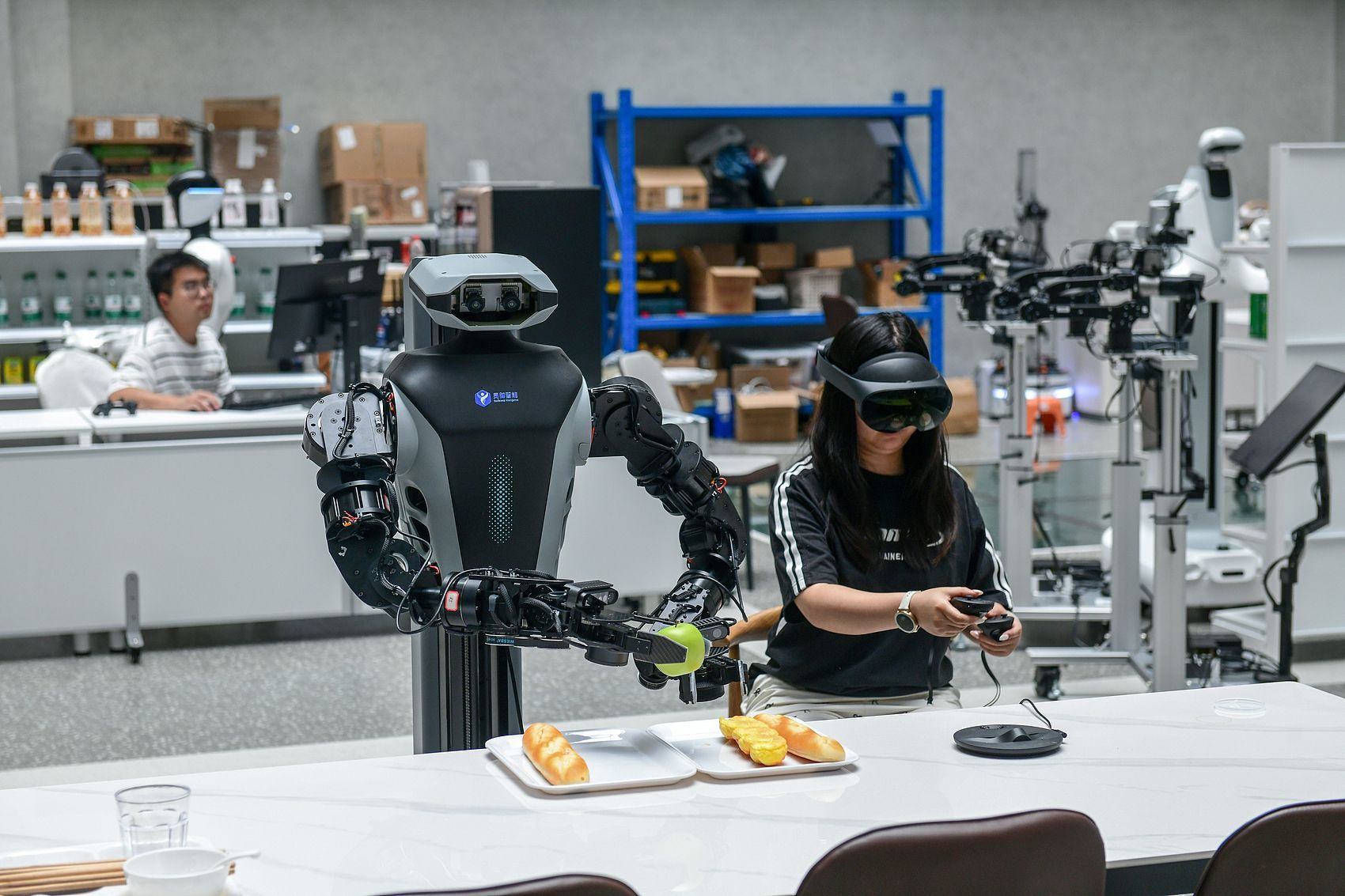
To prepare robots for future jobs, many labs and enterprises are training humanoids on real-world tasks like preparing breakfast, with human operators collecting data to help machines better understand and interact with the physical world required for everyday work (VCG)
Yet this approach isn’t without issue. Some participants pretended to clean tidy homes or fold the same shirt 10 times in a row just to complete the tasks, producing inconsistent and unreliable data. “Remote communication and online quality checks simply didn’t work,” adds Zhou, “according to our engineers, nearly 90 percent of the data was unusable.”
Zhou’s team has now standardized the process by moving data collection onsite, often in rented houses that resemble lived-in spaces. Freelancers receive standardized training, while supervisors monitor the process in real time, correcting movements as required. Each dataset is also assigned an ID card, containing details such as the collection date, location, and calibration settings of the recording device. “The goal is traceability,” Zhou explains. “If something goes wrong, we can pinpoint where it happened and take corrective action.”
Zhou believes that general-purpose humanoids capable of walking, talking, and handling household tasks like humans remain decades away: “That will require not only better data and algorithms, but also a dramatic decline in hardware costs, major improvements in energy density, and broader public acceptance.”
Despite rapid progress toward real-world deployment, how robots will ultimately fit into the home remains to be seen. PhD student Liang hopes to bring humanoid robots to every household at an affordable price within the next decade, to do chores, prepare meals, and feed pets. “I don’t just want it to know how to do these things, I want it to know when to do them, to have initiative,” he says.
Zhou, meanwhile, believes intelligent robots will become as common in households as smartphones, though not necessarily the uncanny, lifelike androids of our sci-fi fantasies. “Instead, we could see specialized smart machines embedded throughout the home,” he says. In Zhou’s vision, robotic arms might wash dishes and prepare ingredients in the kitchen, while a separate system in the wardrobe would fold clothes. “I don’t think it has to be a human-shaped robot with two legs, two arms, and a head, ” he says, “but they will still do the work people would rather avoid.”
Exit Stage Left: China’s Robots Need a Job is a story from our issue, “I, Humanoid.” To read the entire issue, become a subscriber and receive the full magazine.
Related Articles