

Around noon on December 3, 2025, in temperatures as low as minus 8 degrees Celsius, hundreds of people gathered in a desert in northwestern China for a few minutes of emotional whiplash—excitement and nerves, then thrill and rising hope, then a sinking sense of loss. In the end, though, the mood turned positive.
They were watching the maiden flight of the reusable, two-stage rocket Zhuque-3 (ZQ-3), China’s first attempt to land a booster from an orbital launch. The result was mixed: the second stage reached orbit as planned, but the booster—the first stage that powers liftoff and is designed to return to Earth—ran into trouble at the final step. As its engines relit for the landing burn, it crashed about 40 meters from the landing target.
Spectators at the site, mostly staff of this commercial rocket developer, LandSpace, knew that failures were far more common for debut flights and congratulated each other on the result.
The public was supportive, too. Under a Weibo post about the flight, one upvoted comment wrote “Failure is the mother of success,” citing Elon Musk’s SpaceX as an example—its Falcon 9 rocket achieved a soft landing in 2015 after several failed attempts. That comparison is hard to escape this year. As ZQ-3’s team prepares for a second attempt, SpaceX has only loomed larger—listing on the Nasdaq this June in a debut that briefly made Musk the world’s first trillionaire, even as its Falcon 9 keeps flying at a cadence the rest of the industry is still chasing.
China’s commercial space sector only emerged in 2015, when the government opened the door to private investment, and it has advanced rapidly ever since. LandSpace, often dubbed “China’s SpaceX” by the media, is a forerunner in the industry. Its Zhuque (朱雀) rockets, named after the Vermilion Bird, one of China’s four divine animals, are the company’s flagship low-cost, medium-lift launch vehicle line for commercial missions.
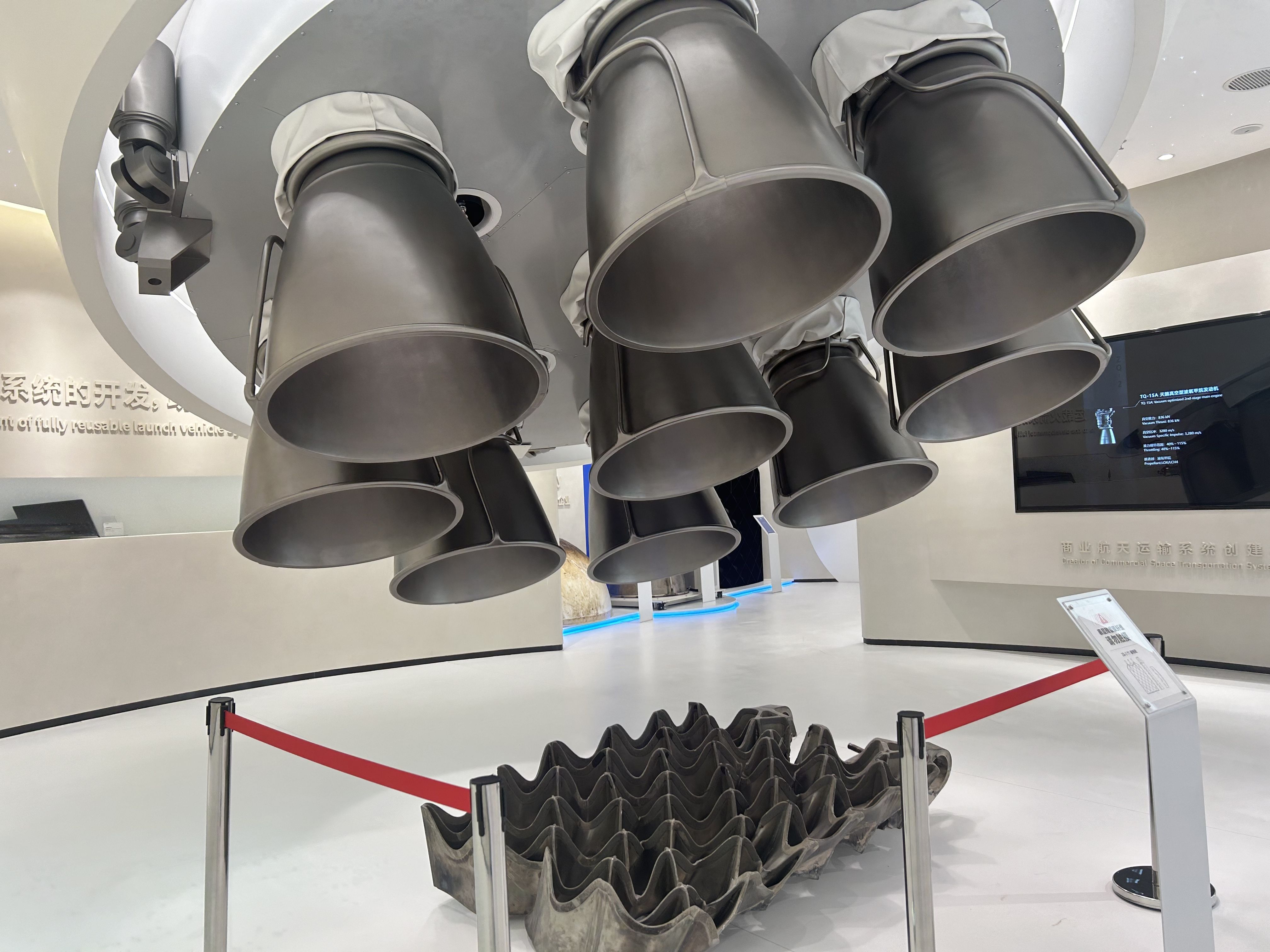
A model of a section of the nine-engine first-stage booster of the ZQ-3 is on display at LandSpace’s Beijing headquarters (Tan Yunfei)
In 2023, LandSpace successfully launched its ZQ-2, marking the world’s first rocket to reach orbit on methane and liquid oxygen, or methalox—a preferred fuel for reusable rockets due to its clean combustion and lower maintenance needs.
Alongside ZQ-3, both state-owned and private players are racing to develop reusable rockets, with over 10 test launches planned this year. The push reflects a broader industry effort to cut launch costs and boost efficiency—an increasingly urgent goal for China’s space sector, which plans to deploy tens of thousands of satellites over the next decade to build large-scale constellations and support satellite internet, IoT, and the future 6G network.
Learn more about China’s recent space exploration:
- Close Encounters: Inside Chinese UFO Hunters’ Search for Extraterrestrial Life
- What Reactions to Female Astronaut Say About Gender Roles
- Romantic Naming of Chinese Space Missions
Widely seen as a turning point, 2026 was described by People’s Daily in January as “a pivotal year for the development of China’s commercial space sector.” As the industry moves closer to mass production and deployment, we spoke with Liu Ziteng, director of the System Engineering Department in the Rocket R&D Division at LandSpace, for an insider’s perspective:
TWOC: Can you describe your work at LandSpace?
Liu Ziteng: Our department works at the very front end of the rocket development process, defining the vehicle’s overall design, from its configuration and dimensions to its mass and other general characteristics. Based on that, we establish the detailed design requirements for the hardware and software teams. We then oversee the development of each subsystem throughout the program, tracking their progress and ensuring that everything ultimately meets the overall system requirements.
Q: ZQ-3 has drawn a lot of attention. What’s special about it?
Liu: As China’s first rocket that attempts to recover a booster during orbital launch, ZQ-3 is distinctive in several ways. The most striking is probably its choice of body material and propellant.
Its structure is made of stainless steel rather than the traditional aluminum alloy. Although steel is denser and therefore heavier, it performs better in both high and low temperatures, a natural advantage for reusable rockets, whose first-stage boosters must withstand extreme temperatures as they re-enter the atmosphere. In addition, China already has a strong stainless steel industry, and choosing this material speeds up production and reduces overall costs.
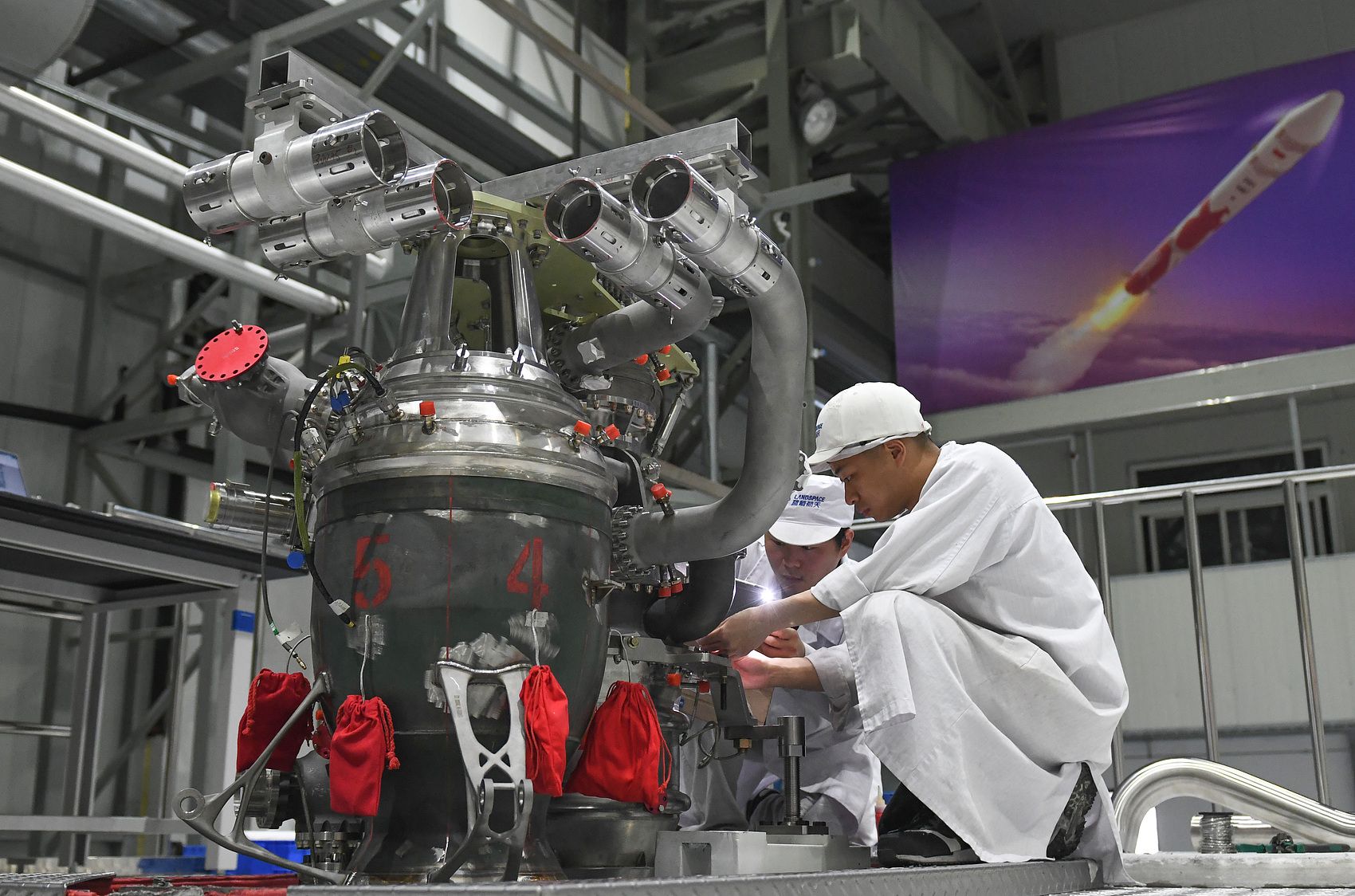
LandSpace now produces over 100 methalox engines annually. Methalox has been adopted by major rocket developers worldwide, including SpaceX’s Starship. (VCG)
Methane and liquid oxygen, essentially the same natural gas we cook with, are easier and cheaper to source than traditional propellants like kerosene. We’ve been committed to methalox rockets since 2018, when we decided to build our engines and other core technology in-house rather than buy them. It also burns cleaner, leaving mainly carbon dioxide and water, making the recovered booster quicker to prep for its next flight.
Q: What’s next for ZQ-3?
Liu: The first flight of ZQ-3 gave us a large amount of valuable data, which we have carefully analyzed to identify the issues it revealed. ZQ-3 is scheduled for another flight later this year. In this mission, we will incorporate new insights to enhance the rocket’s performance, aiming for a successful soft landing.
If the launch goes as expected, we will carry out a thorough inspection of the recovered booster and evaluate whether it is suitable for further flights. This process is also part of how we establish and refine our inspection and maintenance standards. At the same time, we will continue to conduct other mission demonstrations beyond booster recovery.
Q: Why is it important to develop commercial space?
Liu: Take the United States, for example: It moved quite early to develop its commercial space sector to address challenges faced by NASA and other government agencies, particularly the high cost and low efficiency of launch services and related operations. Bringing commercial players has helped improve the sector as a whole.
Since around 2000, China has also made efforts to encourage commercialization across various sectors. By 2015, the experience of the US had, to some extent, demonstrated that commercial space is a viable and effective approach.
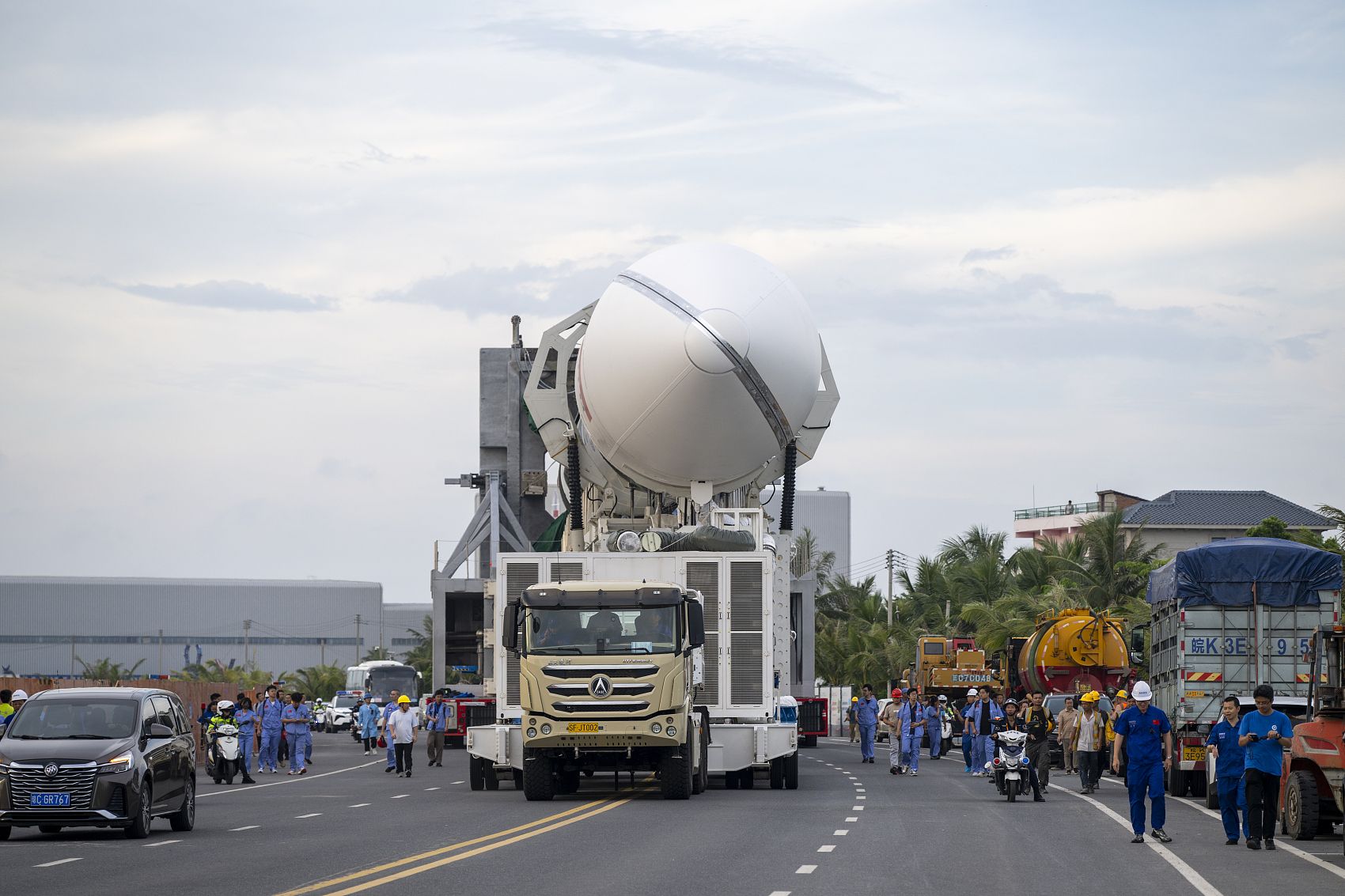
A Long March-12 rocket is transported to its launch pad at the Wenchang Commercial Launch Site in Hainan. China currently faces a shortage of launch pads, with 25 currently active and another 17 under construction. (VCG)
Commercial companies have a strong incentive to achieve breakthroughs in reusability. Fundamentally, it’s about reducing cost, which is inherently driven by commercial logic. For state-owned developers, they have already forged a path with a series of reliable launch vehicles that future missions will mainly use. Reusability may not be their top priority. But I think ultimately, it’s a destination we will all reach. Besides lowering costs, commercial players can also respond to a national-level demand for advanced aerospace technologies.
Q: Some media have dubbed LandSpace the “SpaceX of China.” How do you see this comparison?
Liu: We take it as a compliment. SpaceX is a pioneer and the fastest-moving company in the sector. In that sense, we are also on a path of exploration and seeking to break new ground. However, in terms of overall technological capability, we must acknowledge that there is still a gap between us.
Going forward, we will continue to refine ZQ-3 through additional flight tests to develop it into a highly capable launch vehicle comparable to the Falcon 9. Our objective is to continuously evolve and upgrade our product line, and ultimately not only catch up with but surpass current industry pioneers.
Q: What’s your team like?
Liu: People may assume that aerospace engineers like us are very serious, reserved, even rigid, and our work is highly technical and dull. But we are not so different from an internet company. Our pace of work is relatively flexible, and our teams are generally young, many in their 30s. At LandSpace, young engineers are encouraged to step up and take on significant responsibilities early in their careers, and we’re also committed to hiring and training new graduates.
At the same time, we also rely on experienced industry veterans and senior experts to mentor our younger engineers. They work together on projects, allowing the junior team members to grow through hands-on experience. This open and inclusive environment helps us fully realize our innovative capabilities.
Q: What are the challenges and opportunities you are facing right now?
Liu: As a commercial company, we are expected to provide launch services at a lower cost compared with state-developed rockets, which means we start with inherently compressed profit margins. At the same time, the aerospace industry has extremely high reliability and safety requirements. There’s zero tolerance for safety-related failures from a regulatory perspective. In that sense, we’re walking a tightrope. This creates constant pressure, but it is also where our competitive edge will come from.
However, we also have a few advantages. As I mentioned above, China has a solid industrial and commercial foundation that provides us with a wide range of materials and processing options. Policy-wise, the government has continued to provide strong support for the sector. With market enthusiasm growing, more social and market capital has flown into the industry. We have also benefited from strong support from local governments and universities, ranging from testing infrastructure to research partnerships.
Q: How will the development of the space industry affect people’s daily lives?
Liu: The most relevant aspect is probably satellites. Navigation satellites support apps such as Baidu Map or Amap, helping users determine their location and navigate to their destination. Remote sensing satellites help monitor weather and detect changes in terrain and geographic features, while communication satellites overcome the limitations of ground-based stations, providing better coverage for devices like mobile phones. In one way or another, they’ve made daily life easier.
Moreover, space travel is already a reality—Blue Origin’s flights, for one. Here in China, as far as I know, several companies plan to roll out their own. Technically, it isn’t that complicated; the harder part is making it affordable for everyone, which may still be some way off.
The interview has been edited for length and clarity.
Can China Build Its Own “Falcon 9”? is a story from our issue, “I, Humanoid.” To read the entire issue, become a subscriber and receive the full magazine.
Related Articles