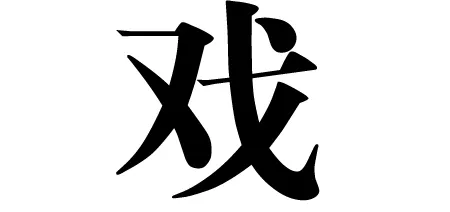

From death matches to child’s play, we trace the origins and evolution of the character 戏
You probably recognize the character 戏 (xì) as a word of whimsy, but its origins are not so innocuous. It first appeared over 3000 years ago inscribed on bronze ware. In its original form 戲, the left side of the character was a phonetic guide and the right side of the character 戈 (gē, a spear or sword) hinted at its meaning.
Why would a word now known as “play” or “theater” have a weapon in it? Because in ancient days, 戏 referred to wrestling or fist fighting matches to the death. When leisure and entertainment became more civilized, these competitions were enacted instead, so the character 戏 came to mean “performance.” In some matches, wrestlers looked like they were playing around, so 戏 took on even broader, tamer meanings as “game” and, eventually, “joking.”
These days, 戏 is everywhere in the performing arts: theater house (戏院 xìyuàn), stage (戏台 xìtái), Peking Opera (京戏 jīngxì, also known as 京剧 jīngjù), Huangmei Opera (黄梅戏 huángméixì, “Yellow Plum Theater,” a genre popular in Anhui), a buff (戏迷 xìmí), or an actor (戏子 xìzi, a derogatory term from the days when people looked down on thespians).
戏 can transcend its literal meaning and do some idiomatic heavy lifting. Originally, 逢场作戏 (féng chǎng zuò xì) referred to spontaneous performances that itinerant entertainers staged wherever they found a suitable place. Now, the idiom just means “to play along” (a kind of “acting” that we all do). In another idiomatic turn, 戏 can pit rivals against one another. Long ago, 唱对台戏 (chàng duìtáixì) described rival troupes doing similar shows concurrently to steal each other’s business. Now, any action in opposition to another can be a form of 唱对台戏. In daily life, you might occasionally find something particularly dramatic or unexpected; then it has a lot of “theatrical characteristics” (戏剧性 xìjùxìng).
Even more fun are 戏’s incarnations as “play.” 嬉戏 (xīxì) is to frolic, 戏耍 (xìshuǎ) is to tease and 儿戏 (érxì)—which literally means “children’s games”—can be a metaphor for something trivial. If your boss regarded your professional ambitions thus—视同儿戏 (shì tóng érxì)—then you’re in trouble. You would need to convince him that what you’re pursuing is 非同儿戏 (fēi tóng érxì), or a serious matter that isn’t to be treated lightly.
Back to “joking.” 戏弄 (xìnòng) is to make fun of, 戏谑 (xìxuè) is to banter or ridicule, 戏称 (xìchēng) is a comical nickname, 戏言 (xìyán) are humorous remarks and 戏说 (xìshuō) is an amusing narrative (as in the popular renditions of The Three Kingdoms and of Emperor Qianlong). The TV shows or stories about ancient history might be amusing, but what is never meant to be funny is current military affairs. A common saying goes 军中无戏言 (jūn zhōng wú xìyán) —there’s no joking around in the military.
The best uses of 戏 are in colloquialisms. The character can be a measure of success. If someone says, 这事儿有戏 (zhèshìr yǒuxì), they mean “This thing has hope; it could work out.” By contrast, if someone says 没戏 (méixì), there’s no chance in hell it’s going to happen. Nosey people or those with schadenfreude might perversely delight in 戏. One sinister sentence, often uttered by evil characters in movies, goes 这下可有好戏看了 (zhèxià kě yǒu hǎoxì kàn le)—“stick around for the show.”
Life’s a dream, at least is is according to this Chinese character.
Related Articles