In the days before a typhoon, the sky has a habit of lying to you. It shines a deep blue, and lone clouds drift like mislaid socks. Meteorologists refer to this in terms of atmospheric swells and troughs, the tumult sucking in energy before it spills it out again, but in common parlance it goes by another name: the calm before a storm.
As I sat on a ledge at Fayu Temple, a four-century-old Buddhist shrine halfway up the slope of Mount Putuo, the sky was blue, but the atmosphere was anything but calm. The courtyard in front of me, one of many in the sprawling temple complex, was thick with crowds and scented with the woody burn of incense.
I was resting my legs from the heat, waiting in line for a lunch ticket at the temple cafeteria. Only a few of the island’s 30-odd temples have cafeterias, and the tickets are a hot item. The previous day, I had tried to secure a ticket at Puji Temple, the island’s largest, but when I arrived at 10 a.m., they were already sold out.
“Don’t worry,” a monk emerged and assured the assembled crowd, “Everyone will get a ticket today.”
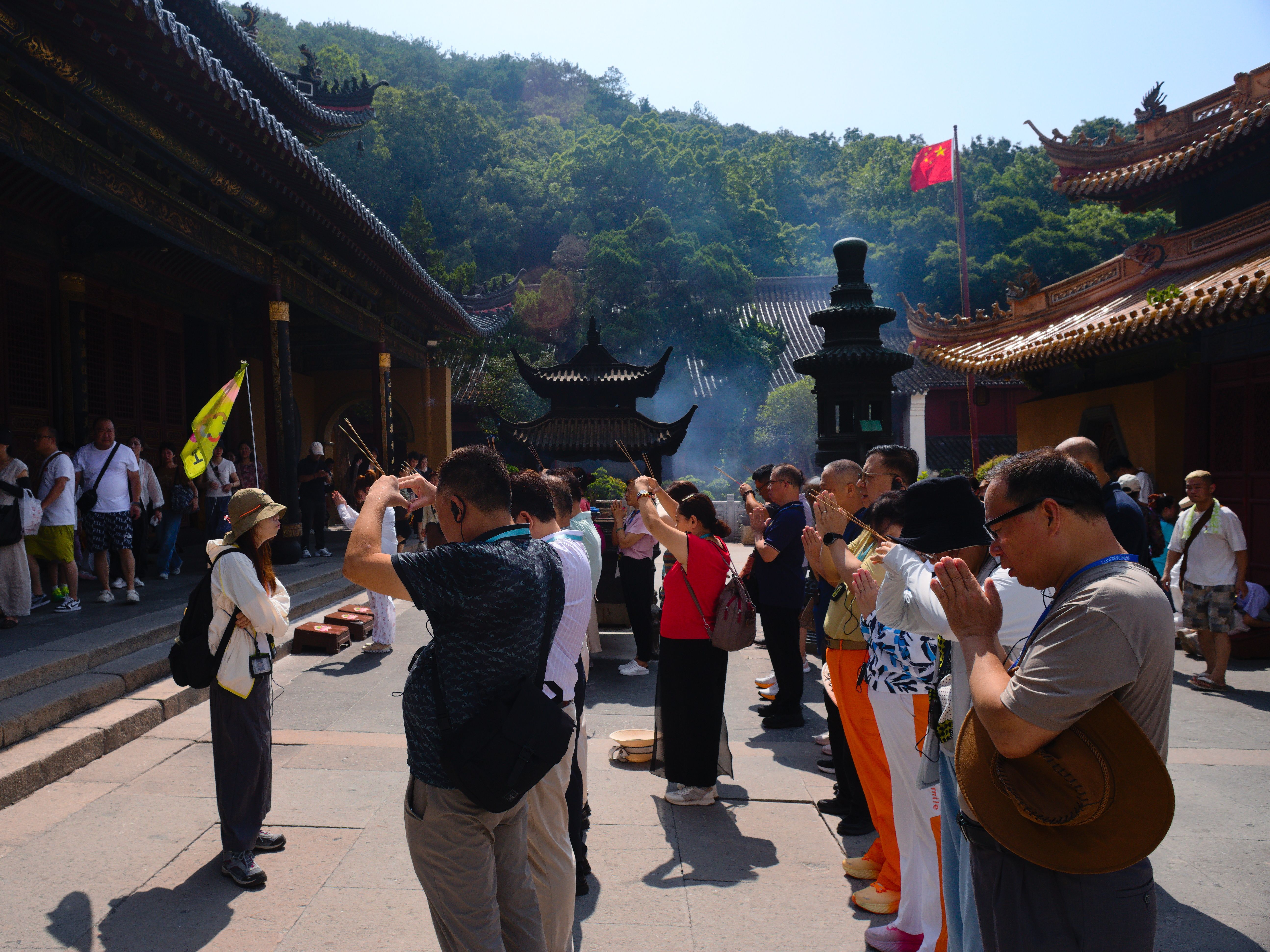
A tour guide leads a tour group in prayer inside Fayu Temple (Evan Taylor)
But my mind was on a different problem. Typhoon Dolphin was approaching, and it was a question of when, not if, the ferry service off the island would be stopped. Then the message came: the last boat would be tonight at 8 p.m., and the ferry would not run again for four days. But first was lunch. After paying five yuan, I filed into the cafeteria, where large metal bowls contained rice, braised vegetables, and tofu. Guests were free to refill their bowls as many times as they liked, as long as they washed their own dishes.
If Guanyin, the bodhisattva of compassion and mercy, one of the most revered Buddhist figures in the world and the patron mother of Mount Putuo, was not able to save me from the weather, she could at least provide a hearty lunch.
Travel more around China:
- Jianshui: One of China’s Last “Living” Ancient Cities
- Qingtian: China’s “Little Europe” with a County-Town Heart
- Ma’andi: The Mysterious Land of Butterflies
Under Guanyin
Since the Song dynasty (960 – 1279), Mount Putuo has stood amongst the thousand-plus islands of Zhejiang province’s Zhoushan archipelago as a site of Buddhist pilgrimage. In the Chinese Buddhist tradition, it is the physical manifestation of Mount Potalaka, where Guanyin obtained enlightenment. The most common origin story dates to the Tang dynasty (618 – 907), when a Japanese monk, Egaku, carried a statue of Guanyin from Mount Wutai on toward home. A storm trapped him at Putuo, which he took as a sign that the bodhisattva did not want to leave the island.
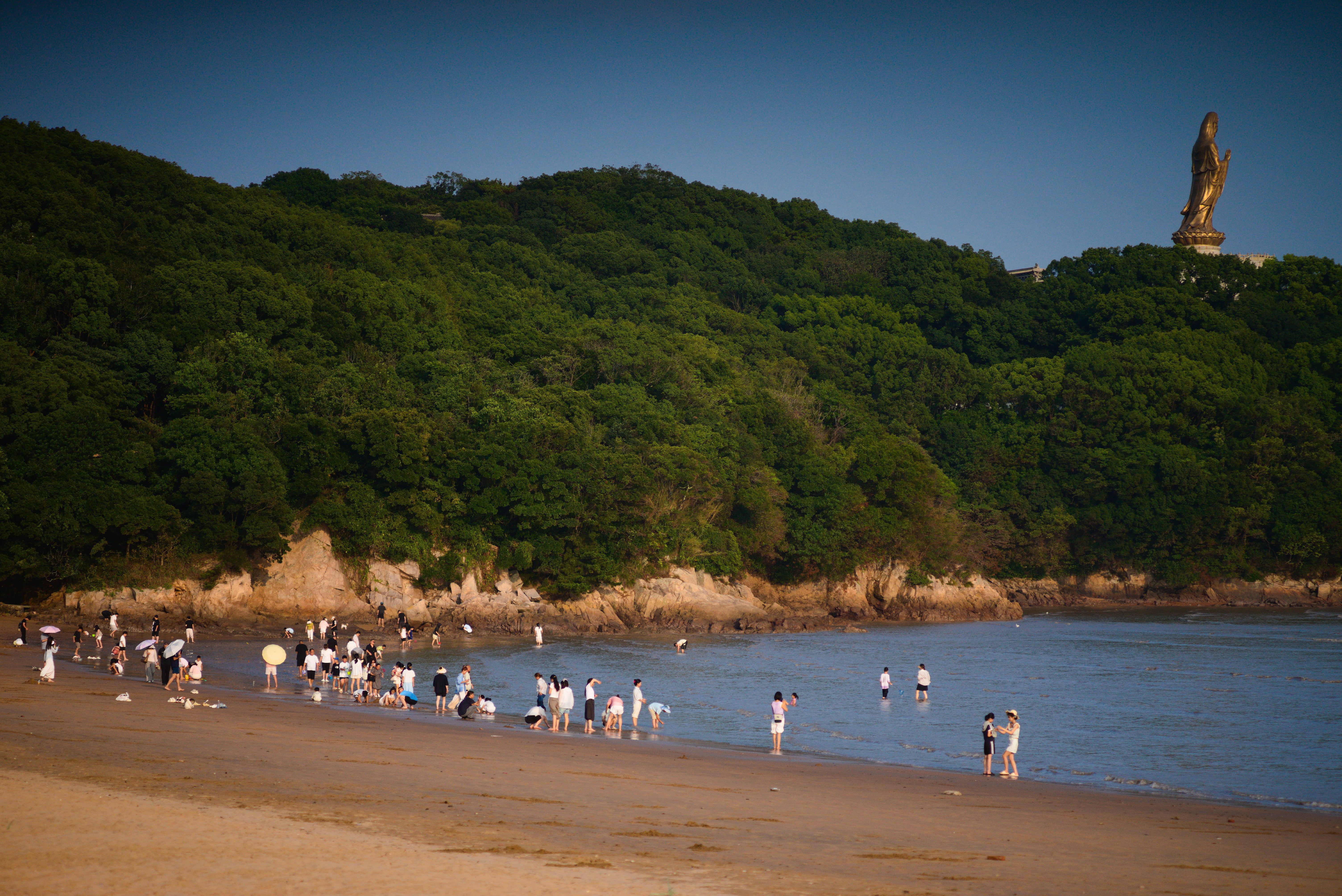
Mount Putuo is one of China’s four sacred Buddhist mountains and home to a 33-meter-tall statue of Guanyin (Evan Taylor)
Besides statues of Guanyin, the second most common item on the island is bicycles. No private motor vehicles are allowed on the island; only buses that circulate between temples are permitted. This extends to local businesses. When we arrived, my hotel owner, a local proud of his lengthy prayer bracelets, met me outside the ferry terminal and strapped my suitcase into baskets on the back of his bicycle. “Each business is only allowed one bicycle,” he jokingly complained. “So you can’t rent me one?” I asked. “Definitely not,” he laughed. “Anyways, the roads here are too steep and curvy. Tourists would crash.”
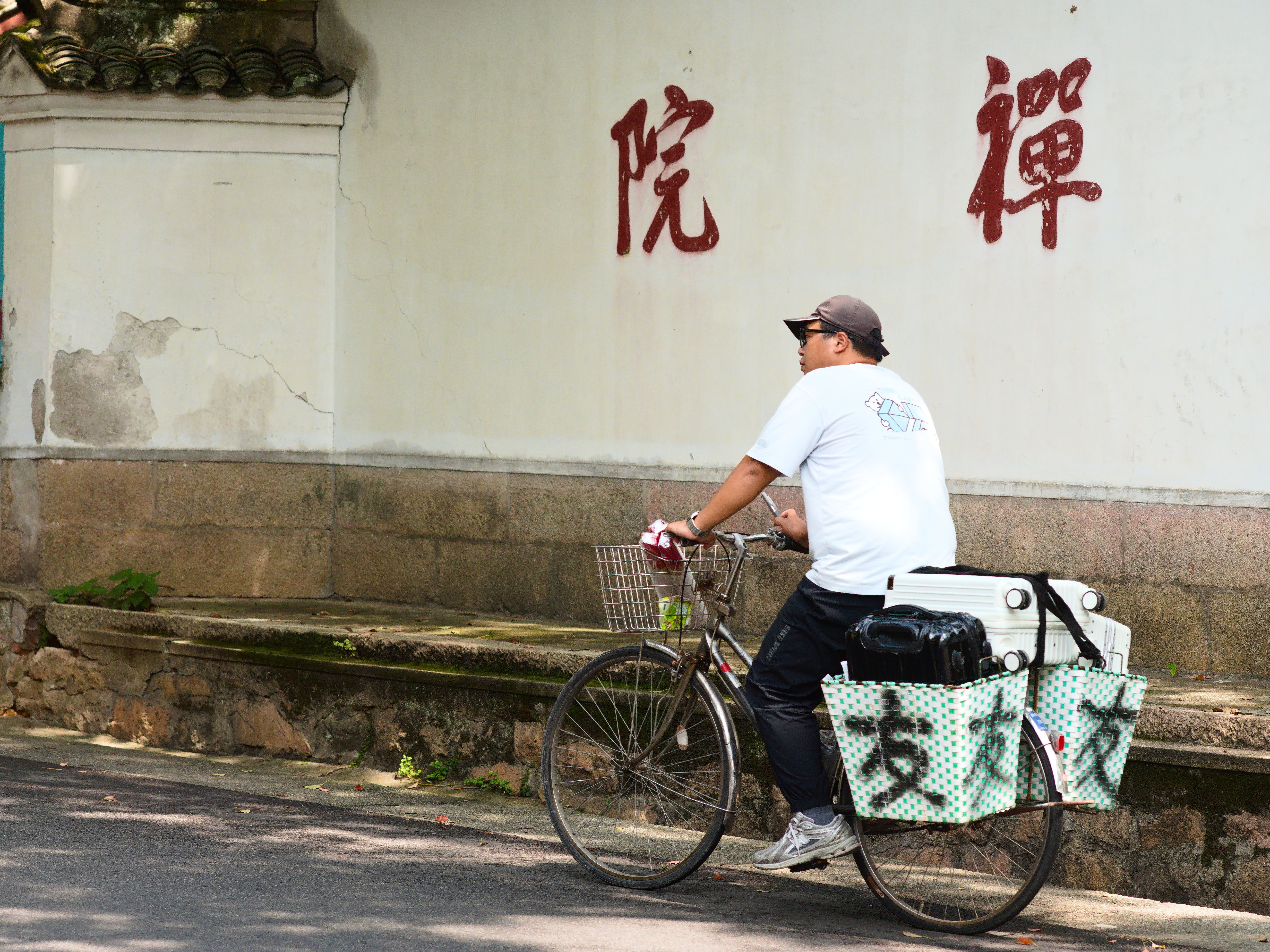
With private vehicles banned on the island, bicycles are the only form of transportation for locals (Evan Taylor)
It was already late afternoon, but even on a weekday, the island was still humming with crowds during summer vacation season. I was staying in the island’s Xitian area, a short walk from the port, where most village housing had been transformed into homestays and hotel rooms. My destination was the Hundred-Step Beach, where I had read that swimming was allowed in the summer months. However, at the top of the staircase, a lifeguard told me that the swimming area was closed due to the incoming typhoon.
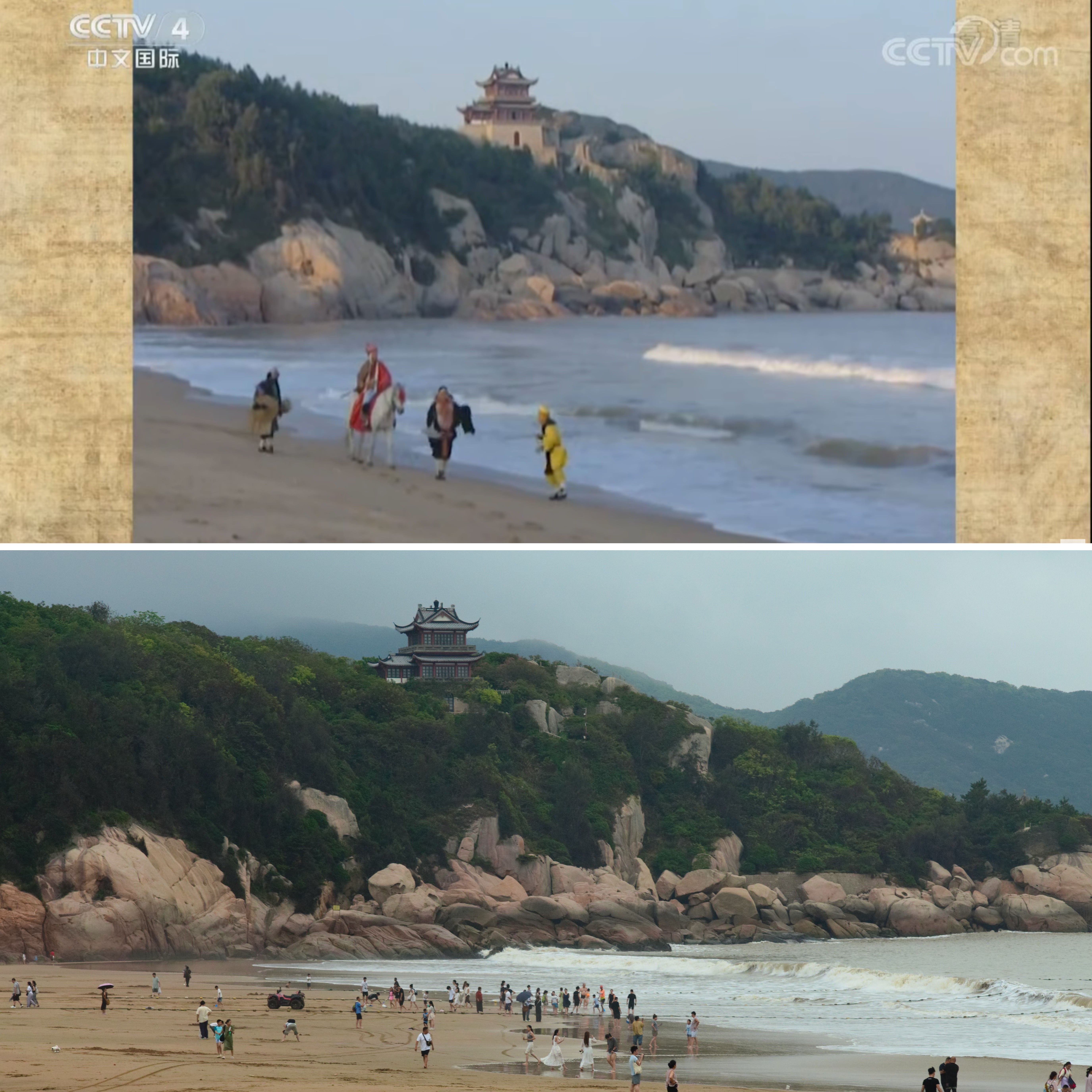
Hundred-Step Beach was the filming location for the ending theme of the TV show Journey to the West Sequel (2000), where the four pilgrims are seen walking along the shore into the sunset (top screenshot via Journey to the West Sequel; bottom image by Evan Taylor)
But strolling around the sand was still allowed. The beach appears in the 2000 television production of Journey to the West Sequel, and recreating the iconic shot, with Liuguan Pavilion in the background, is a favorite photographic motif. A pair of young women in white flowing dresses were at work, directing a photographer friend on where to stand. After scrambling back up the stairs, a gardener offered his hose for people to wash off their sandy feet. “Xiexie pusa (Thank you, bodhisattva),” a woman called out to the gardener, laughing.
Hungry, I headed to one of the many vegetarian all-you-can-eat buffets on Xianghua road, a small commercial alley next to Puji Temple. Then it was down to the Golden Sands Beach, where low tide exposed the mudflats along the coastline, tinted peach in the setting sun. Crowds ventured out, squishing the cooling ocean mud between their toes. On shore, a son and his father dug a hole deep enough to form a pool of water to cleanse their feet. Overlooking the tranquil scene was Nanhai Guanyin, the 33-meter-high statue that stands watch over the island’s southern seas.
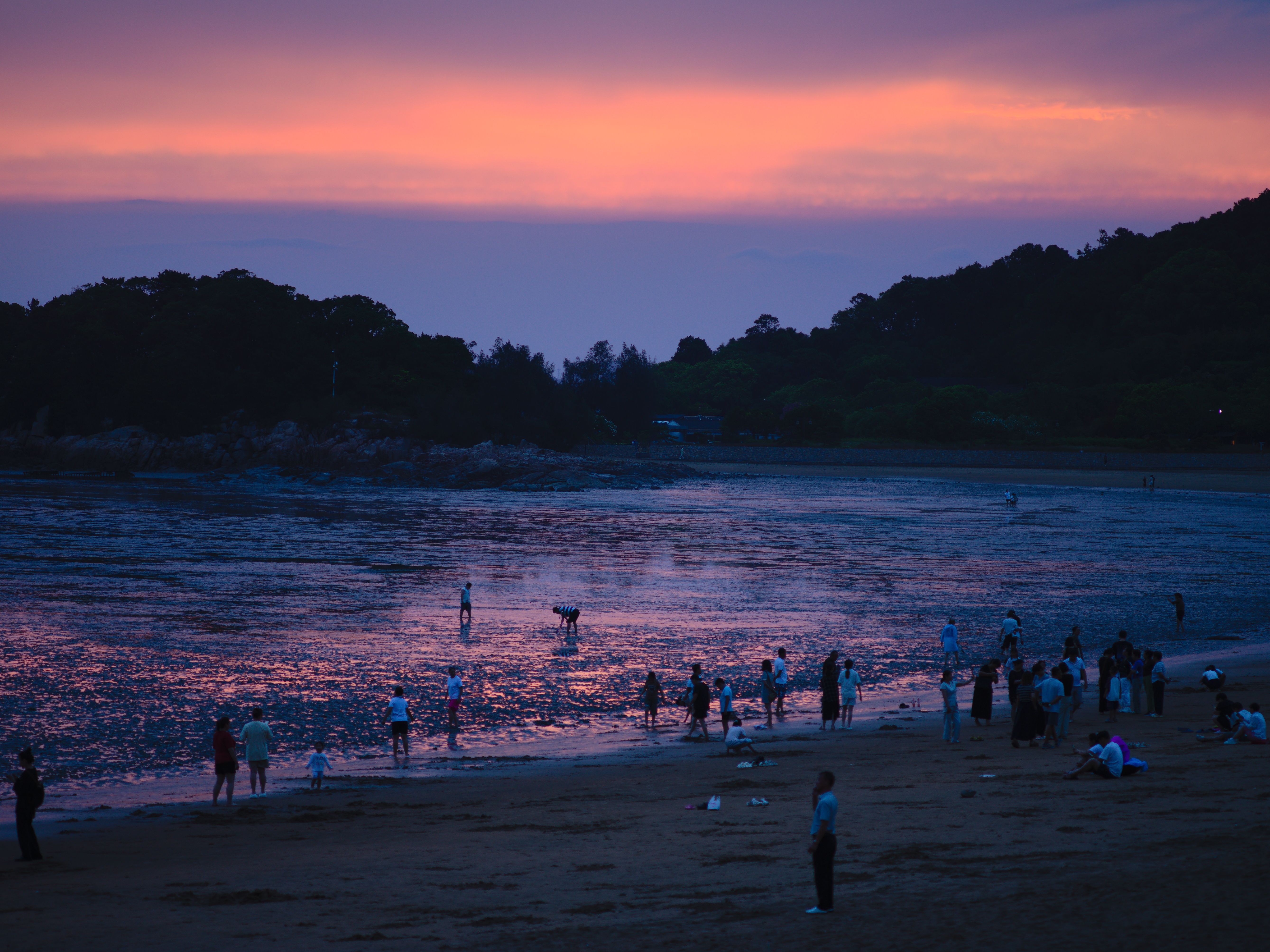
Tourists venture out into the mud flats at sunset on Golden Sands Beach (Evan Taylor)
Guanyin’s shifting identity
But while Mount Putuo’s Guanyin statue stands as a solid sentinel, it hides a continuously transformative nature for the deity. What was originally a man became a woman, and what was once an Indian import became one of the most worshipped figures in Chinese Buddhism.
The earliest images of Guanyin in China, such as those found in the caves of Dunhuang produced during the Tang dynasty, depict the figure as a muscular, often mustachioed man. This was Avalokitesvara, the Sanskrit name from which Guanyin (formally Guanshiyin) derives, meaning perceiver of sounds of the world. According to Chun-fang Yu, a Columbia University scholar of Buddhism, “the feminine transformation of the bodhisattva probably reached its completion during the Yuan [1206 – 1368].”
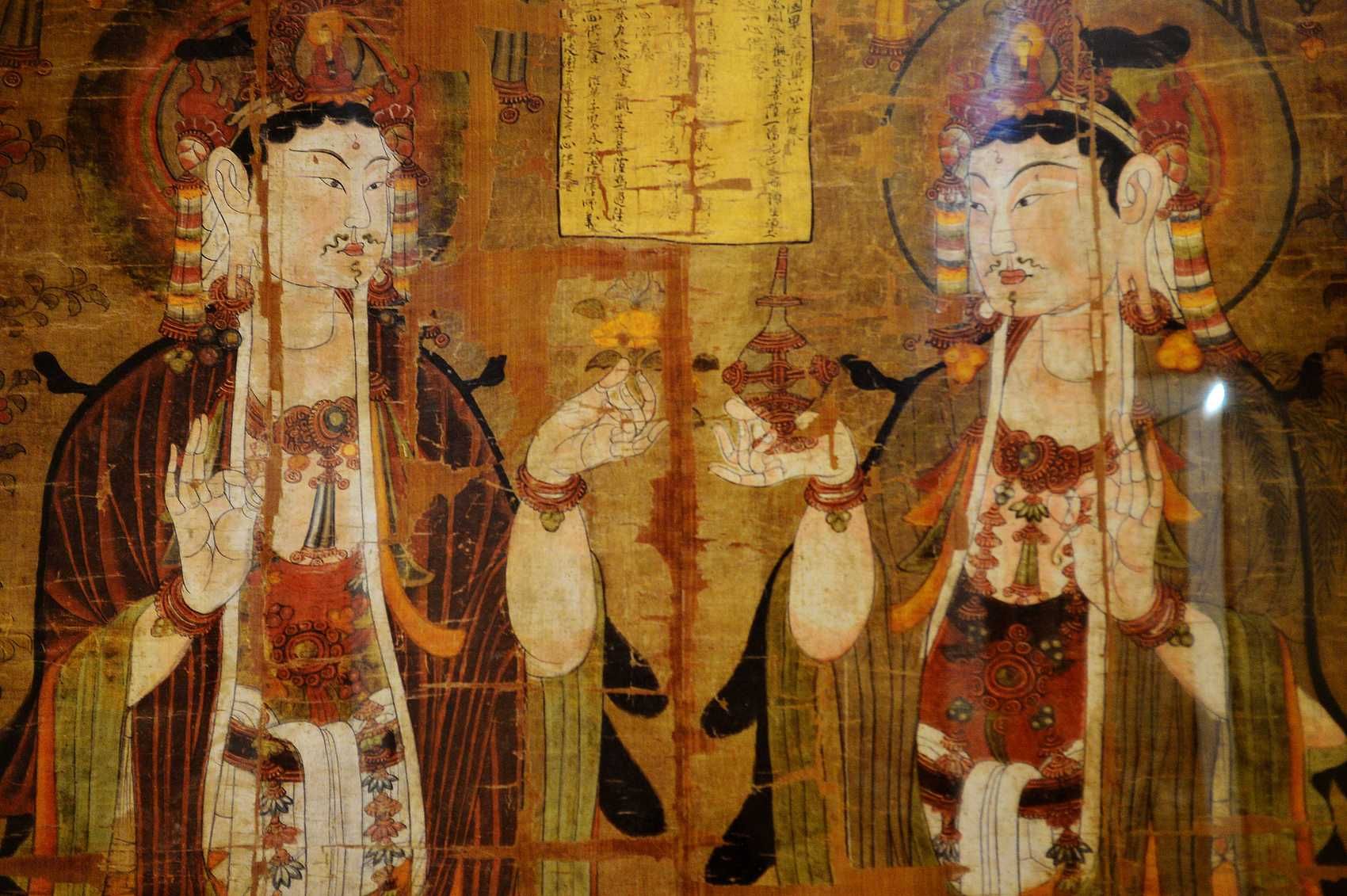
Two Avalokitesvara in mirror-reverse as mustached male figures, painted in the Tang dynasty, originally from Dunhuang and now housed at the British Museum (VCG)
In China, women’s devotion to Guanyin is expressed in many forms, from home altars and artistic expression to adopting elements of her appearance through jewelry and hairpins. However, while in daily worship images of Guanyin were undoubtedly female, the images of Guanyin used in Buddhist temples across China, including at Mount Putuo, are androgynous, as “the orthodox Buddhist clergy has refused to recognize Guanyin as feminine,” according to Yu.
These transformations continue today, as Guanyin is now increasingly a figure of devotion in North America, both for convert Buddhists and new-age, non-Buddhist practitioners. The latest iteration of worshippers comes from the LGBTQ community, who, usually lacking sympathetic imagery in traditional religious iconography, have found inspiration in Guanyin’s shapeshifting nature.
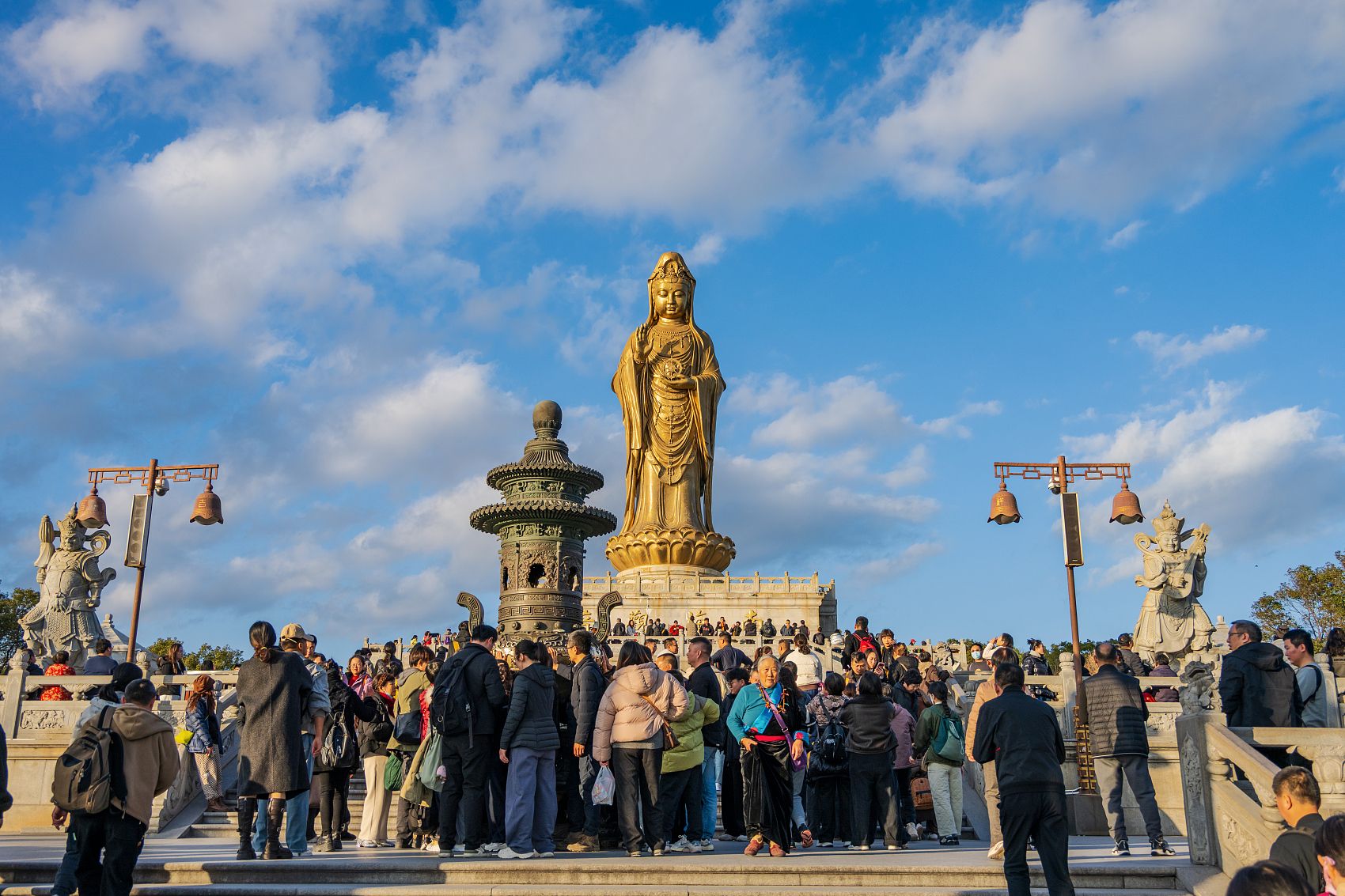
The large Guanyin statue on Mount Putuo is androgynous (VCG)
Not so “pure” island
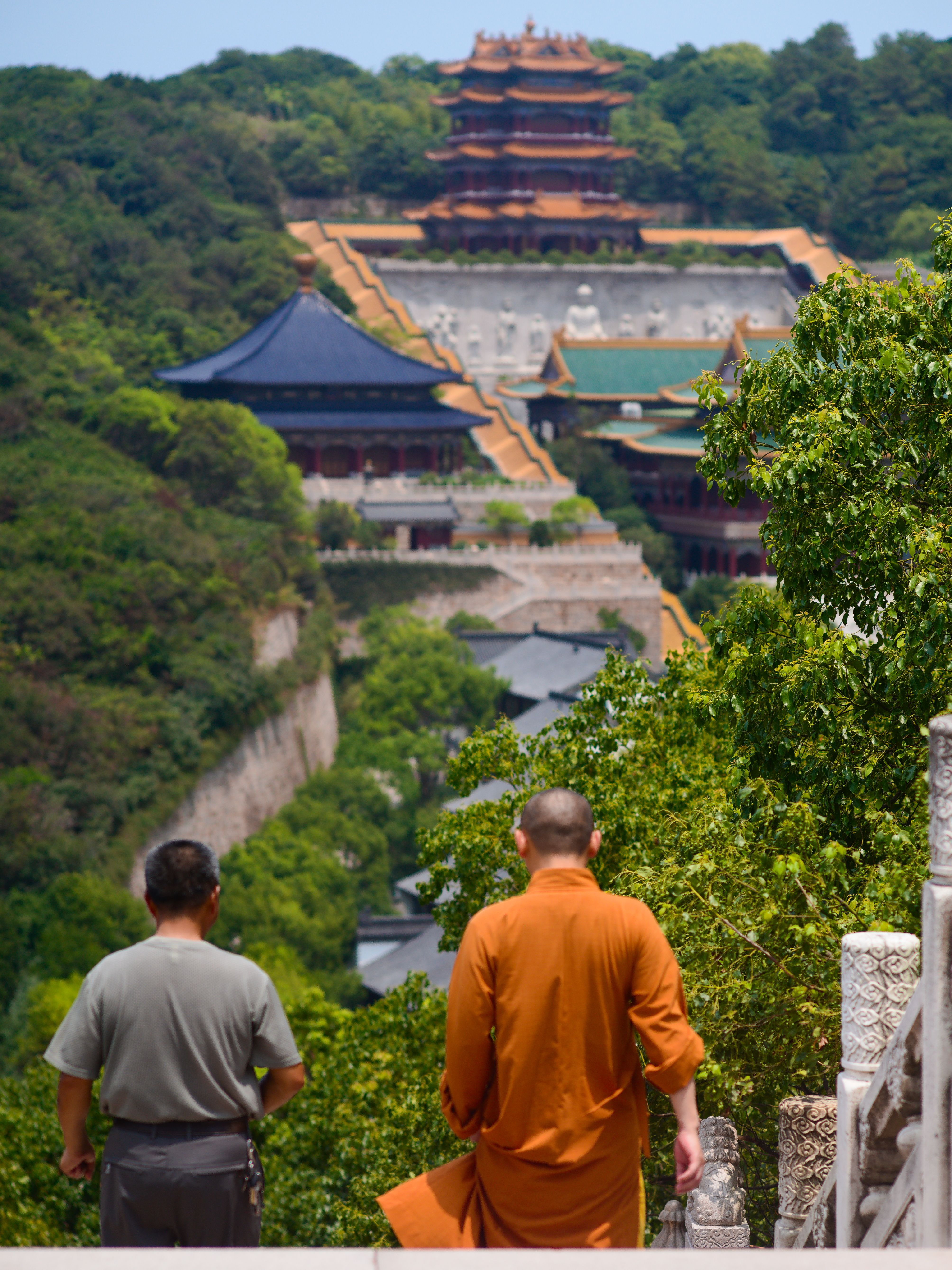
A monk accompanies a pilgrim down the stairs at Wanfo Pagoda. Across from them is Baotuo Temple, completed in 2011, the newest on the island. (Evan Taylor)
Days begin early on the island. This is due to the summer heat and the fact that many of the visitors are here on single-day guided tours, where a shuttle bus will take them to all of the daka (check-in) attractions on the island. Ferry service from Zhoushan begins at 6:30 a.m., and by 7 a.m. a tour bus is already parked outside a vegetarian cafeteria by my hotel.
Like Guanyin herself, travelers to the island occupy a multi-natured position. Many are devout Buddhists, here to pray at one of the holiest sites in Chinese Buddhism. That morning, when I went on an early hike to Guanyin Cave, an elderly lady sang prayer chants as two younger women sat in lotus poses on the ground. According to my hotel owner, the largest group of visitors to the island are from Henan, the birthplace of Chan Buddhism. And at the Hundred-Children Hall, the altar table was piled high with flower bouquets from those wishing prosperity for their offspring.
But the island is also a beacon for tourism. It is rare to see anyone performing the strenuous sanbu yibai ritual common at other Buddhist holy mountains, where pilgrims prostrate themselves in prayer every three steps. Gift shops offering the same type of mass-produced trinkets found in ancient towns across China are common. Coming down from the Yuantong Chan Temple, I struck up a conversation with a man and his son. They were from Xi’an, and it was their first time on the island. I asked if they were Buddhists. “Of course, but we are here on vacation.”
In fact, this dual nature has long been present in visitors to Mount Putuo. Marcus Bingenheimer, a professor of religions at Temple University in Philadelphia and author of the book Island of Guanyin: Mount Putuo and Its Gazetteers, notes that in Ming (1368 – 1644) and Qing dynasty (1616 – 1911) gazetteers of the island, authors frequently used the phrase wuru (吾儒), meaning “we Confucians.” These were not Buddhists visiting the temples for pilgrimage, but detached literati there for objective observations.
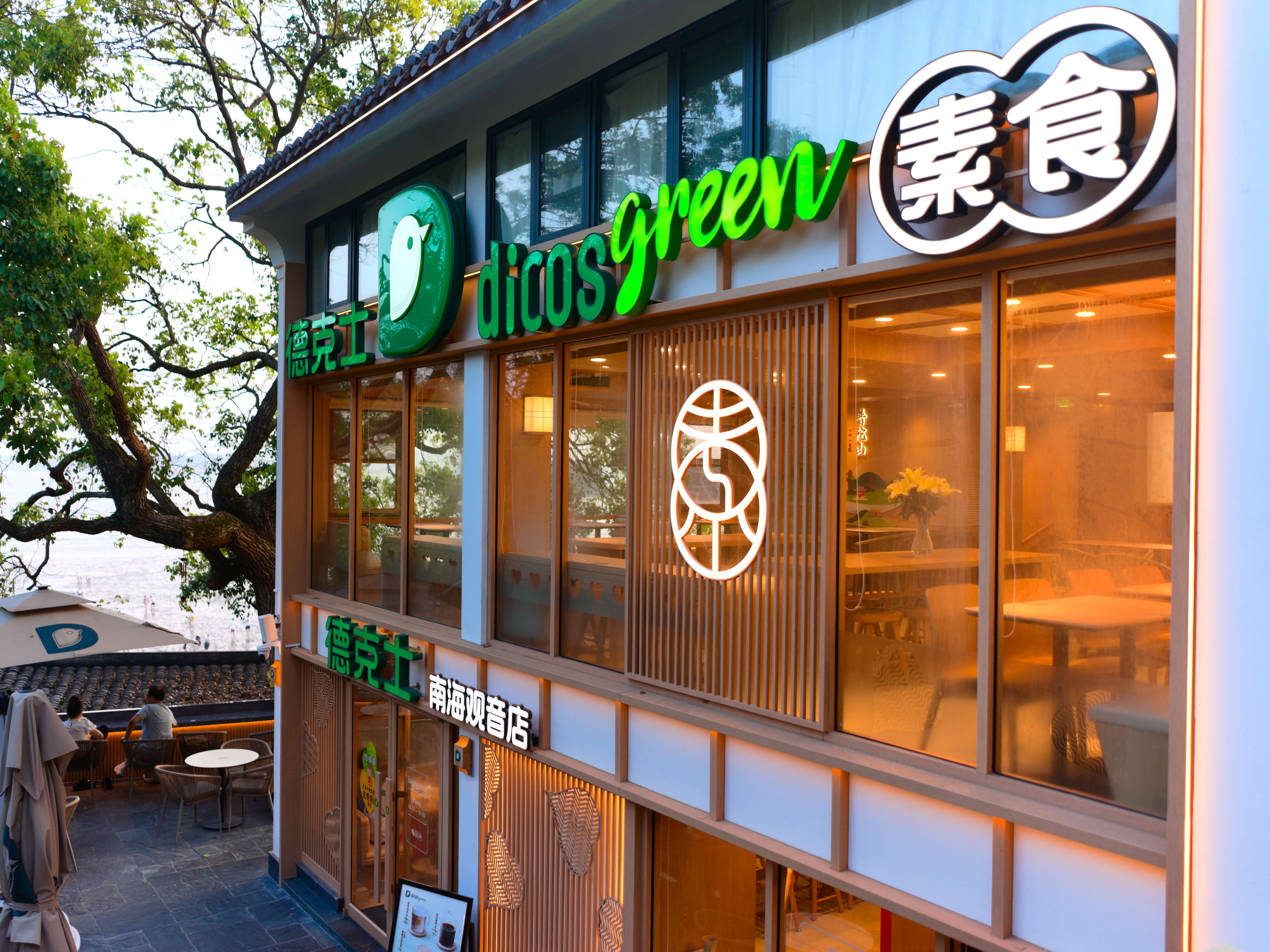
Most restaurants on the island are vegetarian, including the Chinese fast food chain Dicos (Evan Taylor)
The duality shows up in the island’s restaurants: the temple cafeterias, the vegetarian buffets, and even a vegetarian branch of the Chinese fast-food chain Dicos. But equally popular are the dapaidang (大排档, street-side food stalls) that spring up at dusk. Customers here pile their table with seafood and down bottles of the local Zizhulin beer. At the one I went to on my second night, a man on a balcony belted out karaoke versions of early-1990s pop songs, including Li Chunbo’s “Xiao Fang,” a song familiar to generations of Chinese. Mount Putuo may market itself as a “Pure Island,” but spend 30 minutes in a cattle pen-like line waiting for an overpriced shuttle bus amid the din of loudspeakers advertising ice water and sausages, and you feel more like you are in Disneyland.
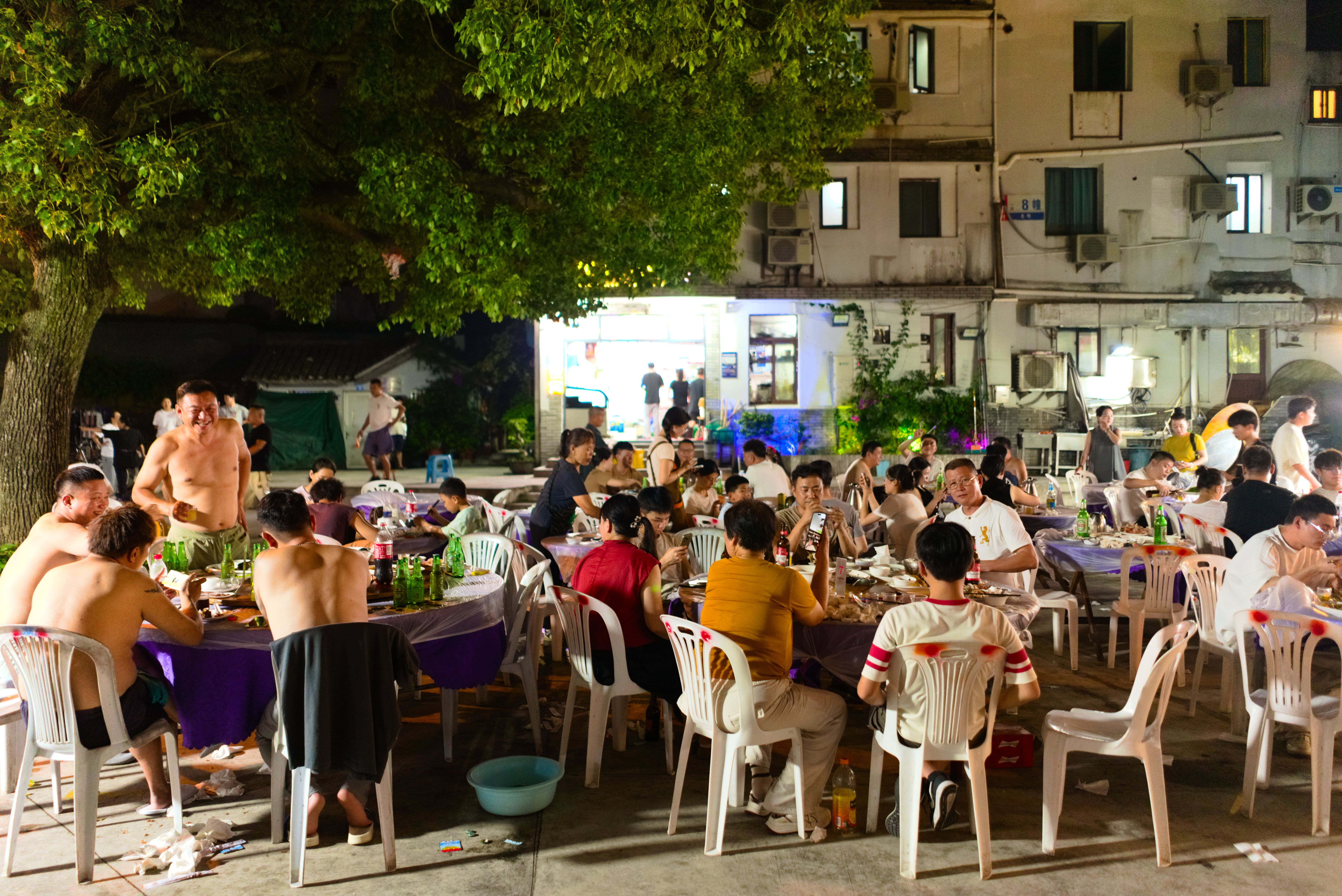
Vendors set up stalls and dining areas outside as the sun sets and the temperature cools on the island (Evan Taylor)
I had endured one such line to take the bus from Puji Temple to the island’s north side, then the cable car to the island’s highest point. At the cable car’s base, however, I did not venture inside the loud, fluorescent-lit waiting hall. Instead, I turned left and walked up the steep slope to Wanfo Pagoda. Here, for the first time since I arrived on the island, there was serenity. A lone monk sat in the shade on a folding stool, and the far-off surf could be heard rushing against the rocky cliffs. Inside the pagoda, small golden Buddha figures lined the wall, purchased as donations by families hoping for filial blessings.
On the opposite slope is Baotuo Lecture Temple, a massive, recently built structure intended for actual Buddhist study, 11 bodhisattvas, including Guanyin, were carved into the concrete wall. Here too, there was almost no one, quiet enough that the many cats could nap away the midday heat in the shade of a temple overhang.
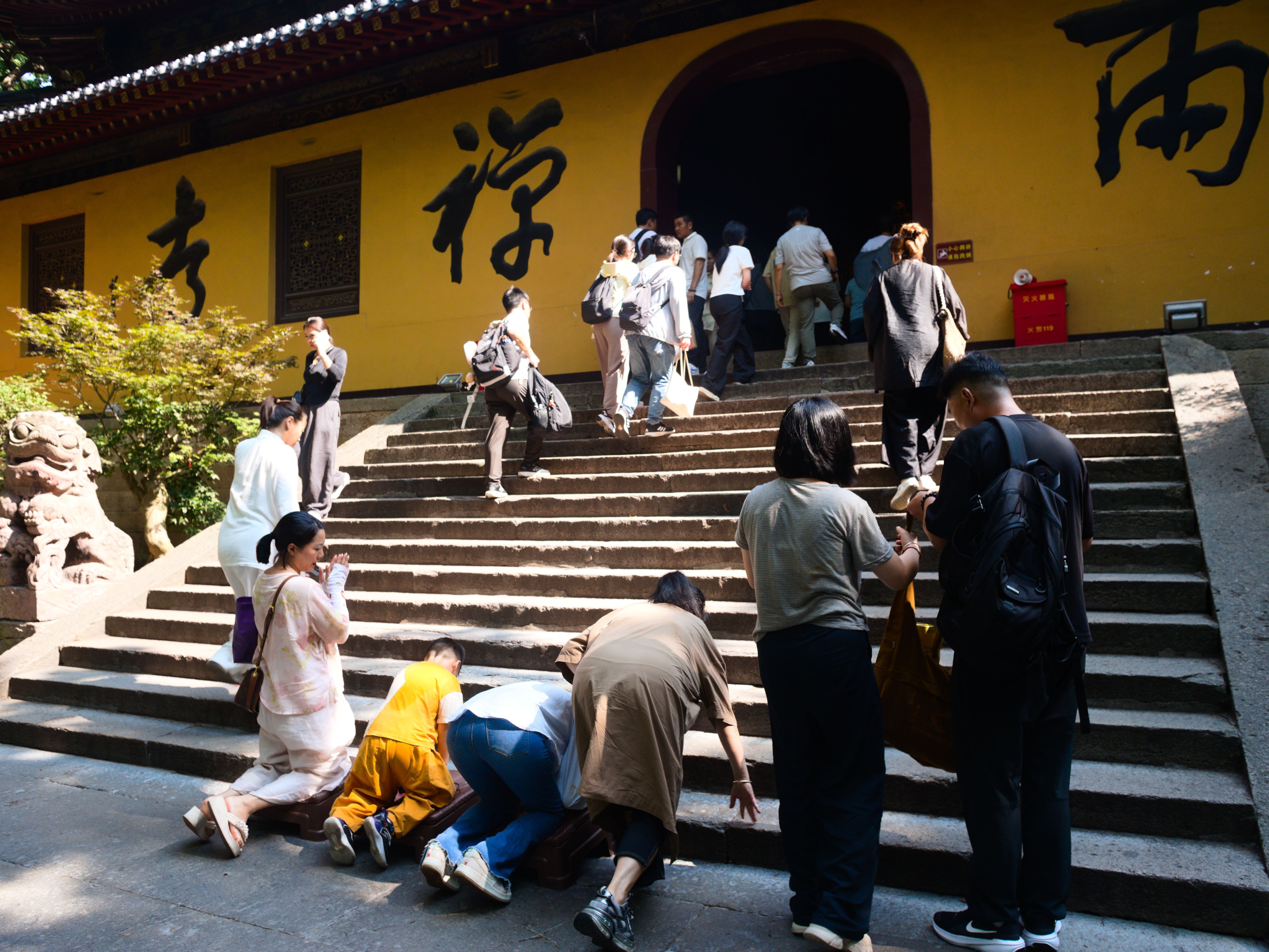
Visitors pray on the steps of Fayu Temple (Evan Taylor)
The sky the next morning gave no hint of the storm, but social media posts were ominous, and I planned the day as if it would be my last on the island. When I checked out of my room, I asked the always helpful hotel owner how many rooms he had for rent; he told me 20 and that they were full year-round. Doing the math in my head, I understood his Buddhist hospitality came with a side of tourist-derived financial security.
The calm before a storm
Fayu Temple, the island’s second-largest after Puji and home to the five-yuan lunch, was my next stop. The saffron temple walls held in the bustle, with tour-group flags flying everywhere amid the camphor trees and grand, icon-filled halls. The heat got the better of me. So I sat in the shade of palm trees along the Thousand-Step Beach, the longest beach on the island, and watched a family wet their feet in the surf, and then began walking along the winding cliffside road toward the Xianghui Nunnery. Passengers on the road were sparse, with only a lone monk strolling in contemplation and a construction crew napping away their lunch break. After 20 minutes, I saw an abandoned house in the brush. I went to explore, and there, on the windowsill beneath the shade of a fig tree, sat two statues of Guanyin: a wooden carving of the bodhisattva in the half-lotus posture, common in Buddhist temples, and, beside it, a colored standing feminine Guanyin, the kind often seen on home altars. Here on the island, the two icons coexisted side by side.
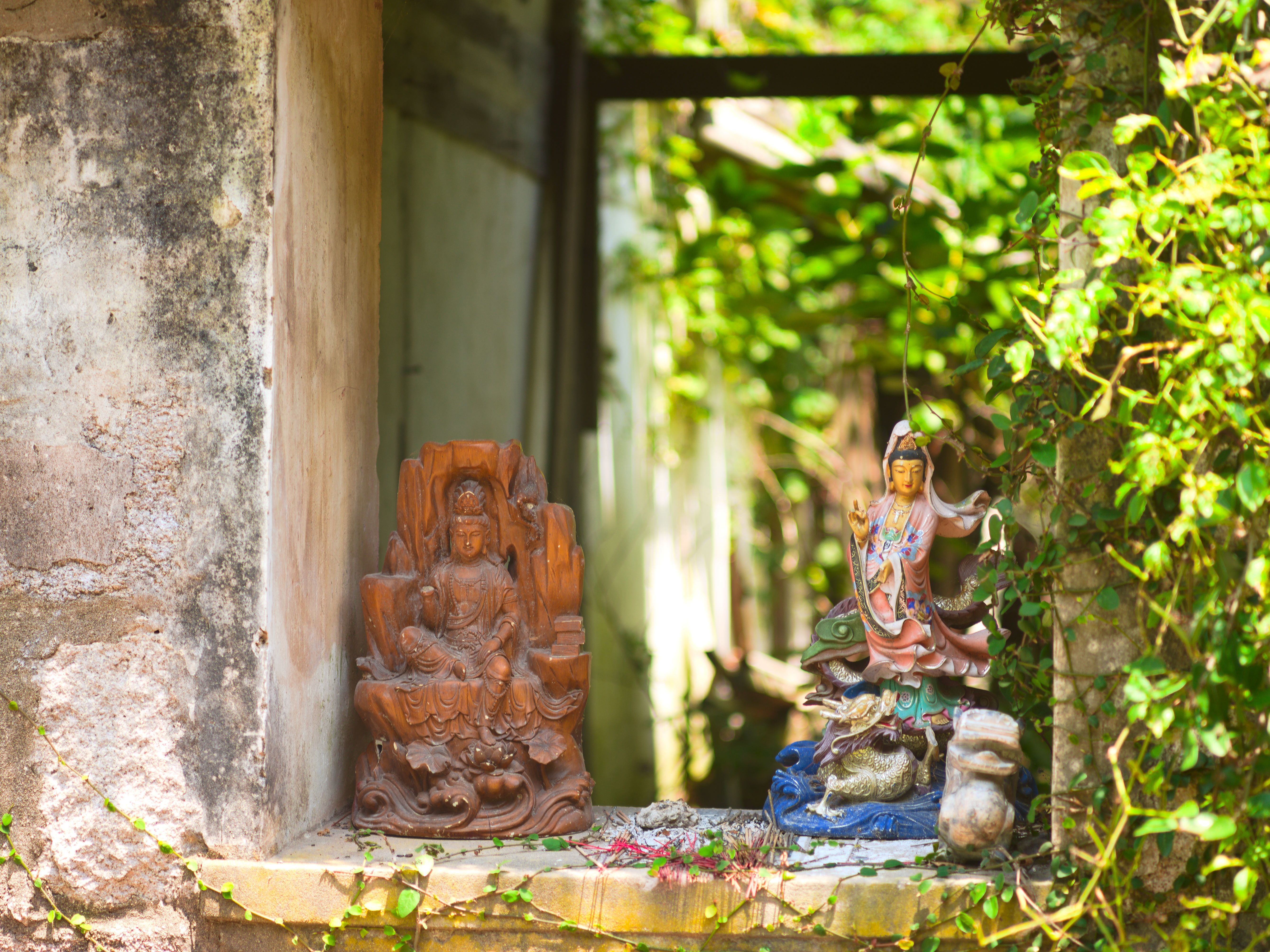
Two statues of Guanyin, found on the windowsile of an abandoned house on Putuoshan’s northwest side (Evan Taylor)
By then, it was time to return and to catch the ferry before the swell of last-ditchers filled up the port. The ferry took us to Zhujiajian, another island near Mount Putuo where I waited for my bus to leave Zhoushan. A friend had told me of a surf club at Dongsha Beach that she likes to frequent here. I had time to kill and, hoping to see surfers paddling out through the waves of the incoming typhoon, I headed down, passing roadside stands selling colorful floating toys and beach tents. But unsurprisingly, all open water activity had been halted due to the weather. Instead, I drank a beer at the beachside cafe and watched the crowds. They waded out ankle-deep into the surf, the occasional umbrella being bent backward by the wind, as the waves broke against the powder blue sky. In an earlier millennium, the monk Egaku was stranded here by an incoming storm and was only able to depart after leaving behind a Guanyin icon on the island. With countless Guanyin statues now standing across the island and revered by millions, I trusted that the Bodhisattva would grant me safe passage this time.
Mount Putuo: The Many Faces of Guanyin’s Island is a story from our issue, “Weight of the Nation.” To read the entire issue, become a subscriber and receive the full magazine.
Related Articles